 |
 |
|
“The fact is,
I, the person about to be initiated into Tibetan sacred mysteries,
was no native, no Tibetan, not even an oriental, but an American,
hailing from Arizona. And here, at the end of the ceremony,
I would become a full-fledged Buddhist monk, a Lama.”
|
|
|
|
The story of Theos Bernard begins in the deserts of southern
Arizona. Raised by his mother in Tombstone, Bernard entered
the newly founded University of Arizona, in Tucson, in 1926.
Bernard's early college years were interrupted, however, by
a near fatal illness which profoundly altered his life. It
was while convalescing in the Dragoon Mountains that Bernard
claims to have met his first spiritual teacher, a yogi from India who had
been a friend of his family for many years, who began to instruct
him in the fundamentals of yoga. Although he had been pursuing
a degree in law, Bernard completed his studies in 1934 only
to turn to religious and philosophical pursuits.
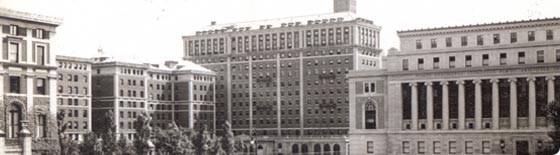
Theos Bernard entered Columbia University in the fall of
1934, immediately following his graduation from the University
of Arizona. At the time of his entry, there was no formal
program of studies in religion, and courses on the subject
had only been being taught for seven years, mostly through
the efforts of Bernard's advisor in the philosophy department,
Herbert Schneider. The records of Bernard's career during
this time are sparse, and his official transcript gives only
a brief account of the courses he took — a mixture of
philosophy and anthropology courses — noting simply that
on June 2, 1936, he was awarded the degree of Masters of Arts
(AM).
Of his own account, though Bernard's first two publications
are autobiographical and tell the story of his education and
pursuit of authentic religious instruction, they give no account
of his years at Columbia. Rather, Heaven Lies Within Us
and Penthouse of the Gods were both published following
his trips to India and Tibet from 1936 — 37 and textually
laid the groundwork for his later books through the slightly
fictionalized narrative of a personally validated authentic
religious tradition. The full context of Bernard's life story
however, lies unspoken in the world of his uncle, Pierre Bernard,
and New York’s high society of the 1920s and 1930s.
|
|
|
|
|
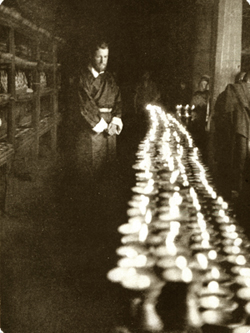
At the Jokhang
Temple, Lhasa
|
|
|
|
|
Pierre Arnold Bernard (a.k.a., Oom the Omnipotent) founded the
New York Sanskrit College in midtown Manhattan in the early
part of the twentieth century. Together with his wife, Blanche
de Vries, Oom began instructing a number of wealthy New York
socialites in the science and practices of yoga. Chief among
Oom's students was Mrs. Vanderbilt, who funneled not only
friends, but a substantial amount of money his way to establish
a discreet sanctuary in which Oom could lecture and instruct.
The result was The Mystic Order of the Tantriks of India and
an estate that was to become the Clarkstown Country Club in
Nyack, New York. Here Oom did, indeed, lecture and instruct
on the practices of yoga — even publishing a journal
— but also provided a socially liberal yet exclusive
resort for young New Yorkers, and put at their disposal a
world-class research library described as "approximately
7,000 volumes on the subjects of philosophy, ethics, psychology,
education and metaphysics as well as much collateral material
on physiology, medicine and the related sciences." More
significantly however, Oom provided his services — either
directly or incidentally — as a matchmaker for the membership.
It was into this world that he brought his nephew, Theos Bernard,
who quickly married one of the young women there, Viola Wertheim.
|
|
|
“I had become
aware of my discovery of those deep joys that I had never before
dreampt existed in this life, and I felt that all my effort
gained for me a reward altogether overwhelming.”
India
and Tibet
|
|
|
Completing his master's degree in 1936,
and with the financial leisure accorded him by his marriage,
Bernard was able to embark on an extensive trip to India and
Tibet in late summer of 1936. Narrating his account, Bernard
tells of seeking out the teacher of Hindu yogi whom he had
met once in Arizona through his mother. Arriving in India
in time only to hear of the death of his would-be guru, Bernard
tells of seeking out other teachers in India traveling the
length and breadth of the country, from Kasmir to Ceylon (Sri
Lanka) taking religious initiations and instruction on various
yogic techniques. He finally made his way to Calcutta where
he was able to make contacts which eventually led to a meeting
with and becoming a student of Lama Tharchin in Kalimpong.
Here, Bernard spent a period of intensive study of the Tibetan
written language and three spoken dialects. After close to
a year in India, he was finally able to secure permission
from the British political officer in Sikkim, B.J. Gould to
travel to Tibet. Once there, Bernard had audiences with the
Ganden Tri-pa, the Regent of Tibet, Reting Rinpoche, and numerous
other officials in the Tibetan government. In addition, Bernard
received Tantric empowerments, engaged in a meditative retreat,
and acquired numerous books included a complete set of the
Buddhist canon, a set of the Treasury of Revealed Teachings
(rin chen gter mdzod) and several hundred more volumes
of Tibetan works..
|
|
|
|
|
|
Shortly after returning from India
and Tibet, Theos Bernard was divorced by his wife Viola. Completing
his first two
books, Bernard began touring, giving a series of lectures
in America and Europe. Promoting himself and his new
books in England, Bernard authored several magazine articles
both about the political situation in Tibet and his
experiences there. In conjunction with the British publication
of Penthouse of the Gods (published under the title
of Land of a Thousand Buddhas), Bernard's accounts
were picked up by the British tabloid press at the time, and,
though their sensationalistic reports concerning his identity
as "a white Lama" garnered some positive public
feedback and interest, it also earned him the scorn and private
dismissal of British Intelligence operatives (who
had monitored his activities since his first entry into Tibet)
as a fraud and imposter.
"In the West, there is the preconceived
notion that man cannot know metaphysical truths by direct
experience; therefore, at best, metaphysical truths can only
be speculations, inferences, or ungrounded faith."
|
|
|
|
Returning to America, Bernard began
teaching and lecturing on yoga on the Upper East side of Manhattan,
where he met a wealthy Polish opera star who first became
one of his students and, later, a romantic interest. Within
a year, Bernard and Ganna Walska were married and the two
moved to California where they purchased a large piece of
land, which they named Tibetland to house Bernard’s collection
of Tibetan manuscripts, provide accommodations for visiting
Tibetan lamas, and to serve as the center for his translation
efforts. During this time, he continued working on and eventually
completed his Ph.D. dissertation for Columbia University,
Hatha Yoga: The Report of a Personal Experience (1943),
though Bernard’s marriage to Ganna Walska was to be short
lived. While Walska proceeded to convert the property into
a horticultural museum (Lotusland), Bernard went on to produce
a fourth book, The Philosophical Foundations of India,
and together with his third wife, Helen, returned to India
in 1947, this time seeking "rare manuscripts" in
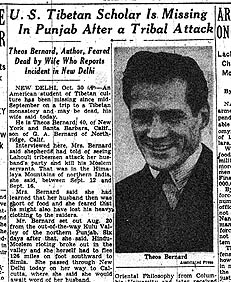
the hills of Spiti near Ladakh. Entering the Punjab en route
to his destination, his party of Muslim porters was rumored
to have been attacked by a group of rioting Hindus. Conflicting
reports about his whereabouts circulated for several months,
and though his wife waited for him in Calcutta, he never returned.
Despite his talents and good fortunes which had led him so
far, in the end Bernard never saw his aspirations fulfilled
and, like Tibet, fell victim to the larger forces at play
during the twilight of the old empires.
|
|
|
|
|
|
|
|
|
|
|
|
|