Seeking the Root of Chinese Media Control
 Political control over media is not a newfangled phenomenon, but has co-existed with the flow of information through China’s history. Dating back to the feudal monarchy era [3], emperors implemented censorship on literary works and used “literary inquisition” [4] to punish intellectuals whose writing was considered offensive to the ruler [5]. From the Republic of China period (1912-1949), the “Marxism media theory[6]” from the Soviet Union started to influence China while the emerging bourgeoisie attempted to fight against press restrictions [7]. The media continued its tradition to follow political instructions after the establishment of the People’s Republic of China. During the early years of the “new China,” there was no journalism but purely propaganda. Media functioned as an extension of the party’s power and disseminated political rhetoric to mobilize public support [8].
China’s media system underwent tremendous changes during the reform period in the late 1970s. The Chinese government decided to give up its monopoly over information and started to commercialize and partially privatize media institutions which were previously owned and financed by the state[9]. Instead of being full-time “mouthpieces” of the CCP, the post-reform media has provided more convincing and sophisticated messages to compete for readers. Despite the fact that marketization has changed the way news is delivered, the state is still exerting a great deal of media control. At Xinhua news agency’s 60th anniversary of establishment, President Jiang Ze-min claimed that media must keep the party's spirit and maintain a correct orientation for public opinion [10]. Similarly, President Hu Jin-tao in 2002 restated media’s role of “mouth and tongue” between people and the party [11]. Consequently, Chinese media nowadays must accord with its commercial and market-based goals as well as hewing closely to the party line. Marketization co-exists with political control in China’s media system and has resulted in a hybrid situation known as the “market-based party media system.”[12]
All Newspapers, the Same Face
Media censorship was not truly released after the reform period and continues to be a problem in China’s modern media system. An interesting phenomenon that has formed as a result of the media censorship in China is the high level similarity among different newspaper contents. Because of the strict control over which topic to be reported about and how to report each topic, the papers began to cover exactly the same issue using exactly the same images and headlines, and the contents were highly identical as well.
(click to enlarge)
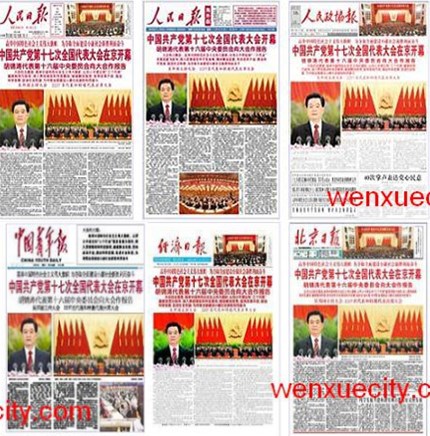
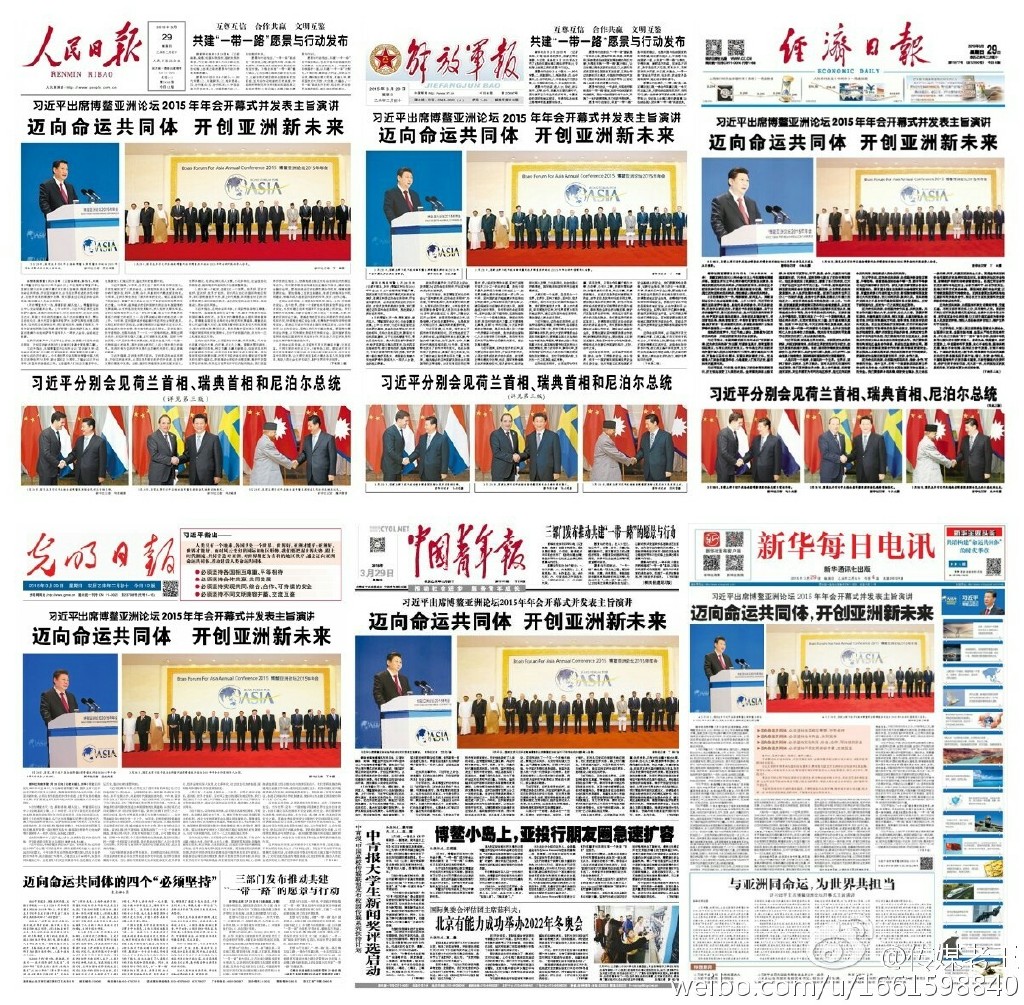
China's Communist Party Congress, October 2007 Boao Forum for Asia, March 2015
How does the Chinese government implement the control media content, and what strategies does the authority use to achieve such a huge success controlling over information? Let’s move to the next page and see how Chinese media censorship works.
- Feudal monarchy era”: Started from 221BC, when Qin Shi Huang conquered all opposing states and unified China and established the Qin Dynasty; ended at 1912.
- Literary inquisition: the speech crime, refers to official persecution of intellectuals for their writings in imperial China. The Inquisition took place under each of the dynasties ruling China, and the Qing was particularly notorious for the practice. Such persecutions could owe even to a single phrase or word which the ruler considered offensive.
- Xiaohong Zhao, “the History and Challenges of Media Censorship,” Sichuan University, 2006, p.18.
- Marxism media system: a central- peripheral hierarchy media system in which central agencies directly follow government manipulation, while peripheral (regional or private) agencies report local news to, and follow instructions from, central organizations.
- Zhao, “the History and Challenges of Media Censorship,” 22-24.
- Tai, “China's Media Censorship: A Dynamic and Diversified Regime,” 188-189.
- Daniela Stockmann and Mary E. Gallagher, "Remote Control: How the Media Sustain Authoritarian Rule in China"Comparative Political Studies, 5.
- “A Brief Guide to China’s Political Media Situation,” Baidu Scholar, April 2013, 1-2.
- Ibid., 2.
- Zhongdang Pan, “Bounded Innovations in the Media,” in You-tien Hsing and Ching Kwan Lee, Reclaiming Chinese Society, (Oxon: RoutledgeMay 28, 2009,) 187.