Frank da Cruz
25 September 2007 Most recent update:
Mon Sep 11 07:37:50 2023
Old card punch models, 1890 through the 1930s. These are machines that that
punch holes in stiff paper cards in selected positions within fixed rows and
columns to record information that can be read back or interpreted later by
other machines called card readers, which are connected to or integrated
with tabulators, computers, or other devices. Punched cards were invented
about 1750 for the control of textile looms, and
were adopted for use in Herman Hollerith in the
1890 US census. From there they quickly spread to business and eventually
government and science applications, where they dominated information
processing and computation until about 1980, and even for some decades after
that were used in voting machines.
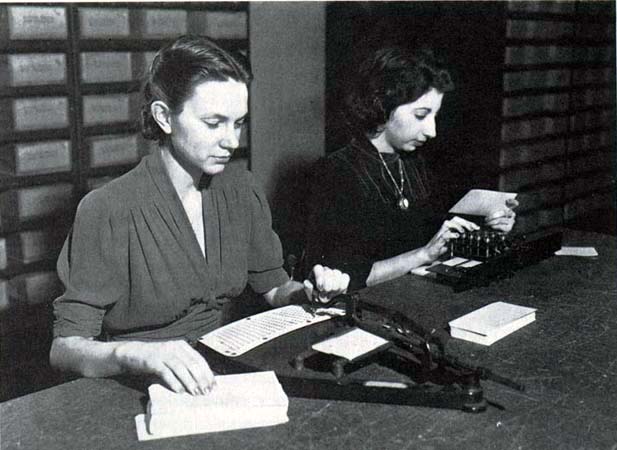
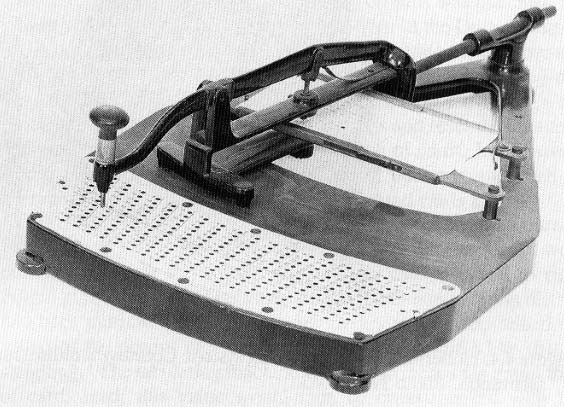
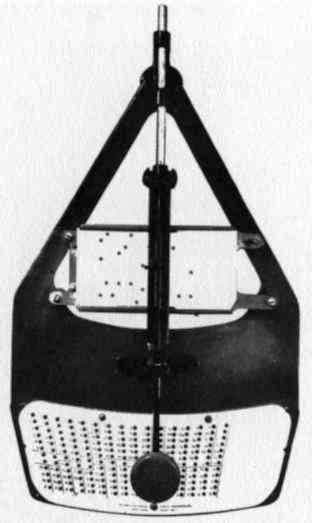
Hollerith Pantographic Card Punch 1890
Herman Hollerith's Pantographic Card Punch, developed for the 1890 US
census. Photo: [74]. Prior to
1890, cards were punched using a train conductor's ticket punch that allowed
holes to be placed only around the edge of the card, and was not
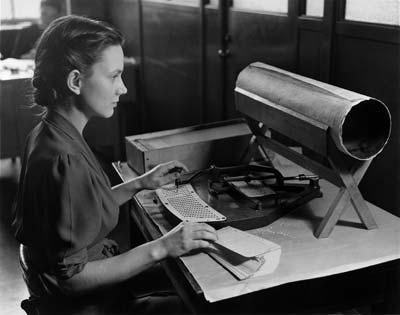
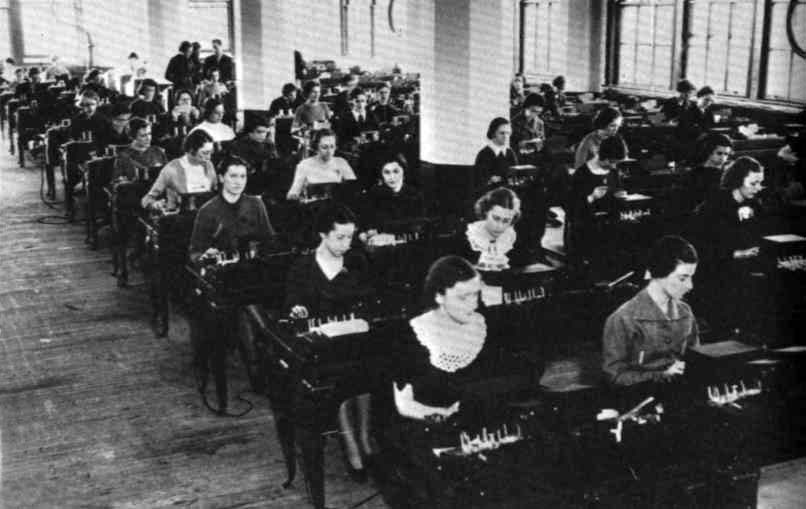
Pantographic punch 1920 census
terribly accurate, and tended to induce strain injuries. The Pantographic
punch allowed accurate placement of holes with minimum physical strain, one
hole at a time, and also provided access to the interior of the card (not
just the edges) allowing more information per card. A skilled Pantograph
operator could punch 700 cards per day (compared to electric keypunch
operators in the 1950s, who could work at a sustained rate of 200 cards per
hour).
Hollerith Type 001 Numeric Key Punch: 1901
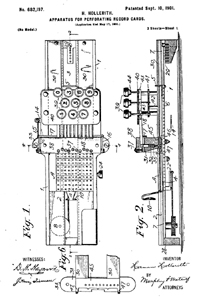
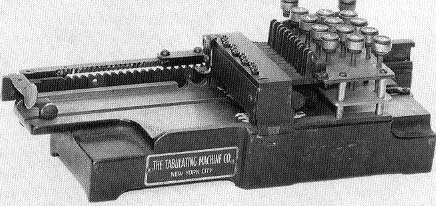
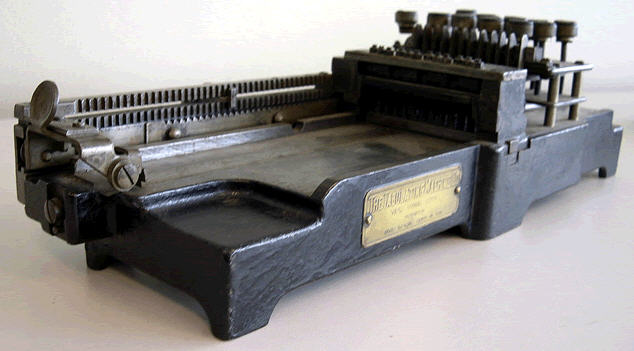
The photos show Herman Hollerith's Type 001 manual (non-electric) numeric
key punch. The nameplate indicates it was manufactured by The Tabulating
Machine Co., Hollerith's company that was to become IBM. The 1901 patent
diagram [44] is shown at left (click
image to magnify). This was the first key punch (i.e. card punch
operated from a keyboard), allowing a skilled operator to punch much faster
than on previous models. Also see
Baehne [91]
Plate 3.
Photo: [74]
Key-punching contest
In this uncredited photo found on the Web, we see the Pantographic Card
Punch and the Type 001 Key Punch side by side, in what is probably a
reenactment of the 1890 and 1920 US Census recording techniques. The IBM
001 was approximately twice as fast. I believe the lady on the left is the
same as in the photo above labeled Pantographic
punch 1920 census, so although Wikipedia says that photo was taken in
1919, this one looks more like 1940s or 50s. The IBM 001 could have been
used in either the 1910 or 1920 census. By 1930 (see below) much faster
punches were available, e.g. the 016 with automatic feed.
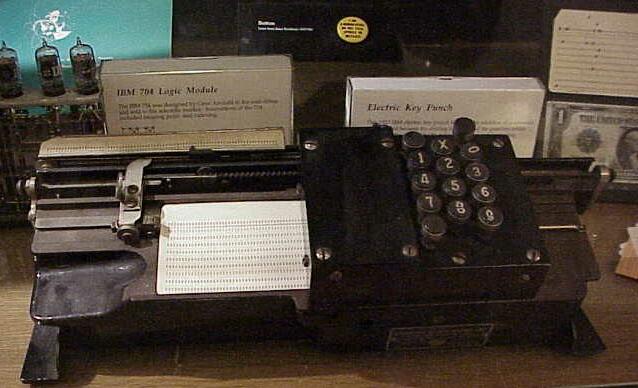
IBM 011 Electric Key Punch: 1923
IBM 011 Key Punch -
Click image to enlarge
This shot is from the
Stanford University
History Exhibits, which identifies it as the IBM Electric Key Punch
(1923):
"Adding relays and magnetic coils to the punches that
were used to enter data greatly reduced the data entry effort. This machine is
from the 1930s. The card had 80 columns, to hold 80 digits. Punching the
X-key, above the digits, indicated minus. We still find many data files in
commerce today that are 80 characters wide. Alphabetic characters could be
entered by punching the top key and a digit 1-9 in the same columns for A-I,
the X-key and 1-9 gave J-R, and 0 and 1-9 gave S-Z." [NOTE: pre-1928 models
punched 45 columns, not 80.]
Austrian [44] says, "Although this IBM
key punch resembles earlier Hollerith models, electricity has been added to
lighten the job of punching. ... Hollerith's systems opened up an important
new field of employment to women, starting with the 1890 Census."
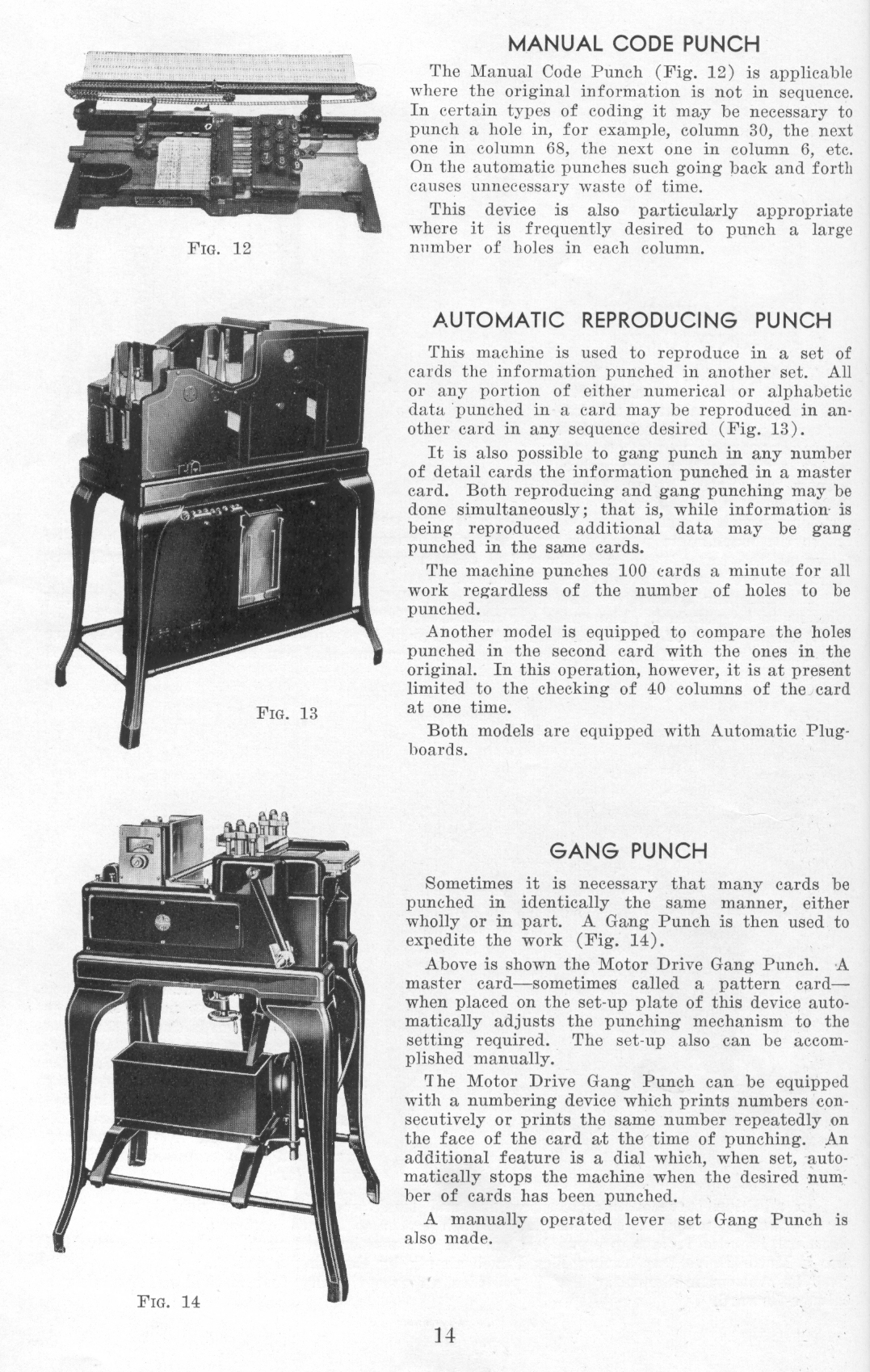
(IBM 002 Port-A-Punch...
IBM 012 Duplicating Punch...
IBM
797 Document Numbering Punch...
Note: there was also a later-model
Port-A-Punch
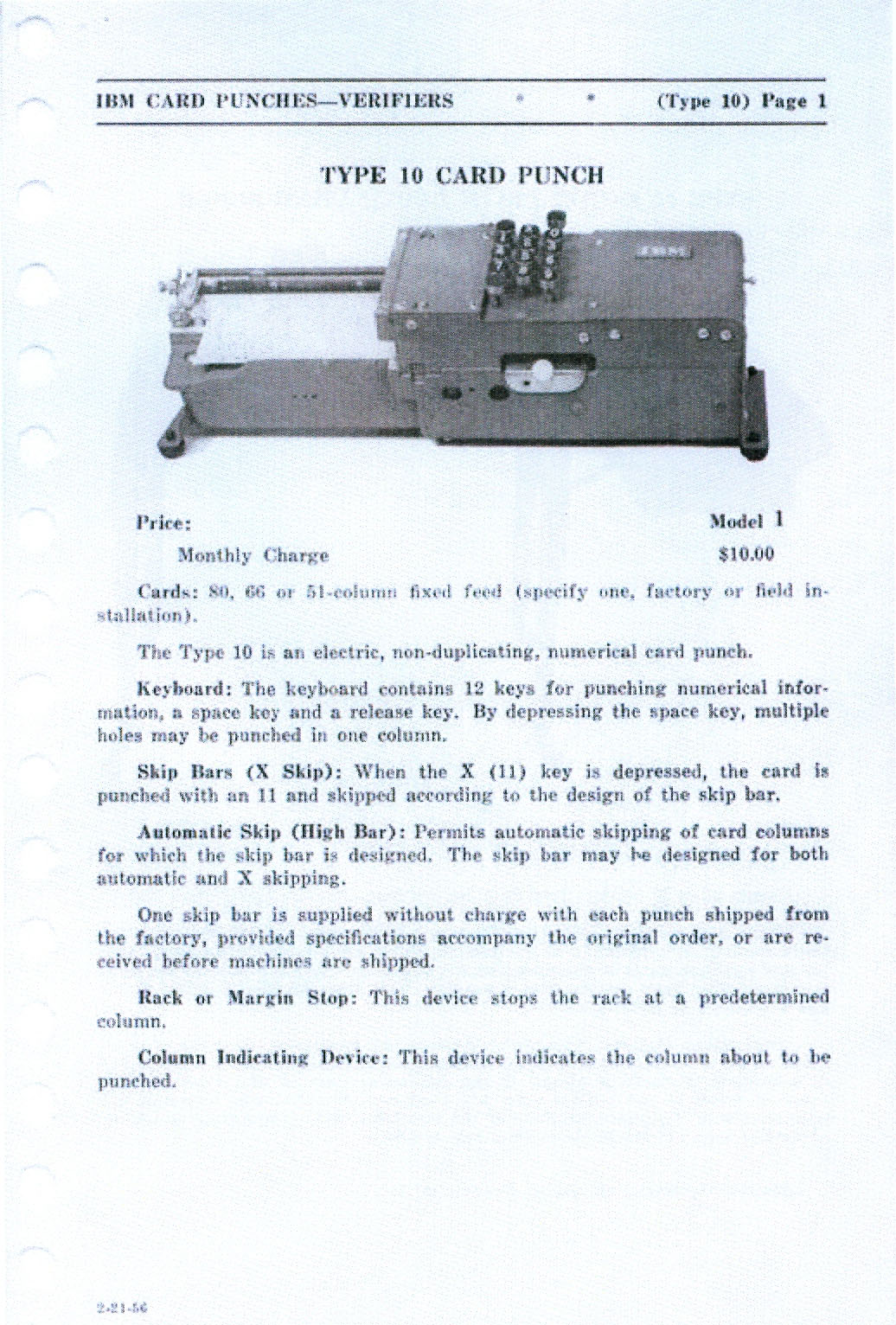
in 1958.) The Type 10 Card Punch similar to the one shown above was
listed in a "2-21-56" sales manual as an electric, non-duplicating,
numerical card punch available in 80, 66, or 51-column models with skip bar.
(SEE SCAN; thanks to Dick Weaver for finding this.)
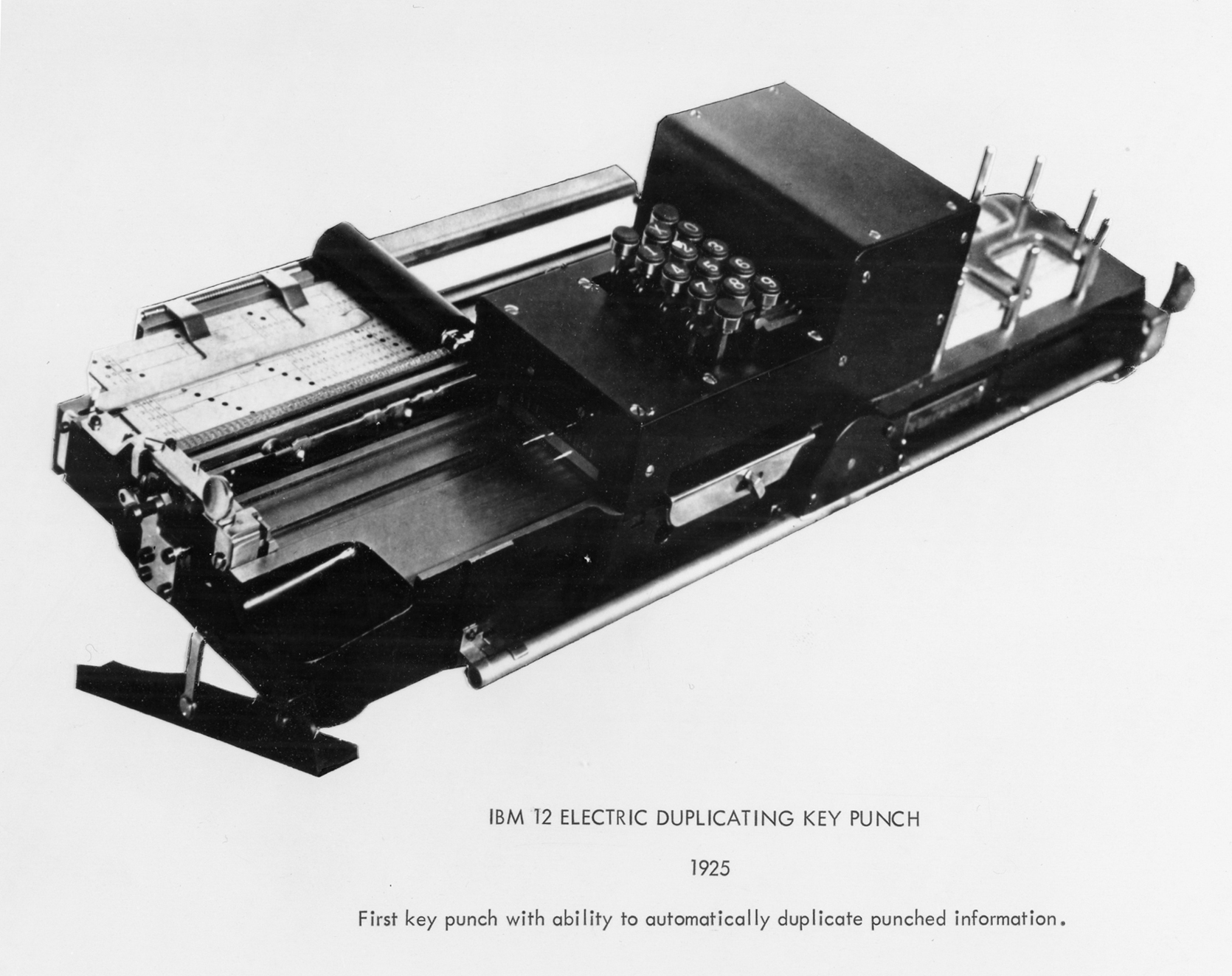
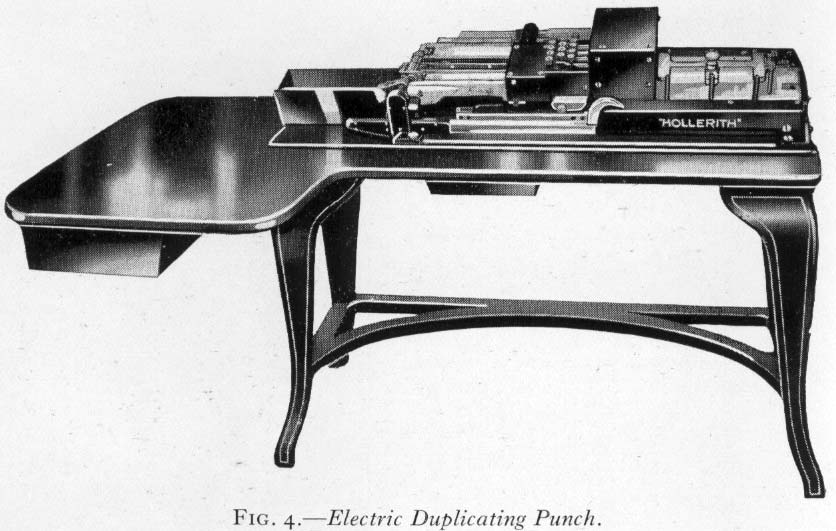
IBM 012 Electric Duplicating Key Punch: 1925
Photo: IBM Archives, Machine Files;
click image to enlarge
The IBM Type 012 tabletop key punch (1925) was the first model capable of
duplication; that is, automatically copying columns from one card to another.
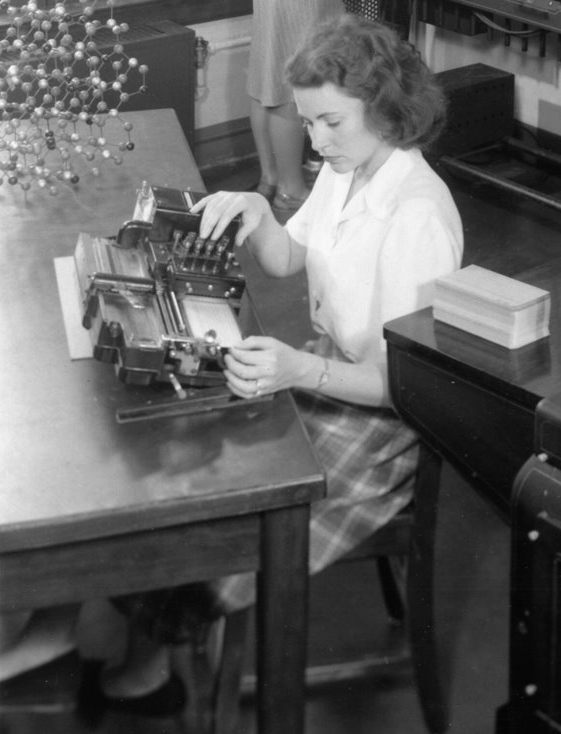
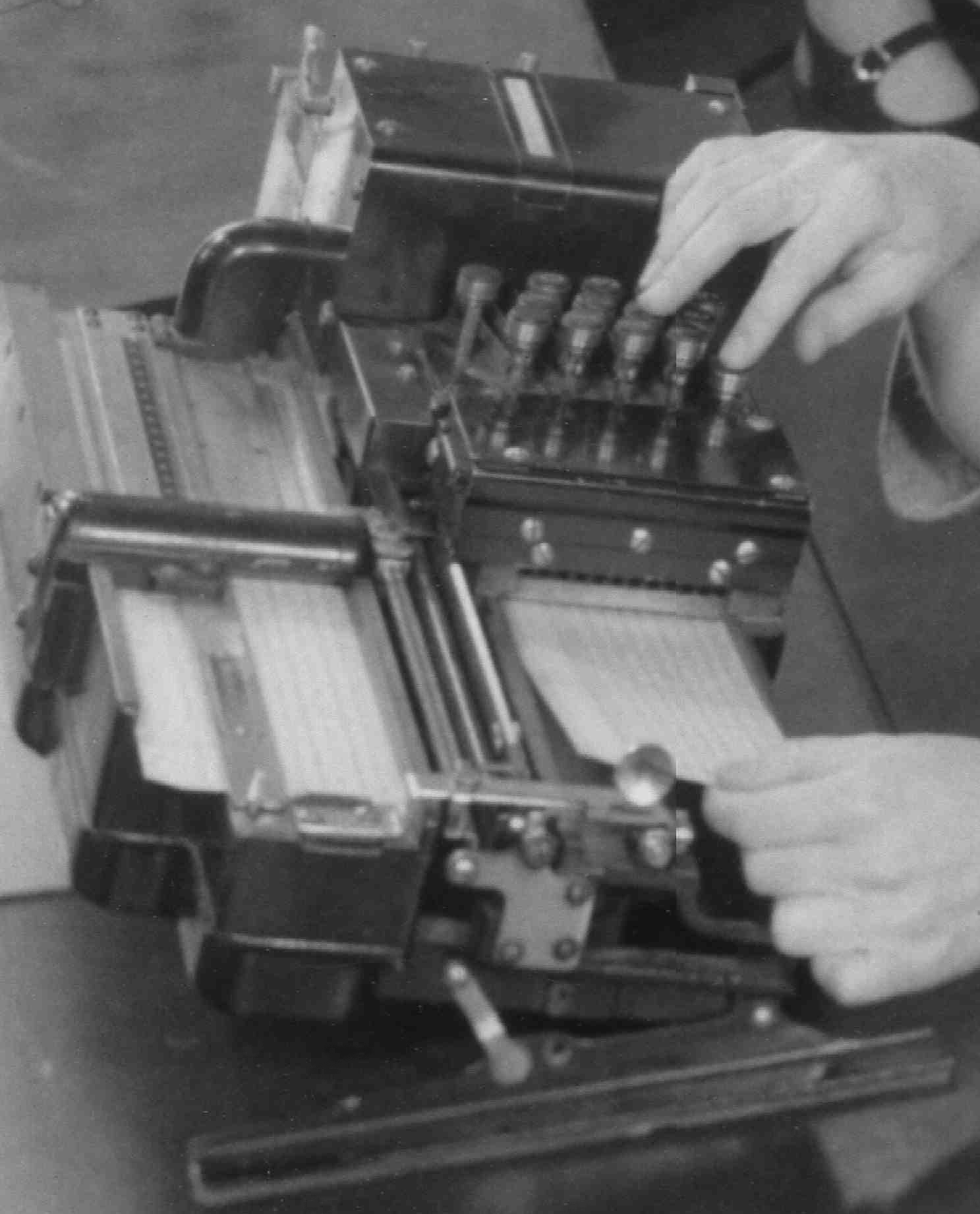
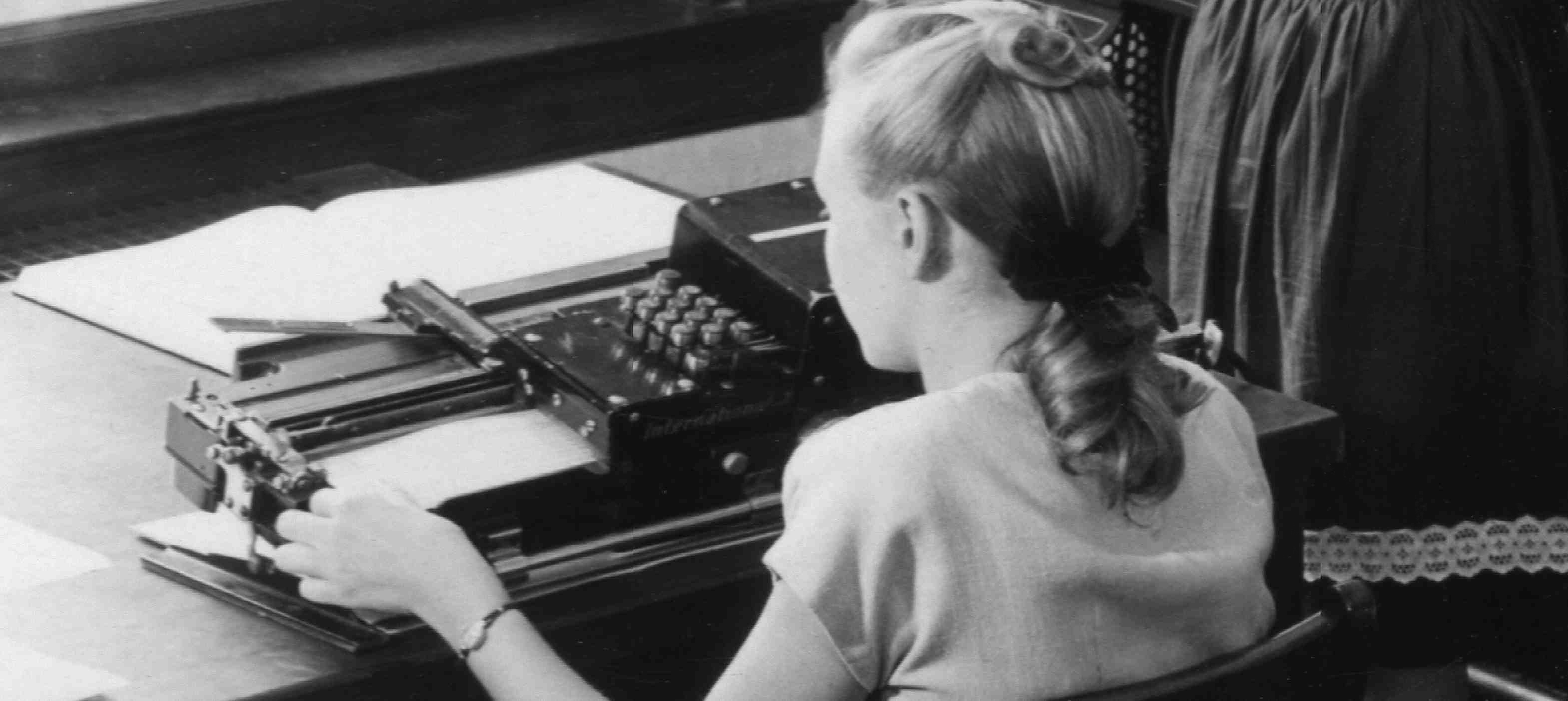
Left: What appears to be a Type 012 Electric Duplicating Key Punch in the
Crystallography Lab at the California
Institute of Technology.
It appears that this punch was procured for the lab through a
request from
Linus
Pauling to IBM's Director of Pure Science,
Columbia's Wallace Eckert in 1947.
Photos:
(all but the IBM one at top left)
circa 1947, Gates and Crellin Laboratories, Division of
Chemistry and Chemical Engineering, Caltech; courtesy Larry Henling,
Beckman Institute, Caltech.
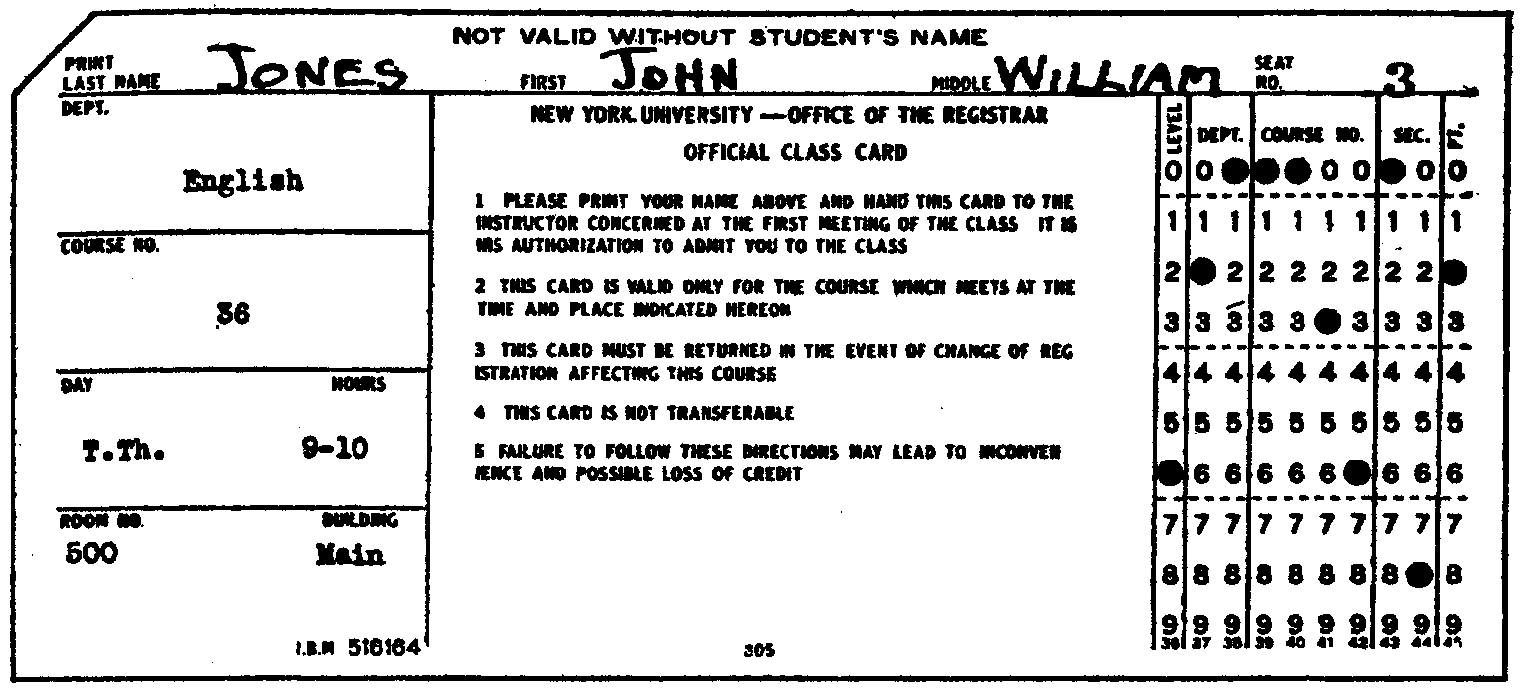
IBM Punch Cards
Prior to 1928, IBM cards were punched with round holes;
originally in 20 columns, but by the late 1920s, 45 columns, as shown in
this New York University registration card, reproduced from Baehne [91]. All punches introduced prior to 1928,
including the 016, used round holes and 45 or fewer columns.
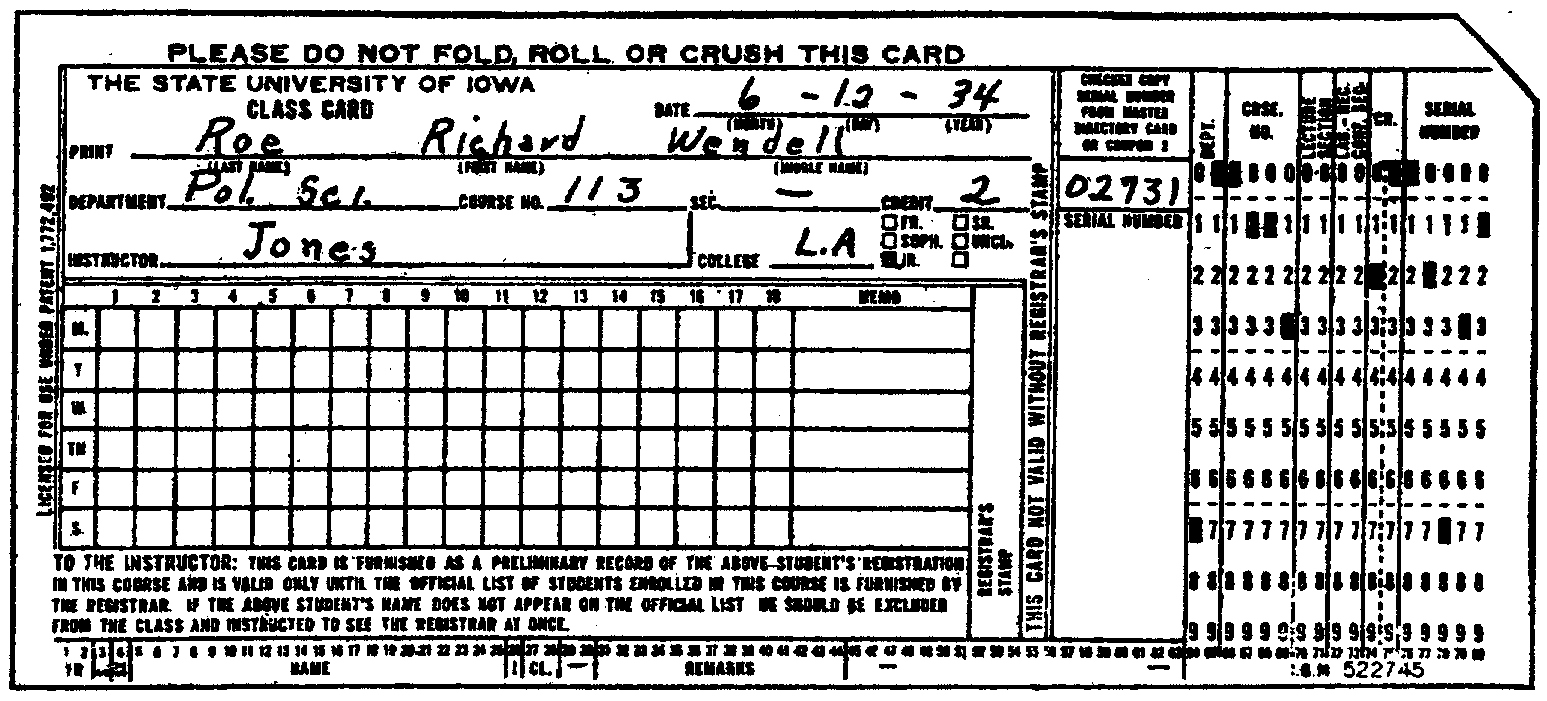
Beginning in 1928, IBM cards had rectangular 1mm×3mm holes 80
columns across, as shown in this Iowa State University registration card,
also reproduced from Baehne [91]. All
punches introduced after 1928, including the Types 016, 31, and 32 and
possibly the 011, and of course the later 026,
029, and related models, produced 80-column cards.
IBM Type 016
Motor Driven Electric Duplicating Punch: 1929
Photo:
[50]; CLICK to enlarge.
The IBM Type 016 Motor-Driven Electric Duplicating Key Punch, introduced in
1929, the kind used in Columbia's Statistical and Astronomical Laboratories,
and later in Watson Scientific Laboratory. This was
IBM's first punch with automatic feeding and ejecting mechanisms; it was
marketed until 1960 (there was also an 015 model
that lacked duplicating feature).
The punching is done magnetically, and information from one
card can be transferred automatically to another by a duplicator. The
keyboard contains 12 punching keys, one for each row on the card. There are
also space and eject keys. A master (program) card can be used to control
automatic tabbing and duplication of fields. A skilled operator could punch
100-200 cards per hour on this model.
Herb Grosch recalls,
"You put a stack of blank
cards in the feed [right], a single card, part of which you wanted to
duplicate ('master card'), in the to-and-fro rack, and clipped a skip bar
to the front of the carriage
(p.82).
A notch said skip, a deeper notch said copy."
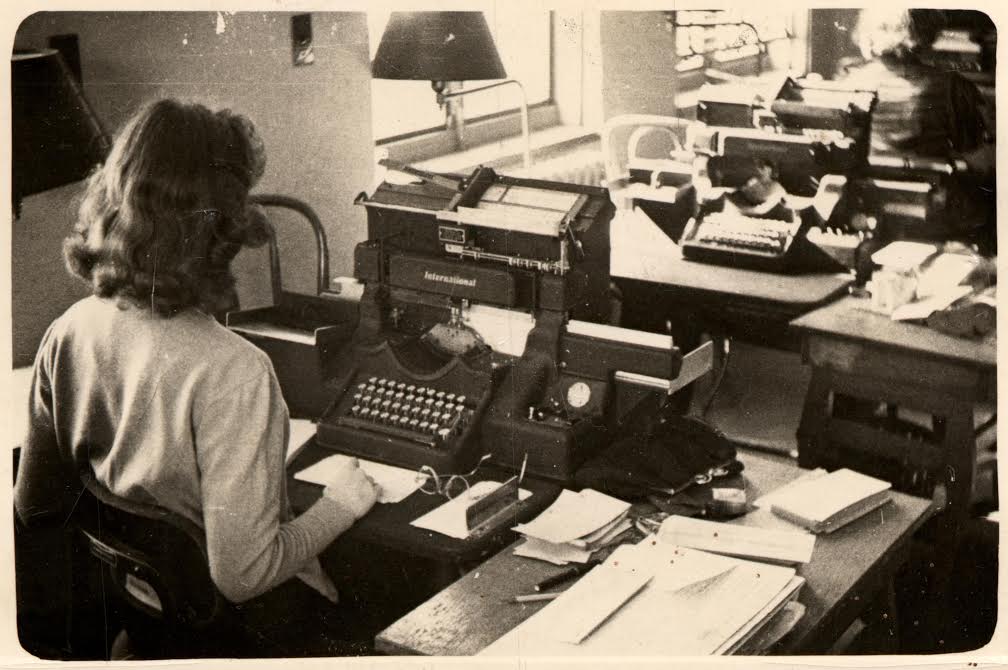
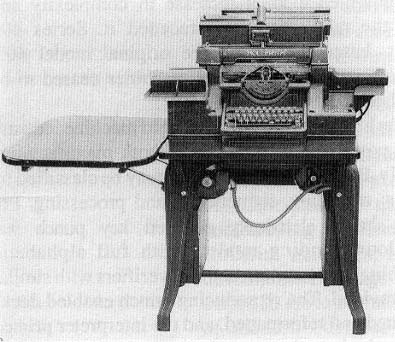
This is the IBM 032 Printing Punch of 1933, the first model capable of
punching letters as well as digits (except by multipunching) and of
printing the punched characters across the top of the card; each keystroke
activated the typewriter type bar and the card puncher
simultaneously.
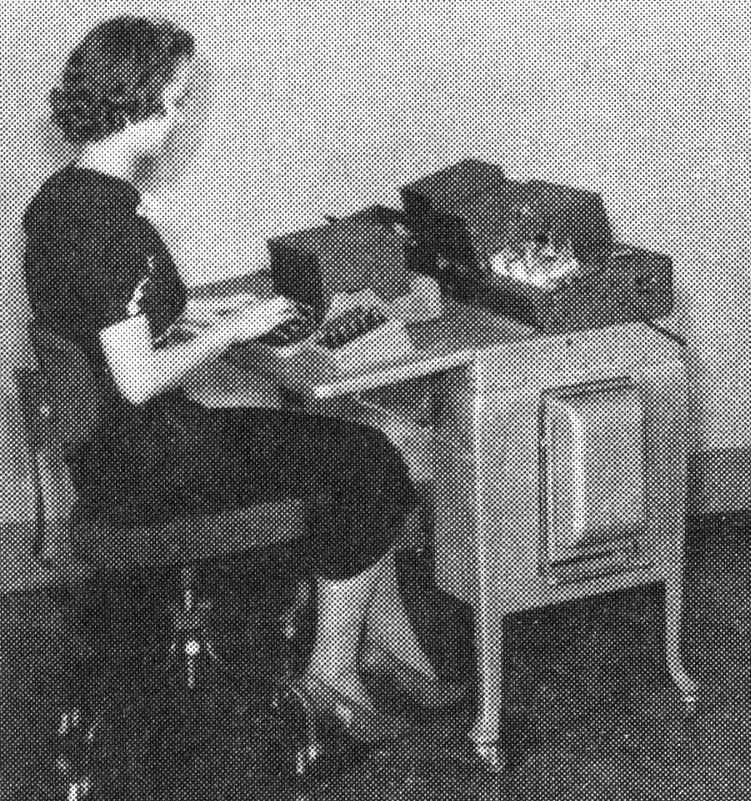
Photo at left was found at the Flickr page
of Dr. Shaiyan Keshvari; it's
of his Mom Katy at an IBM 032.
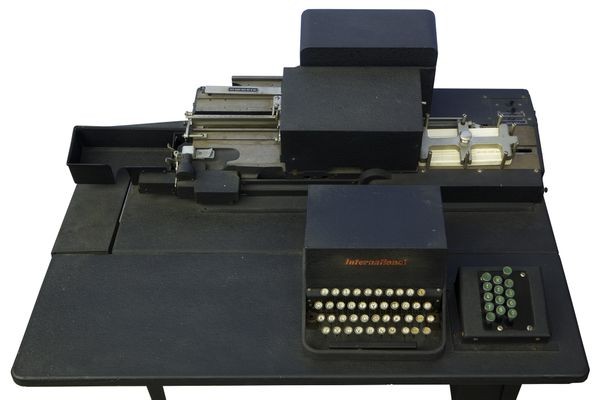
The IBM Type 31 Alphabetical Duplicating Punch,
a motor-driven key punch from 1934, with a typewriter-like
keyboard and a separate numeric
keypad [40].
This model (current
with the release of the IBM 405 accounting machine,
used the new (1928) standard 12x80 cards
and was almost certainly in use at the statistical and astronomical
laboratories, BASR, and elsewhere at Columbia
prior to the introduction of the 024 and 026 models in 1949.
CLICK
HERE for a closer view of the alphabetic keyboard, "similar to a
conventional manual typewriter except that the shift, tab, and
backspace keys were eliminated, and a skip, release, stacker
and '1' key were provided"
(IBM
History Archive).
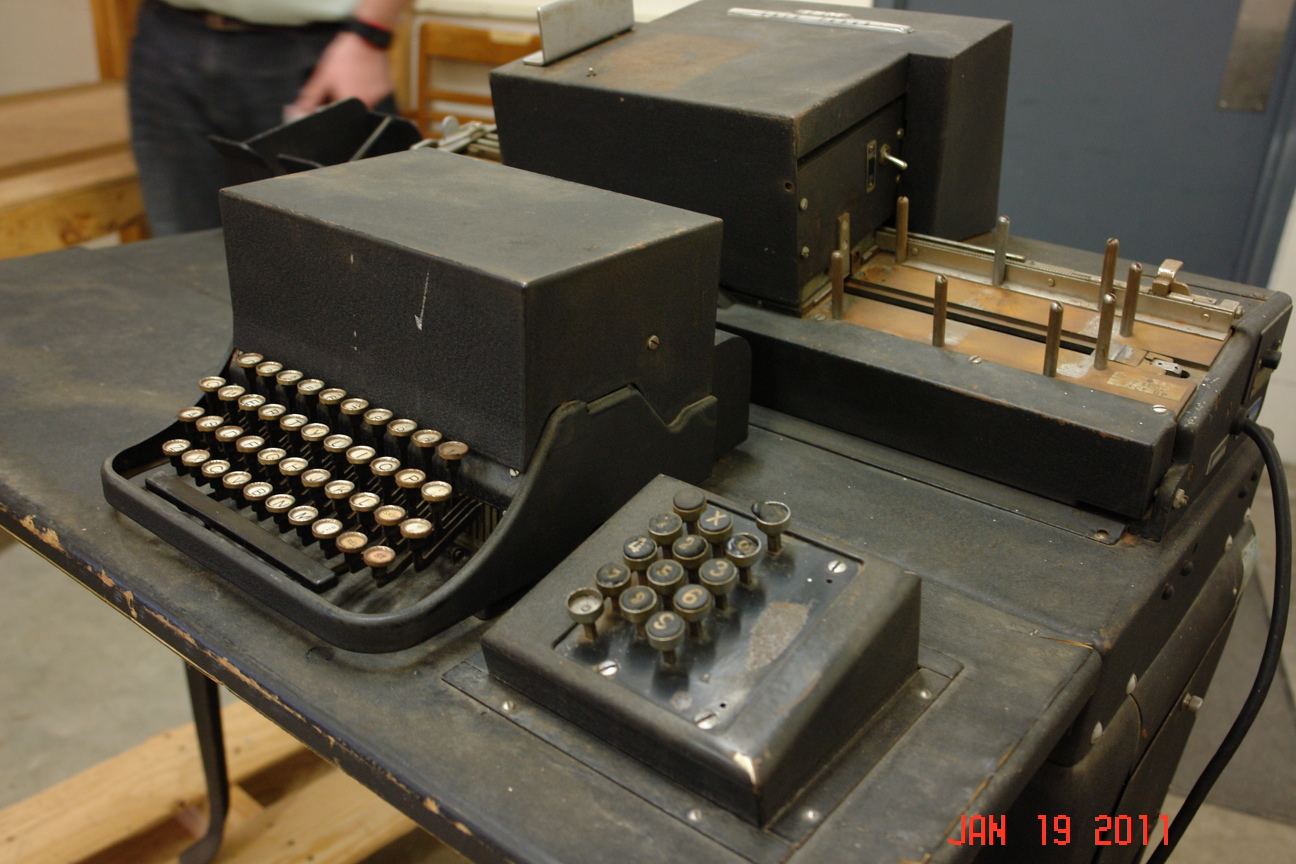
CLICK HERE for a gallery of a recently excavated
IBM 031 at the Iowa Department of Transportation, and its story.
Type 31 punches at the US Social Security Administration,
circa 1935. Photo: [103],
CLICK to enlarge.
Also see the "mature" key punches:
IBM 024 and 026 punches,
The IBM 029 Card Punch,
The IBM 129 Key Punch.
Thanks to Paul Varnum, Iowa Department of Transportation, for the color
IBM 031 photos from 2011, and to Henry "Strontium Black Cat" for finding the
Katy/IBM032 photo in 2019.
 Herman Hollerith's Pantographic Card Punch, developed for the 1890 US
census. Photo: [74]. Prior to
1890, cards were punched using a train conductor's ticket punch that allowed
holes to be placed only around the edge of the card, and was not
Herman Hollerith's Pantographic Card Punch, developed for the 1890 US
census. Photo: [74]. Prior to
1890, cards were punched using a train conductor's ticket punch that allowed
holes to be placed only around the edge of the card, and was not