Biopolymer Gels
We study static properties (structure and mechanics) and dynamic properties (deformation and relaxation) of biopolymer gels with multiple modalities including confocal rheology. These studies not only allow us to address fundamental questions about gels and gelation but also guide development of gels with particular properties for use in bioengineering applications and biophysical studies.
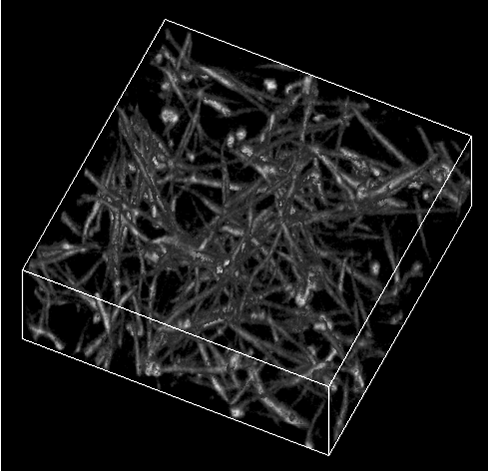 3D reconstruction of a collagen I gel imaged with confocal reflectance microscopy.
Cancer Cell Invasion
We investigate cancer cell invasion in biopolymer gels of specific biochemistry, mechanical properties, and network structure. Imaging invading cells and collagen fibers allows visualization of the reciprocal interactions between cells and their environment; moreover, the invasive morphology a cell employs as it navigates environmental obstacles suggests underlying molecular mechanisms the cells use for invasion.
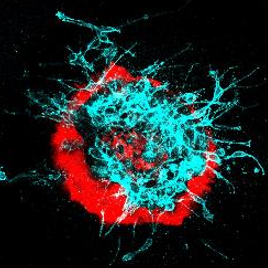 A model ductal carcinoma in situ in which a breast cancer spheroid (blue) surrounded by a thin layer of basement membrane (red) and embedded in a collagen I gel shows collective invasion as the cells breach the basement membrane and then progress to single cell invasion.
Supercooled Liquids
Amorphous systems below their freezing temperatures are known as supercooled liquids and glasses. Experiments show that supercooled liquids are structurally homogeneous but dynamically heterogeneous. We have long used single molecule imaging of fluorescent probes to characterize dynamic heterogeneity at the molecular length scale.
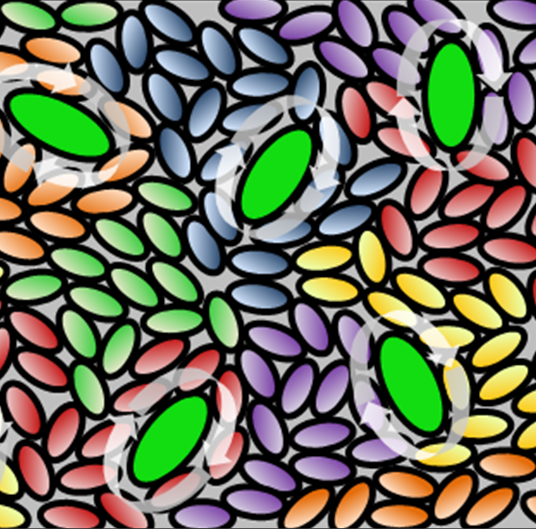 Schematic depiction of a supercooled liquid with spatially heterogeneous dynamics and embedded probe molecules.
Jamming in Biology
We are interested not only in the properties of molecular supercooled systems but also in how similar phenomenology plays a role in biological processes. We study the role of jamming in biology with both Cellular Potts Model simulations and experiments.
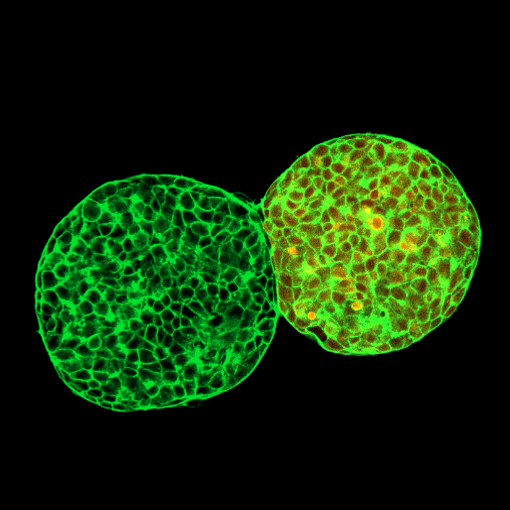 Spheroids composed of healthy breast epithelial cells become arrested in a coalescence assay.