Computer Generations
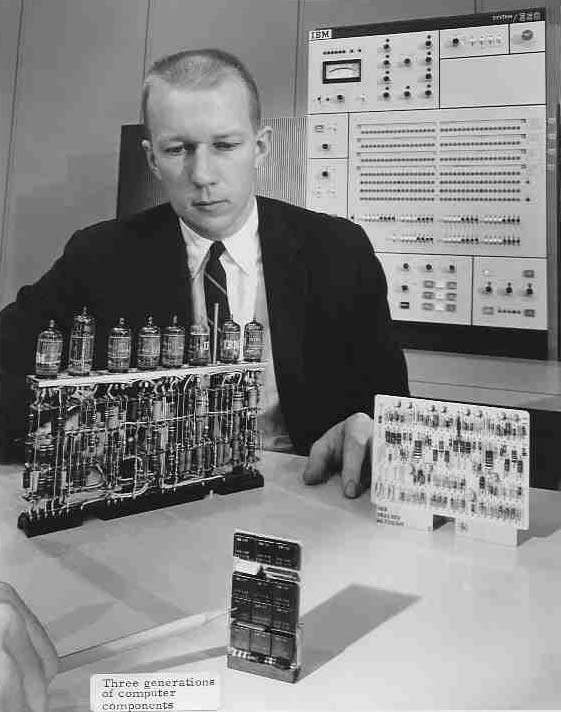
The the late 1960s and early 70s, there was much talk about "generations" of computer technology. This photo illustrates what were commonly known as the three generations:
- First generation: Vacuum tubes. Mid
1940s, beginning with ENIAC. IBM pioneered the
arrangment of vacuum tubes in pluggable modules such as the one shown on the
left in the photo. The IBM 650 (1953) was a
first-generation computer, as were the pioneering IBM one-off
SSEC (1948) and NORC (1954),
both built by Columbia University's Watson Lab.
- Second generation: Transistors (right). 1956. The era of
miniaturization begins. Transistors are much smaller than vacuum tubes,
draw less power, and generate less heat. Discrete transistors are soldered
to circuit boards like the one shown, with interconnections accomplished by
stencil-screened conductive patterns on the reverse side.
The IBM 7090 was a second-generation computer.
- Third generation: Integrated circuits (foreground), silicon chips contain multiple transistors. 1964. A pioneering example is the ACPX module used in the IBM 360/91, which, by stacking layers of silicon over a ceramic substrate, accommodated over 20 transistors per chip; the chips could be packed together onto a circuit board to achieve unheard-of logic densities. The IBM 360/91 was a hybrid second- and third-generation computer.
Omitted from this taxonomy is the "zeroth" generation computer based on metal gears, such as the ancient Greek Antikythera mechanism, the Babbage Difference and Analytical Engines (1820s-1830s), the 1890 census tabulator, and the Harvard/IBM Mark I (1940-43). Or on electromechanical relays, such as the Harvard Mark II and the Bell Labs Relay Computers (1939-51).
Other generations were to follow: the fourth (1971-1980) based on Very Large Scale Integrated (VLSI) circuits such as the Digital Equipment Corporation PDP-10, PDP-11, and DECSYSTEM-20, and the IBM PC and PC/AT. And then a fifth based on Ultra Large Scale Integration (ULSI) and parallel processing (21st Century laptops, notebooks, tablets, etc). And then whatever else comes next, e.g. quantum computers. In any case, at this writing (2021) the average cell phone or "smart watch" has more memory and computing power and speed than our third-generation IBM 360/91 did, which sold for millions of dollars and occupied acres of floor space.
Translations of this page courtesy of...
| Language | Link | Date | Translator | Organization |
|---|---|---|---|---|
| Czech | Čeština | 2024/09/08 | Alena Piksaeva (Алёна Пиксаева) | Allekredittkort.org |
| Finnish | Suomi | 2023/09/11 | Kerstin Schmidt | writemyessay4me.org |
| French | Français | 2023/09/11 | Kerstin Schmidt | admission-writer.com |
| German | Deutsch | 2023/09/11 | Kerstin Schmidt | pro-academic-writers.com |
| Portuguese | Português | 2025/07/09 | Chris Wilkins | EssayWriter.com |
| Russian | Русский | 2024/09/08 | Alena Piksaeva (Алёна Пиксаева) | Kreditkortlistan.se |
| Spanish | Español | 2023/09/11 | Kerstin Schmidt | justbuyessay.com |
| Ukrainian | Українська | 2025/12/08 | James S. | WriteMyEssay AI |