

Digging Deeper
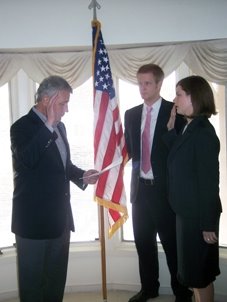
Postbaccalaureate Premedical Program alumna Kathryn Haas was recently awarded the Army’s Health Professions Scholarship and commissioned as a Second Lieutenant in the U.S. Army Reserve. According to GoArmy.com, the Health Professions Scholarship provides a full tuition waiver for a graduate-level health care degree at any accredited medical, dental, veterinary, psychology or optometry program in the United States or Puerto Rico.
Prior to exploring her interest in medicine, Haas earned a Bachelor of Arts in English from Brown University.
What led up to your decision to pursue medicine?
After college, I was at a point in my life where I was going to be promoted in a job that I did not envision as a part of my career path. I was interested in science coursework during high school, but stayed away from it in college. I decided it was time to do some serious soul searching of my strengths, weaknesses, likes, and dislikes.
What ultimately led to my decision was a congressional staff delegation trip to Fort Riley, Kansas where I spent a weekend with the Reserves, many of whom were medics. During the trip, I trained on their obstacle course, toured mobile operating rooms and met with army nurses and physicians. I was inspired by their work, and thought it would be a privilege to help others safeguard their health.
Why did you choose the Postbaccalaureate Premedical Program of Columbia University?
In my mind, Columbia University is the gold standard for this type of program. It's also hard to ignore the facts. The Postbaccalaureate Premedical Program is the oldest and largest of its kind with a top rated faculty. Additionally, I heard about the great Postbac community, which was and is important to me because it’s important to have people around who understand what you're doing and why you're doing it. The program has a 90 percent acceptance rate into medical school for those who have committee support.
Did you always intend to serve your country?
Absolutely not in this way. I was raised with a sense of duty and obligation for good citizenship, but no military influences were present until my adult life.
I was working on Capitol Hill for Senator Chuck Hagel who, as a member of the Senate Foreign Relations Committee, spoke often about the war and America's stance in the world. I realized the most my life had changed since 9/11 and since our country had gone to war was that I had to take off my shoes at the airport. I thought I could do more, dig deeper.
I wound up speaking with military recruiters in New York City, but I was too scared to commit. During my lag year of the Postbac Program, however, I contacted a military recruiter and was invited to Madigan Army Medical Center at Fort Lewis in Washington. I met with the Medical
Officers there and toured the facilities.
After the trip, I sought guidance from my parents and learned about my grandfather’s service as a Navy Surgeon on a hospital ship in World War II. Initially, my grandfather was prevented from enlisting because of a medical issue. He had surgery to have the issue corrected in order to be reconsidered for the service. Learning about my grandfather made it pretty easy for me to commit to four years of active duty, and I am excited for the challenge!
Tell me about your relationship with U.S. Senator Chuck Hagel of Nebraska.
I worked for Senator Hagel for 21 months as his personal assistant and his scheduler. Senator Hagel is someone who, in my mind, lives an example of integrity, accountability, and competence.
When I was selected to be commissioned, I invited Senator Hagel to administer the oath of office to me. On a trip to Nebraska, he came to my parents’ house for my commissioning ceremony. All five of my siblings were present, which made the ceremony all the more special.
Where will you be living and going to school while serving in the U.S. Army Reserve?
I will be attending Loyola University Chicago Stritch School of Medicine. The Army’s Health Professions Scholarship allows me to attend medical school anywhere I’ve been accepted in the U.S.
During the summers, I have a six week Reserve obligation. Next summer, I'll attend the Officer Basic Leadership Course near San Antonio, Texas. The following two summers I will have the opportunity to work in an Army hospital.
How do you feel about being awarded the Army’s Health Professions Scholarship?
I am overcome. I am honored and proud. I feel like I have a very high privilege to be someone who will one day care for our soldiers and their families.
For more information about the Army’s Health Professions Scholarship, visit http://www.goarmy.com/amedd/hpsp.jsp.