URBAN DESIGN STUDIO/ FALL - 95
PROBES
LOWER MANHATTAN
Pirasi Povatong
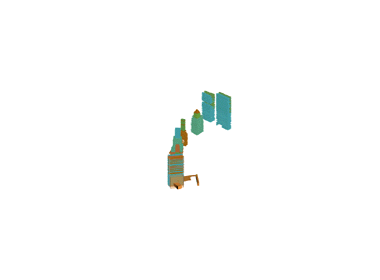
Piransri Povatung.notes by Grahame Shane.
Pete's initial regional research focused on the old Dutch core and its
expansion by a series of landfills, beginning his theme of man's impact
on the natural landscape.
His research established a clear morphological
difference between the narrow, irregular streets of the old core and the
new expansions like the World Trade Center and World Financial Center at
Battery Park City.
The old streets were characterized by set back
skyscrapers on irreglar lots while the new developments were
self-contained enclaves, detatched from the city. Broad Street emerged
as the spine or backbone of the old core and pete begon to wonder how to
re-introduce a relationship to "nature' back into this core. he began
to make distinctions along the length of the street, as it curved into
the center of the core.
At the river end (and at the Chase Plaza end) a
Tower in the Park situation allowed for the introduction of trees
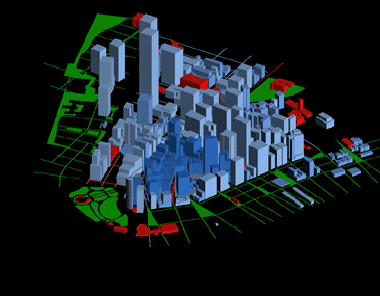
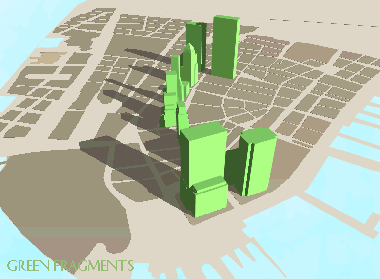
(orchards etc), along the canyon of the street three "green" buildings
were proposed as markers which would bring light down into the street
(introducing green atria behind their facades and up in their sections).
The sequence of the street would thus be re-programmed, just as the
sections of the vacant buildings would be re-programmed with public
spaces, loft spaces, live-work situations and commercial uses (as well
as park spaces in section).

 <
<
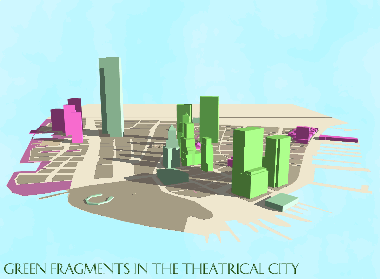
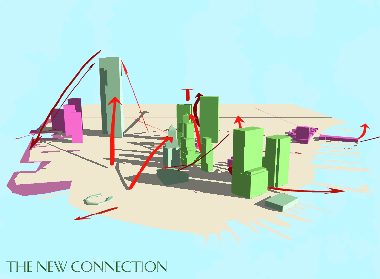
Downtown Manhattan contained an old core which was closely based on the natural situation of the port city.Successive expansion of the city,expanding waterfrontsinto the rivers with landfills,have altered this original relationship remains as a trace,built over,levelled down,and built over again.
My study found that Broad Street is one of the oldest traces of the original city,acting as a spine to the old core,and as a connection from nature to the city,from the river to the city core.
My project wants to restore Broad Street to its former position as a spine of the canyon-like core,with a system of 'green' connection as a link to nature and the water.

 <
<
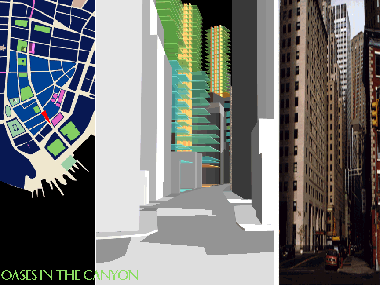
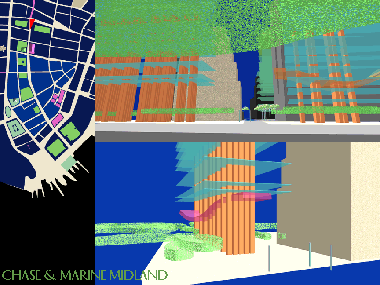
So hereby I proposed another scenario,a design guideline for this particular area ,a 'Green' system,a connective urban structure housed within those vacant buildings,working in conjunction with the highly memorable pieces of architecture in the area.Nature will be a 'neutral' matrix for this new urban topography,applicable not only in Broad street but everywhere in this abandoned artifice,indicating our mutual responsiveness to caring how we live with nature.
These 'Green' fragments will provide an information-free sanctuary space from the hyperkinetic,theatrical and entertaining city tableaux outside,interweave the 'peaks' to establish connections across the city.I
proposed another system of barrier-free information system along with the nature,juxtaposing the flow of nature with the flow of information.Each of these would has a specific quality so as to offer a gradually different character of place,with reference to the Core and the Edge differences aforementioned.
On the water's edge,the border between the radical artifice and nature,I transformed the 60's glass-and-steel building into pieces.The top floors will be a mixture of residential and business uses,providing a variety of living/working relationship such as homeoffice,home-lobby-office,duplex-street-office,etc.,with the 'home'side facing the river and the 'work'side facing the canyon.I provide 'third space'for the inhabitants between home and work,with facilities such as pubs,beauty parlours,newsstands,etc.
On the lower level,I sculpted the floors for a huge interior public space.This space will be a public meeting place,arrival space for passengers from South Ferry and Heliport,both of which will be linked to this space by a pedestrian bridge over the highway .The now-windswept plazas outside will be heavily planted with apple trees from Water street to the water's edge,mildly symbolising the city with time:seasonal changes,while reducing the severe verticality of the towers.
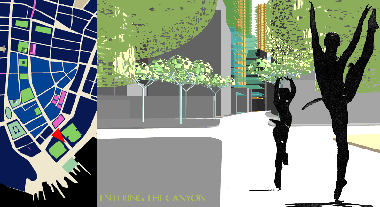
Now we are leaving the edge,moving towards the canyon,emerging from the appleyard to enter stone artifice.On the street I put some arcades with a tree-like structure.I hope this tree-architecture will be a nice buffer zone between the edge and the core,light and dark,soft and hard.It can also be used as a link to the tableaux nearby such as Fraunces Tavern or Stone street.
Then we enter the Broad street canyon.Here I picked four buildings ,those with high visibility ,imageability,and vacancy,to house both the new dwelling/work units and a series of public/green spaces.The green will locate on the ground level of each building,a garden in the machine,but discreetly as oases in the canyon,giving only minimal clues to the pedestrian outside,and providing surprise and joy for random public.The greenery will receive daylight from the top through skylight and atrium,with optional light from the street facade through sun scoop or clerestory window.


Working altogether,this system will try to restore the fragmented city,bringing the pieces together to create a coherant sense of place,within a matrix of public/green space and cyberspace.
Final Jurors; Irena Latek, Christine Boyer, Marissa Oliver, Mark Robbins, Lauren Otis, Michael Webb, Michael Manfredi, James Sanders, Joan Ockman, Andrea Kahn.
At the Final Jury Irena Latek admired the conceit of the application of
the Plan Voisin (orchard) to the already built environment, she liked
the analysis and the vertical application, her main question was what
was so desirable about the street as it is?
Would the project build on
the sense of what was already there.
Richard Plunz also commended the
project for the way in which it kept the formal energy of what was a
unique place in the world to live, he felt the proposal was too sweet
and too soft for the place, which was tough and in some ways nasty.
Lauretta Vinciarelle added that the proposal was a worthwhile study but
needed to be mixed income, obviously upper income at the moment, it
needed to be more specific, offices were shrinking and various sectors
might inhabit their spaces.
Jim Sanders praised the vertiginous sense
communicated by the presentation, he felt it captured well the sense of
the street.
Mark Robbins commented on the stratification of the scheme
which allowed old uses to remain and on the retention of the old facades
except on the three new insertions which punctuated the dark canyon of
the street.
Joan Ockman questioned if the street began to be an enclave
(could it have gates?), she wondered how the axis of the street would be
resolved in the trees/forest at either end, did it have a proper
terminus? She really enjoyed the "Situationalist" drawing of the towers,
showing how they "drifted" in relation to the street.
She and Irena
Latek liked the concept of the roof top parks, allowing the street to
exist as before below.
Lauren Otis pointed out that in Midtown people
sought out the ground plane and upper level facilities never were
popular except with tourists, downtown the issue was retail uses needed
at street level to make it fuller urban experience. Problem of elevator
access to upper level public spaces.
Richard Plunz ended by pointing out
that the project showed how the interior of the island could be
attractive, not just the new edges.