URBAN DESIGN STUDIO/ FALL - 95
PROBES
HARLEM
Tatsuya Utsumi
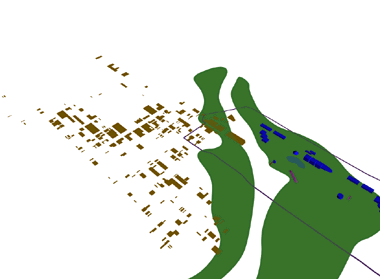
Notes on project and jury by Grahame Shane.
Tatsuya is a very sensitive designer whose ambition stretched from the
regional scale of the Harlem River Valley to small infill sites in
Central Harlem.
Inevitably he was not able to cover all of this
territory in great depth.
He attempted successfully to sketch out what
his responses would be to all the questions raised by this vast range of
material.
His presentations have become very clear, well organized and
successful, especially the one before the last jury with its elaborate
animation (which earnt him a round of applause from his fellow
students).
His last presentation did not explain in detail all the
details of his South Bronx intervention, much to the frustration of the
Jurors.
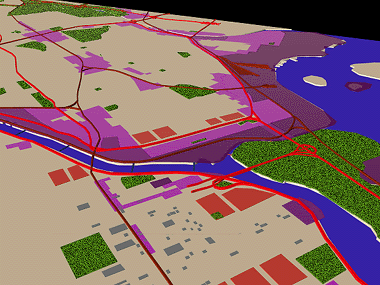
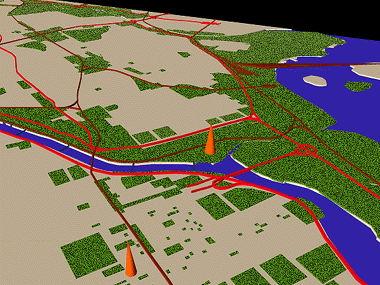
In the regional scale, I set up a revised zoning procedure. The mixed used green veil takes the place of abandoned industrial areas. The green veil will generate job place, institution, housing and recreational space. The sites attract families, business people, corporations, investors and governments because of its natural environment and accessibility (parkways, railways, airways and waterways).
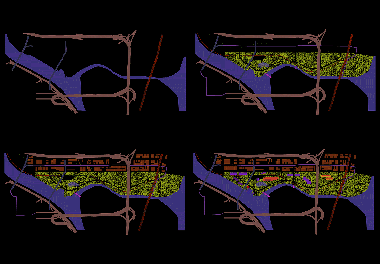
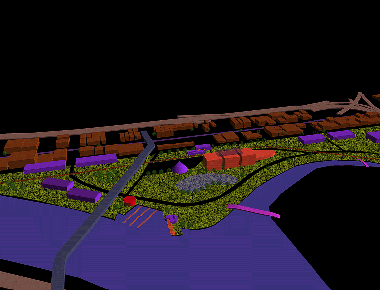
Although the geographical isolation, periphery of Manhattan, gives negative image to the Northern East Harlem, I would like to regard the site as the center of the proposed green veil.
In addition to the highway and railroad access, as the basis for establishing perimeter center, I propose a revised transit (passengers and freight) structure ( bus loop, water shuttle, and new railroad). The bus loop connects each local neighborhood; water shuttle brings people to Midtown, Down Town and La Gardia; new railroads connect the district to Penn Station, Long Island, New England and the rest of New York State region.
The edge of South Bronx, which used to be the major employment center of the Bronx and has 20 percent of the borough's manufacturing and wholesale jobs, is separated from the interior Bronx by the Major Deegan and Bruckner Expressways which provide excellent truck access.
In this site I propose light industry, such as garment, food and furniture factories, warehouses, distribution center, back offices and recreational center.
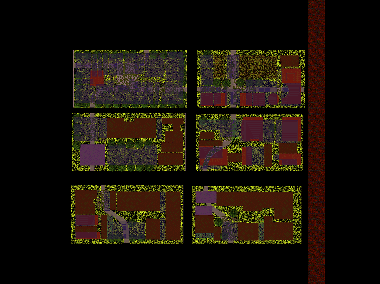
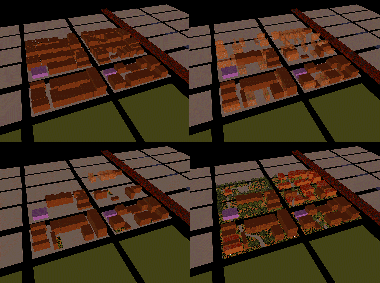
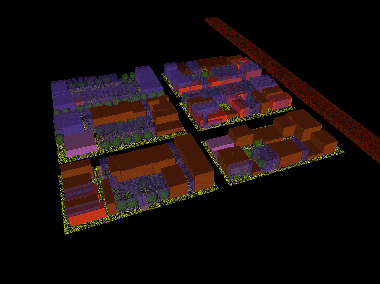
The green veil overlaps the local neighborhood combining with green infill.
I consider the vacant lots as the resources of the community development; otherwise vacant lots invite trouble to the neighborhood such as toxic waste, crime etc. and would accelerate the decay of neighborhood.
In the local scale I am going to propose block rehabilitation idea to support the community development. Here, vacant lot will be the site of the gardens or new project. Vacant building will be used as proposed institutions.
Block rehabilitation proposal includes community parks, educational centers, daycare centers and new housings. The network of these elements will help for neighborhood problems, and would become the social background for the regional green veil idea.
Block rehabilitation doesn't require any public control. It is controlled by neighborhood organizations. This participation process give the residents an opportunity to feel proud of their neighborhood.
Final Jurors; Irena Latek, Sharon Haar, Mark Robbins, Audrey Matlock, Lauretta Vinciarelli, Claus Herdeg, Scott Marble, Richard Plunz, Modjeh Brataloo.
At the Final Jury Tatsuya compressed his presentation and left the
Jurors wondering about the nature of his "Green Veil".
Lauretta
Vinciarelli wondered if this was a new form of suburbia, agriculture or
parks, was it reversible or forever?
Claus Herdeg appreciated the
overall scenario as a "what if ..." research" (he would oppose it if it
was an master plan), but felt that the small scale of the resulting
buildings was inappropriate for its setting beside the monumental
setting of the Triborough Bridge Approach.
Irena Latek pointed out that
green space is not natural in the city, it is an artificial man made
landscape, a built landscape. She felt that such spaces were part of the
tradition of the city and it was not clear to what pattern or tradition
these new green spaces would belong.
Richard Plunz also questioned the
viability of the "Green veil" low density approach because of land
values and the cost of the clean up required on toxic industrial sites.