|
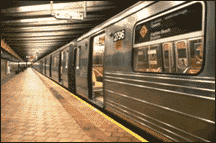 Subways are a fast, easy, and inexpensive way to
get around the city. Trains run 24 hours a day, with
waiting time between trains normally just a few minutes,
depending on the time of day. The 714-mile New York
City subway system has 468 stations serving 24 routes
- more than any other system in the world. It operates
24 hours a day, is safe, and is used daily by more than
3.5 million people. Subways are a fast, easy, and inexpensive way to
get around the city. Trains run 24 hours a day, with
waiting time between trains normally just a few minutes,
depending on the time of day. The 714-mile New York
City subway system has 468 stations serving 24 routes
- more than any other system in the world. It operates
24 hours a day, is safe, and is used daily by more than
3.5 million people.
Subways traverse Manhattan, Queens, Brooklyn, and the
Bronx; Staten Island is served by the Staten Island
Railway, with connections to the Staten Island Ferry
from the St. George station. The SIR trains run 24/7;
the fare is the same as for bus/subway.
Routes are identified by letters, such as A B C and
by numbers, such as 1 2 3. The different lines are different
colors. Free subway maps are available in the Official
NYC Guide, at NYC's Official
Visitor Information Center, and at any subway
station booth.
The Metropolitan
Transit Authority (MTA; 718/330-1234, non-English
718/ 330-4847) is the source for route and schedule
information for subways and buses throughout the five
boroughs.
Tips
Subway Entrances: Subway entrances in New York are
usually found on street corners, marked with a staircase
descending to the station. The stop will have a large
green ball outside (indicating a booth inside where
you can buy tokens or MetroCards) or red ball (no token
booth inside; you must have fare available to enter).
Uptown/Downtown: Directions will usually be to take
either an uptown or downtown train; there are also several
crosstown shuttles. Many subway entrances specify Uptown
Only or Downtown Only, meaning trains on the platform
accessed by that specific entrance will be going in
only one direction. A platform with trains running in
the opposite direction will most likely be across the
street behind you - an entrance across the street to
your left or right will most likely have trains running
in the same direction. Generally, subway stops for uptown
are on the east side of the street, downtown on the
west. Streets ascend in number as they run north. For
example: If you're at 14th Street and your destination
is 50th Street, you'll be going uptown (to get to midtown).
Cost: The cost is $1.50 per ride, no matter how
far or how many times you transfer (as long as you don't
pass through the turnstile gate; if you do, another
fare must be paid). Purchase either tokens (coins for
each ride) or a MetroCard, which can save you money
on multiple rides. Options include the $4 one-day Fun
Pass; the 7- ($17) and 30-day ($63) unlimited ride cards;
and a pay-per-ride card ($10 for 11 rides but you may
put any amount onto a MetroCard).
Please note that in May, subway and bus fares will be
raised to $2. Monthly unlimited-ride MetroCards will
also rise to $70, from $63, with insurance for lost
cards; weekly cards will increase from $17 to $21; one-day
"fun passes" will go up to $6 or $7 from the
current $4; and express bus fares will jump from $3
to $4. But riders will get a free ride for every five
purchased at the regular price, instead of the current
bonus for every 10 rides.
Transfers: If you pay your fare with MetroCard,
you may transfer free from bus to subway, subway to
bus, or bus to bus within two hours of the time you
paid your fare. Unlimited Ride MetroCard includes all
transfers, at no charge.
Where to Get a MetroCard: There are 3,500 MetroCard
merchants throughout the city including NYC's Official
Visitor Information Center and many subway stations and
hotels.
Getting Information in the Station: There is a Passenger
Information Center bulletin board near the main booth
in every station, with subway map and map of the area
immediately surrounding the station. Station booth agents
can give you directions and a free subway map.
Going Through the Turnstiles: Slide your MetroCard
through the slot in the top of the turnstile or deposit
your token in the turnstile and walk through. You might
need a little practice sliding your MetroCard. Insert
as directed on the card: Make sure the black stripe
is facing you; slide with the M of MetroCard going through
first; slide the card not too quickly and not too slowly.
There will be a text message on the turnstile saying
if entry is granted ("GO") or not. If entry
doesn't happen, follow instructions to slide the card
again at that turnstile (you'll lose the fare if you
switch turnstiles) or to put more money on the card.
People in wheelchairs may pay their fare by alerting
the station booth agent that they are about to enter
the system. They can then pay their fare and the station
booth agent will open the special entry gate for them.
Autogate is a place near the turnstile where mobility-impaired
customers can enter the subway with a special Autogate
MetroCard.
Boarding the Right Train: Follow the signs displaying
the subway route you want to take. At the platform edge
abovehead you'll find signs that tell which trains stop
there and the direction the trains are going, such as
Uptown (northbound), Downtown (southbound), or Brooklyn-bound.
The front and side of every train display the route
number or letter. In many instances, more than one train
route stops at a platform so you'll want to be sure
to read the route number before you get on.
Knowing When to Get Off: Conductors make announcements
so you'll know the next stop along the line. To be sure
you're traveling in the right direction, check the subway
map. Every subway car has a map posted on the wall by
a door; new cars have route maps suspended from the
ceiling with scrolling announcements of each stop.
|