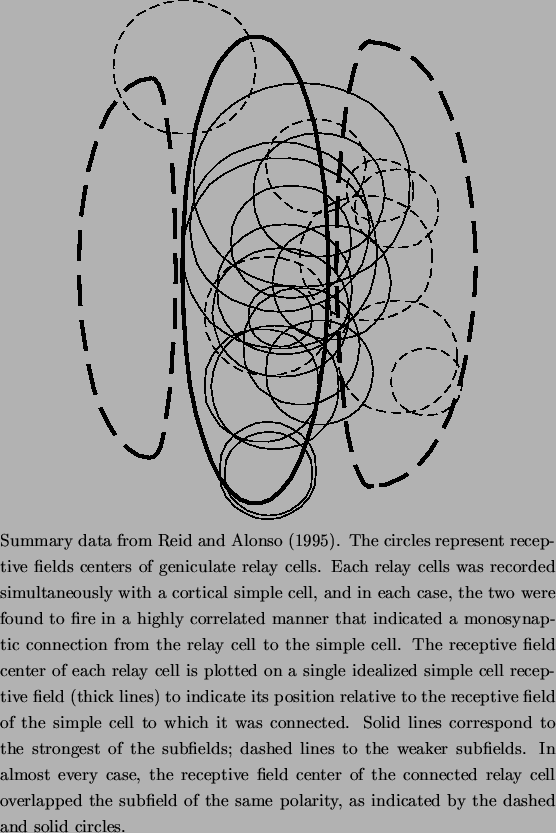
One of the most specific predictions of the the feedforward model is that the geniculate input has a definite spatial organization. Is the LGN input segregated into ON and OFF regions that correspond to the simple cell's visually defined ON and OFF subfields, as predicted by Hubel and Wiesel (1962)? An affirmative answer was given by the cross-correlation experiments of Tanaka (1983) and Reid and Alonso (1995). These authors found that functional connections between a simultaneously recorded LGN relay cell and simple cell were present when the center of the relay cell receptive field overlapped a simple cell subfield of similar response polarity. That is, a relay cell and the simple cell were connected if a relay cell's ON center overlapped an ON subfield of the simple cell, or an OFF center overlapped an OFF subfield (Figure 2). Conversely, ON (or OFF) center relay cells rarely connected to a simple cell with an overlapping OFF (or ON) region, and the strength of the synaptic connection was correlated with the degree of overlap of the receptive fields (Reid and Alonso, 1995). Thus, the geniculocortical projection to each cat simple cell is wired with extreme precision in just the manner required to support the feedforward model.
Support for a role of the spatial arrangement of LGN inputs in generating orientation selectivity was also provided by Chapman et al. (1991). They found in ferrets that, after silencing cortical cells with topical application of muscimol, they could record from the LGN relay cell axons terminating within the corresponding region of layer 4. Surprisingly, the receptive fields of LGN axons recorded within a given vertical penetration formed a region in visual space that was elongated parallel to the preferred orientation of cortical cells recorded in the same column prior to muscimol application. Given that only 40% of layer 4 neurons are orientation selective in the ferret (Chapman and Stryker, 1993), however, it remains to be determined whether, on a cell-by-cell basis, there is a consistent relationship between the distribution of the receptive fields of the presynaptic afferents and the orientation preference of the cell.