

The Laws of God and Man
When students woke up early this morning, prepared for a full day trip to a monastery outside the city, they discovered that the early Moscow springtime had vanished, the sunshine and mild temperatures replaced with angry grey skies. At the breakfast table, we were further chilled by the news that four of our classmates had been held at gunpoint by police demanding their documents last night. Police pulled over Ailis Brown, Jennifer Ho, Alan Rappeport and Nicole Still, who were taking a cab back to the hotel after a late dinner. The officers informed them that, since they could not present their visas — which were kept by the hotel's front desk they were in "beeg trouble." From 1 to 3 a.m., the frightened students remained in custody, first on the side of the road, then at the police station across town. Their cab driver's cell phone died just as they had managed to tell Prof. Ari Goldman that they were "stuck," and they were not given the opportunity to use another phone. Finally, the police, who seemed interested only in bribes, drove them home after the students repeatedly explained that they did not speak Russian, their documents were back at the hotel, and they did not have any money. "I feel like I can't go anywhere now without being grabbed and harassed by the police," said Jennifer, who had already experienced two run-ins with the law for trying to film in the Red Square vicinity with Molly Knight. One of our translators, Masha Kramarenko, who had dined with the students that evening, was upset but not surprised by the incident. "Foreigners are often harassed in Moscow," she said, shrugging her shoulders. "It's a fact that the police are corrupt." With more than half of us shaken up by police encounters and everyone exhausted in general, two students, Ailis and Manya Brachear, stayed behind to catch up on sleep and continue their feature reporting. Everyone else wearily boarded a bus bound for the Sergiev Posad monastery, founded by St. Sergius in the 14th century. Our guide, Moscow Times reporter Andrei Zolotov, encouraged us to be pilgrims today, rather than journalists or tourists. He began our two-hour trip with a prayer for a guardian angel to watch over us on our journey, and blessed each student by name. Blessed or not, we soon had to stop the bus while three students ran into the woods for a bathroom break and encountered a dead wolf. Just outside Sergiev Posad, we stopped at a church in Radonezh, the village where St. Sergius spent his childhood. On the site where the young saint had encountered an angel disguised as a monk, we briefly observed a Russian Orthodox service celebrating the first week of Lent, the 40-day period in which believers traditionally abstain from eating meat in preparation for the most important holiday of the church calendar, Easter. At Sergiev Posad, which includes a monastery with 200 monks, a seminary with 650 students, a museum and several churches, we had our first glimpse of snow and ice. Lulled into a false sense of security due to the warm weather this week, some of us had left our winter clothes behind. A coatless Brian McGuire ended up wearing an enormous black fur hat that Elizabeth had just purchased from a street vendor. Maxim Romanov, a 23-year-old theology student, gave us a tour of the Moscow Theological Seminary and Academy, housed in the Tsar's former residence on the monastery grounds. His day begins with prayers at 7 a.m. and ends at 11 p.m. In between, he and his classmates study church history and theology, ancient and modern languages and other relevant topics. The smell of beeswax and incense hung heavily in the air, as Maxim walked us through the seminary church on the way to the seven-room museum of icons, vestments and models of churches. Many of the original treasures were missing, he said, "possibly destroyed by the ungodly government we had in our country for seven decades." The Soviet government closed Sergiev Posad from 1920 until the end of World War II, Maxim explained. Unlike other houses of worship under communism, the buildings remained intact and the monastery remained an important center for Russian Orthodoxy. At the end of the tour, we asked Maxim and three of his classmates about their religious aspirations and life at the academy. "Probably the number one role that we have is to bring people back to the church," Maxim said. "We have a problem with other religions coming into Russia and stealing our people, who were not allowed in Soviet times to worship." Andrei Dorokhim, a 31-year-old former international banker, agreed, adding that he thinks the Russian government should play a more active role in preserving Russian Orthodoxy. "We need to have a legal basis to persuade people that other religions are wrong," he said. "We need to have a strict definition about what you can call a church and what you can call a sect. We can't treat the small religious groups like the Seventh- day Adventists like a church. We need to restrict and make special rules about them." After the discussion, we were served the same Lenten fare as the theological students, followed by a tour of the monastery's churches. The Trinity Cathedral, where Ivan the Terrible was baptized, houses the relics of St. Sergius and icons painted by the famous iconographer Andrei Rublyov. Priests there lead a continuous service from 5 a.m. to 9 p.m. The other churches and chapels also housed numerous holy relics and historic icons. We had a few hours to spare until dinnertime at a local restaurant, which served traditional Russian meals bathed in butter. Some students walked to the Art and Pedagogical Museum of Toys, where finely crafted dolls and wooden toys are displayed and sold. Darren Foster perused a gun shop, while Jennifer and Molly relaxed and chatted about the attractiveness of the academy students. "As broadcast people, you have to think about these things," Molly said. Unfortunately, they were not allowed to film Maxim without the blessing of the rector. Noah Haglund, on the other hand, was disappointed by the fresh young faces we had encountered in the school. "I think to be a real priest, you have to be some wild man with twigs sticking out of your beard," he said. After dinner, we boarded the bus back to the hotel, tired from our long trip and anticipating an early wake-up call for the flight to Kiev in the morning. Click here to read more about the Lenten fare served at the monastery.
|
|||||||
|
QUICK LINKS: Feature Stories | Dispatches | Photo Essays | Itinerary | Maps | About This Class
A project of the Columbia University Graduate School of Journalism made possible by the Scripps Howard Foundation. Comments? E-mail us. Copyright © 2002 The Graduate School of Journalism at Columbia University. All rights reserved. Reproduction in whole or in part without permission is prohibited. |


 |
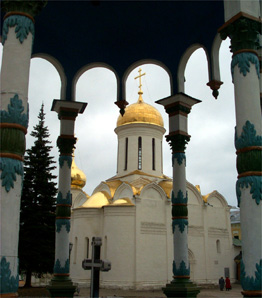 |
PHOTO BY ALAN RAPPEPORT
Students visited several churches on the grounds of Sergiev Posad |
 ITINERARY MAPS OF RUSSIA AND UKRAINE ABOUT THIS CLASS E-MAIL US ITINERARY MAPS OF RUSSIA AND UKRAINE ABOUT THIS CLASS E-MAIL US |