Introduction to Earth Sciences I
2.6 Marine Tides
Every one who has been to the beach or spent any time near
a shore line knows something about the behavior of tides. They appear to
the beachgoer as the advance and retreat of the high water line. In fact,
we all know that what is happening is that the water level is rising and
falling throughout the day. Tides are a very predictable feature of the
Earth and result from the interactions of the Earth, Moon and Sun, together
with the rotation of the Earth and Moon.
The basic features of tides are well known:
- In most places there are two high and two low tides each day.
- The height of the high tide varies, having two maxima in a
month.
The figure below shows these features in tide gage readings (the height
of the tide) at several locations around the world for the same one month
period. You can see that in some places there are two high and two low tides
a day (called semi-diurnal) and in others there is only one (called diurnal).
Note also that the maximum height of the tide changes throughout the month.
Look carefully and you will also see that the time at which the tide reaches
a maximum advances a little each day.
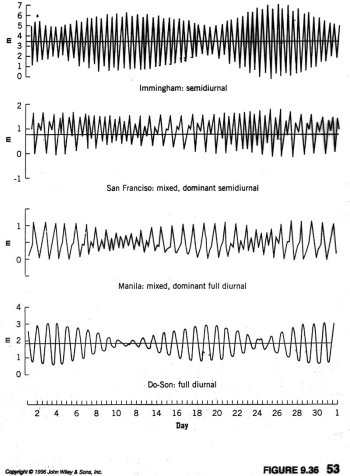
Figure 2.6.1
- Tides are very different from place to place throughout the
Earth.
The figure below shows how the tidal heights actually vary throughout
the world. The pattern is very complex in detail and cannot be explained by
the simple theory we cover in the following. Note that the animation at the
very end of this section shows how this complex pattern varies through a month.
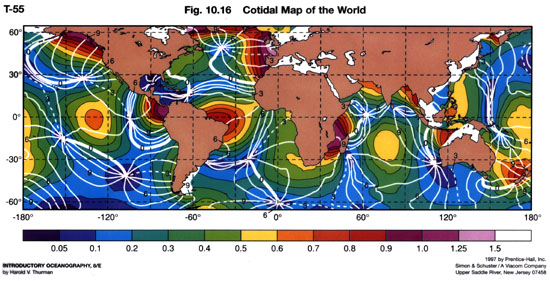
Figure 2.6.2
These basic features can be explained by the "equilibrium"
theory of tides.
Tides are caused by the gravitational attraction of the
Moon and Sun. The Moon's effect is about 54% of the total - gravitational
force is proportional to the masses of the interacting bodies, but inversely
proportional to the square of the distance separating the bodies
so, although the Sun outweighs the Moon by a factor of 10 million the fact
that it is almost 400 times further away than the Moon gives the Moon the
gravitational edge.
Water is very weak and will respond to gravitational attraction
or "pull" by trying to move in the direction of the force. So
the water covering the Earth distorts by making a bulge toward the Moon.
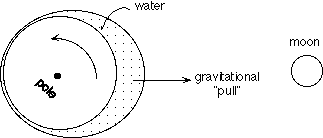
Figure 2.6.3
As the Earth rotates, points on the surface move in and
out, under the bulge, and hence experience high and low tides. But there's
a problem with this model of tides; it can't account for there being two
high and two low tides each day. It can only explain one high and one low
as the Earth rotates beneath the one bulge. Our simple model is incomplete
because it doesn't take account of the rotation of the Earth/Moon system.
We generally think of the Moon rotating around the Earth on a monthly basis
while, in fact, the Earth and Moon rotate around each other. The gravitational
attraction acts to "connect" the two bodies and they rotate in
unison. If they were of equal mass they would rotate about their mid-point
like a baton thrown in the air by a majorette. Because the Earth's mass
is much greater than the Moon's, the point about which Earth and Moon rotate
together (CM) is near the Earth's surface.
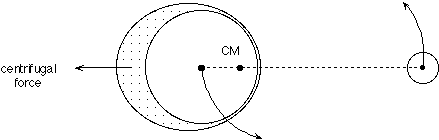
Figure 2.6.4
The animation that is available at
http://plabpc.csustan.edu/general/tutorials/PlanetaryMotion/PlanetaryMotion.htm
shows you how the motion of two bodies rotating around each other is affected
by the relative sizes of the masses. You can use the sliders to change the masses.
You will see how making the masses more nearly equal causes the center of rotation
to be somewhere about half-way between the bodies, while if one mass is much
greater than the other the center of mass, and hence the rotation point is actually
within the more massive body. That's the way it is with the Earth/Moon system.
The critical effect this has is that it gives rise to a
second force - the centrifugal force - that acts in the opposite direction
and wants to create a water bulge on the opposite side of the Earth, away
from the Moon.
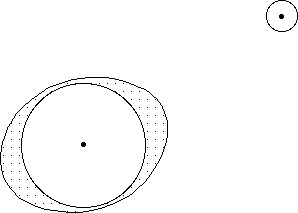
Figure 2.6.5
These two forces, in combination, give rise to equal size
bulges on both sides of the Earth, and explain why there are usually two
high and two low tides a day. This explains one of the most basic observations
about tides.
We also know that the basic pattern of daily tidal variations
changes from place to place. Usually there are two high and two low tides
but the height of the two "highs" is usually not the same. In
some places there is only one high tide in a day and in others the signal
appears mixed between the two. The gross features of this variable behavior
are explained by remembering that the Earth's rotational axis is tilted
with respect to the plane of the ecliptic by 23.5° as we know
from our previous studies, and the Moon is inclined at about 5°. The
net effect is that the tidal bulge is 28.5° off the equator.
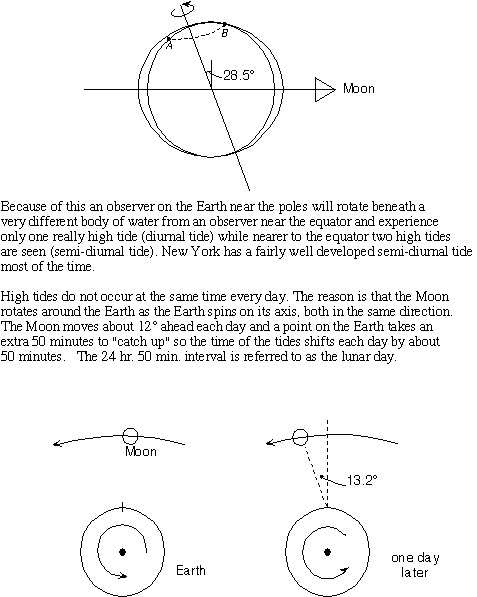
Figure 2.6.6
That's almost everything. All that's left is to explain
why the height of the tides change during a month.
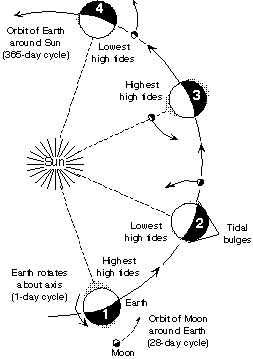
Figure 2.6.7
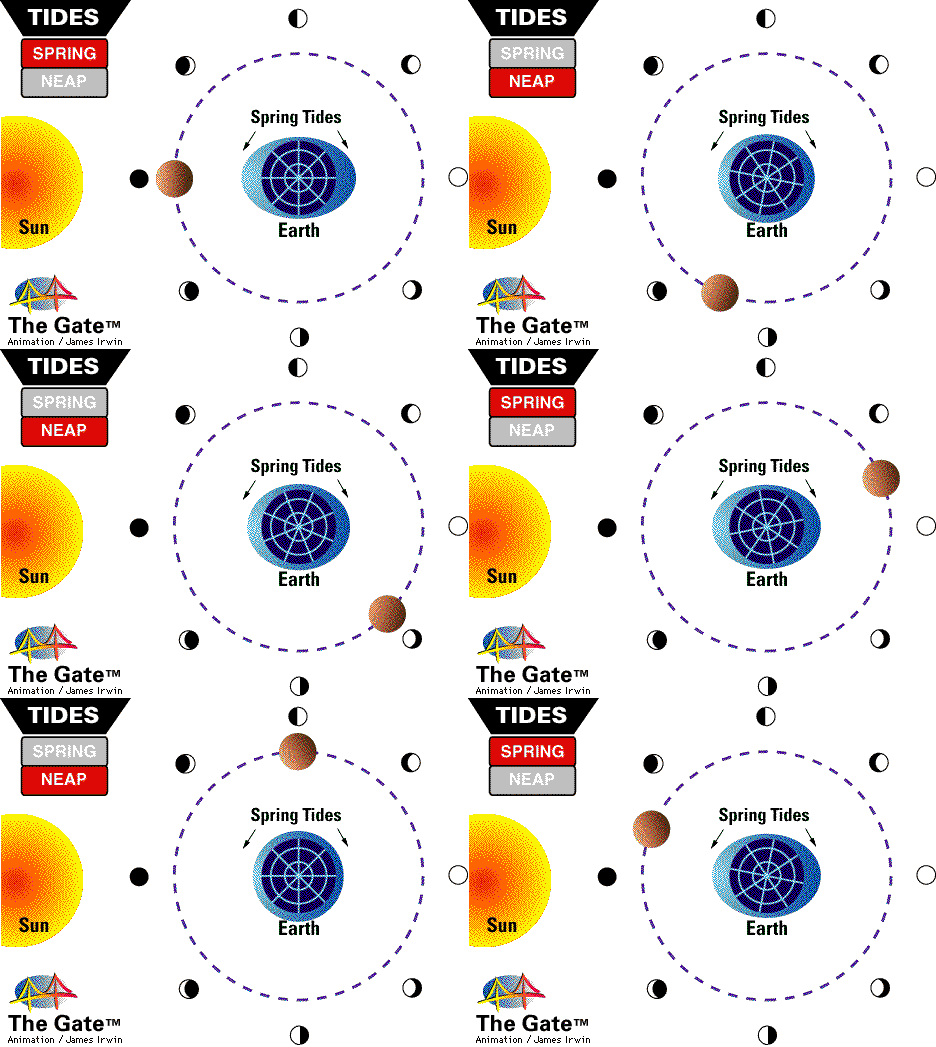
Figure 2.6.8
Another way of looking at it:
 |
Figure 2.6.9 |
Video resource: World
Tides Video (QuickTime ~7MB) | World Tides Video
(Streamed Real Media)
This is due to the combined effect of Moon and Sun. When
the two are aligned the gravitational attractions of the two reinforce and
create very high tides. This occurs when the Moon is "full" and
"new". When the Moon and Sun are maximally out of line, at the
Moon's "quarter" positions, the tides are lowest. The high tides
are called Spring tides and the lowest are rip tides. We often hear news
reports that describe the destructive effects of storms that surge at the
same time as a Spring tide - just about the worst combination.
Mini-Quiz:
In reality, tides are even more complex than have been
described above and we need a more complete theory (or model) to explain
their exact behavior. Missing from our simple model are the continents (our
equilibrium model has a fully water enshrouded Earth) and the topographic
effects of the seafloor including bays and inlets. Even the friction between
the seafloor and the water layers must be factored in. These effects are
very complex and no fully complete model of tides actually exists. All are
approximations.
Topic 1 /
Topic 3 /
Topic 4 /
Topic 5