Imagine you are working in an NGO in remote Africa. Your connection comes and goes at the drop of a hat. When it goes, it can last a few seconds, a few hours, or even days. On your best day you are pulling 20kbps, and all you want to do is find funding without having to spend an entire day looking at one donor’s website just to find the basic information you need. You find a site, only it’s laid out in a way so that it is difficult to glean what the organization does, what kind of information to expect from the site, and whether or not the information is still current. You have to click a lot of links to find granting information.
Once you do, the grant applications are 1MB in size and will take forever and a day to download. Suddenly, your NGO is no longer just trying to obtain much
needed granting information, and overcome Internet access problems, it’s starting to wonder if the donor’s heart is even in the right place, with all the barriers to entry that donor is creating for the NGO. That is why it is absolutely vital that donor organizations, whose target audience includes NGOs in developing countries, make a concerted commitment to implementing as many of these recommendations for low bandwidth web design as possible.
The reality is that, more and more, donor organizations are using the Internet as the primary way of disseminating information about their funding. It is certainly cheaper than mailing packets of paper or CD-ROMs out to organizations in target countries, calling them on the phone, advertising on television or radio, or sending a representative door to door. The cost of such efforts would certainly be massive, and it would prove very difficult to ensure that every last potential recipient be reached with this information. The money saved can be, instead, dedicated to projects and programs themselves. Utilizing web technology in this way also serves as a way to sell your donor organization to other donors—websites can be a surefire way to look credible and professional. This is most likely to become even more the case as the Internet penetrates deeper into the far reaches of the globe. This is a problem for areas with weak Internet penetration and low bandwidth, because it has the potential to actually increase the digital divide, as areas with higher bandwidth have greater access than areas with lower bandwidth. This is especially true in rural areas around the world. We could very easily increase not only the digital divide, but the poverty gap, as well.
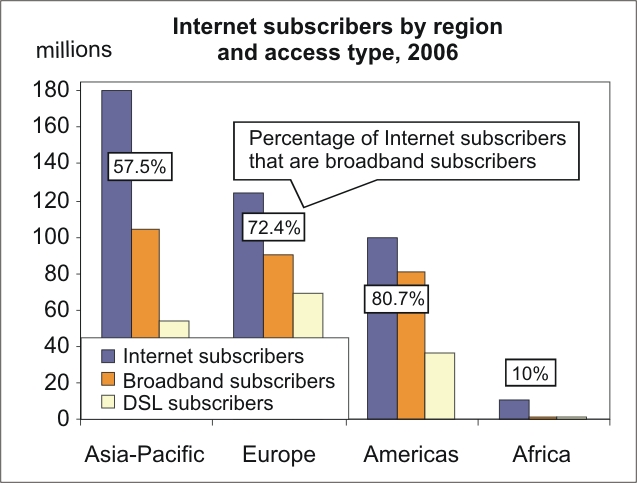
Looking at global Internet access and use on the aggregate reveals a relatively grim picture in developing countries. In terms of access to the Internet in 2005, 69% of developed economies had Internet in their households, while the same was true of only 33% of developing economies, and 6% of least developed economies (1). The proportion of those who used the Internet in 2005 paints an even bleaker picture: 65% of people in developed economies, 23% in developing economies, and 4% in least developed economies (2). Taking this to the rural level, Internet penetration in 2006 looks even more abysmal: East Asia and Pacific 13%, Europe and Central Asia 22%, Latin America and Caribbean 3%, Middle East and North Africa 3%, South Asia 7%, and Sub-Saharan Africa 1.4% (3). But the most striking statistic is the divide in percentage of those with broadband access out of total subscribers: 57.5% Asia-Pacific, 72.4% Europe, 80.7% Americas, and 10% Africa. In other words, there is a lot of low bandwidth in areas with the most need, especially in Africa (should that come as a surprise) (4).
It is also important to consider how the Internet is used by NGOs in low bandwidth environments. People often have to creatively overcome slow connections and Internet unreliability. This means they are likely to visit fewer web pages, click on fewer links, not dig as deeply into web pages, and therefore will naturally access less information. It is important to also consider that larger NGOs may have the resources to pay for more bandwidth, but because they have more employees, they may have to split that bandwidth across more computers, dramatically cutting down their per person bandwidth, and slowing their respective connections to a crawl. Thus, it behooves donor organizations to take this into consideration when building websites designed to deliver grant information to these areas.
Return to "Web Design by Development Organizations for Low Bandwidth"

 Once you do, the grant applications are 1MB in size and will take forever and a day to download. Suddenly, your NGO is no longer just trying to obtain much needed granting information, and overcome Internet access problems, it’s starting to wonder if the donor’s heart is even in the right place, with all the barriers to entry that donor is creating for the NGO. That is why it is absolutely vital that donor organizations, whose target audience includes NGOs in developing countries, make a concerted commitment to implementing as many of these recommendations for low bandwidth web design as possible.