FRANK'S COMPULSIVE GUIDE TO POSTAL ADDRESSES
Effective Addressing for International Mail


- Author:
- Frank da Cruz
New York City
[email protected] - Last Update:
-
Thu Feb 19 15:58:01 2026
Eastern USA time
- Quick Access:
- Go to the INDEX and click on a country name.
- Para los latinoamericanos:
- Buscar códigos postales
CONTENTS
- INTRODUCTION
- GENERAL PRINCIPLES
- THE USA
- CANADA
- THE CARIBBEAN
- LATIN AMERICA (MÉXICO) (BRAZIL) (CUBA) (COLOMBIA)
- AUSTRALIA
- NEW ZEALAND
- EUROPE (ITALY) (NETHERLANDS) (GERMANY) (FRANCE)
- THE FORMER CZECHOSLOVAKIA
- THE FORMER YUGOSLAVIA
- THE FORMER SOVIET UNION
- ASIA (THE TWO CHINAS) (JAPAN) (SINGAPORE) (INDIA)
- THE MIDDLE EAST
- AFRICA
- ATLANTIC AND PACIFIC
- BRITAIN AND IRELAND (ENGLAND) (SCOTLAND/WALES) (NORTHERN IRELAND) (IRELAND)
- COUNTRY INDEX
- QUIZ ANSWERS
- Disclaimer:
- MAINTAINANCE OF THIS DOCUMENT
ISWAS A PUBLIC SERVICE OF the ex-KERMIT PROJECT AT COLUMBIA UNIVERSITY. It was was originally written for our own business purposes (international shipping of our software in the pre-Internet days) and does not claim to be definitive, complete, systematic, up to date, or unopinionated. All opinions and conclusions are those of the author (or the contributors or references cited). Apologies for any inappropriate terminology, especially since this document aims to eradicate it. Format: handmade HTML with accented or non-Roman characters encoded in UTF-8, properly announced to allow inclusion of text in many languages and scripts. For more information about UTF-8 CLICK HERE and HERE. - Background:
- This document started in the 1980s as a short tip-sheet, organized
geographically, with sections for regions or specific countries. Then about
1990, everything changed – the breakup of the Soviet Union, the
reunification of Germany, the breakups of Yugoslavia and Czechoslovakia.
This document reflects the changes, rather than simply starting over,
because at the time we were faced with a big address conversion problem.
Such events will continue to happen as time goes on so it's useful to recall
their impact, even on this tiny area of human endeavor. Hence the sections
labeled
The Former Soviet Union
,The Former Yugoslavia
, etc. - Updates:
- The 14 November 2000 edition adds links to postal authorities in many
countries, which are recapitulated alphabetically (in English) in the INDEX at the end. The 15 May 2001 edition adds ISO
3166-1 codes to the country list in Index; this is the familiar
Internet top-level domain (TLD) for each country (in most cases), and these are
also used on international mail containers, machine-readable passports, and
in national currency identifiers.
Lots of corrections and expansion in
January 2003. The February 2003 version is much expanded, including new
tables and sections for Africa, the Mideast, Latin America, and with each
country name in the Index linking back to the relevant section of the main
document. In June 2003, the tables of English, Scottish, and Welsh counties,
which are no longer used in UK addresses, was moved out to a separate file and the UK section was modernized.
The UTF-8 conversion was done on 20 January 2003; the previous ISO-8859-1 Latin Alphabet 1 version, current as of that date, remains available HERE (but won't be updated). The UTF-8 version includes text in Greek, Cyrillic, Arabic, Hebrew, Hindi, Chinese, Japanese, Korean, Tibetan, Thai, Khmer, and other scripts that can't be represented in Latin-1 but are easily accommodated by UTF-8. Most of this text is in the COUNTRY INDEX. Anybody who can supply missing country names or other relevant items in native language and script is welcome to send them in; I'll be glad to add them (with credit, of course).
Periodic updates of any postal reference are necessary because countries change, provinces within countries change, postal codes change, addressing standards and recommendations change. The Internet makes matters simultaneously better and worse: better because now we can link to the postal authorities in each country and to other relevant sites, worse because web addresses change out from underneath us constantly. Thus any document like this is doomed to decay over time if it's not constantly maintained. The last update time is shown at the top. Feel free to report stale links, or send corrections, suggestions, or new information, by e-mail to [email protected].
- Acknowledgements:
- Aleida Morel (Dominican Republic),
Mari Carmen Fonseca, Juan Castro, Patrick Decker, Andrew Leonard, Beth Espy, Tom Doan (México).
Fernando Cabral, Steve Slayton (Brazil).
Roberto Homs (Cuba),
بهاء عبيدات / Baha Obeidat (Palestine),
Felipe Zapata Roldán (Colombia),
Josh Gross, Kevin Tarr (Costa Rica);
Johnny Franco Arboine (Costa Rica, Nicaragua, Ecuador);
Craig Hartnett, Doug Ewell, Alexis Hunt, John Sawyer, Benoît Le Nabec (Canada),
Irineu de Assis (Bolivia, Paraguay, and Colombia),
Cord Wischhöfer, ISO 3166/MA-Secretariat (Europe & North Africa).
Gerhard Helle, First Secretary, Universal Postal Union, Berne.
Kjetil Torgrim Homme (Norway).
Xander Jansen, Gert Grenander,Abigail
, Sjoerd Cranen, Reinier Olislagers, Ken Martin, Roland Witvoet, Richard Paul, Liza R, Marco van der Wal, Jan Kamphorst, Laurenz van Gaalen, (Netherlands).
John Klensin, Alexander Svensson, Alex Bochannek, Asmus Freytag, Otto Stolz, Claus Langhans, Clemens Gutweiler, Ralph Babel, David Krings, Jens Peter Hammer, Christian Asche (Germany).
Christoph Päper (Liechtenstein, Lëtzeburg).
Marco Cimarosti, Peter J. Russell, Guido Camilla (Italy).
Александр Лысиков / Alex Lisikov, Bill Conerly (Russia).
Олександр Лисіков / Alex Lisikov (Ukraine).
Алег Гайко / Aléh Haikó (Belarus).
Peter Russell (Lithuania).
Klein Tamás Márton, Zsbán Ambrus (Hungary).
Eduard Vopicka, Radovan Garabík (The Czech Republic and Slovakia).
Dustin Du Cane (Poland).
Marjan Baće, Sindi Keesan, David Vidmar, Bojan Milenkovic (The Former Yugoslavia).
Վաչէ Գունտաքճը / Vaçe Kundakçı (Armenia).
გიორგი ლებანიძე / Georgi Lebanidze (Georgia).
روزبه پورنادر / Roozbeh Pournader (Iran).
Sannidhya Misra, Stewart Evans, Yateendra Joshi (India).
Eric Nedervold, Dieter Walter (Nepal).
Anthony Fok Tung-Ling, Stephen Yang, Tom Tschritter, Henry Groover, Ed Callaway (China).
Paul Hastings (Thailand).
Graham Rhind, Arthur Marsh, Doug Moncur, Kevin K., Andrew Donnellan (Australia).
Elizabeth Eggers, Ken Westmoreland, Ben Arnold, Derek Sivers, Andrew Kerkham, "Paul" (New Zealand).
Peter Reynolds (Nigeria).
Ken Westmoreland (Kenya).
Eberhard W Lisse, Ken Westmoreland (Namibia).
Topi Linkala, Miikka-Markus Alhonen, Jarkko Hietaniemi, Era Eriksson (Finland).
Craig Hartnett (Zambia, Zimbabwe, Rhodesia, Nyasaland).
John Hagerson (Sri Lanka, Taiwan, Vietnam, Israel, Serbia, Egypt).
Mordecai Glickman (Israel).
Avery Yen (Taiwan).
Kenneth Joseph Vella (Malta).
Andy Bell (Hong Kong).
Samuel Dickey, “Agroni” (Kosovo).
Joshua Holman (St. Martin & St. Barthélemy; Diego García)
Fridjon Gudjohnsen (Iceland).
Gerben Vos, Ir. P. (Peter) Mazereeuw, John Robertson (the ex-Netherlands Antilles).
Pekka Pihlajasaari (Malaysia).
Giselle Vassallo Pitto, Ken Westmoreland (Gibraltar).
Darrell K. McKown, US Army Postal Operations, Germany (APO/FPO/DPO).
Gabriel Sroka, California State University.
Ed Callaway (Kyrgyzstan).
Ken McSwain (Philippines, Australia).
Andrew Liepins (Mauritius).
Johnny Franco Arboine (El Salvador, Guatemala, Nicaragua).
Ken Westmoreland (Faroe Islands, Greenland).
Jacqueline Mohen (France).Britain and Ireland: John Benton, Ross Chandler, Craig Cockburn, Peter Crabb-Wyke, David Levy, James Grinter, Ian Morrison, Shane Wilson,
George D
, Hugh Dunne, David Goddard, Johannes Eggers, Christy Looby, Finlay Smith, Gerard Lardner, Robert Gormley, G.S. Sinclair, Chris Cooke, Colin Russ, Stewart Potter, Bill Bedford, Chris Harrison, P. Breathnach, Michael Everson, Mark Dyche, David Gowdy, Guy Burgess, Alan Berry, Ken Westmoreland, Jonathan Nigel, Peter Reynolds, Martin Spamer, Chris Davies, Benjamin Brundell, Mark Jolly, Liam McGee, William Wallace, Andy Paterson, Sarah Woodhouse, Mark Brader, Paul Black, Bernard Treves Brown, Greg Boettcher, Peter Kirk, Michael T. Farnworth, Andrew Leonard, Chris Woodhouse (Royal Mail), Philip Woods, John Marsh, Paolo Montanelli, Angela Watts, Gary Delaney, Kevin Tarr, "Rick", Cian Brennan.General information and corrections: Daniel Schwarz, Marty Simon, Linda Beek, Dan Olsson, Peter Russell, Ken Westmoreland, Gert Grenander, Marcy Strawmyer, Mark Brader, László Kende, Tex Texin, Helgi Jonsson, Roozbeh Pournader, Tom Gewecke, Magda Danish, Stuart Brown, Noah Levitt, Herman Ranes. Miikka-Markus Alhonen, Marco Cimarosti, Kent Karlsson, Celvin Niklas Jojakin Ruisdael, Hans Schievelkamp, Pete Russel, Doug Ewell, Philip Newton, Jim Brent, Christian Rosner, Howard Laker, Cassandra Phillips-Sears, Austin Knight, G. Herbke, Joshua Holman, George Rhoten, Jay Davis, Tom Richards, Malik Kalfane, Jean-Christophe Deschamps, Chris Morris, Bettina Morton, Gregg Lobdell, Paul Buhler, Steve Williamson, John Sawyer, Anthony P. Lew, the IBM International Components for Unicode (ICU) library, and the Web page Country names in various languages by Werner Fröhlich for several of the native-script country names (Bangladesh, Sri Lanka, etc).
- Reference:
-
Law, Gwillim, Administrative Subdivisions of Countries,
McFarland & Company (1999). Updates available on the Web at
http://www.statoids.com. See this
reference for states, provinces, or other subdivisions of any country
(website updated frequently).
- Resources:
- USPS Postal Explorer
- Postal Facts
- USPS International Mail Manual
- USPS IMM Index of Countries and Localities
- USPS Domestic and International Postage
- Universal Postal Union (UPU)
- UPU Addressing Solutions and Database
- La Unión Postal de las Américas, España y Portugal
- Carribean Postal Union
- European Union Postal Services
- ISO 3166 Alpha-2 Country Codes (Wikipedia)
- ISO 3166 Part 2: Country Subdivisions
- A comprehensive but unofficial list of countries and country codes
- University of Texas Map Library
- Google Maps
- UN Maps (PDF, zoomable)
- The Unicode Consortium
- Wikipedia List of Postal Codes
- Issues:
INTRODUCTION
[ Next ] [ Top ] [ Contents ] [ Index ] [ Home ]This document tries to describe – or invent when necessary – conventions for addressing postal mail from within the USA to other countries that are both (a) effective (i.e. have a good chance of working), and (b) as inoffensive as possible when addressing choices might be controversial. Note that the general problem – how to address mail from country A to country B, for all A's and B's – is an n × n problem, of which this document attempts to address only one dimension: mail from the USA to elsewhere. But even this is a moving target as addressing guidelines and formats of each country are constantly revised.
The very term country can be controversial. Who decides what is a country and what isn't? The criterion used in this document is simple: if the USPS lists it in its Index to Countries and Localities, we treat it as a country. Thus some localities (such as Reunion Island) that are not distinct countries are listed, whereas other localities that consider themselves countries (such as Western Sahara) are not listed (but still discussed). Rationale: if you address mail from the USA to WESTERN SAHARA, the USPS won't know what to do with it. If you want to send mail to SAINT PIERRE AND MIQUELON (a part of France that is in Canada) from the USA, it doesn't make sense for the mail to go all the way to France and back.Similarly, saying that a particular country is in Europe or Africa or Latin America or Asia or the Middle East can be controversial. Where does Russia go? Turkey? Egypt? The Falkland Islands (Malvinas)? I've made a few groupings like this for convenience, e.g. to keep the number of tables to a minimum and avoid duplications – these choices are purely logistical and not political or ideological.
The best international addressing strategy is one that is not only consistent and inoffensive, but that also achieves to whatever degree possible several potentially conflicting goals:
- The address complies with the addressing guidelines of the originating
country (USA in this case) and is dispatched to the correct destination
country without any delay caused by the address itself.
- The address complies with the addressing requirements of the
destination country and is dispatched to the target address
without address-related delay.
- The address fits your own organization's database and record-keeping needs, ideally allowing reports and selections by country, city, etc.
When this document was first written for internal use in the late 1980s, the
United States Postal Service (USPS) had no published guidelines for addressing
international mail – if it did, we'd have just used them. There were no
standard or recommended names for countries. The situation has improved since
then with the appearance of the USPS
International Mail Manual
(IMM), including an index of
countries and localities
, first discovered (by me) in 2000, newly available
in HTML so we can link directly to it and to sections of it. The new HTML
version also seems to be greatly expanded over the earlier versions, for
example containing long lists of cities with postcodes for each country
(e.g. Russia).
ISO International Standard 11180, Postal Addressing
(1993)
(withdrawn
15 Jan 2004), by the way, was
no help at all, except that it contained a reference to the Universal Postal
Union:
http://www.upu.int/
which provides tip sheets for addressing mail to each country. But there is no way to tell how authoritative or current the UPU guidelines are – they are not dated, and they give no references. But for some countries, the UPU provides the only guidance available. It should also be noted that addressing guidelines are incidental to the UPU's primary mission, which is creating standards for the description of postal addresses (that is, defining and naming the elements), not for their rendition, which is left to each country.
August 2006: The UPU's website has changed a lot since I wrote the previous paragraph. The addressing recommendations for each country, which are found HERE, now have dates, and have more information (e.g. lists of state/province abbreviations, additional examples), and there is a comprehensive page of links to postcode lookups for each member country HERE.April 2022: The UPU's website has changed a lot since I wrote the previous paragraph. The addressing recommendations for each country seem to have disappeared and there is no postcode lookup.
USPS Service Updates The United States Postal service delivers mail to most of the countries on earth, but there are some exceptions and restrictions owing to politics (Cuba), war (Gaza), natural disasters (Haiti), or other factors such as isolation (Pitcairn Island). To see the current list of affected countries, visit the USPS Service Updates page.
Note: At some point USPS converted its website from http: to https:, but without forwarding the old URLs to the new ones, thus breaking every USPS link in this page, and in many other pages too, no doubt. All USPS links in this page were converted to https in July 2017, but not every single one of them has been tested; if you find nonfunctional USPS (or any other) links, please let me know.
Abbreviations and Acronyms:
IMM International Mail Manual (USPS) ISO International Organization for Standardization Portable Document Format (Adobe Acrobat) UPU Universal Postal Union USA United States of America USPS United States Postal Service
GENERAL PRINCIPLES
[ Next ] [ Top ] [ Contents ] [ Index ] [ Home ]As a basis for discussion, let's begin by looking at a typical international address:
JOE BLOGGS Person's name COMPUTER CENTER Department (if any) CURTIN UNIVERSITY OF TECHNOLOGY Institution or Company (if any) 309 KENT STREET Street Address (or Post Office Box) BENTLEY WA 6102 City Line (WA = Western Australia) AUSTRALIA Country Name
It illustrates several points, all of which are discussed later in greater detail:
- Order of Presentation
- In the USA, we write addresses in
minor-to-major
order, with the most specific (smallest) item (e.g. person's name) at the top, proceeding to the most general (largest) item (i.e. country name) at the bottom. This order is not necessarily used in other countries (e.g. Iran, Russia), but since we are sending mail from the USA, it might be safer to use it in all cases because our own postal service must process the address first. - The Country Name
- For domestic mail (mail within the USA), we omit the country name. For
all other countries, we write the country name as the last line, by itself, in
all CAPITAL LETTERS, with no accompanying notations such as postal codes, or
hints as to which continent the country is on. We
use country names consistently; they are listed in the
Index. In the USA and many other countries, postal
sorting machines read and sort by the country name. Thus within each country,
the country name list must be well-known and standardized.
According to USPS officials that I interviewed in 2002: unless the country name is CANADA, the USPS does not read and does not care about anything that appears above it. International mail from the USA to any country but Canada goes to a single location in that country for sorting and separation. Thus when sending mail from the USA to any other country we are free to format the address according to the requirements of the destination country (for mail to Canada, the addressing requirements conform to our own; for details see the section on Canada).
I'm not sure it is still true (in 2004) that the USPS does not care about different destinations within a big country. Recent editions of the IMM seem to imply otherwise, e.g. by including long lists of cities in different countries, complete with postcodes. See the section on the Former Soviet Union.
- The City Line
- The line just above the country name shows the town, and sometimes the
major subdivision of the country, known as the state, province, county,
district, territory, land, shire, department, canton, prefecture, oblast,
autonomous region, etc, depending on the country, and often a postal code to
aid in automated sorting. We call this the City Line. Since the USPS does
not read or care about this line (except in mail to Canada and, by some accounts, the UK),
it can and should be formatted as required by the destination country.
A handful of national postal authorities now recommend writing postal code on a line by itself, above or below the city line (Ecuador, Ukraine... and now also the UK). In such cases, the
City Line
occupies two lines. As far as I can tell, this is a recent development and is largely ignored in many of the countries that recommend it (e.g. Russia). In any case, it makes formatting and parsing international addresses all the more complicated, and might also cause addresses to exceed address-line limits, where they did not before (e.g. for postal scanners, databases, forms, or window envelopes).Hungary is a special case. Zsbán Ambrus reports (December 2016):
Postal addresses in Hungary have the town name above the street address, unlike most countries. So a full destination address to Hungary is usually made of at least four lines:
- name of recipient,
- town name,
- street address or post box number,
- four digit postal code.
While the United States might ignore the destination city in international mail, other countries do not necessarily do so. For example, mail from England to Los Angeles is sent directly to Los Angeles, whereas a letter to New York goes on a flight to New York. The journey of a letter from Nome (Alaska) to Provideniya (Siberia), if sent westward rather than east, could be 23,000 miles shorter if the USPS processed the city line.
The following table shows a sampling of City Line formats. Punctuation shown in the Format column is to be taken literally:
Format Examples town, province postalcode India town province postalcode USA, Canada, Australia postalcode town-province Brazil postalcode town, province China, México postalcode town (provincia) Italy postalcode town Most other European countries & ex-USSR; Israel town postalcode New Zealand, Thailand, Japan, Singapore town, county Ireland (except Dublin) town
postalcodeUK, Russia, Ukraine, Kazakhstan, Namibia, Swaziland town
street-addess
postalcodeHungary postalcode
townEcuador, Sudan town Hong Kong, Syria, Iraq
In the formats above, province
stands for whatever each country calls
its subdivisions (e.g. state
in the USA), and often is abbreviated
according to local postal standards. Here are some variables in City Line
format, all of which are illustrated later in this document:
- Upper and Lower Case
- The postal authorities of the USA, Canada, UK, and many other countries
recommend that the City Line (and preferably the entire address) be written in
ALL UPPERCASE. In the UK, the City Line (Post Town) and postcode should use
only capital letters, but the remainder of the address can (but need not)
be in mixed case.
- State/Province
- In some countries (like the USA, Canada, and Australia) the province
(state, county, etc) is necessary, in others it is omitted, and in others it
is either optional, or needed in some cases but omitted in others.
- Punctuation
- In some countries (like Ireland) punctuation must be used in the City
Line, but in others (like the USA, Canada, and Australia), it should not be
used.
- Postal Codes
- Postal codes, in countries that have them, are usually numeric,
sometimes containing a space or a hyphen. Different countries use different
terms for postal codes (e.g. Zone Improvement Plan, Postleitzahl) and
different abbreviations for the terms (e.g. ZIP, PLZ, CEP, CAP, PIN).
See the Wikepedia page
on Postal codes.
European postal codes can have an alphabetic prefix, denoting the country, separated by a hyphen (such as DK-1234 in Denmark), but this seems to be going out of style (more about this in the section on Europe). Canadian, UK, and some other postal codes contain mixtures of digits and letters. Depending on the country, the postal code can go in the city line (left or right of the city), above it, or below it. In most countries where the postal code is on the right, we separate it by two (2) spaces (unless it is really a zone, like
Dublin 4
, and not a postal code) (Dublin reference semi-obsolete as of July 2015, see Ireland section).
For the lines above the city line, each country has its own standards, which are discussed to some extent in the sections on individual countries such as Cuba and México, but for details consult the postal authority websites of each country, which are accessible from the tables at the beginning of each main section of this document. For the purposes of international mail, the main thing is to get the country line right so the USPS sends it to the right country, and city line right so the main receiving depot in the country can route it to the right town or city, whose local post office will deal with the rest.
In the years and decades since I started working on this page in the 1980s, resources have appeared that today are likely much more current, comprehensive, and well-maintained; for example the Wikipedia List of Postal Codes, its pages for each country, its page on the Universal Postal Union, etc.
When sending international mail:
- The Country Line must be understandable by the USPS. Therefore,
use the English name of the country (INDEX), not
the local name, e.g. use GERMANY, not DEUTSCHLAND. To be more precise, use
the same name the USPS uses for the country in the IMM, e.g. GERMANY and not
FEDERAL REPUBLIC OF GERMANY. The USPS IMM names are usually the common
English names, but not always (for example, the USPS lists CÔTE
D'IVOIRE, but not IVORY COAST). When more than one name is listed for the
same country, you should use your knowledge of current events to choose the
one that is most current and acceptable in that country, as we have done in the
INDEX, bearing in mind that the choice might be
controversial (e.g. BURMA vs MYANMAR; each choice is likely to offend a
different group of people, but MYANMAR is currently the official name of the
country in English). In any case, use only one name for each country so you
can produce reports by country, keep country-specific information in your
database, etc.
CLICK HERE to see the current USPS list of country names. You will note that in some cases more than one name is accepted for a given country. You should pick one, as we have done here, for consistency in databases, sorting, etc.
- The City Line must be understandable by the
postal authorities in the destination country. When the town or province has
an English name different from the real name (such as Cologne for Köln
in Germany, or Vienna for Wien in Austria, or Prague for Praha in the Czech
Republic, or Copenhagen for København in Denmark, or The Hague for Den
Haag in the Netherlands), you should normally use the local name since the
USPS does not pay attention to the City Line in most cases. If desired,
however, you can write the name in local notation above the (English)
City Line. Example:
ABC Holding B.V.
Marijkestraat 11
NL-2518 BG Den Haag
THE HAGUE
NETHERLANDS
The form you choose depends on your own database and record-keeping requirements, for which is it always best to use consistent city names.
- The lines above the City Line must be understandable by the
destination post office. So don't attempt to translate the more specific
parts of the address. For example, in a Polish address, don't change
Ulica Piotrowa
in Kraków toPeter's Street
, since the Kraków post office is the one that handles the street address.
When sending mail to Russia, Israel, Greece, Armenia, China, etc, it is perfectly acceptable to write the lines above the City Line in the native script. According to the USPS IMM, it is also OK to write the City Line in the native script, but it must also be written in English below the native script and above the Country Line (USPS guideline (d) below):
198156 САНКТ ПЕТЕРБУРГ
198156 SAINT PETERSBURG
RUSSIA
Obviously if you don't have a way to write the address in Cyrillic, Hebrew, Greek, etc, it can be transliterated in whatever way is most acceptable at the receiving end. Most countries that use non-Roman writing systems can deliver letters that are addressed in Roman transliteration – Russia, Greece, Israel, most Arab countries, Japan, Korea, and both Chinas among them.
For mail to México, Italy, France, etc, if you can print accented
Roman letters, all the better. If you can't, leave off the accents or
transliterate according to language-specific rules (as in German ä
to ae
– see section on Germany).
Never put ATTN: person's name
or any other notations such as
apartment number below the City or Country Line. This interferes with
automatic sorting and can slow down delivery. (Personally, I think
bureaucratic notations like ATTN are useless – if you have addressed
your mail to a person, then of course it is for their attention.)
Americans should avoid referring to other countries' postal codes as Zip
codes, and also should not call other countries' administrative
subdivisions states. These are common errors on address forms. Use
"State or Province" and Zip or Postal Code
on your address forms.
It's not perfect, but it indicates that we understand that other countries
can have their own terminology.
The USPS used to list the following general addressing guidelines (2019); most (but not all) of these points apply also to international mail:
- Always put the address and the postage on the same side of your mailpiece.
- On a letter, the address should be parallel to the longest side.
- All capital letters.
- No punctuation (This does not necessarily apply to all countries; some countries require punctuation in their addresses).
- At least 10-point type.
- One space between city and state.
- Two spaces between state and ZIP (i.e. postal) Code (This applies to countries like the USA and Canada that place the postal code on the right; the USPS does not offer this advice consistently but other countries, such as Canada, are quite emphatic about the need for two – or more! – spaces, so we might as well use them for addresses in all countries that write the postal code on the right, barring explicit instructions to the contrary).
- Simple type (i.e. monospace, fixed) fonts.
- Left justified.
- Black ink on white or light paper.
- No reverse type (white printing on a black background).
- If your address appears inside a window, make sure there is at least 1/8-inch clearance around the address. Sometimes parts of the address slip out of view behind the window and mail processing machines can't t read the address.
- Keep the destination address reasonably near the center.
- If you are using address labels, make sure you don't cut off any important information. Also make sure your labels are on straight. Mail processing machines have trouble reading crooked or slanted information.
The following additional guidelines are given in Section 122 the IMM for addressing international mail:
- At least the entire right half of the address side of the envelope,
package, or card should be reserved for the destination address,
postage, labels, and postal notations.
- Addresses must be printed in ink or typewritten. Pencil is unacceptable.
- The name and address of addressee must be written legibly with roman
letters and Arabic numbers, all placed lengthwise on one side of the
item. For parcels, addresses should also be written on a separate slip
enclosed in the parcel.
- Addresses in Russian, Greek, Arabic, Hebrew, Cyrillic, Japanese, or
Chinese characters must bear an interline translation in English of the
names of the post office and country of destination. If the English
translation is not known, the foreign language words must be spelled in
roman characters (print or script).
- Mail may not be addressed to a person in one country
in care of
a person in another country. - The name of the sender and/or addressee may not be in initials except
where they are an adopted trade name.
- Mail may not be addressed to Boxholder or Householder.
- The following exceptional form of address, in French or a language
known in the country of destination, may be used on printed matter:
the addressee's name or Occupant. Example: MR THOMAS CLARK OR OCCUPANT.
- The house number and street address or box number must be included
when mail is addressed to towns or cities.
- The address of items sent to General Delivery (in French, Poste
Restante) must indicate the name of the addressee. The use of initials;
figures; simple, given names; or fictitious names is not permitted on
articles addressed for general delivery.
- The last line of the address must show only the country name, written in
full (no abbreviations) and in capital letters. For example:
MR THOMAS CLARK
117 RUSSELL DRIVE
LONDON  WIP 6HQ
ENGLAND
MS C P APPLE
APARTADO 3068
46807 PUERTO VALLARTA JALISCO
MEXICO
In the absence of more-specific guidelines, don't put more than six lines (including the country name) in an international address, nor more than 38 characters in any line (these are the requirements for France). Pieces that do not follow the guidelines are liable to be rejected by automatic sorting machines, slowing down their delivery.
Here's an example of a well-formed address for mail from the USA to Canada:
PROF FRED FOO            1. Most specific line at the top
DEPARTMENT OF HISTORY    2. Less specific...
MOUNT ROYAL COLLEGE      3. Less specific...
4825 RICHARD ROAD SW     4. Street Address
CALGARY AB  T3E 6K6      5. City Line
CANADA                   6. Country Line (not used in domestic mail)
It conforms to both US and Canadian postal addressing guidelines. It's printed in a fixed font with all capital letters and contains absolutely no punctuation. The lines go from most specific at the top to most general at the bottom. The City Line includes the official province abbreviation with no comma and two spaces before the postal code, which is the format recommended by Canada Post. The country line is at the bottom. The postal code goes in the City Line, not the Country Line, on the left or right according to the standard of the destination country.
Link
POST OFFICE BOXES AND GENERAL DELIVERY
This document considers mainly regular street addresses, but there are other classes of delivery, such as the post office box (where the addressee has a locked mail box is in the post office) and general delivery (where the post office holds the mail for pickup by the addressee). Different countries use different terminology and notation for these forms of delivery:
Country Term for post office box Term for General delivery USA PO BOX GENERAL DELIVERY United Kingdom PO Box POSTE RESTANTE México, Spain, ... Apartado Poste Restante France BP (Boite Postal) Poste Restante Netherlands Postbus Poste Restante Norway, Denmark, ... Postboks Poste Restante Germany Postfach Postlagernd
For general delivery (poste restante – to be called for
), the
addressee's name must match the name on the proof of identity (such as a
passport) that the addressee will show upon picking up the mail. In the
United States, the +4
part of the ZIP+4 code for General Delivery is
9999, and for a Post Office Box, the last four digits of the PO Box number.
THE USA
[ Next ] [ Top ] [ Contents ] [ Index ] [ Home ] [ Map ] [ Google Map ]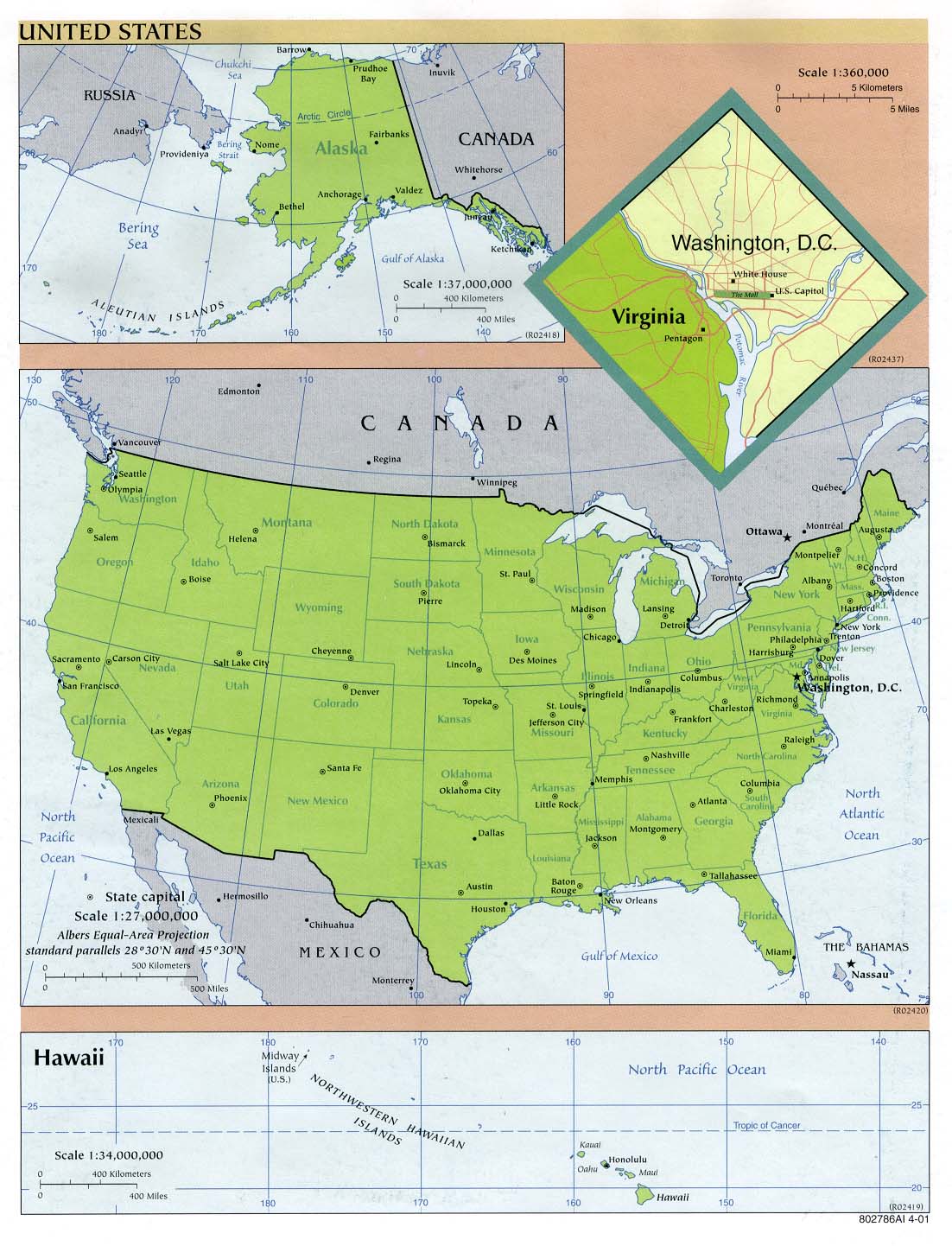
USA address format is:
town ST nnnnn-nnnn
where ST is the official USPS 2-letter state or territory abbreviation from the table below with no comma preceding it, followed by the ZIP or ZIP+4, for example:
JOHN DOE
ACME INC
123 MAIN ST NW STE 12
ANYTOWN NY  12345
in which ST, NW, STE, and NY are abbreviations recognized by USPS (for Street, Northwest, Suite, and New York, respectively). If ZIP+4 is used, the two parts of the ZIP code must be separated by a single dash (and no spaces). The state abbreviation and ZIP code should be separated by one or two spaces (depending on which recommendation you read). Examples:
OSHKOSH WI  54901                      (5-digit ZIP)
FRANKLIN SQUARE NY  11010              (5-digit ZIP)
NEW YORK NY  10025-7799                (ZIP+4)
FORT RICHARDSON AK  99505-5700         (ZIP+4)
Uppercase is used, as recommended by the USPS, for ease of automatic scanning and application of bar codes. See the USPS ZIP Code directory or other relevant publications for additional addressing recommendations such as the format of street addresses, recommended abbreviations, etc, all of which help to keep your mail from being rejected by the automatic sorters. Some useful information on USA addresses can be found at the USPS Website:
https://www.usps.com/
In cases where the street name and number might be too long
(e.g. for
a database field, or for an automatic reader), any part of this line that
denotes a sub-part of the main address (e.g. an apartment or suite number)
can or should be put on a separate line above the street name and
number:
JOHN DOE
ACME INC
STE 12
123 MAIN ST NW
ANYTOWN NY  12345
Don't spell out state names or use old-fashioned state abbreviations for
them like Ala
, Miss
, or N.Y.
. Here is the table of
states and other postal entities of the USA with their official 2-letter
abbreviations (source: USPS National ZIP Code Directory) that are recognized
by the USPS and its postal sorters:
AA Armed Forces Americas AE Armed Forces Europe AK Alaska AL Alabama AP Armed Forces Pacific AR Arkansas AS American Samoa AZ Arizona CA California CO Colorado CT Connecticut DC District of Columbia DE Delaware FL Florida FM Federated Micronesia GA Georgia GU Guam HI Hawaii IA Iowa ID Idaho IL Illinois
IN Indiana KS Kansas KY Kentucky LA Louisiana MA Massachusetts MD Maryland ME Maine MH Marshall Islands MI Michigan MN Minnesota MO Missouri MP N. Mariana Islands MS Mississippi MT Montana NC North Carolina ND North Dakota NE Nebraska NH New Hampshire NJ New Jersey NM New Mexico NV Nevada
NY New York OH Ohio OK Oklahoma OR Oregon PA Pennsylvania PR Puerto Rico PW Palau RI Rhode Island SC South Carolina SD South Dakota TN Tennessee TX Texas UT Utah VA Virginia VI US Virgin Islands VT Vermont WA Washington WI Wisconsin WV West Virginia WY Wyoming
Military addresses use APO (Army or Air Force Post Office) or FPO (Fleet
Post Office for the Navy, Marine Corps, or Coast Guard) instead of the city
name, and then the state
name is AA (for Americas), AE (for Europe),
or AP (for Pacific), e.g.:
SGT NICK FURY
HEADQUARTERS COMPANY
7TH ARMY TRAINING CENTER
ATTN: AETT-AG
UNIT 28130
APO AE  09114-8130
Or:
Mr Hiremm N Firem
CMR 333 Box 2345
APO AE 09903-0024
Most overseas military addresses are loaded into the USPS Address management system (AMS) so if you dont know the ZIP Code for a particular PSC or CMR number you can look it up on USPS look up a ZIP code:
- In the street address simply type in the CMR or PSC number and Box number;
- In the City type in APO or FPO;
- The State will be AE, AA, or AP depending on what part of the world it is in.
Mail addressed to Overseas Military members must be addressed to a specific individual. Mail addressed to “Any Service member”, “Occupant” or similar type generic name will not be processed or delivered to the address listed on the mail piece.
As of 2009, certain diplomatic sites have DPO (Diplomatic Post Office) addresses, similar to APO addresses (DPO AA, DPO AE, DPO AP, followed by Zip or, preferably, Zip+4), as in this example for the US Embassy in Rabat, Morocco:
EMBASSY
Unit 9400, Box 0201
DPO AE  09718
DPO Addresses do not use PSC or CMRs in their addressing system. Diplomatic installations that don't have DPO addresses can be mailed to in care of the US State Department in Washington DC. All others require international mail.
APO/FPO/DPO addresses can be used only from the USA or other areas served by the US Post Office, or from other APO/FPO/DPO addresses. Mail from elsewhere to these locations must be addressed through the town, city, and country in which the military or diplomatic installation is located, e.g.:
Embassy of the United States of America
2 Avenue de Mohamed El Fassi
Rabat
MOROCCO
(That is the address given by the embassy, but it should have postal code.) You can always refer to the USPS Postal Bulletin (see References below) published every two weeks to see if APO/FPO/DPO zip codes are valid and refer to the restrictions or limitations on certain articles and sizes of articles that could be prohibited.
References:
- USPS Postal Bulletin Archives.
- National ZIP Code Directory, Volumes I and II, US National
Information Data Center,
Washington DC (published annually). - STATE ABBREVIATIONS, a brief document at the USPS website sketching the history of the abbreviations used for states of the United States. The current 2-letter codes were adopted along with the Zip Code in 1963.
Links:
- US Postal Service
- USPS Postal Explorer
- USPS Pub 28 (PDF, big)
- USPS History
- USPS Domestic Addressing Tips (2019)
- USA ZIP Code Lookup
- US Military Postal Service Agency
- Free Postal Code tools for the USA (ZIPCodeSoft).
For more about automatic sorting of US mail, see the Kermit News article, Kermit Helps Automate Mail Delivery.
CANADA
[ Next ] [ Top ] [ Contents ] [ Index ] [ Home ] [ Map ] [ Google Map ]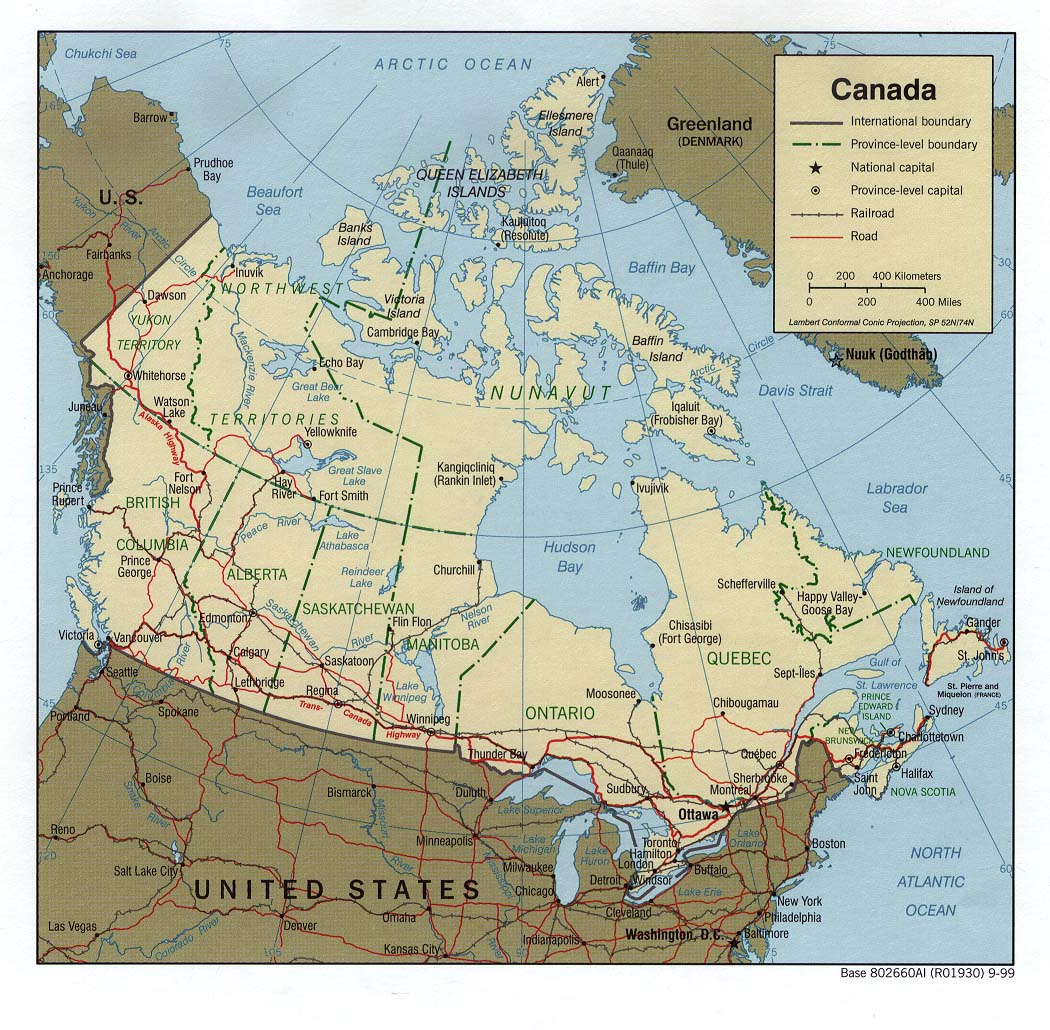
The Canada city line format is like the USA format:
town province postalcode
No commas or other punctuation*, postal code on the right separated by two spaces. Upper case is preferred but not required except in the postal code. Example:
SASKATCHEWAN WATER CORP
111 FAIRFORD STREET EAST
MOOSE JAW SK  S6H 2X1
CANADA
| * | Punctuation should not be used unless it is part of a proper name, such as in “ST. JOHN'S”. |
Canada has 2-letter abbreviations for its provinces and territories, just like we have for our states, and which do not conflict with ours:
Symbol English Name French Name Inuktitut Name AB Alberta Alberta BC British Columbia Colombie-Britannique MB Manitoba Manitoba NB New Brunswick Nouveau-Brunswick NL (3) Newfoundland and Labrador Terre-Neuve-et-Labrador NT (1) Northwest Territories Territoires du Nord-Ouest NS Nova Scotia Nouvelle-Écosse NU (1) Nunavut Nunavut ᓄᓇᕗᑦ ON Ontario Ontario PE Prince Edward Island Île-du-Prince-Édouard QC (2) Quebec Québec SK Saskatchewan Saskatchewan YT Yukon Yukon
Notes:
- On 1 April 1999, Northwest Territories split in two. The new (eastern)
half is called Nunavut and the western half is still called Northwest
Territories (not
"Bob"). Until 12
December 2000 Nunavut's province symbol was NT; after that it became NU (but
NT should still work, and in fact is still listed in many places as the
official symbol for Nunavut).
- Prior to 1991
the
symbol for Quebec was PQ.
- In December 2001, the province of Newfoundland was renamed to Newfoundland and Labrador. Effective 21 October 2002, NL is recognized as the symbol for the renamed province. The previous symbol, NF, could still be used until 21 April 2003, now only NL is accepted.
Canadian postal codes are always LNL NLN (Letter, Number, Letter, Space,
Number, Letter, Number). (In this context, Number
means
Digit
.) The first segment is the Forward Sortation Area; the second
is the Local Delivery Unit. The postal code is placed two spaces to the
right of the province/territory abbreviation. All letters in the City Line
(and preferably the entire address) should be uppercase. Examples:
CALGARY AB  T2H 1M5
MOOSE JAW SK  S6H 2X1
ST LAURENT QC  H4N 1J7
MISSISSAUGA ON  L5K 1Z8
YELLOWKNIFE NT X1A 2P7
TALOYOAK NU  X0E 1B0
NORTH POLE NT  H0H 0H0    <-- ("Ho Ho Ho")
Doug Ewell has written a report on the semantics of Canadian postal codes; CLICK HERE for details.
The city or town name must not be translated. If the official name of the municipality is French, it must be written in French including accents; if it is English, it must be written in English. Canadian postal policies emphasize equal treatment of English and French, but they do not mention other languages of Canada such as Inuktitut, Cree, Lakota, Micmac, Ojibwa, etc. I assume that locality names must be written in Roman letters and not Canadian Syllabics, although I could not find any statements to that effect at the Canada Post website. In Nunavut, the Inuit languages Inuktitut and Inuinnaqtun are official languages, along with French and English; road signs are in both Roman and Inuit Syllabics – what about mail?
By the way, it turns out that even French town names with accents are stored internally in uppercase ASCII without accents, as you can see in postcode lookup. (In February 2020, Benoît Le Nabec clarifies: "In fact, both are accepted. If you enter the city name with accents the application ‘Find a Postal Code’ will return the city name with or without accents as a choice."
Links (last checked: 22 September 2017):
- Canada Post
- Addressing Guidelines
- Postcode Lookup (Canada Post)
- Canada Postal Guide
- Canadian Postal Codes (Doug Ewell)
- Free Postal Code tools for Canada (ZIPCodeSoft).
- Nunavut: The New Territory - Basic Facts
- Inuit language finds home on net (BBC News, 3 Nov 2004).
- Unified Canadian Aboriginal Syllabics (Alan Wood)
Canadian postal humor: Canada Post doesn't really charge 32 cents for a
stamp. It's 2 cents for postage and 30 cents for storage.
(Gerald
Regan, Cabinet Minister, 31 Dec 1983 Financial Post)
THE CARIBBEAN
[ Next ] [ Top ] [ Contents ] [ Index ] [ Home ] [ Map ]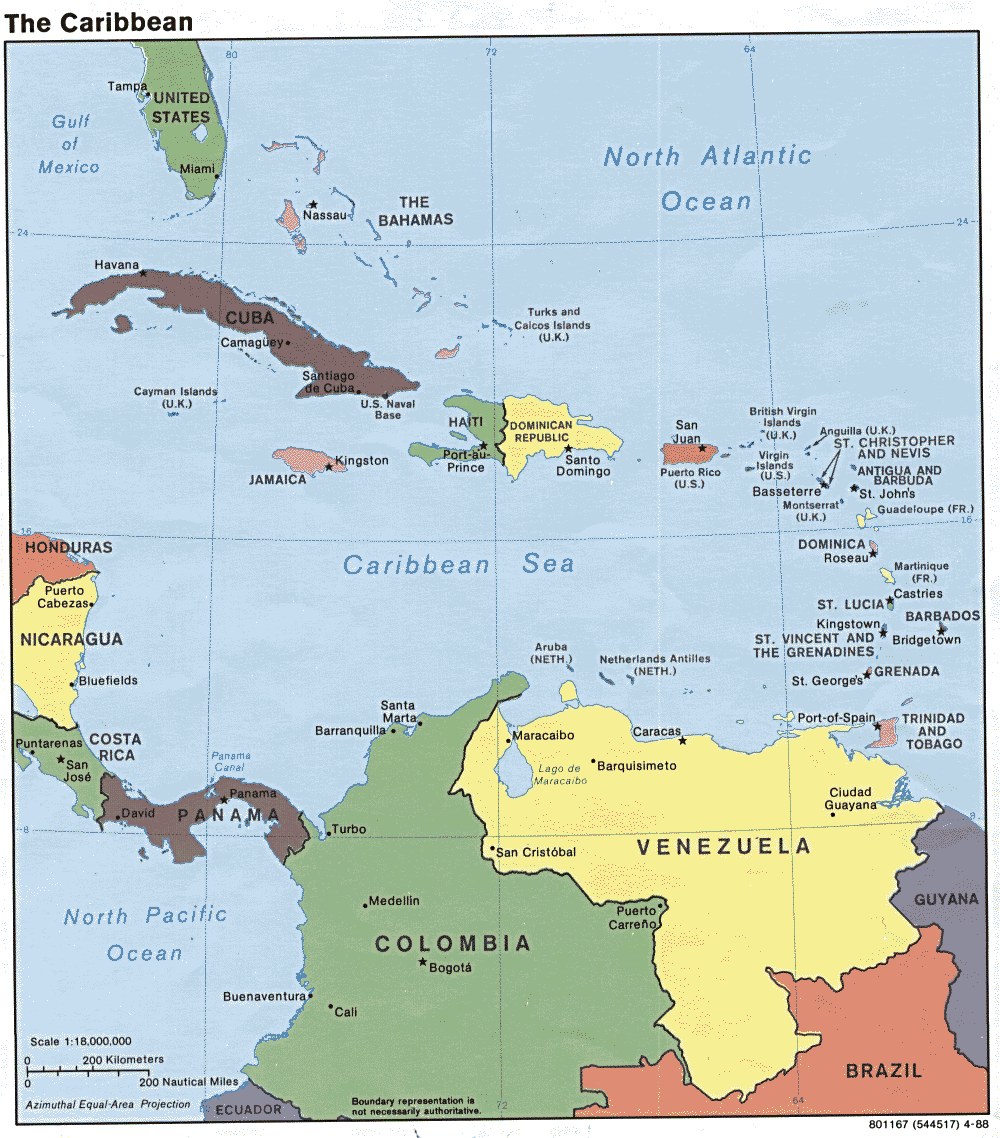
Here's a summary table of Caribbean localities showing the USPS country name (see INDEX for local, long, and other forms), ISO 3166 Alpha-2 Code, United Nations Car Code (these codes are explained in the section on Europe), postcode format (if any), and sample City line. As far as I can tell, neither ISO nor Car codes are used in Caribbean postal addresses. The right two columns are taken from the Universal Postal Union, when available (a surprising number are not). In the postcode format, n indicates a digit and L indicates an uppercase letter; italic words like town and island are to be replaced by actual town or island names. Country names link to the country's postal authority website, if known, or other relevant site, if any.
USPS Name ISO Car City Line Format City Line Example ANGUILLA AI -- town AI-2640 THE VALLEY ANTIGUA AND BARBUDA AG -- town St. John's ARUBA AW -- town Oranjestad BAHAMAS BS BS town NASSAU BARBADOS (*) BB BDS town BBnnnnn Cheapside, Bridgetown BB11000 BERMUDA (*) BM -- town LL nn Hamilton HM 12 BONAIRE (*) BQ ?? town Kralandijk BRITISH VIRGIN ISLANDS VG -- town, island, VGnnnn Road Town, Tortola, VG1110 CAYMAN ISLANDS (*) KY -- po-box
island KYn-nnnnP.O. Box 123 SAV
Grand Cayman KY1-1010CUBA (*) CU C CP nnnnn town CP 10600 CIUDAD DE LA HABANA CURACAO (*) CW ?? ??? ??? DOMINICA DM WD town ROSEAU DOMINICAN REPUBLIC (*) DO DOM nnnnn town 10902 SANTO DOMINGO GRENADA GD WG town ST. GEORGE'S GUADELOUPE (*) GP -- nnnnn town 97163 POINT À PITRE HAITI (*) HT RH HTnnnn town HT6110 PORT-AU-PRINCE (*) JAMAICA (*) JM JA town zone KINGSTON 10 MARTINIQUE (*) MQ -- nnnnn town 97246 FORT DE FRANCE MONTSERRAT MS -- town OLD TOWNE NETHERLANDS ANTILLES (*) defunct, see notes above and below PUERTO RICO PR -- Address through USA SABA BQ Address through BONAIRE (?) SAINT CROIX (*) VI -- US Virgin Islands - Address through USA SAINT EUSTATIUS BQ ?? Address through BONAIRE (?) SAINT JOHN (*) VI -- US Virgin Islands - Address through USA SAINT KITTS AND NEVIS KN -- town BASSETERRE SAINT LUCIA LC -- town CASTRIES SINT EUSTATIUS (*) BQ ?? town ORANJESTAD SINT MAARTEN (*) SX ?? town KOOLBAAI SAINT THOMAS (*) VI -- US Virgin Islands - Address through USA SAINT VINCENT AND THE GRENADINES VC -- town KINGSTOWN TORTOLA VG -- town, TORTOLA, VGnnnn .. Address through BRITISH VIRGIN ISLANDS TRINIDAD AND TOBAGO TT TT town
islandPort of Spain
TrinidadTURKS AND CAICOS ISLANDS TC -- town Providenciales VIRGIN GORDA VG -- town, VIRGIN GORDA, VGnnnn .. Address through BRITISH VIRGIN ISLANDS
Don't write ANTILLES, CARIBBEAN, LEEWARD ISLANDS, VIRGIN ISLANDS, WEST INDIES, BRITISH WEST INDIES, or BRITISH ISLANDS under the country name, despite advice to that affect that can be found elsewhere, since the USPS operates on country names, not on names of regions or areas. Notes:
- BARBADOS is installing a new postal code system,
CLICK HERE for
information. In the sample city line shown, Cheapside is a district of
Bridgetown. The address of the postal authority itself is written this way.
- BERMUDA postcode is LL LL for post offices boxes; HM AX to
HM NX (but no HM IX) in Hamilton, HB BX elsewhere. Postcode lookup has been
discontinued (2004). Sample Bermuda addresses:
56 Church Street                PO Box HM 100
Hamilton HM 12                  Hamilton HM AX
BERMUDA                         BERMUDA
Anguilla has a single postal code, AI-2640 for everybody.
See the Bermuda Yellow Pages website for a list of postcodes, as well as for the
proper way to address a letter
in Bermuda (27 June 2012). - CUBA: See section on Cuba.
- DOMINICAN REPUBLIC: A
system of five-digit postcodes covering the entire nation was announced
in July 2004 (previously only the capital had postcodes). The Distrito
Nacional has been split into two Regiones, Santo Domingo de Guzmán
(postcodes 10700–11999)
and (a smaller) Distrito Nacional (postcodes
10100–10699 ). Other regions have postcodes ranging from 21000 to 94999. Addresses in Santo Domingo and the Distrito Nacional should include the Sector (District) after the street address and before the City Line. Postcode lists for Santo Domingo are available HERE and for the rest of country HERE. A post office box isApartado Postal
. In order to choose the right postal code you have to know the zone where a given address is, and as far as I know, there is no way to look this up. - GUADELOUPE and MARTINIQUE are full-fledged departments of
France and use French postal codes and
CEDEX delivery (see section on France). Until July
2007, ST. BARTHÉLEMY and the French side of ST. MARTIN were
part of Guadeloupe. Now they are French Overseas Collectives, along with
Polynesia, Wallis & Futuna, St. Pierre & Miquelon, and Mayotte. They
will still be part of the French postal system but receive new postal
codes in July 2008. References:
[1]
[2]
[3]
[4].
- HAITI...
Mail delivery in Haiti is problematic with the massive disruption and
displacement caused by the earthquake of January 12, 2010, the cholera
epidemic, and the occupation. According to this
page, since the 2010 earthquake mail sorting is done in a big tent,
almost certainly by hand, i.e. no automation or scanning, and therefore no
finicky rules of formatting. Just write all the information needed to
locate the addressee: name, street and number if any and if known (or name
of refugee camp, etc), town, municipality, district, department, written in
French or Kreyol, followed by the country name HAITI. In the cases of
well-known towns or cities such as Port-au-Prince, Ounaminthe,
Gonaïves, or Jacmel, the municipality, district, and/or department are
not necessary. Read this
page before attempting to send anything other than a letter by post to
Haiti. Links: News from Haiti
Post (in French); Haiti Post
Facebook page.
- JAMAICA: Zone numbers are used only for Kingston. A system of
postal codes was devised some time back in which (for example)
Kingston 1 would be JMAKN05 - the JM is for Jamaica, the A is one
of the four zones (A-D) and KN is Kingston (KN05 would be
easier to remember but would look too much like a Bermuda postal code).
However, in 2007 Jamaica post announced:
"POST
CODE PROJECT SUSPENDED INDEFINITELY" (this news issue is still current
as of October 2010, so it seems to be the official despite
sites like this).
- NETHERLANDS ANTILLES no longer exists, the islands are now
independent countries, addressed separately, e.g. (note: no accents should
be used in country names, write CURACAO, not CURAÇÃO):
US Consulate General
J.B. Gorsiraweg 1               (street and number)
Willemstad                      (town)
CURACAO                         (island, i.e. name of country)
- US VIRGIN ISLANDS: Put the name of the island in the City Line,
and put the town or city in the line above that:
BUREAU OF VITAL RECORDS
VIRGIN ISLANDS DEPT OF HEALTH
CHARLOTTE AMALIE                (town)
SAINT THOMAS VI  00801          (island VI  Zip)
- CAYMAN ISLANDS has published a Postcode Addressing Guide HERE (PDF). Two spaces are required between the island name and the postcode.
LATIN AMERICA
[ Next ] [ Top ] [ Contents ] [ Index ] [ Home ] [ Map1 ] [ Map2 ]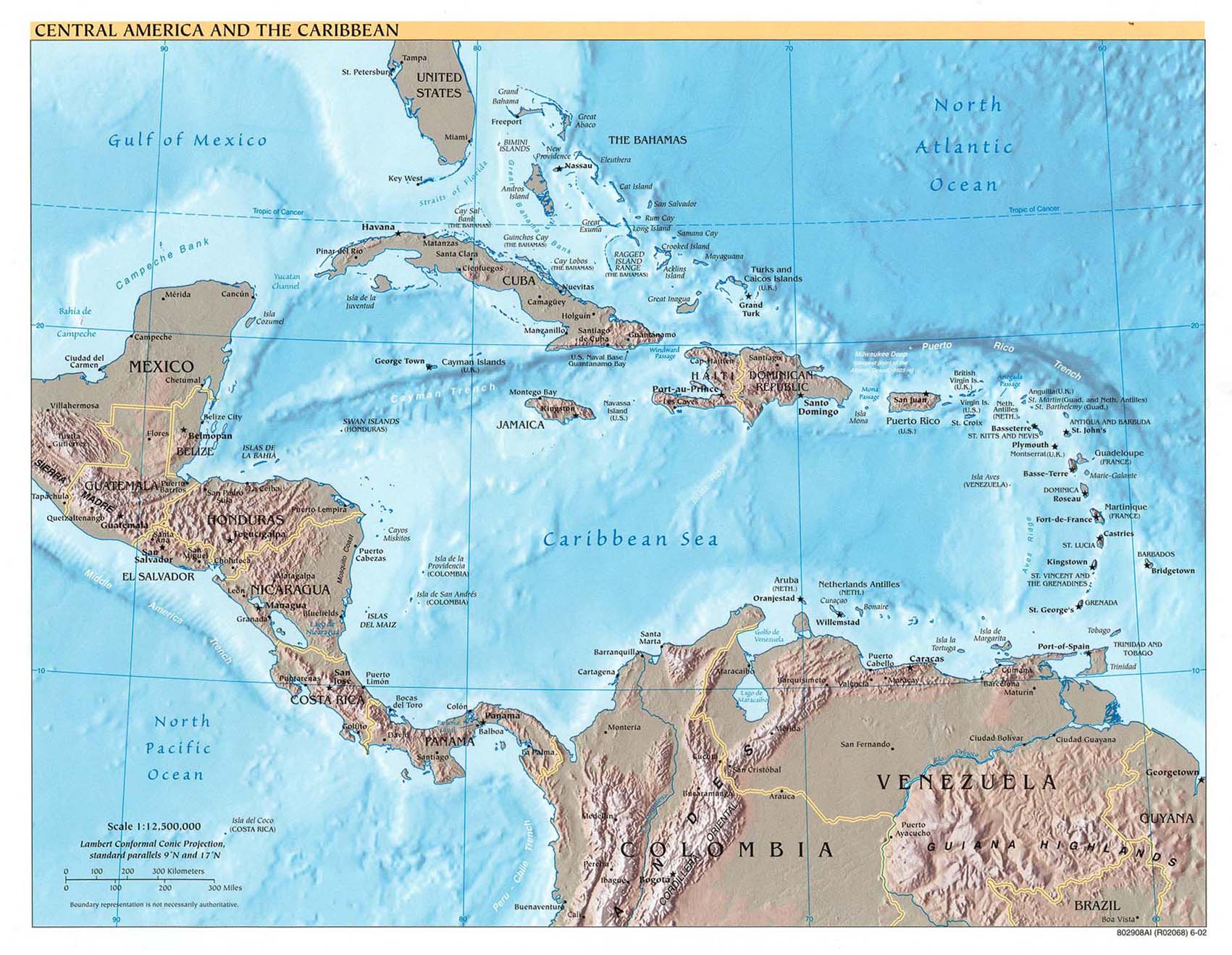
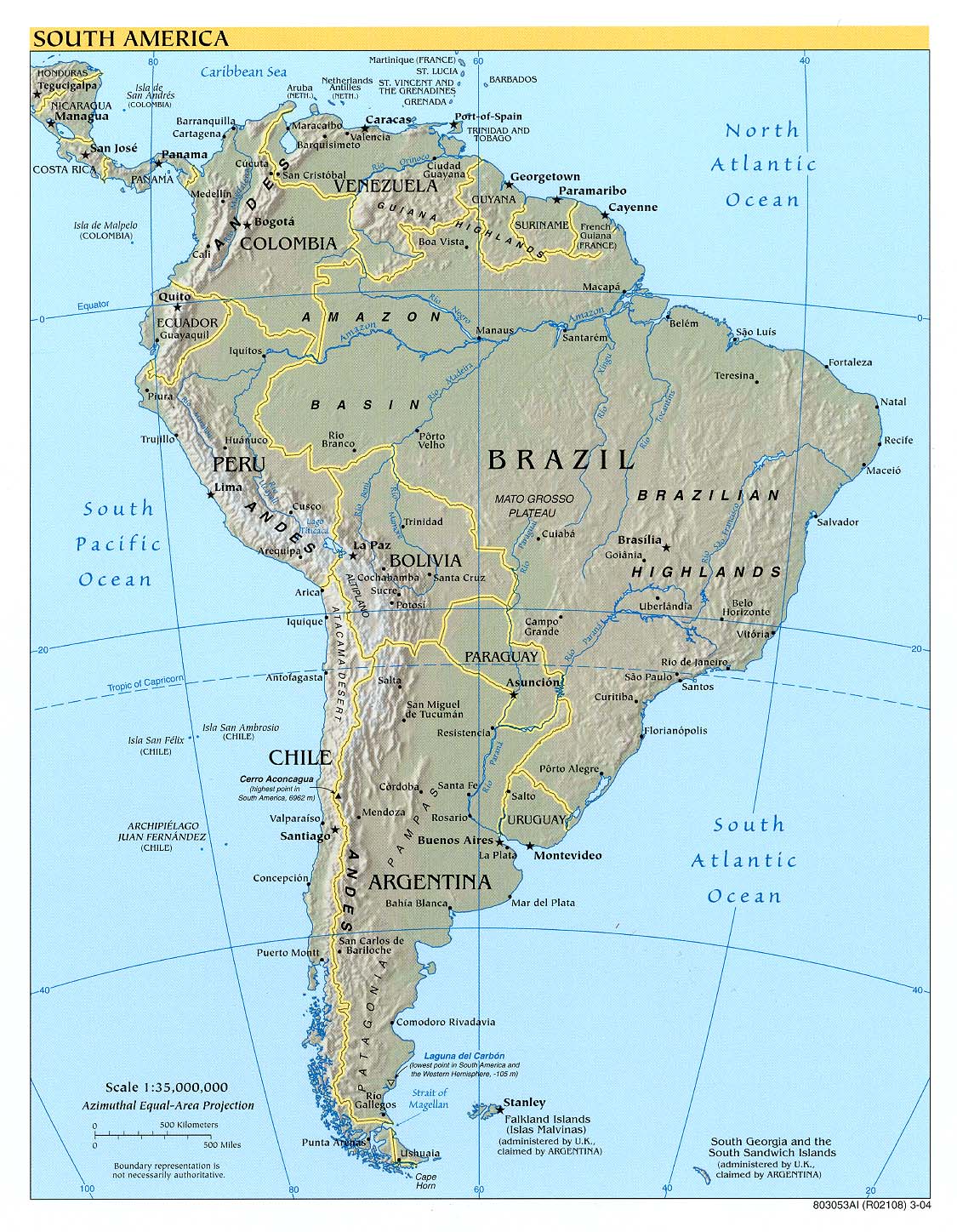
Here's a summary table of Latin American countries showing the USPS country name (see INDEX for local, long, and other forms), ISO 3166 Alpha-2 Code, United Nations Car Code (these codes are explained in the section on Europe), postcode format (if any), and sample City line. As far as I can tell, neither ISO nor Car codes are used in Latin American postal addresses. The right two columns are taken from the Universal Postal Union except where I had better information. In the postcode format, n indicates a digit and L indicates an uppercase letter; italic words like town and district are to be replaced by actual town or district names. Non-italic letters, spaces, and hyphens are to be taken literally (such as CP, which stands for Código Postal, Postal Code). Country names link to the country's postal authority website, if known, or other relevant site.
USPS Name ISO Car City Line Format City Line Example ARGENTINA AR RA LnnnnLLL town S3000ADQ SANTA FE BELIZE BZ BH town BELIZE CITY BOLIVIA BO BOL town COCHABAMBA BRAZIL BR BR nnnnn-nnn town-LL 40301-110 SALVADOR-BA CHILE CL RCH nnnnnnn town 6500709 SANTIAGO COLOMBIA CO CO town BOGOTÁ COSTA RICA* CR CR nnnnn town 10104 SAN JOSÉ CUBA CU C CP nnnnn town CP 10600 CIUDAD DE LA HABANA DOMINICAN REPUBLIC DO DOM nnnnn town 10902 SANTO DOMINGO ECUADOR EC EC LnnnnL
townP0133B
QUITOEL SALVADOR SV ES CP nnnnn district
townCP 01120 MEJICANOS
SAN SALVADORFRENCH GUIANA GF -- nnnnn town 97300 CAYENNE GUATEMALA GT GCA nnnnn-town 09001-QUETZALTENANGO GUYANA GY GUY town GEORGETOWN HAITI HT RH nnnn town 6110 PORT-AU-PRINCE HONDURAS HN -- nnnnn town 11101 TEGUCIGALPA DC MEXICO MX MEX nnnnn town, LL 02860 MÉXICO, DF NICARAGUA NI NIC nnnnn
town43000
GRANADAPANAMA PA PA town PANAMÁ PARAGUAY PY PY nnnn town 1209 ASUNCION PERU PE PE town LIMA 39 PUERTO RICO PR -- (Address through USA) SURINAME SR SME town PARAMARIBO URUGUAY UY ROU nnnnn
town11000
MONTEVIDEOVENEZUELA VE YV town nnnn state CARACAS 1010 DISTRITO CAPITAL
* 23 December 2021: John Franco-Arboine points out that the Zip Codes of Costa Rica were designed based on province, canton, and district. All districts in Costa Rica correspond to a single zip code and that the system can be extended from 5 digits to 9 digits by subdividing each district into sectors and areas:
https://correos.go.cr/codigo-postal/
https://en.wikipedia.org/wiki/Postal_codes_in_Costa_Rica
https://es.wikipedia.org/wiki/Anexo:C%C3%B3digos_postales_de_Costa_Rica
Buscar códigos postales en Latinoamérica y NorteaméricaEn la Internet suele pasar que, al comprar en algún website como Amazon.com te piden un "Zip code" o código postal, y en muchos de los países la gente no conoce lo suyo porque no se usa en los correos en la vida real. Sin embargo, hay que ponerlo en los formularios del Web. Aquí se busca.
Ésta es nueva sección del documento, todavía le falta mucho trabajo y averiguaciones. Al alcanzarme el tiempo voy a mejorarla, buscando nuevos enlaces para los países "desaparecidos" o sin enlaces. Mientras tanto si tienes mayor información favor de mandármela, gracias. 2011 / 03 / 01
|
Detailed sections on México, Brazil, Cuba, and Colombia follow this section.
When addressing mail to a Latin American country, don't write SOUTH AMERICA or CENTRAL AMERICA under the country name.
Venezuelan city lines include the city name, then the 4-digit postal code, then either ESTADO followed by the state name or else DISTRITO CAPITAL (formerly DISTRITO FEDERAL) for Caracas. The postcode might have a letter suffix:
CORO 4101-A ESTADO FALCÓN
You can address French Guiana through France; it's part of the French postcode and delivery system. You should also be able to address it directly too, thus avoiding the double ocean crossing.
Note that Ecuador, Nicaragua, and Uruguay (according to the UPU) write the postal code on its own line. As always, postcodes are in flux. The examples above (current as of January 2003) are contrasted with examples from our own database from just a few years prior:
Bahia Blanca 8000   ARGENTINA
Santiago 9          CHILE
Bogota              COLOMBIA
Nival 4             GUATEMALA
Asuncion 2968       PARAGUAY
Montevideo 11000    URUGUAY
The postal system of Costa Rica is notoriously quirky. A system of
postcodes is being instituted in two steps, beginning in 2007. A video
(narrated in Spanish) is available on the Correos de Costa Rica website
explaining the steps. The first is 5 digit postal code (código
postal) in which the first digit is the province (provincia), the second and
third denote the county
(cantón), and the last two the
district (distrito) within the cantón. Then, since few Costa Rican
streets have names and houses do not tend to have house numbers; a second
step will create numeric codes for streets and addresses covering the whole
country.
Links:
- Costa Rica Postcode List
- Costa Rica Postcode Lookup
- Costa Rica, where the streets literally have no names
- When Getting Directions, It Helps To Know Where the Fig Tree Was
- With Costa Rica's mail, it's address unknown
- La Unión Postal de las Américas, España y Portugal
- Carribean Postal Union
MÉXICO
[ Next ] [ Top ] [ Contents ] [ Index ] [ Home ] [ Map ]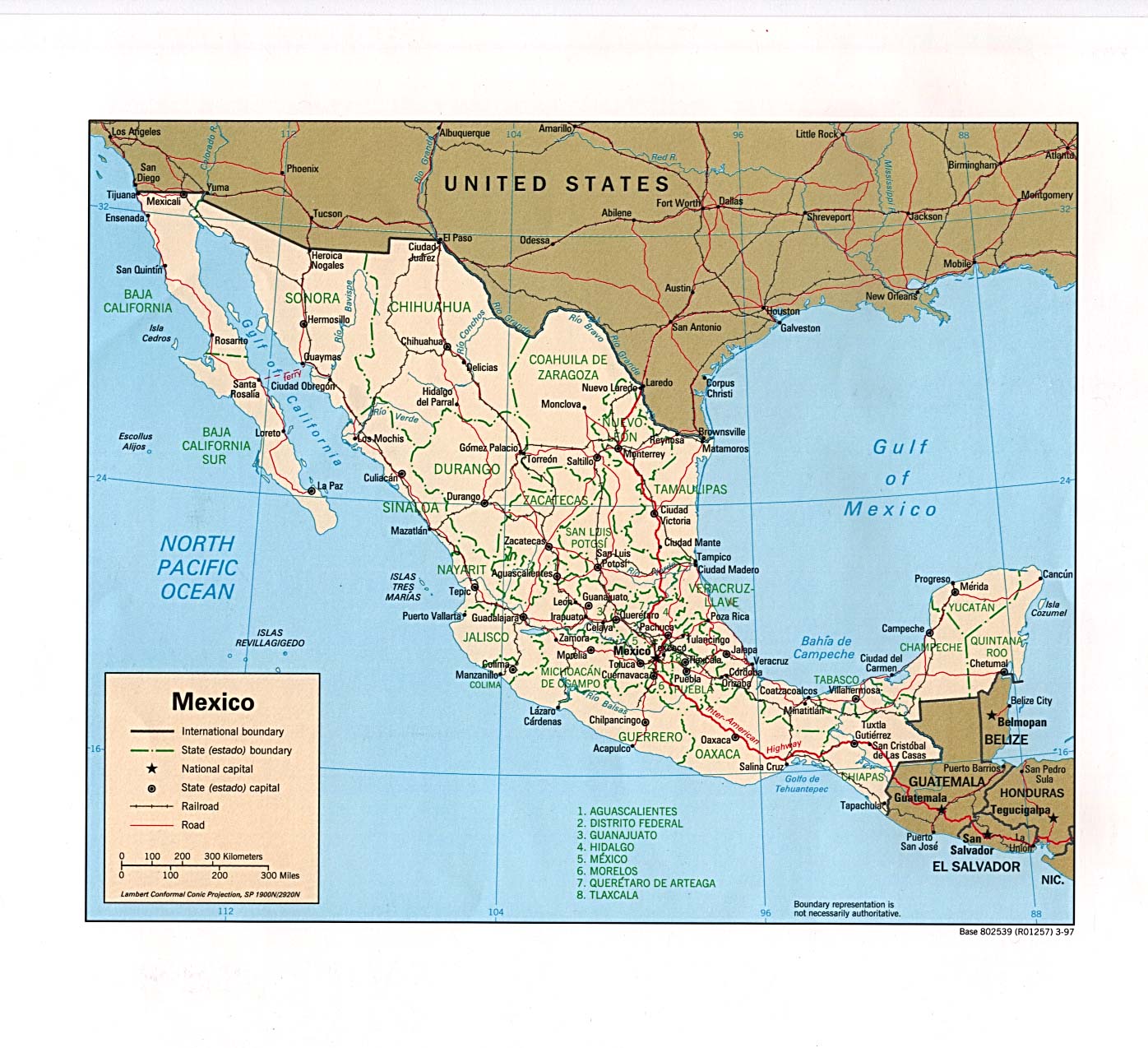
For purposes of addressing mail from within the USA, the name of the country is MEXICO. In Spanish, the 'e' has an acute accent: México. In Spain and parts of Latin America, some people prefer the more phonetic spelling, "Méjico" (just as in the USA, some Texans might prefer to write "Tejas").
México has states (estados) like Jalisco, Sonora, etc, which are included in the address. The state for México City is DF (Distrito Federal = Federal District), similar to Washington DC in the USA or Canberra ACT in Australia. DF is divided into Delegaciones including México City, San Jerónimo, etc.
Postal codes are 5 digits. Examples:
03100 Ciudad de México, DF
10200 San Jerónimo, DF
62000 Cuernavaca, MOR
85100 Ciudad Obregon, SON
Here are the states of México and their abbreviations (source: Wikipedia 22 May 2019):
Name Conventional 2-letter 3-letter Aguascalientes Ags. MX - AG MX-AGU Baja California B.C. MX - BC MX-BCN Baja California Sur B.C.S. MX - BS MX-BCS Campeche Camp. MX - CM MX-CAM Chiapas Chis. MX - CS MX-CHP Chihuahua Chih. MX - CH MX-CHH Coahuila Coah. MX - CO MX-COA Colima Col. MX - CL MX-COL Durango Dgo. MX - DG MX-DUR Guanajuato Gto. MX - GT MX-GUA Guerrero Gro. MX - GR MX-GRO Hidalgo Hgo. MX - HG MX-HID Jalisco Jal. MX - JA MX-JAL Mexico City CDMX MX - DF MX-CMX México Edomex. or Méx. MX - EM MX-MEX Michoacán Mich. MX - MI MX-MIC Morelos Mor. MX - MO MX-MOR Nayarit Nay. MX - NA MX-NAY Nuevo León N.L. MX - NL MX-NLE Oaxaca Oax. MX - OA MX-OAX Puebla Pue. MX - PU MX-PUE Querétaro Qro. MX - QT MX-QUE Quintana Roo Q. Roo. or Q.R. MX - QR MX-ROO San Luis Potosí S.L.P. MX - SL MX-SLP Sinaloa Sin. MX - SI MX-SIN Sonora Son. MX - SO MX-SON Tabasco Tab. MX - TB MX-TAB Tamaulipas Tamps. MX - TM MX-TAM Tlaxcala Tlax. MX - TL MX-TLA Veracruz Ver. MX - VE MX-VER Yucatán Yuc. MX - YU MX-YUC Zacatecas Zac. MX - ZA MX-ZAC
"México" is the state of Mexico (as opposed to the country or the city). The two-letter codes are not official, but are widely recognized and used. The three-letter code is specified in ISO 3166-2:MX. I suspect that "MX" is not really part of the code, but in any case the only official guidance I can find for Mexican Postal addresses (May 2019), which is:
Manual de Asignación de Códigos Postales y Estandarización de Domicilios Postales, Correos de México, Diciembre 2016shows state names written out in full in its addressing examples, e.g.:
Daniel González Ortiz Apartado Postal Administración Calvillo A44 20801 Calvillo, Aguascalientes MEXICO
The 5-digit postal code goes on the left, then the town or city, a comma,
and the state abbreviation. In large cities, I am told it is important to
put Colonia
for District (when known) in Mexican addresses, for
example:
Facultad Latinoamericana de Ciencias Sociales
Carretera Al Ajusco Km.13, Colonia Héroes de Padierna
Apartado 20-021, Delegación Alvaro Obregón
01000 Ciudad de México, DF
MEXICO
Some terms and abbreviations included in Mexican addresses are listed in the table below. Of states, municipalities, and their subdivisions there is not a strict hierarchy; for example, a municipio may contain several cities, or a city may contain several municipios (similar to how New York City contains several counties).
Estado State Municipio Municipality (major subdivision of estado, similar to a county) Ciudad, Cd. City Colonia, Col. Neighborhood of city Localidad City or town within a municipio Población A populated place (city, town, or village) Delegación Administrative subdivision of a city, like a borough Asentamiento Subdivision of a municipio Apartado (Apartado Postal, Apartado de Correos, Casilla Postal) Post office box Calle Street CP Código Postal (postal code)
Links:
Mexpost: México Postal Service correosdemexico.com.mx Manual de Asignación de Códigos Postales y Estandarización de Domicilios Postales Correos de México, Diciembre 2016 Postcode lookup Try this Google search
BRAZIL
[ Next ] [ Top ] [ Contents ] [ Index ] [ Home ] [ Map ]
Brazilian addresses have states (estados) and a 5+3-digit postal code (CEP, Código de Endereçamento Postal) that goes on the left. The state goes on the right, separated by a dash. There should be no other punctuation. Example:
20071-003 Rio de Janeiro-RJ
If a postal code has only 5 digits (like our own ZIP without the plus
4
), add -000
to the end:
04103-000 São Paulo-SP
The state for Brasilia is DF (Distrito Federal), like Washington DC, e.g.:
70084-970 Brasilia-DF
Always use the exact spacing and punctuation shown above – no periods,
commas, etc. Never include CEP
in the address; it just means
postal code
. For example, if you have an address like:
Rio de Janeiro, RJ CEP 20071-003
it should be written as:
20071-003 Rio de Janeiro-RJ
The states of Brazil and their official abbreviations are:
AC Acre AL Alagoas AP Amapá AM Amazonas BA Bahía CE Ceará DF Distrito Federal ES Espirito Santo GO Goiás
MA Maranhão MT Mato Grosso MS Mato Grosso do Sul MG Minas Geraís PR Paraná PB Paraíba PA Pará PE Pernambuco PI Piauí
RN Rio Grande do Norte RS Rio Grande do Sul RJ Rio de Janeiro RO Rondônia RR Roraima SC Santa Catarina SE Sergipe SP São Paulo TO Tocantins
Noticed in July 2007: Brazil seems to have joined the countries that are putting the postal code as the bottom line, as you can see if you look at the current version of Formas de Endereçamento (link just below), although it seems the format described here is still accepted. Examples of the two formats (from the Brazil post website):
I suspect the first ("old") format is better for sending mail to Brazil from the USA, because USPS expects the see the city line just above the country name.
Links:
Correios Brasil Brazil Post http://www.correios.com.br/ Consulta de CEP Postcode Lookup http://www.correios.com.br/servicos/cep/default.cfm Formas de Endereçamento Addressing Guidelines http://www.correios.com.br/servicos/cep/cep_formas.cfm
CUBA
[ Next ] [ Top ] [ Contents ] [ Index ] [ Home ] [ Map ]
Monday, September 16, 2013, Reuters: The United States and Cuba sit down on Monday in Havana for a second round of talks on re-establishing direct mail services between the two countries after a 50-year ban.
Direct mail service between the USA and Cuba has been suspended since 1963. Mail addressed to Cuba from the USA or vice versa is routed through third countries such as Mexico and can take weeks to arrive. Starting in 2009 there have been preliminary meetings on re-establishing a direct postal link.Mail other than first-class mail (letters) from the USA to Cuba is restricted by US law: parcels, gifts, materials of any kind; only certain things are allowed, as described in this USPS web page. Similarly, letters and postcards from Cuba will be delivered, packages probably not. Commercial package services such as Fedex and UPS do not deliver to Cuba.
Direct mail service between the USA and Cuba was reinstated March 16, 2016, by President Obama (see article). But (at least as of October 20, 2020) there are many restrictions (see USPS page).
Cuban addresses are written like this:
Sr. Héctor García Marizá
Reina #35, apt. 4a, e/ Gervasio y Escobar
Ciudad de La Habana, CP 11900
CUBA
where:
Reina #35 = street and number
apt. 4a   = apartment number
e/        = between streets Gervasio and Escobar
CP        = Código Postal (postal code)
After this line may be the Reparto (zone) and Municipio; that is, minor divisions, for example:
Sr. Jorge Pérez Rodríguez
Calle Martí #24, apt. 4a., e/ Corombé y 26 de Julio
Rpto. Abel Santamaría, Aguacate
Palma Soriano, Santiago de Cuba, CP 22222
CUBA
that is:
Person
street / number, apartment, between streets
Reparto, Pueblo
Municipio, Provincia, Postal Code
CUBA
"esq." (esquina, corner) can be used instead of
e/
(between) when the house is on the corner, for example:
Calle Martí #24, apt. 4a., esq. Corombé
In practice the CP is rarely used and mail, if otherwise properly addressed, can be delivered without it.
The divisions of Cuba are:
Provincia → Municipio → Ciudad or Pueblo → Reparto or Barrio or Communidad
A reparto or barrio is a division of a city or town, whereas a communidad is an isolated zone ("oasis de casas dentro del campo desierto") outside of the town but which falls within its jurisdiction; for example in the municipio of Nuevitas is the town Playa Santa Lucía, and some 3km distant is the communidad Palmas de Lucía (meanwhile capital city of the municipio of Nuevitas is the ciudad of Nuevitas).
Note that the general scheme does not apply to Ciudad de La Habana, which is a Provincia. There are many Municipios without Ciudad or Pueblo; for example, Ciudad de La Habana has these general options:
Ciudad de La Habana → Municipio → Pueblo → Reparto or Barrio
Ciudad de La Habana → Municipio → Reparto or Barrio
And for Municipio Especial Isla de la Juventud, the scheme is:
Municipio Especial Isla de la Juventud → Ciudad o Pueblo → Reparto o Barrio
The Provincias, with their recommended abbreviations, are:
PR Pinar del Río CA Ciego de Ávila CH Ciudad de La Habana CG Camagüey HA La Habana LT (Victoria de) Las Tunas MT Matanzas HO Holguín VC Villa Clara GR Granma (Bayamo) CF Cienfuegos SC Santiago de Cuba SS Sancti Spíritus GT Guantánamo IJ Municipio Especial Isla de la Juventud
Municipio Especial Isla de la Juventud is a special municipio; that is, not a provincia, but treated as a provincia.
Links:
- Cuba Government Website
- Correos de Cuba
- Comunicaciones postales
- Country Conditions for Mailing - Cuba (USPS)
COLOMBIA
[ Next ] [ Top ] [ Contents ] [ Index ] [ Home ] [ Map ](This section by Felipe Zapata Roldán, 11 December 2005) In Colombia, the postal code system has not been implemented yet, but there's a plan to do it in the near future (postal codes exist but they are not used). A standard mailing address (residential, commercial, or industrial) looks like this:
NAME COMPANY DEPARTMENT/DIVISION (May contain the building and office number) STREET ADDRESS CITY, DEPARTMENT (Department = state, optional) COLOMBIA
The format of the street address is:
STREET ###L $ ###-###, extra info
In which STREET field may be CALLE, CARRERA, AVENIDA, CIRCULAR, TRANSVERSAL; # of course are numerical digits (in groups of two or three); $ may be written '#' or 'No' and it stands for número and means crossing, usually, a CALLE crosses a CARRERA and vice versa. Which goes first depends on which face of the block the location is in; extra info may be the building name or number, apartment, block, story, level, etc.
Example:
Felipe Zapata Roldán
Universidad Nacional de Colombia, Sede Medellín
Escuela de Física
CALLE 59A 63 - 120
Medellín, Antioquia
COLOMBIA
Important: In Colombia, for natural persons, we use both father's last name and mother's maiden name... it's better if you know them... still, if you don't, there's no problem.
There's also a special kind of address, the Colombian P.O. Box, or Apartado Aéreo or A.A., meaning something like 'airmail post office box'; here's an example:
A.A. 3840 Medellin
COLOMBIA
No name, no company, no nothing.... that's all optional. All that is needed is a number up to 5 digits and the name of the city. Any citizen or company may open an A.A., and just like in many countries they have to pay a maintenance fee.
Links:
AUSTRALIA
[ Next ] [ Top ] [ Contents ] [ Index ] [ Home ] [ Map ]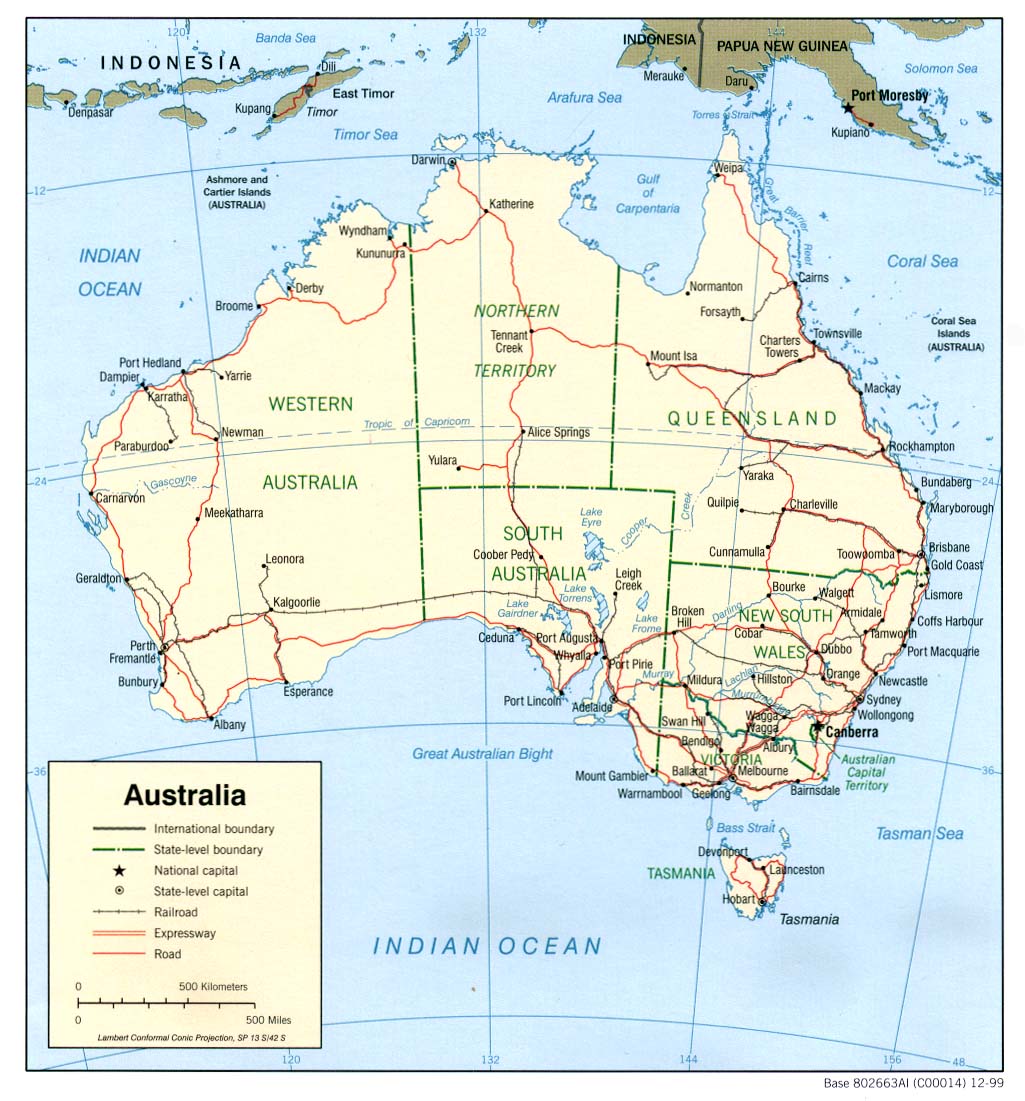
Australia uses the same address format as the USA and Canada. It has 4-digit numeric postal codes and the following states, always abbreviated in caps as follows:
Abbrev Full Name Postboxes and
Large UsersStreet Addresses ACT Australian Capital Territory 0200-0299 2600-2639 NSW New South Wales 1000-1999 2000-2599, 2620-2914 NT Northern Territory 0900-0999 0800-0899 QLD Queensland 9000-9999 4000-4999 SA South Australia 5800-5999 5000-5799 TAS Tasmania 7800-7999 7000-7499 VIC Victoria 8000-8999 3000-3999 WA Western Australia 6800-6999 6000-6799
NSW includes Norfolk Island; WA includes Christmas and Cocos (Keeling) Island. ACT includes the Jervis Bay Territory, which shares the 2540 postcode with surrounding areas in NSW, but is addressed as "JERVIS BAY ACT 2540"*.
Write Australian city lines as follows:
town state postal-code
Use all uppercase letters, no punctuation, put two spaces before and after the state abbreviation. Examples:
CANBERRA  ACT  2614    AUSTRALIA
SYDNEY  NSW  2000      AUSTRALIA
(Doug Moncur reports in 2012, "However some of your information for the ACT in Australia is wrong. Australia Post doesn't really believe Canberra exists so while a lot of suburbs have 26xx codes, some have 29xx codes. This used to be limited to Tuggeranong but they've started allocating 29xx codes to new outer north suburbs as well, eg Crace - see this site for a list.... And PO Boxes can be PO Box or LPO Box - LPO being a Local Post Office. Most times PO Box will do just fine, but here on campus they recommend LPO if you have a private box to make it clear you want to pick your mail up from the post office in the Student's Union building...")
Within Western Australia lies a small area calling itself the Hutt River
Province Principality, which seceded from Western Australia and the
Commonwealth of Australia in 1970 over a wheat-quota dispute. Whatever its
legal and international standing, it has no listing in the USPS
International Mail Manual, so mail from the USA to that area must be
addressed via Northampton WA 6535
in Australia. For further info,
search the Web for Hutt River
.
Links:
- Australia Post
- Australia Addressing Guidelines
- Australia Postcode Lookup
- Address Presentation Standards (PDF)
| * |
Thanks to Andrew Donnellan for this item, who also notes:
"It is a popular belief that the JBT is in fact part of the ACT; this is not
true, although Jervis Bay was transferred to the federal government for the
purposes of servicing the national capital, ACT law applies in the JBT, JBT
residents are enrolled to vote in an ACT electoral division, and the ACT
Government operates various governmental functions in the JBT, they are
legally separate territories under separate administration.)
"It is also worth noting that the special large volume postcodes are being phased out - for example, the Australian National University lost its 0200 postcode in the last few years. I don't have more information on exactly what Australia Post's policy on withdrawing these postcodes is however." |
NEW ZEALAND
[ Next ] [ Top ] [ Contents ] [ Index ] [ Home ] [ Map ]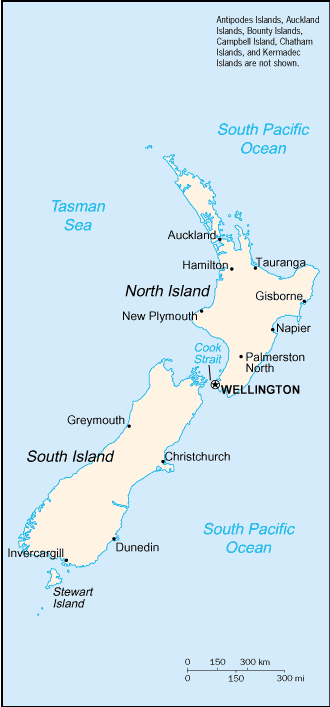
New Zealand, like Australia, uses 4-digit postal codes but until recently they have been relatively optional, used mainly for presorting bulk mail. New Zealand Post didn't even show them in their own contact addresses:
Customer Service Centre
New Zealand Post
Private Box 39100
Wellington Mail Service Centre
Wellington
NEW ZEALAND
All this has changed. As noted on the New Zealand Post website:
The current postcode system has become outdated for mail sorting. The development of new suburbs, more apartment living and overall population growth has seen a 25% increase in delivery points in the last ten years. Added to this are a number of issues that present problems for efficient and accurate mail sorting and delivery. ... New postcodes will resolve these problems by creating a unique address for every delivery point in New Zealand Post's delivery network. ... The new postcodes will entirely replace the existing postcode system. All postcodes currently in use will be replaced. ... The postcode is [now] mandatory for all addresses.
The change took effect in June 2006. The old postcodes are invalid. The
hard cutover
took place in June 2008.
must be used on bulk mail and the postcode can be omitted from regular mail.
The new postcodes are now required on all mail. Examples
showing the new and old postcodes:
Upper and lower case may be used in all parts of the address, but for the benefit of USPS, the name of the country, NEW ZEALAND, must be written in all uppercase. The former NZ Post requirement for lots of space between the town name and postal code has been dropped, one or two spaces are now sufficient.
A reader, Paul, points out (in 2018) that New Zealand does not have states or provinces, so if a Web or paper form requires you to enter one you can use a "region"; these are listed in Wikipedia; for example:
A 2012 map of New Zealand regions can be found here (as of July 2018):1 Castle Street Dunedin 9016 Otago NEW ZEALAND
https://koordinates.com/layer/4240-nz-regional-councils-2012-yearly-pattern/
References (all good as of 21 July 2018):
- New Zealand Post
- How to Address Mail
- Addressing Standards and Guidelines
- Postcode Directory
- Postcode Finder
EUROPE
[ Next ] [ Top ] [ Contents ] [ Index ] [ Home ] [ Map ]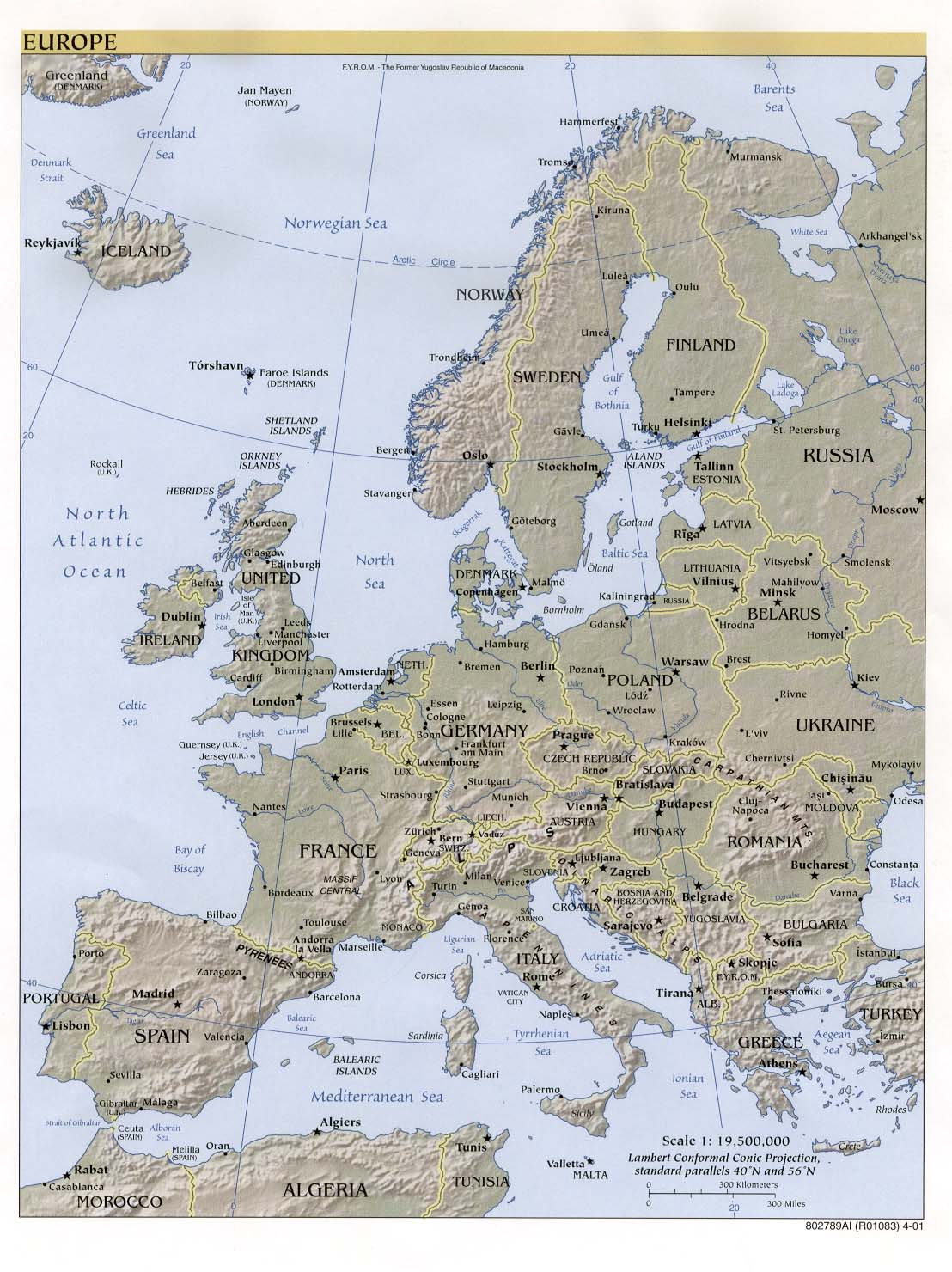
(The UK and Ireland have their own sections towards the end of this document.)
Europe
is an imprecise term, especially as it relates to which countries
are part of it and which are not. Geographical, political, and cultural
definitions tend to disagree. Furthermore, countries such as Spain, France,
Denmark, and the Netherlands that are indisputably European might include
parts that are elsewhere. CLICK HERE for a discussion.
All European countries except Ireland have postal codes. They are almost always written on the left-hand side of the City line, before the name of the town or city. The format of the postcode itself varies from country to country: number of digits, grouping, and in a few cases an alphabetic part.
After World War II and up until the mid-1990s, all European postcodes
included country-code prefixes. These were originally United Nations car
codes
(one, two, or three letters), kept in an annex, Car (Or Road)
Distinguishing Signs
, to the 1949/68 United Nations Conventions on Road
Traffic, adopted in part by the European Conference of Postal and
Telecommunications Administrations (CEPT). These codes were not accepted by
the Universal Postal Union as a world standard, but were widely used anyway.
Beginning in 1994, car codes were supposed to be replaced by ISO 3166 Alpha-2 codes, but it seems this was not done to any great extent outside of Scandinavia. Thus for some decades (say 1970-1994) a letter to Sweden would have a City and Country line like the following (note: two spaces recommended after the postcode):
S-126 25  Stockholm
SWEDEN
Then in 1995 this became:
SE-126 25  Stockholm
SWEDEN
More recently in most European countries, the recommendation is to omit the country prefix for internal mail, but to use it for international mail. Many countries (not all) also recommend all uppercase letters for better automatic sorting results:
126 25  STOCKHOLM
SWEDEN
The situation is definitely confusing with postal standards, guidelines, and examples in flux and in conflict. The Universal Postal Union recommends that the ISO Alpha-2 Country Code be used for international mail, and that the country code prefix be omitted on domestic mail (e.g. within Italy), but of course the local standards of each country prevail, and to confound matters, Alpha-2 codes can change or (worse) be recycled; for example, Czechoslovakia was CS but when it split into the Czech and Slovak Republics in 1993 the codes became became CZ and SK, respectively; then in 2003 Serbia and Montenegro, which had inherited YU from Yugoslovia, had its code changed to CS (Crna Gora i Srbja), and then in 2006 Serbia and Montenegro split and received the codes RS and ME, respectively.
Postal addresses that appear in printed matter, databases, and on the Web can be found in all three formats. CEN (see Links at the end of this section) recommends in Annex C of EN 14142-1:2003 (a standard for addresses) that cross-border mail should be prefixed by the ISO 3166-1 Alpha-2 code where the postcode precedes the locality in the destination country.
Thus, depending on whose guidelines you read, the CEPT country code should be used, or the ISO code should be used, or there should be no country code at all. For example, the local standard of Germany might say something like "Under no circumstances should a country code such as D or DE be prefixed to the postcode", but the standard in (say) Switzerland for sending mail to Germany might call for a D or DE prefix. In any case, the prefixes should do no harm except perhaps to cause the mail piece to be rejected by automatic sorters in the source country, the destination country, or both, in which case they are handled manually. As far as I can tell, the USPS doesn't care about them.
Here's a summary table of European countries showing the USPS country name (see INDEX for local, long, and other forms), ISO 3166 Alpha-2 Code, United Nations Car Code, postcode format, and sample City line. The country-code prefix is omitted, as in the UPU examples, except where the UPU states explicitly that it should be used. In the postcode format, n indicates a digit and L indicates an uppercase letter; italic words like town and district are to be replaced actual town or district names. Non-italic letters, spaces, and hyphens are to be taken literally. Country names link to the country's postal authority website, if known, or other relevant site.
USPS Name ISO Car City Line Format City Line Example ALAND ISLAND (*) FI AX AX-nnnnn town AX-22111 MARIEHAMN ALBANIA AL AL nnnn town 1001-TIRANE ANDORRA AD AND ADnnn town AD500 ANDORRA LA VELLA AUSTRIA AT A nnnn town 1010 WIEN BELARUS BY BY See The Former Soviet Union BELGIUM BE B nnnn town 4000 LIEGE BOSNIA-HERZEGOVINA BA BIH See The Former Yugoslavia BOSNIA / REPUBLIKA SRPSKA BA BIH See The Former Yugoslavia BULGARIA BG BG nnnn town 1000 SOFIA CROATIA HR HR See The Former Yugoslavia CYPRUS (*) CY CY nnnn town 1900 NICOSIA CZECH REPUBLIC CZ CZ See The Former Czechoslovakia DENMARK DK DK nnnn town 1566 COPENHAGEN V ESTONIA EE EST See The Former Soviet Union FAROE ISLANDS (*) FO FO nnn town 100 TÓRSHAVN FINLAND (*) FI FIN nnnnn town 00550 HELSINKI FRANCE (*) FR F nnnnn town 34092 MONTPELLIER GERMANY DE D nnnnn town 35035 MARBURG GREECE GR GR nnn nn town 101 88 ATHENS HUNGARY (*) HU H town
street-address
nnnnBUDAPEST
Virág Tér 3. IV.61
1540ICELAND IS IS nnn town 110 REYKJAVÍK ITALY IT I nnnnn town (LL) 00144 ROMA (RM) LATVIA (*) LV LV See The Former Soviet Union LIECHTENSTEIN (*) LI FL nnnn town 9486 SCHAANWALD LITHUANIA LT LT See The Former Soviet Union LUXEMBOURG LU L nnnn town 2998 LUXEMBOURG MALTA (*) MT M town LLL nnnn ZEJTUN ZTN 1000 MOLDOVA MD MD See The Former Soviet Union MONACO (*) MC MC nnnnn town 98000 MONACO MONTENEGRO (*) ME ?? See The Former Yugoslavia NETHERLANDS NL NL nnnn LL town 1098 SJ AMSTERDAM NORTH MACEDONIA (*) MK MK nnnn town 1000 SKOPJE NORWAY NO N nnnn town 0107 OSLO POLAND PL PL nn-nnn town 00-940 WARSZAWA PORTUGAL PT P nnnn-nnn town 1250-096 LISBOA ROMANIA RO RO nnnnnn town 050000 BUCARESTI RUSSIA RU RUS See The Former Soviet Union SAN MARINO SM RSM nnnnn town 47899 FIORINA SERBIA (*) RS ?? See The Former Yugoslavia SLOVAK REPUBLIC SK SK See The Former Czechoslovakia SLOVENIA (*) SI SLO See The Former Yugoslavia SPAIN (*) ES E nnnnn town 28070 MADRID SPITSBERGEN SJ Address through NORWAY SWEDEN SE S nnn nn town 105 00 STOCKHOLM SWITZERLAND CH CH nnnn town 8037 ZÜRICH UKRAINE UA UA town
nnnnnKIEV
01055VATICAN CITY (*) VA V nnnnn town 00120 CITTÀ DEL VATICANO
When addressing mail to a European country, don't write EUROPE under or next to the country name.
- ALAND ISLAND (ÅLAND, AALAND; (from Ken Westmoreland): “Although
the Åland Islands (an autonomous Swedish-speaking province of Finland)
remain part of the Finnish postcode system, they use the prefix 'AX' instead
of 'FIN', eg:
AX-22111 MARIEHAMN
The Islands originally sought incorporation into Sweden, but the League of Nations decided to uphold Finland's territorial integrity. However, as part of Finland the Islands have far more autonomy than they would have had as part of Sweden, including having their own postal service since 1984. Note that in Swedish, an official language in the rest of Finland, the country is known as Republiken Finland. (Easier to guess than 'Suomen Tasavalta').
USPS IMM Issue 29, July 2003, Updated With Postal Bulletin Revisions Through March 4, 2004, lists ALAND ISLAND as a valid country-name for postal delivery; I do not recall seeing it previously (prior to May 2004, the advice given here was to address through Finland, which probably still works, as I expect that mail addressed to ALAND ISLAND from the USA goes to Finland anyway). The UPU says (07/2003)it is necessary to add the code 'AX' before the postcode
, as in the example. - CYPRUS: Southern part only (the Republic of Cypress). Mail to (the
Turkish Republic of) Northern Cyprus must be addressed to
Mersin 10, TURKEY
, Mersin being the neighbouring Turkish province, with the10
implying that Cyprus is its tenth county. Southern Cyprus can be addressed directly, e.g.CY-1900 Nicosia, CYPRUS
. Note that routing mail to Northern Cyprus through Turkey works, but might be controversial. If I find evidence of a noncontroversial way to address mail to Northern Cyprus that works in all cases, I will list it here (the problem is that The Turkish Republic of Northern Cyprus is not recognized by any country other than Turkey itself). - FAROE
ISLANDS / Faeroe
Islands / Føroya postcodes are three digits and separate
from those of Denmark, of which it is (officially!) part, hence
"FO-100 Tórshavn". In more detail (as Ken Westmoreland points out):
"Originally, the Faroe Islands were part of the Danish postcode system, using
the number range 3800 to 3899, as they came under the Danish post office,
and the prefix 'DK' was used, before it was later changed to 'FR'
following their government's takeover of postal services in 1976. About
1987, the present three-digit system was adopted, with 'FR' being changed
to 'FO', in line with its ISO 3166 code."
-
GREENLAND, once part
of the Danish postcode system with postcodes DK-39xx, e.g.
DK-3900 Godthåb, is now a "constituent country in the Kingdom of
Denmark" with its own official language (Greenlandic rather than Danish),
its own ISO 3166 country code (GL), and its own postcodes
and town names (GL-3900 Nuuk).
- About FINLAND, from Topi Linkala:
The reason to use FIN- instead of FI- [as a country-code prefix for the postcode] is that items posted outside Europe and North America tend to go to Fiji Island instead to Finland when FI is used. The post of Fiji Island forwards misrouted mail to Finland in excess of hundreds of kilos each day and this becomes very costly
(REFERENCE). (Later – July 2004 – Era Eriksson points out that this same page now says to use FI.) - FRANCE: The French postcode system includes many areas outside France
proper, including Monaco, Corsica, Guadeloupe, Martinique, Saint Pierre and
Miquelon, Reunion, French Guiana, Mayotte. All of these are country names
recognized by the USPS, but mail to Corsica should be addressed to France
with the correct postcode, e.g.
20000 AJACCIO
. Mayotte is the island in the Comoros that voted to stay French when the others voted for independence, but the UN supports the Comoros' claim to the island. New (Feb 2026): Jacqueline Mohen suggested I add the French postal codes and the French address format page at Smarty.com:www.smarty.com/articles/la-poste
to the Europe section.
- HUNGARY's postcode tables can be downloaded from https://www.posta.hu/static/internet/download/Iranyitoszam_Internet.xls, which changes often. The new URL (2024) for the postal codes spreadsheet is https://www.posta.hu/static/internet/download/Iranyitoszam-Internet_uj.xlsx . The web lookup form https://www.posta.hu/szolgaltatasok/iranyitoszam-kereso seems to be working again, and links to the spreadsheet.
—Zsbán Ambrus, 3 January 2024.- LATVIA and ÅLAND are the only European destinations currently listed by the UPU where a country prefix is always required.
- LIECHTENSTEIN mail is handled by Swiss Post.
- MALTA postodes for the island of Gozo are LLL nnn.
- MONACO shares the French postcode system.
- SPAIN controls five places of sovereignty (plazas de soberania) on or near the coast of Morocco – the coastal enclaves of Ceuta and Melilla, which Morocco contests, as well as the islands of Peñon de Alhucemas, Peñon de Velez de la Gomera, and las Islas Chafarinas. Mail from the USA to Peñon de Alhucemas can be addressed to ALHUCEMAS. For Gibraltar, see the UK section. Spain also owns a town, Llívia, that is located inside France (more HERE).
- The island of SPITSBERGEN is part of Norway that has its own ISO 3166-2 country designation, SJ (for SVALBARD AND JAN MAYEN; Svalbard, by the way, is the site of the Global Seed Vault). There is also Bouvet Island (BV), but it's just a rock, and it is highly unlikely that anyone will ever live there.
- VATICAN CITY and SAN MARINO use the Italian postcode system.
- HUNGARY's postcode tables can be downloaded from https://www.posta.hu/static/internet/download/Iranyitoszam_Internet.xls, which changes often. The new URL (2024) for the postal codes spreadsheet is https://www.posta.hu/static/internet/download/Iranyitoszam-Internet_uj.xlsx . The web lookup form https://www.posta.hu/szolgaltatasok/iranyitoszam-kereso seems to be working again, and links to the spreadsheet.
Links:
- Universal Postal Union (UPU)
- Comité Européen de Normalisation (CEN)
- Post-Europ: Association of European Public Postal Operators
- ISO 3166 Alpha-2 Country Codes
- UN CEPT Codes (Distinguishing Signs)
- IETF Top Level Domains
- Controle d'addresses (French address construction)
- Uniserv-Online Software Demonstration (postcode lookup for many countries)
- Albania Postcodes (list)
- Belgium Postcodes (lookup)
- Czech Republic postcodes (lookup)
- Faroese Postcodes (dropdown)
- France Postcodes (lookup)
- Germany Postcodes (lookup)
- Hungary Postcodes (download a spreadsheet)
- Iceland Postcodes (lookup)
- Italy Postcodes (lookup)
- Netherlands Postcodes (lookup)
- Norway Postcodes (lookup)
- North Macedonia Postcodes (list)
- Poland Postcodes (lookup)
- Portugal Postcodes (lookup) (or follow link from Ferramentas (tools) page)
- Romania Postcodes (lookup)
- Slovakia Postcodes (list)
- Slovenia Postcodes (lookup)
- Spain Postcodes (lookup)
- Sweden Postcodes (Lookup on main
page; click
Sök postnummer & adress
) - Switzerland / Liechtenstein Town and Postcode Lookup
ITALY
[ Next ] [ Top ] [ Contents ] [ Index ] [ Home ] [ Map ] [ Google Map ]
The Italian postal code system is called CAP (Codice di Avviamento
Postale, Post Delivery Code). Italian postal codes have a prefix of
I-
(or IT-
, or none at all, depending on where the mail
originates) followed by five digits. The UPU advises leaving off the
country prefix for internal mail and using the ISO Alpha-2 form ("IT") for
mail to Italy, but the Car Code I
is often seen. In practice,
sometimes I
is written in lowercase to avoid confusion with the digit
1
, but I don't know whether or how this affects automatic scanning.
Italy is divided into 20 Regioni (regions) listed in the following table, which shows the region name in Italian (and German or French where applicable), then in English (if different), then an unofficial abbreviation (from the Gwillim Law book) for the region name used in the subsequent provincia table (updated 13 March 2021 from Comuni e città.it):
Abruzzo Abruzzi AB Barletta-Andria-Trani BT Basilicata BC Calabria CI Campania CM Carbonia-Iglesias CI Emilia-Romagna ER Friuli-Venezia Giulia FB Lazio LZ Liguria LG Lombardia Lombardy LM Marche MH
Molise ML Piemonte Piedmont PM Puglia Apulia PU Sardegna Sardinia SD Sicilia Sicily SC Toscana Tuscany TC Trentino-Alto Adige / Trentino-Südtirol TT Umbria UM Valle d'Aosta / Vallée d'Aoste Valle d'Aosta VD Veneto VN
The regione is not used in the postal address, but the provincia is included as the 2-letter abbreviation of the province's capital. Thus in the following address:
GE Fanuc Automation Italia S.r.l
Largo Brugnatelli - Angolo Via Volta
IT-20090 BUCCINASCO (MI)
ITALY
the town of Buccinasco is in the provincia of Milano; the regione of Lombardia is not included in the address.
The provincia abbreviation is called sigla automobilistica
(automobile acronym), and is composed of the first letter of the name of the
province's capital town, plus a second letter from the name. (The only
exception is KR
for Crotone: that is because when the Crotone
province was established, all the possible regular combinations where
already used: CR=Cremona, CO=Como, CT=Catania, CN=Cuneo, CE=Caserta. So, the
acronym was based on the ancient Greek name of the town: Kroton
.)
These acronyms are called sigle automobilistiche because, up to a few
years ago, each province had its own registry of vehicles, and the car
registration plates had this two-letter province abbreviation preceding the
actual number. (This had the side effect that stranger
cars could be
immediately identified when traveling in other parts of Italy. As a
consequence, Italian drivers always had to be very well informed about
soccer matches, as it was not advisable to park a car with a Turin
registration plate in Rome the day after Torino F.C defeated A.S. Roma...)
Guido Camilla adds, "By the way in the past was not advisable to park a car
with a 'Turin' registration plate in Rome the day after Juventus F.C
defeated A.S Roma... or was not advisable to park a car with a 'Milano'
registration plate in Torino close to the stadium the day of Juventus-Milan
or Juventus-Inter match."
Traditionally, the 2-letter provincia abbreviation was given in parentheses after the city, e.g.:
IT-00144 Roma (RM)
IT-57023 Cecina (LI)
IT-50016 S. Domenico di Fiesole (FI)
IT-20041 Agrate Brianza (MI)
IT-38014 Gardolo (TN)
IT-20064 Gorgonzola (MI)
IT-20010 San Pietro All'Olmo (MI)
Italian Post now recommends the parentheses be omitted for the sake of automatic scanning and sorting (but the parenthesized form is still widely used):
I-00144 Roma RM
I-57023 Cecina LI
I-50016 S. Domenico di Fiesole FI
I-20041 Agrate Brianza MI
I-38014 Gardolo TN
I-20064 Gorgonzola MI
I-20010 San Pietro All'Olmo MI
Strictly speaking, the provincia abbreviation is redundant, since it is also embodied in the postal code, which has three fields:
- Digits 1 and 2 identify the province, shown in the table below.
- Digit 3: switches interpretation of the following two digits.
- If digit 3 is odd, digits 3 to 5 identify the area within the province's
capital town.
xxx00?
is the generic code for the whole town, used when you don't know the road's code (the delivery becomes manual and thus possibly slower); thexxx00
code is commonly used, especially by mailing software, which generally only have a database for towns but not a database for roads. - If digit 3 is even, digits 3 to 5 identify the town within the province;
in rural areas, two or more neighboring small towns can share the same code.
Also in this case,
xxx00
is the generic code for the whole province, used when you didn't know the town's code.
Here's a table of provincia, in which the first column is the provincia name, second the provincia abbreviation, third the first two digits of the CAP, and fourth the regione abbreviation keyed to the previous table.
Agrigento AG 92 SC Alessandria AL 15 PM Ancona AN 60 MH Aosta / Aoste AO 11 VD Arezzo AR 52 TC Ascoli Piceno AP 63 MH Asti AT 14 PM Avellino AV 83 CM Bari BA 70 PU Belluno BL 32 VN Benevento BN 82 CM Bergamo BG 24 LM Biella BI 13 PM Bologna BO 40 ER Bolzano / Bolzen BZ 39 TT Brescia BS 25 LM Brindisi BR 72 PU Cagliari CA 09 SD Caltanisetta CL 93 SC Campobasso CB 86 ML Caserta CE 81 CM Catania CT 95 SC Catanzaro CZ 88 CI Chieti CH 66 AB Como CO 22 LM Cosenza CS 87 CI Cremona CR 26 LM Crotone KR 88 CI Cuneo CN 12 PM Enna EN 94 SC Ferrara FE 44 ER Firenze FI 50 TC Foggia FG 71 PU Forlì FO 47 ER Frosinone FR 03 LZ
Genova GE 16 LG Gorizia GO 34 FV Grosseto GR 58 TC Imperia IM 18 LG Isernia IS 86 ML L'Aquila AQ 67 AB La Spezia SP 19 LG Latina LT 04 LZ Lecce LE 73 PU Lecco LC 22 LM Livorno LI 57 TC Lodi LO 20 LM Lucca LU 55 TC Macerata MC 62 MH Mantova MN 46 LM Massa-Carrara MS 54 TC Matera MT 75 BC Messina ME 98 SC Milano MI 20 LM Modena MO 41 ER Napoli NA 80 CM Novara NO 28 PM Nuoro NU 08 SD Oristano OR 09 SD Padova PD 35 VN Palermo PA 90 SC Parma PR 43 ER Pavia PV 27 LM Perugia PG 06 UM Pesaro-Urbino PS 61 MH Pescara PE 65 AB Piacenza PC 29 ER Pisa PI 56 TC Pistoia PT 51 TC Pordenone PN 33 FB
Potenza PZ 85 BC Prato PO 50 TC Ragusa RG 97 SC Ravenna RA 48 ER Reggio di Calabria RC 89 CI Reggio nell'Emilia RE 42 ER Rieti RI 02 LZ Rimini RN 47 ER Roma RM 00 LZ Rovigo RO 45 VN Salerno SA 84 CM Sassari SS 07 SD Savona SV 17 LG Siena SI 53 TC Siracusa SR 96 SC Sondrio SO 23 LM Taranto TA 74 PU Teramo TE 64 AB Terni TR 05 UM Torino TO 10 PM Trapani TP 91 SC Trento TN 38 TT Treviso TV 31 VN Trieste TS 34 FV Udine UD 33 FV Varese VA 21 LM Venezia VE 30 VN Verbania VB 28 PM Vercelli VC 13 PM Verona VR 37 VN Vibo Valentia VV 88 CI Vicenza VI 36 VN Viterbo VT 01 LZ
Here is a UPU example of an Italian address, in which the CAP lacks a country prefix (as required for internal mail and perhaps for mail from certain countries but definitely not for others):
By the way, Italy surrounds at least two other small countries: Vatican City and San Marino, which are properly treated by the USPS as separate countries – VATICAN CITY and SAN MARINO – and by some accounts also a third, the Sovrano Militare Ordine Ospedaliero di San Giovanni di Gerusalemme di Rodi e di Malta, or Sovereign Military Order of Malta (SMOM), consisting of a single building on a Roman street, the Palace of Malta in the Via dei Condotti 68 (you're probably better off using the Roman street address).Sig. Mario Rossi Viale Europa, 22 00144 ROMA RM ITALY
Not only are countries to be found inside Italy, but a piece of Italy can be found inside another country: Campione d'Italia in Switzerland on Lake Lugano. It chose to stay part of Lombardy, and hence Italy, when Ticino became a Swiss Canton in 1798. It uses the Swiss postcode CH-6911 (as well as Italian CAP 22060), the Swiss telephone code +41 91, and has Italian police driving in Swiss-registered automobiles. But it's Italy. (Also see the section on Germany, another country with a piece inside Switzerland.) BUT... (update from Ken Westmoreland in June 2022): "Another change affecting mail between Switzerland and Italy has been Campione d'Italia, the Italian enclave in Ticino, becoming part of the EU Customs Territory, dubbed 'reverse Brexit', which has led to the cancellation of the Swiss postcode CH-6911. From now on, it's I-22061 and nothing else. The cars have had to have their Swiss plates replaced, and get fitted out with Italian ones with the EU flag on them - reverse Brexit again."
Links:
- Poste Italiane
- Come scrivere l'indirizzo (addessing instructions)
- I Codici di Avviamento Postale Italiani (postcode lookup)
- CAP database (ZIP)
- Table of all 20 regioni and autonomous provinces of Italy
- Unione Province d'Italia - news and information about the provinces of Italy
- SMOM - The Sovereign Military order Of Malta
- Enclaves of the World (warning, this site tends to move; for a brief summary of the topic CLICK HERE).
- Enclaves and Exclaves.
NETHERLANDS
[ Next ] [ Top ] [ Contents ] [ Index ] [ Home ] [ Map ] [ Google Map ]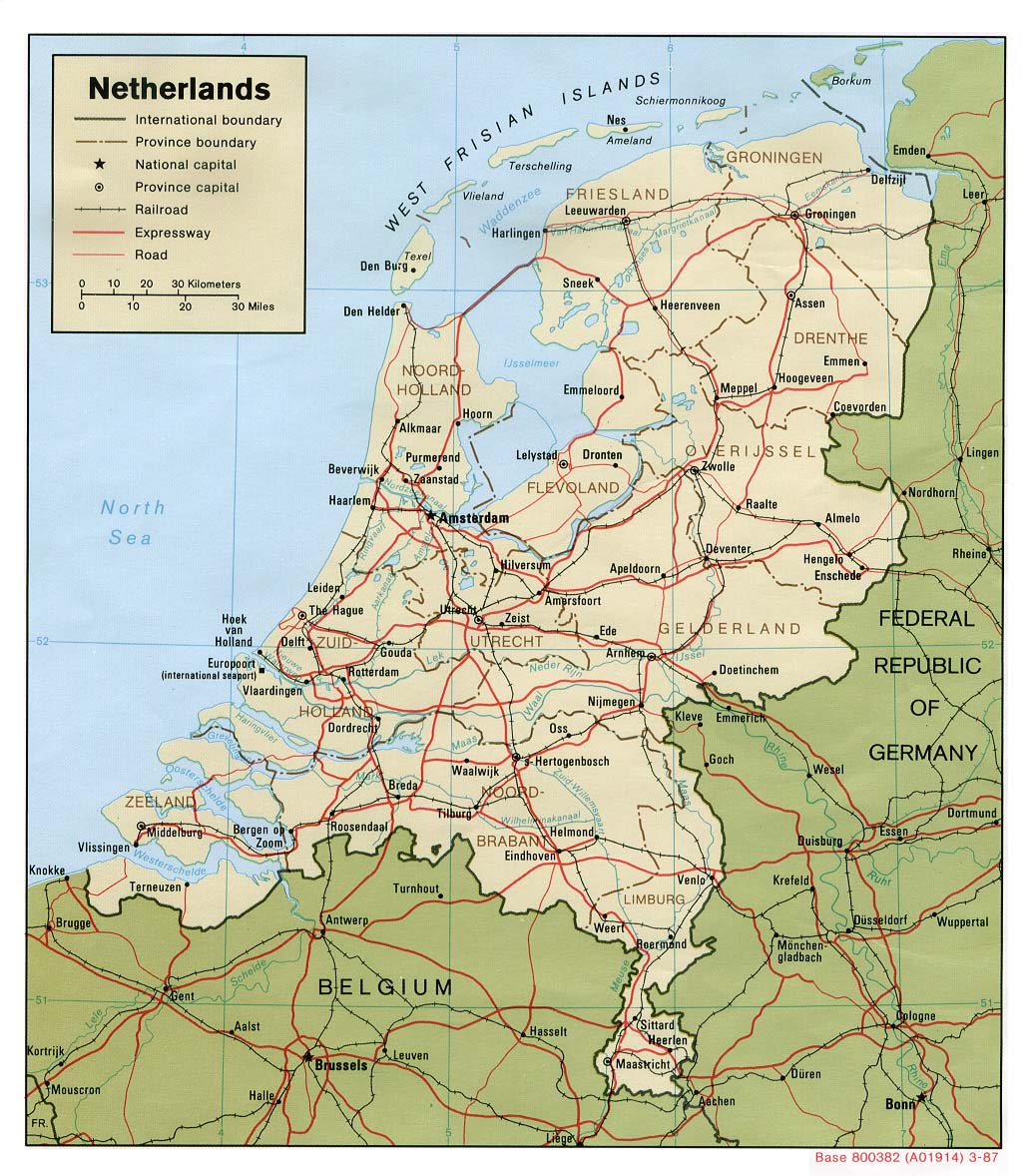
In the NETHERLANDS, a 2-letter delivery code follows the numeric part of the
postal code – this is not a state/province abbreviation, just an
indication of a subzone
within the area indicated by the number.
The four-digit number never begins with 0;
The subzone letters 'F', 'I', 'O', 'Q', 'U' and 'Y' were originally not
used for technical reasons, but almost all existing combinations are now
used as these letters were allowed for new locations starting 2005,
except (because of their associations with the German
occupation during World War II) the combinations SA, SD, and SS.
At some point the postcode-city line was formalized as
postcode (e.g. 3000 DR), two spaces, and then the city name.
In the following, Postbus means PO Box. Don't refer to the Netherlands as Holland. Holland is only one part of the Netherlands. The language spoken in the Netherlands is Nederlands, "Dutch" in English. This is commonly believed to result from English speakers not knowing the difference between the Netherlands and Germany, whose language is Deutsch, but according to the Oxford English Dictionary it comes from the Middle Dutch word "dutsch" that covered both German and Dutch*.3514 BN Utrecht 3563 AW Utrecht 6500 HB Nijmegen 1098 SJ Amsterdam 3000 DR Rotterdam
The provinces of the Netherlands are generally not used in postal addresses, but in case it's ever of any use, here is the list, also showing some well-known towns. There are no standard abbreviations, but this list follows the modern trend of keeping them all the same length:
English Dutch Abbr Towns Drenthe Drenthe DR Flevoland Flevoland FL Friesland (Frisia) Friesland (Fryslân) FR Gelderland Gelderland GE Apeldoorn, Arnhem, Nijmegen Groningen Groningen GR Lemburg Limburg LI North Brabant Noord-Brabant NB Eindhoven, Breda North Holland Noord-Holland NH Amsterdam, Haarlem Overijssel Overijssel OV South Holland Zuid-Holland ZH Rotterdam, Leiden, Dordrecht, the Hague Utrecht Utrecht UT Utrecht Zeeland Zeeland ZE
To address a specific person and or department within an organization, add it below the company name:
t.a.v. means "Ter Attentie Van", equivalent to English "ATTN:". You can also use t.n.v. (Te Name Van) or omit it altogether when it's clear enough you're addressing a person.Company X Finance department t.a.v. Mr. Money Street 684 3000 DR Rotterdam NETHERLANDS
Links (verified 9 Nov 2015):
Netherlands Post http://www.postnl.nl/ Postcode lookup http://www.postnl.nl/zoeken/
Diversion:
- CLICK HERE to read about Dutch enclaves in Belgium, and Belgian enclaves in the Netherlands, Dutch enclaves inside Belgian enclaves, etc etc.
| * | Reinier Olislagers says (Feb 2012): “Dutch actually means Dutch as well as German; it used to be the term Dutch/Low German speaking people used to identify themselves. The term would be 'Diets' in Dutch – but this is virtually unknown – and 'Deutsch' in German. See http://www.etymonline.com/index.php?search=Dutch. Our national anthem has a line on the Prince of Orange (the guy leading the rebellion against the enemy of the time, Spain) being 'van Duitschen/Dietsen bloed' (spelling varies) (of '***' blood) which a lot of Dutch people think means German, but I think it can actually mean Dutch, German or.. both/either, nation states being a recent invention...” For a somewhat different perspective on the topic, see this page: https://www.iamexpat.de/lifestyle/lifestyle-news/deutsch-or-dutch-common-misconceptions-meanings-and-origins (thanks to Jan Kamphorst for the link, January 2021). |
GERMANY
[ Next ] [ Top ] [ Contents ] [ Index ] [ Home ] [ Map ] [ Google Map ]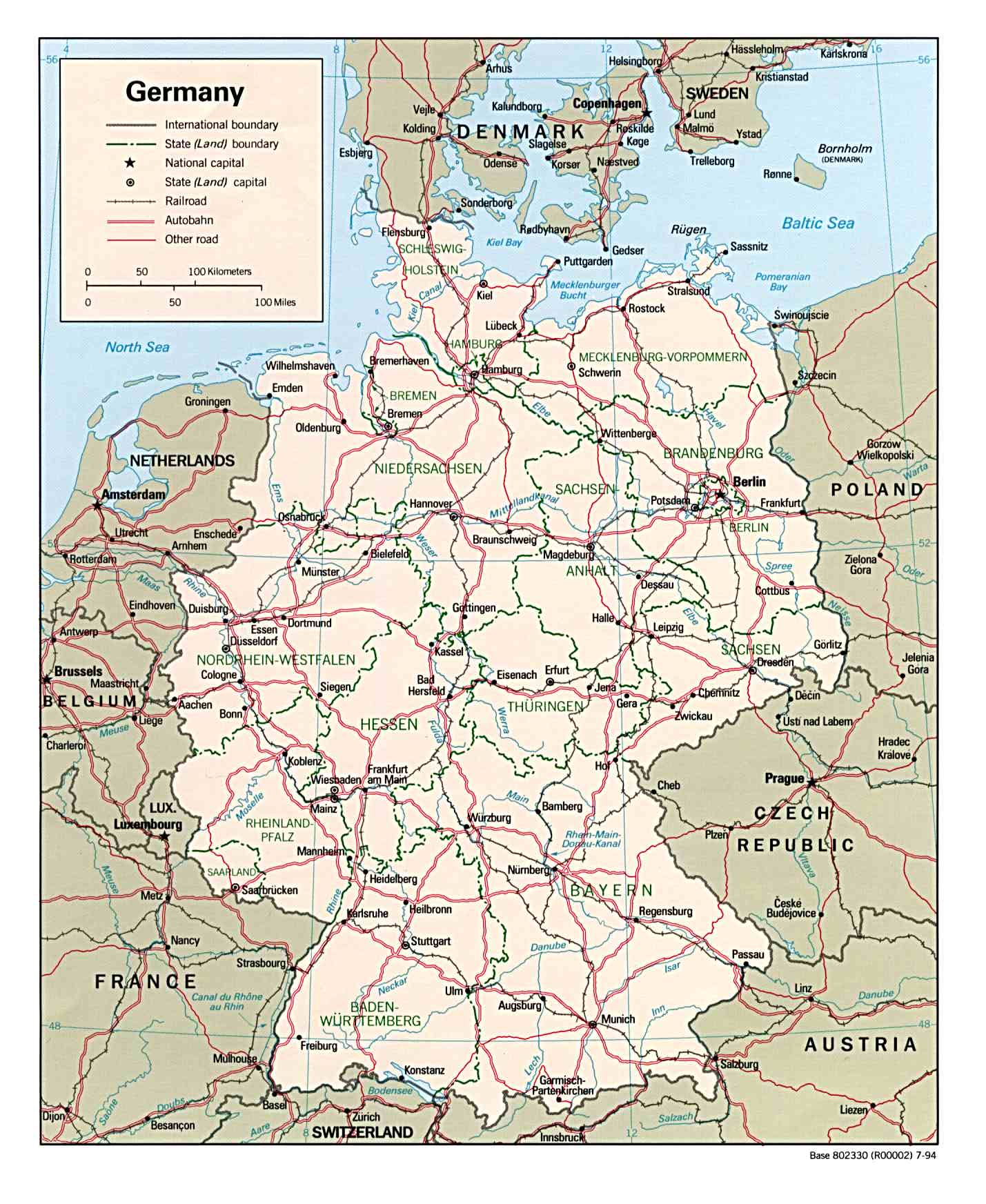
German postal codes are five digits, possibly prefixed by DE-
(for
Deutschland, formerly just D
).
Prior to 1991 (the union of DDR and the Bundesrepublik), the prefixes for
the 4-digit codes were D-
(for the Federal Republic (West)), and
DDR-
(for the Democratic Republic (East)). Then, in the united
Federal Republic, the prefixes were O-
(for East) and W-
(for
West), to distinguish the conflicting 4-digit postcodes of East and West.
Then on July 1, 1993, a new comprehensive Germany-wide 5-digit system took
effect and all the German addresses in all the databases in the world had to
be converted.
The country prefix (D- or DE-) is not used for internal mail, and should no
longer be used for mail to Germany either, at least not according to
the UPU, which says In items for Germany, on no account should a country
code (D- or DE-) be written in front of the postcode. This could cause
delay in processing the items as they cannot be sorted by the sorting
machines
(boldface from the original). The exception would be when sending
mail from a country that requires country prefixes on postcodes in mail
bound for other European countries. (Confused? When sending mail from the
USA to Germany, omit the prefix.)
Alex Bochannek adds,
Prior to conversion, trailing zeroes in the postal code were commonly
omitted, so people would often write 1 Berlin 20 for 1000 Berlin 20. This was
more obvious with large cities that had three zeroes, but even smaller cities
with only one trailing zero could have that digit dropped. So you could say
that while the postal code had four digits, they were written as one to four
digits.
The first German postal codes, which had two digits. were established in
1941, described here.
Four-digit codes were introduced in West Germany between 1962 and 1964. East
Germany followed suit soon thereafter, but did not use postal district
numbers after the city name, but instead incorporated them into the postal
code. Therefore, there was a 1000 Berlin in the west and 1xxx
numbers for the eastern parts of Berlin.
The postal district numbers (at least in the big cities that actually
used them) had a certain sociopolitical connotation. In Berlin the famed
(notorious?) district Kreuzberg used to also be known as SO36 (Süd-Ost
[South East] 36) after their old postal district. I think the SO part
actually predated the numbering and I suspect that it was probably used in
parallel for a while, possibly to indicate mail distribution centers. But
that is pretty much speculation on my part since I never actually saw the
letter designation used on contemporary mail – only the digits.As part of the 1993 PLZ [Postleitzahlen –
Postal Codes] conversion, the trailing postal district number was dropped.
For example, 1000 Berlin 20 covered part of the Berlin district of Spandau.
After the 1993 conversion a finer granularity was possible and 13591 Berlin
was assigned to an even smaller part of Spandau.
You can look up German postal codes here:
http://www.postdirekt.de/plzserver/
or in Frank's copy of the Deutsche Bundespost Postleitzahlenbuch ( onsite only :-) You can convert pre-1993 4-digit postalcodes to current 5-digit ones here:
http://www.informatik.uni-stuttgart.de/dienste/plz.html
Also note the following transcription rules for German, to be used in cases where you can't print the special German characters:
German Transcription Example Vowel with Umlaut (ä ö ü) Same vowel followed by e(ae, oe, ue)Köln → Koeln German sharp s ess-zet (ß) Two s's (ss) Straße (street) → Strasse
Sharp s is Scharfes s or Eszett in German; although it might
look like a Greek beta (β), it is a ligature of
long s (ſ) with s: ſs
. Here is a German
address with Umlauts and Sharp s and its transcription:
German Transcription
Most street addresses have the street name first, then the house number.
GmbH stands for Gesellschaft mit beschränkter Haftung (company
with limited liability), a corporate status designation similar to English
Ltd.
It is capitalized as shown. About the hyphenation of German
street names, Otto Stolz writes:
In this example [i.e. the one above], the street name is a compound word, and the general rule is that a compound is either written in one single word, or else with hyphens between all of its (1st level) components, cf. http://www.ids-mannheim.de/service/reform/regeln2006.pdf, § 44 (p.45). Particularly, compounds starting with a proper name are always written with hyphens, cf. http://www.ids-mannheim.de/service/reform/regeln2006.pdf. (Unfortunately, the 2006 version of the official orthographic rules are in a monolithic PDF file without the possibility to link directly to the several sections.)Note that not all street names are compounds: some comprise an adjective with a noun, as in
Kurze Straße(in 13585 Berlin) orLivländische Straße(10715 Berlin); some comprise a preposition, an article, optional adjectives and a noun, as inIn den neuen Gärten(12247 Berlin). A particular pitfal lurks in the-ersuffix: normally, it signals an adjective as inBurgunder Straße(79104 Freiburg; fromBurgund= Burgundy), but many proper names end in-er, these can constitute the 1st part of a compound, as inBurgunderstraße(70435 Stuttgart; fromBurgunder= burgundy wine). The only sure way to tell these cases apart is to consult the Postleitzahlenbuch (or to know the local history ;-) (The Burgunder Straße vs. Burgunderstraße example stems from http://faql.de/typographie.html#bindestrich, though they present different evidence.)
Also from Otto Stolz:
There are two more types of addresses you may wish to mention:
- Postfachadressen (Post Office Boxes)
- Großkundenadressen (Large Customer Addresses)
Postfachadressen (PO Boxes):
- In medium, and large, places, post office boxes are assigned particular codes, different from the street's codes. Only small places have a single code both for street, and post office box, addresses. (Cf. Postleitzahlenbuch, p. 25)
- In large places, a particular code covers a range of post office boxes (64 boxes per code, IIRC); hence, the particular post code to be used depends on the post office box number.
- The street address must not be used for a letter to a post office box. e.g.:
An den Oberbürgermeister
Herrn Dr. Baganz
Stadt Mülheim an der Ruhr
Postfach 101953
45466 Mülheim
GERMANY
Großkundenadressen (Large Customers):
- The new, 5-digit, post codes brought a particular form of address for authorities, institutions, or enterprises receiving large amounts of mail. (Cf. Postleitzahlenbuch, p. 26)
- Each of these has its own, particular postcode, different from the codes used in street, or post office box, addresses.
- The street address must not be used for a letter to a
Großkunde, e.g.:
Frau Renate Mustermann
Universität Konstanz
78457 Konstanz
GERMANY
The Postleitzahlenbuch covers only post codes for street addresses; for post office boxes, or
Großkunden, you can consult the WWW page http://www.postdirekt.de/plzserver/. The easiest way, however, to find the correct post code is to look at the sender's address of the letter you are answering, or in the WWW homepage of the adressee.Note that you must use the street address (with its particular post code) for parcels and for express delivery, e.g.:
An den Oberbürgermeister
Herrn Dr. Baganz
Stadt Mülheim an der Ruhr
Ruhrstraße 32–34
45468 Mülheim
GERMANY

Frau Renate Mustermann
Universität Konstanz
Universitätsstraße 10
78464 Konstanz
GERMANY
Christian Asche reports (in June 2017):
In Mannheim, some addresses in the inner city are ”blocks”, instead of regular addresses. Example:Some German cities have different names in English, such as Munich (for München), Cologne (for Köln), and Nuremberg (for Nürnberg). All mail from the USA to Germany passes through a single point: Frankfurt am Main, where it is scanned for delivery within Germany. The scanners are looking for German city names, not English ones. By the same token, American scanners do not look at German city names at all. Therefore you should use German city names in your addresses, not English names:D1, 1-3Source: Sparkasse Rhein Neckar Nord page. More information (in german only): Mannheim Quadratestadt (Wikipedia).
68159 Mannheim
English Name German Name BRUNSWICK BRAUNSCHWEIG COLOGNE KÖLN HANOVER HANNOVER MUNICH MÜNCHEN NUREMBERG NÜRNBERG Example:
Lehrstuhl für Datenverarbeitung
Technische Universität München
Arcisstraße 21
80290 München
GERMANY
What we know today as Germany has evolved over the last centuries from a collection of feuding duchies to a vast empire, and then to a medium-sized West European country; divided from 1945 to 1991, then unified. At its peak the German Empire encompassed most of notheastern Europe. Much of this territory was lost to Germany in World Wars I and II. Hence, many cities and towns once German are now Polish, Czech, Russian, and so on, and in most cases their names have changed from German. Pre-WWI or WWII addresses referring to German town names such as Breslau (now Wroclaw in Poland), Danzig (now Gdańsk in Poland), Preßburg (now Bratislava in Slovakia), Budweis (now České Budějovice in the Czech Republic), Carlsbad (now Karlovy Vary in the Czech Republic), Königsberg (now Kaliningrad in Russia), etc, had to be be adjusted. In similar fashion some East German cities have been renamed (or un-renamed) since reunification, such as Karl-Marx-Stadt (back) to Chemnitz. For more maps of the shifting 20th-Century East European borders, see this page (and scroll down to the maps; thanks to Katarzyna Siwek for the reference).

Although Germany's borders have changed repeatedly, it has always been
subdivided into states (Länder). German states are not used
in postal addresses, but nevertheless sometimes we find addresses in which
a state name is used instead of the country, e.g. Augsburg, Bavaria
.
Such addresses should be converted to omit the state name and to include a
postcode, which can be looked up at sites in the Links at the end of this
section or in the Postleitzahlenbuch. Germany's current states are shown
in the following table. When the English name of a German state or city
is different from the German name, the English name is shown in parentheses.
PLZ is the approximate postal code range for reality checking.
January 2013... This table now incorporates an update of the PLZs
from Jens Peter Hammer. My original values are in bold; either these
were not very accurate, or a once-simple system has become more complicated,
or some combination:
Name ISO 3166-2 PLZ Former Capital Some Other Cities Baden-Württemberg BW 68-69xxx, 7xxxx, 88-89xxx, 97xxx West Stuttgart Baden Baden, Freiburg, Heidelberg, Karlsruhe, Ludwigsburg, Mannheim, Tübingen, Ulm Bayern (Bavaria) BY 63xxx, 8xxxx, 90-96xxx West München (Munich) Augsburg, Nürnberg, Würzburg Berlin BE 10-14xxx East/West Berlin Brandenburg BR 01xxx, 03-04xxx, 14xxx, 15-19xxx East Potsdam Cottbus, Frankfurt/Oder Bremen HB 27xxx-28xxx West Bremen Hamburg HH 20xxx-22xxx, 27xxx West Hamburg Hessen (Hesse, Hessia) HE 6xxxx60-61xxx, 63-65xxx, 68-69xxxWest Wiesbaden Darmstadt, Frankfurt/Main, Fulda, Kassel Niedersachsen (Lower Saxony) NI 2xxxx19xxx, 21xxx, 26-31xxx, 34xxx, 37-38xxx, 48-49xxxWest Hannover Braunschweig, Bremerhaven, Göttingen, Lüneburg, Osnabrück Mecklenburg-Vorpommern (Mecklenburg-West Pomerania) MV 18-19xxx17-19xxx, 23xxxEast Schwerin Rostock, Wismar Nordrhein-Westfalen (North Rhine-Westphalia) NW 4xxxx, 5xxxx32-34xxx, 37xxx, 40-53xxx, 57-59xxxWest Düsseldorf Aachen, Bonn, Dortmund, Essen, Köln (Cologne), Münster, Wuppertal Rheinland-Pfalz (Rhineland-Palatinate) RP 5xxxx, 67-68xxx53-57xxx, 65-67xxx, 76xxxWest Mainz Bad Dürkheim, Kaiserlautern, Koblenz, Ludwigshafen, Trier, Worms Saarland SL 66xxx West Saarbrücken Sachsen (Saxony) SN 0xxxx01-02xxx, 04xxx, 07-09xxxEast Dresden Chemnitz, Leipzig Sachsen-Anhalt (Saxony Anhalt) ST 0xxxx06xxx, 29xxx, 38-39xxxEast Magdeburg Dessau, Halle Schleswig-Holstein SH 23-25xxx21-25xxx, 27xxxWest Kiel Lübeck Thüringen (Thuringia) TH 0xxxx04xxx, 06-07xxx, 36-37xxx, 96xxx, 98-99xxxEast Erfurt Eisenach, Jena
In the postal oddities department, Ken Westmoreland reports on Germany's enclave in Switzerland: "Mail can be sent via Germany to D-78266 Büsingen, or via Switzerland to CH-8238 Büsingen:
"This must be the only place in the world that is part of two countries' postcode systems. Interestingly, while France and Spain operate postal services side by side in Andorra, neither have postcodes for the Principality." Postage inside Andorra is free; there are offices and letterboxes throughout the country. (Also see the section on Italy for more countries or pieces of countries inside of other countries).http://web.archive.org/web/20061004234047/http://www.borderlandtv.com/photos_1.html
Otto Stolz lists several other places that are part of two countries' postcode systems (A for Austria, D for Germany):
A-6691/D-87491 Jungholz
A-6992/D-87568 Hirschegg
A-6993/D-87569 Mittelberg
A-6991/D-87567 Riezlern
«Parcels may be addressed to the A code, while letters may addressed to either. These four places are not really exclaves, as they are connected to the Austrian mainland – though in pathless mountain regions, whilst the roads go in from Germany. Particularily funny is the border around Jungholz: Jungholz's precincts are connected to the Austrian mainland in one single point, on top of the Sorgschrofen mountain.»
Reference:
- Das Postleitzahlenbuch, Postdienst, Deutsche Bundespost, Bonn.
Links:
- http://www.deutschepost.de/ (Deutsche Post)
- Now: http://www.bundesnetzagentur.de/cln_1911/DE/Home/home_node.html (Bundesenztzagentur)
- http://www.bundespost.de/ (a private site)
- Postleitzahlen - Geschichte der deutschen Postleitzahl
- German envelope format
- ISO 3166 Part 2: Country Subdivisions
- Jungholz map
- Enclaves of the World (moves frequently; also see THIS ONE).
- Enclaves and Exclaves (Wikipedia).
- Postleitzahlensuche (official Deutsche Post postcode lookup)
- Postleitzahl (PLZ) Service (unofficial page, search based on maps rather than place names).
- Convertsion of old to new German postcodes (Goethe-Universität Frankfurt a.M.)
- How to enter German characters on non-German keyboards.
- German Places
- German 2-digit Postcodes 1941-1962 (MAP).
- Berlin Postbezirke 1862-1920 (Berlin postal districts 1862-1920).

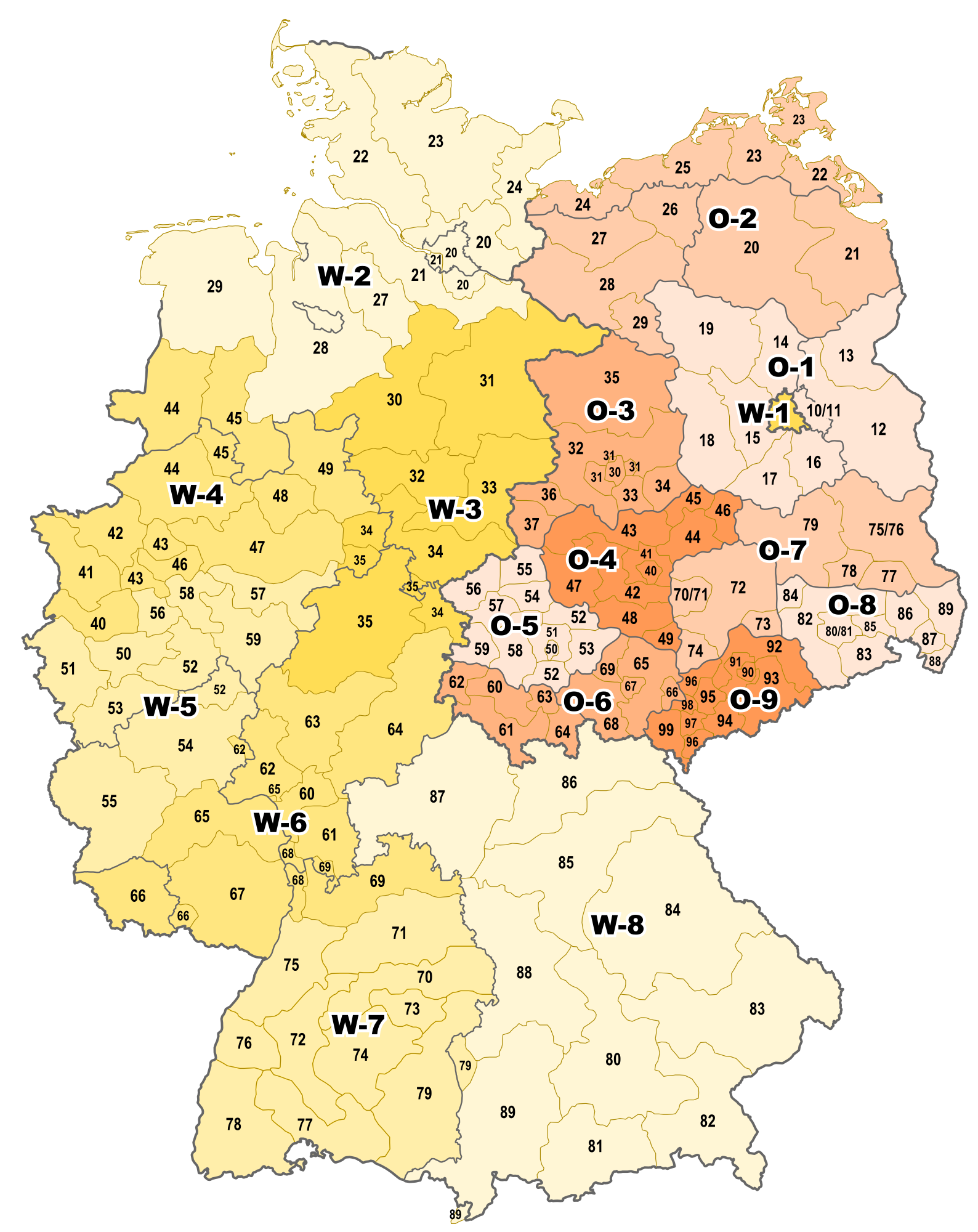
FRANCE
[ Next ] [ Top ] [ Contents ] [ Index ] [ Home ] [ Map ] [ Google Map ]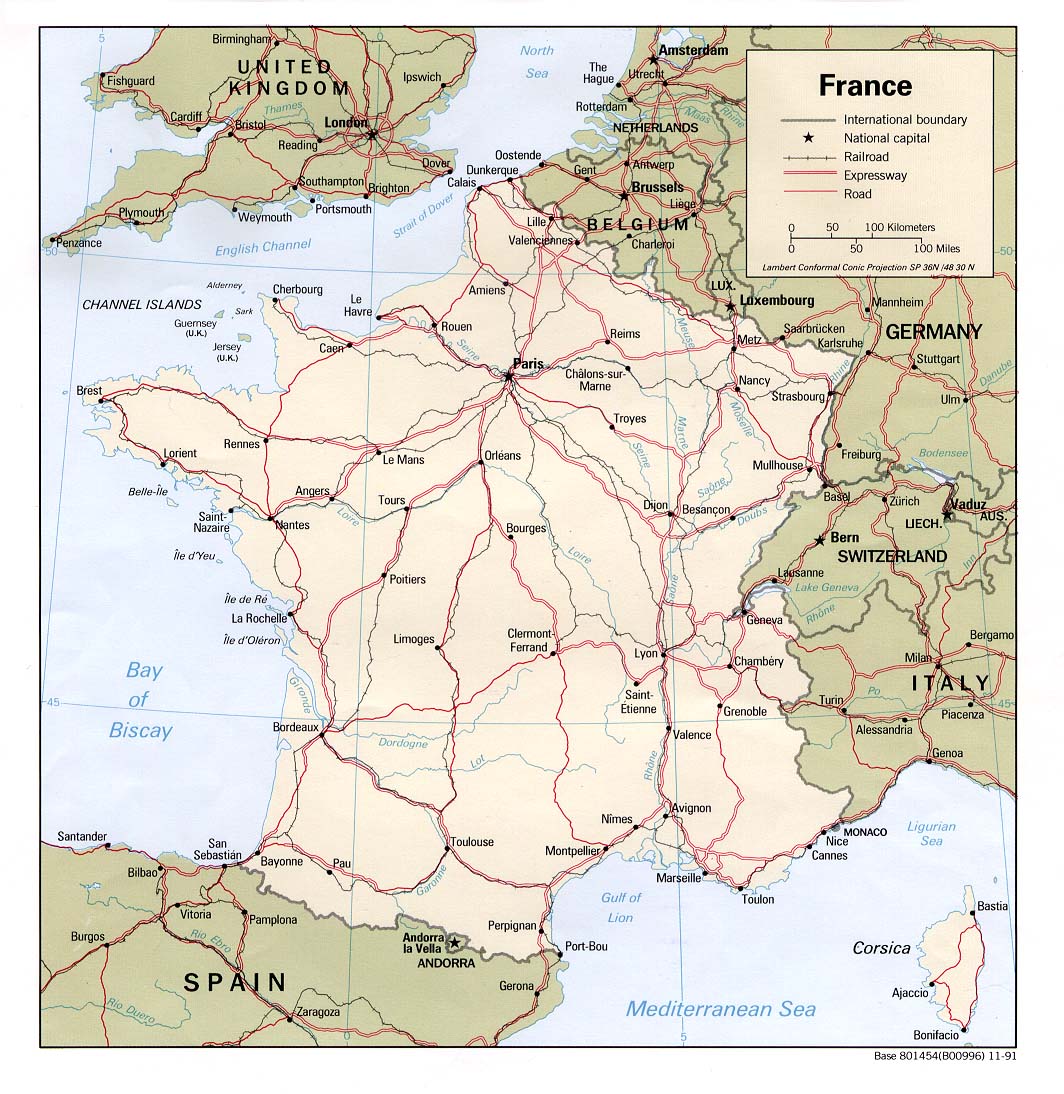
French addresses are straightforward. A typical example (from the UPU addressing formats guide) is:
Société DUPONT
Mademoiselle Lucie MARTIN
Résidence le Capucines
56 RUE EMILE ZOLA
BP 90432 MONTFERRIER SUR LEZ
34092 MONTPELLIER CEDEX 5
FRANCE
Lines from the street address down are supposed to be in all capital
letters. The French also like to write surnames in all caps, as shown, and
an address can include both a street name and number (56 RUE EMILE ZOLA) and
a Post Office Box (BP 90432). The F-
or FR-
country code
prefix is omitted from the postcode in this example, but is often seen in
practice.
The example also shows how the town or city name can be followed by the word CEDEX (Courrier d’Entreprise à Distribution EXceptionnelle), which indicates a special delivery service for business mail; if this word is included in an address (possibly followed by a zone number, as in the example), do not omit it; it's part of the address. Conversely, don't add CEDEX unless you know it's part of the address.
France still owns a tiny piece of North America, the islands of Saint-Pierre and Miquelon (Michelon), just south of Newfoundland, the last remaining bit of New France. Mark Brader points out: "It's the only place I know of in North America where, if you go east from any part of it until you enter a different time zone, you put your watch back; certainly the only one where you put it back half an hour. SP&M uses zone -3; the island of Newfoundland, which has a southward peninsula east of SP&M, uses -3:30." Saint-Pierre and Miquelon was also one of the few parts of North America controlled by an Axis power (Vichy France) in World War II, until it was liberated by General De Gaulle (who some decades later also tried to liberate Québec :-) SP&M is listed in the IMM and addressed is if it were a country:
Receveur du bureau de poste de Saint-Pierre
BP 4330, Place du Général de Gaulle
F-97500 Saint Pierre
SAINT PIERRE AND MIQUELON
Quiz Question 1: What other parts of North America were controlled by Axis powers in World War II?
Several other spots in the Western Hemisphere are also parts of France, and share the same postal codes. These include French Guiana in South America the islands Martinique and Guadaloupe. Each of these is treated by the USPS as a distinct country for addressing purposes. Ditto for French departments in the Pacific Ocean.
Links:
- La Poste
- France Postcodes (lookup)
THE FORMER CZECHOSLOVAKIA
[ Next ] [ Top ] [ Contents ] [ Index ] [ Home ][ Map of Czechoslovakia ] [ Map of Czech Republic ] [ Map of Slovak Republic ]
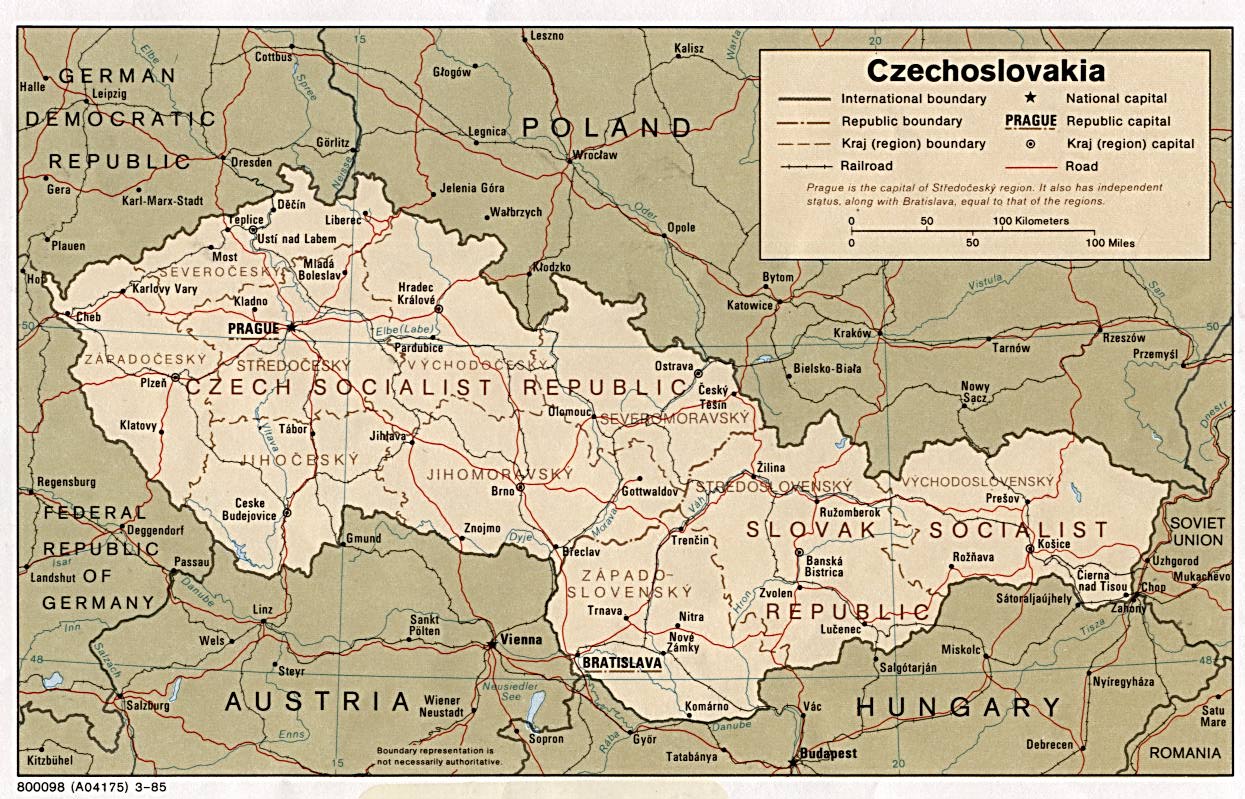

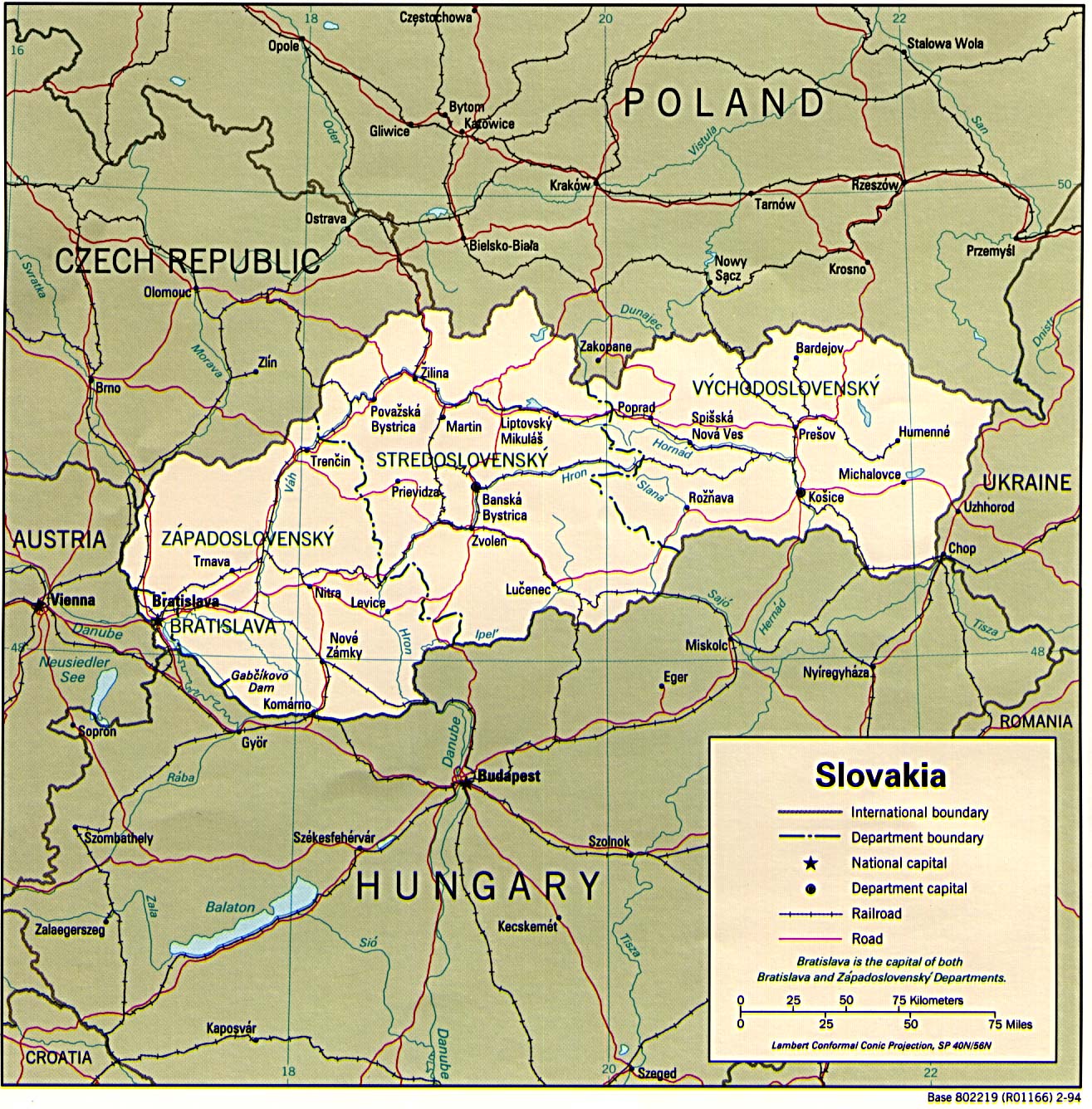
The Czech Republic officially changed its English name to CZECHIA in 2016, but the USPS International Mail Manual edition of March 5, 2018, still used the name CZECH REPUBLIC, so for the present, that is still how mail from the USA must be addressed.
On New Years Day, 1993, Czechoslovakia (ISO 3166 Alpha-2 code CS) split into two countries: The Czech Republic (CZ, containing Prague, Brno, Plzn, etc), and the Slovak Republic (SK, containing Bratislava). The new postal codes are as follows:
CZ 1xx xx     CZ 3xx xx       CZ 6xx xx       SK 9xx xx
CZ 2xx xx     CZ 4xx xx       CZ 7xx xx       SK 0xx xx
CZ 2xx xx     CZ 5xx xx       SK 8xx xx
As you can see, the two countries share the same code space (i.e. their postcodes do not overlap).
Prague and some of the other Czech and Slovak cities also put zone (district) numbers after the city name. Examples:
CZ-602 00 Brno                  CZECH REPUBLIC
CZ-370 06 České Budějovice      CZECH REPUBLIC
CZ-547 01 Náchod                CZECH REPUBLIC
CZ-130 00 Prague 3              CZECH REPUBLIC
CZ-763 14 Zlín 12               CZECH REPUBLIC
SK-811 01 Bratislava            SLOVAK REPUBLIC
Recent guidance says to omit the country prefix from the postcode, as in this example for Slovakia:
Slovenská pošta, š.p.           (Name)
Partizánska cesta č. 9          (Street, number)
975 99  Banská Bystrica 1       (Postal code, city [zone])
Since the Czech name for Prague is Praha, you might want to use the double-city-line format when addressing mail there:
130 00 Praha 3
PRAGUE
CZECH REPUBLIC
Don't use the old German names for Czech and Slovak cities (Preßburg, Carlsbad, Budweis, etc); see section on Germany.
Links:
The official “short name” for the Czech Republic (as of 2016) is Czechia, but don't use it in postal addresses yet since it is not recognized by the USPS (click here to see the current list) (verified 20 June 2022).
Czech Republic http://www.cpost.cz/ Slovak Republic http://www.slposta.sk/online/hlpsc.htm
THE FORMER YUGOSLAVIA
[ Next ] [ Top ] [ Contents ] [ Index ] [ Home ] [ Map ]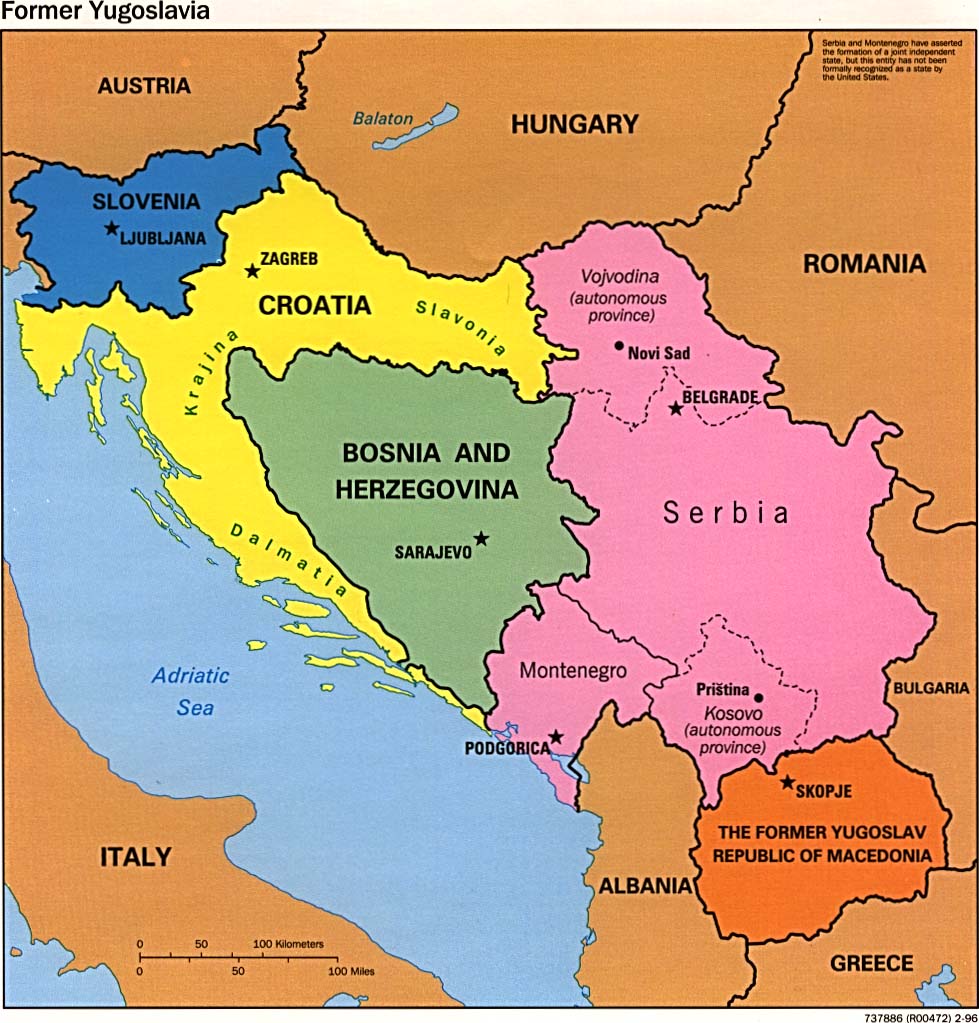
Between 1990 and 2006, what had been the Federated (or Federal) Peoples Republic of Yugoslavia – a federation of six Republics (Bosnia and Herzegovina, Croatia, Macedonia, Montenegro, Serbia, and Slovenia) and two Socialist Autonomous Regions (Kosovo and Vojvodina) – became the following countries (see INDEX for native-language, alternative, and former names). Prior to 1990, the ISO 3166-1 code for Yugoslavia was YU; after that each republic received its own code. From 1990 to 2006, the republics of Serbia and Montenegro were federated into a single country having code CS (which had formally belonged to Czechoslovakia); in 2006 they separated and received the codes shown below. As always, the spelling of country names for addressing purposes is the USPS spelling since, after all, it is the USPS that must recognize the country name.
KOSOVO declared itself an independent republic on 17 February 2008. At first international mail service Kosovo under the administrative supervision of an interim United Nations (U.N.) mission and required special notations in the address, now it is a regular country with its own postal codes.
Country ISO Some cities or towns in the new country BOSNIA-HERZEGOVINA BA (MAP) Sarajevo, Pale, Banja Luka, Tuzla CROATIA HR (MAP) Zagreb, Dubrovnik, Split, Rijeka, Osijek KOSOVO XK (MAP) Priština, Prizren, Đurakovac, Štrpce, Vučitrn NORTH MACEDONIA MK (MAP) Skopje, Kruševo, Medżitlija MONTENEGRO ME (MAP) Podgorica [Titograd] SERBIA RS (MAP) Belgrade [Beograd] (Serbia), Novi Sad (Vojvodina). SLOVENIA SI (MAP) Ljubljana, Maribor, Novo Mesto, Litija, Slovenj Gradec

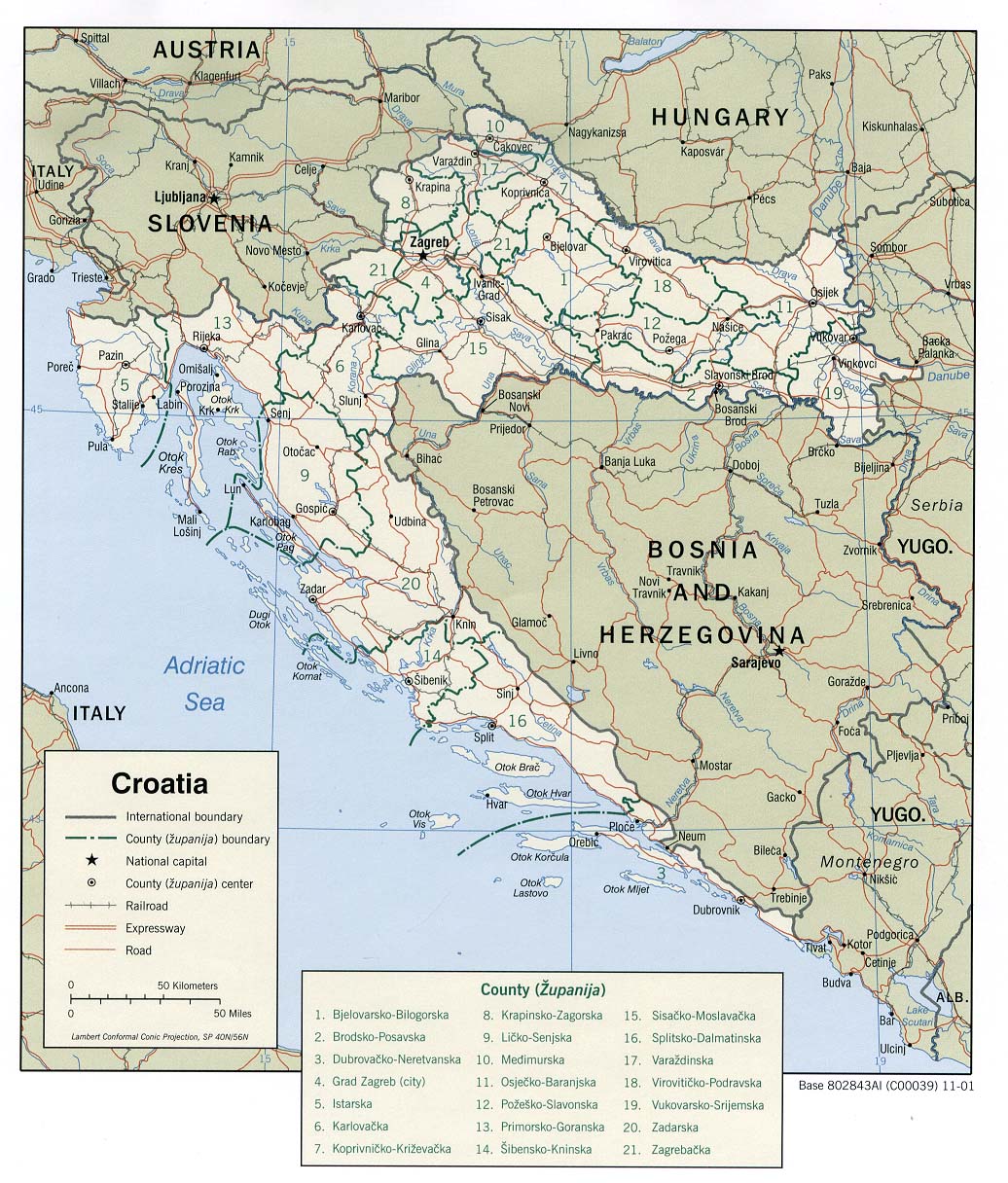
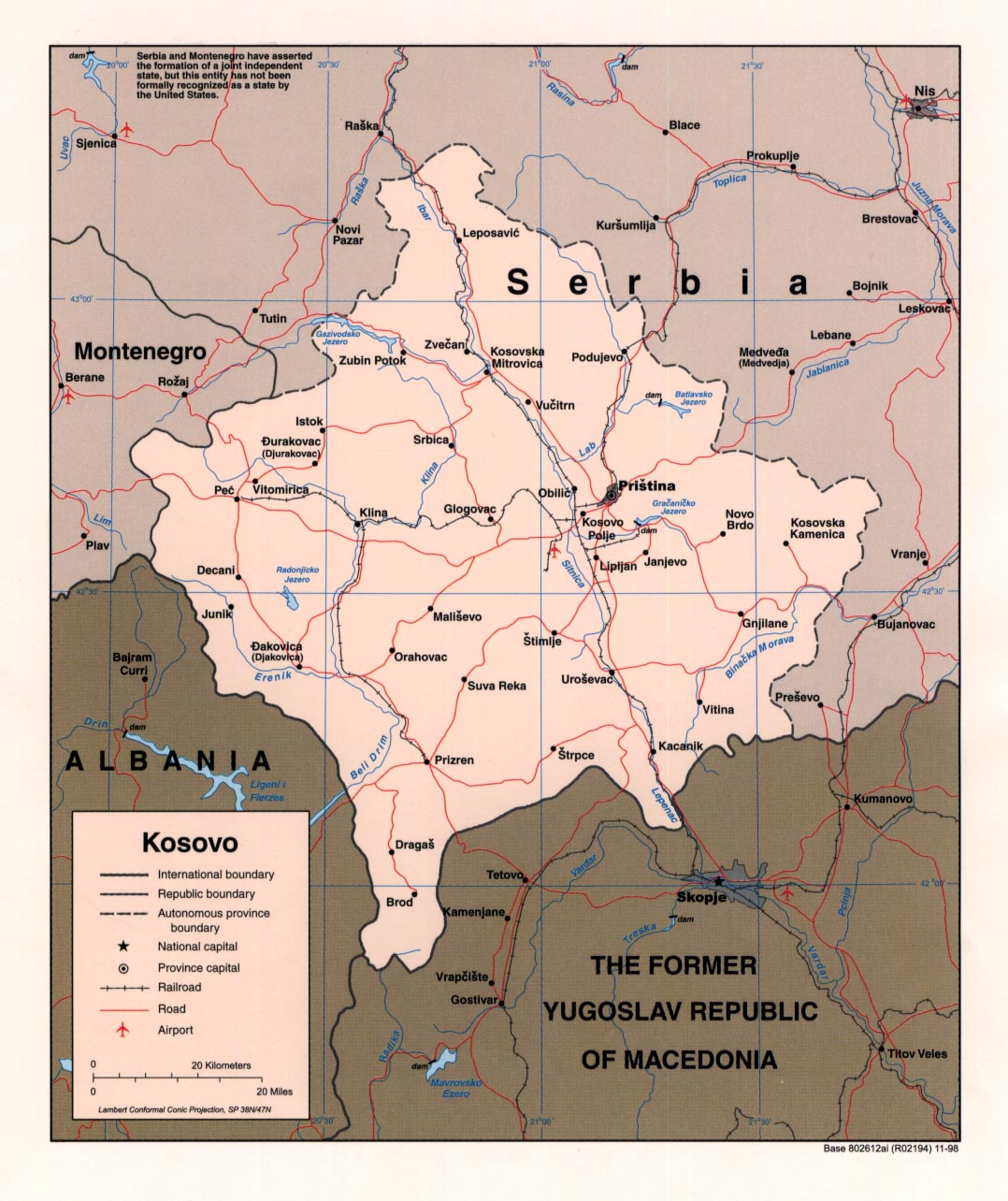
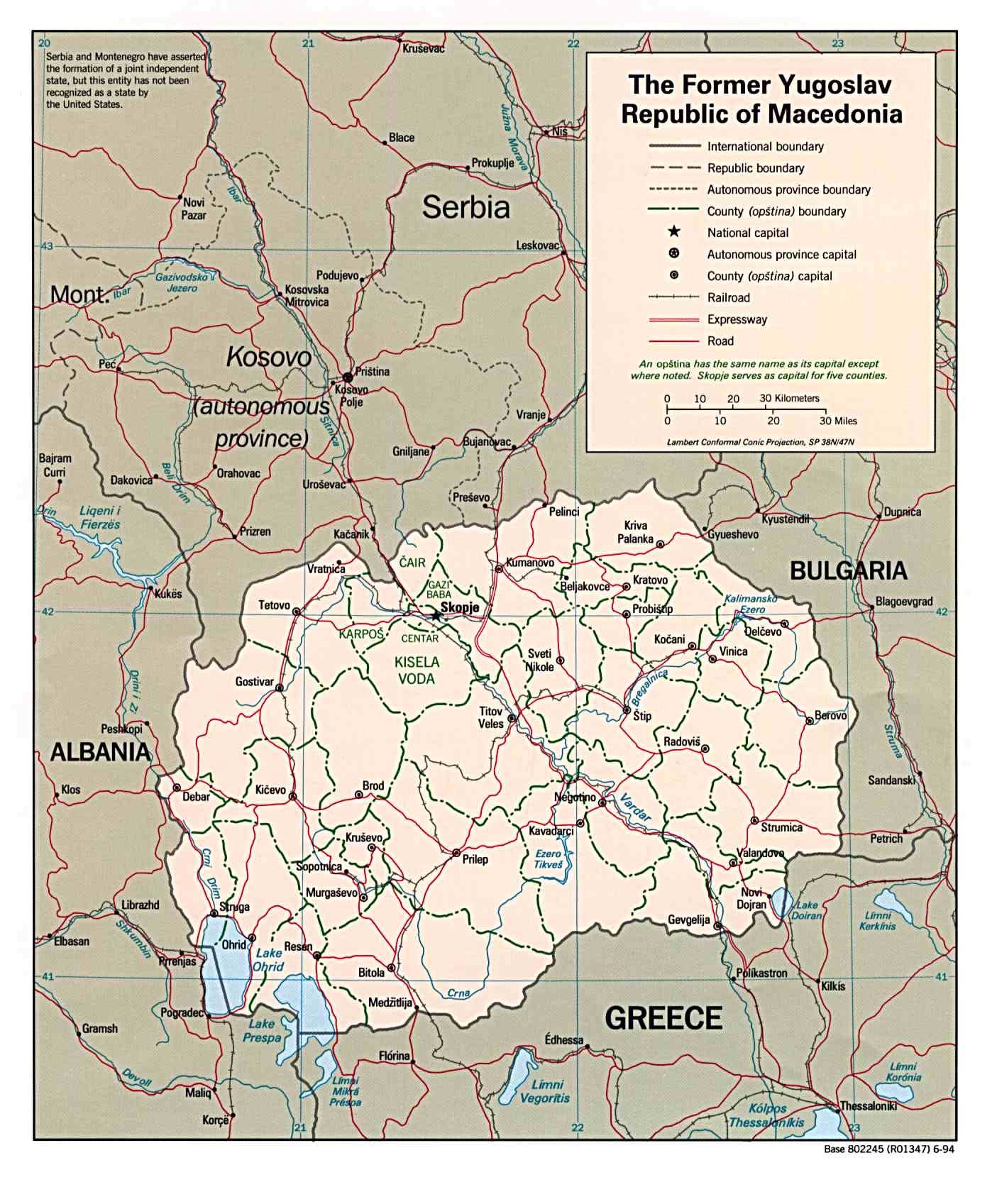


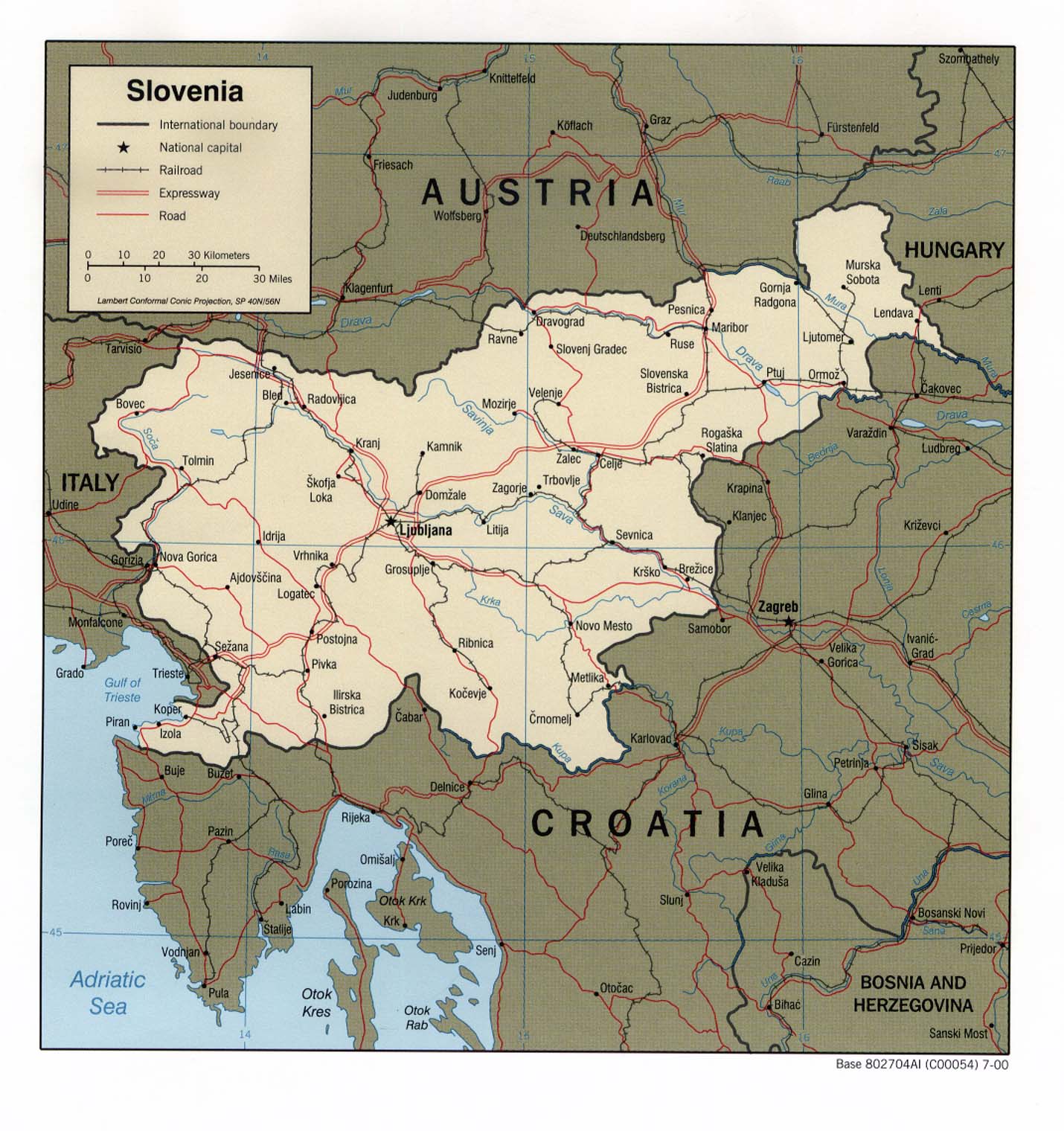
Here's the regular-format table for these counties:
USPS Name ISO Car City Line Format City Line Example BOSNIA-HERZEGOVINA BA BIH nnnnn town 71000 SARAJEVO CROATIA HR HR nnnnn town 10000 ZAGREB KOSOVO XK KS nnnnn town 10000 PRISTINA NORTH MACEDONIA MK MK nnnn town 1000 SKOPJE MONTENEGRO ME ?? nnnnn town 81000 PODGORICA SERBIA RS ?? nnnnnn town 106314 BEOGRAD SLOVENIA SI SLO SI-nnnn town SI-1001 LJUBLJANA
Note: The status of Kosovo vis-a-vi Serbia is complicated and special license plates and car codes might be required when driving from Kosovo to Serbia; see this Wikipedia page.
Slovenian Post requires the ISO Alpha-2 country code to be used on all items entering or leaving Slovenia.
"Bosnia-Herzegovina" (Bosna-i-Hercegovina) sounds like two countries but
really is one, with two main parts: a Serbian part (Republika Srpska, which has its own
postal website HERE, and the
Bosniak/Croat Federation of Bosnia and Herzegovina (Federacija
Bosna-i-Hercegovina); the latter also administers a separate district named
Brcko in the northeast which is not part of Republika Srpska or the
Bosniak/Croat Federation. (Note: Bosnian
refers to nationality,
Bosniak
refers to the Bosnian-speaking population, as opposed to the
Serbs and Croats). Bosnia-Herzegovina has 5-digit postal codes:
BA-71000 Sarajevo
BOSNIA-HERZEGOVINA
From September 2006, the country code for Serbia, including the autonomous regions, is RS:
RS-11000 BEOGRAD (formerly YU-11000 BEOGRAD)
SERBIA
On January 1, 2005, Serbian Post introduced a six-digit address code
for
each Serbian postal address, to replace the previous 5-digit postal code.
The website shows the following sample address:
Петар Петровић
Палмотићева 027 008
11000 Београд Реои:
             106314
in which the first line is the person's name (Petar Petrovich), the second
line is presumably the street and house number (Palmoticheva 027 008),
the third line is the postcode and code (11000 Beograd = Belgrade; I'm not
sure what the small notation is to the right of Београд), and
the fourth line shows the new address code at the bottom right. The site
is not clear about the relationship of the postcode and the address code
(the example shows both the postcode and the address code in the same
address, but the text says Instead of the existing postal code, a new
address code is introduced
), but the Universal Postal Union writes the
same address like this:
Mr. Petar Petrovic
Palmotičeva 27 - 8
106314 BEOGRAD
REPUBLIC OF SERBIA
The USPS, however, still lists the name of the country as SERBIA-MONTENEGRO (IMM Issue 34, May 14, 2007 Updated with Postal Bulletin Revisions Through February 28, 2008).
Macedonia (Makedonia, Makedonija) was a controversial name, contested by Greece an the former Yugoslav repbublic. Effective 26 January 2020, USPS adopted the name (REPUBLIC OF) NORTH MACEDONIA (IMM Revision: Republic of North Macedonia Name Change).
Also note the usage of the Cyrillic versus Latin alphabet. Croatian is always written with Latin letters (but see THIS); Serbian (spoken in Serbia, Montenegro, and part of Bosnia) can be written with Cyrillic or Latin (BELGRADE can be БЕОГРАД or BEOGRAD). Latin letters seem to be the rule in Bosnia and Kosovo but Cyrillic is also used; Cyrillic predominates in Macedonia. People of many nationalities besides Serbs, Croats, Bosnians, etc, live in these countries, including Hungarians, Romanians, Czechs, Slovaks, Albanians, Turks, and Gypsies. Reportedly, in Vojvodina the street signs used to be in six languages: Hungarian, Romanian, Ukrainian, Czech, Slovak, and Serbian/Croatian.
Links:
- Bosnia and Herzegovina Address Format (Universal Postal Union)
- Croatia Address Format (Universal Postal Union)
- Montenegro Address Format (Universal Postal Union)
- North Macedonia Address Format (Universal Postal Union)
- Serbia Address Format (Universal Postal Union)
- Slovenia Address Format (Universal Postal Union)
- Address Code - A New System of Item Addressing (Serbia Post)
- Address Codes Search Engine: Instructions for Use (Serbia Post)
- Serbia and Montenegro Assigned ISO Country Codes (ISO news release, 29 Sep 2006)
- Croatia: an Overview of its History, Culture and Science
THE FORMER SOVIET UNION
[ Next ] [ Top ] [ Contents ] [ Index ] [ Home ] [ Map ] [ Soviet Union Map ]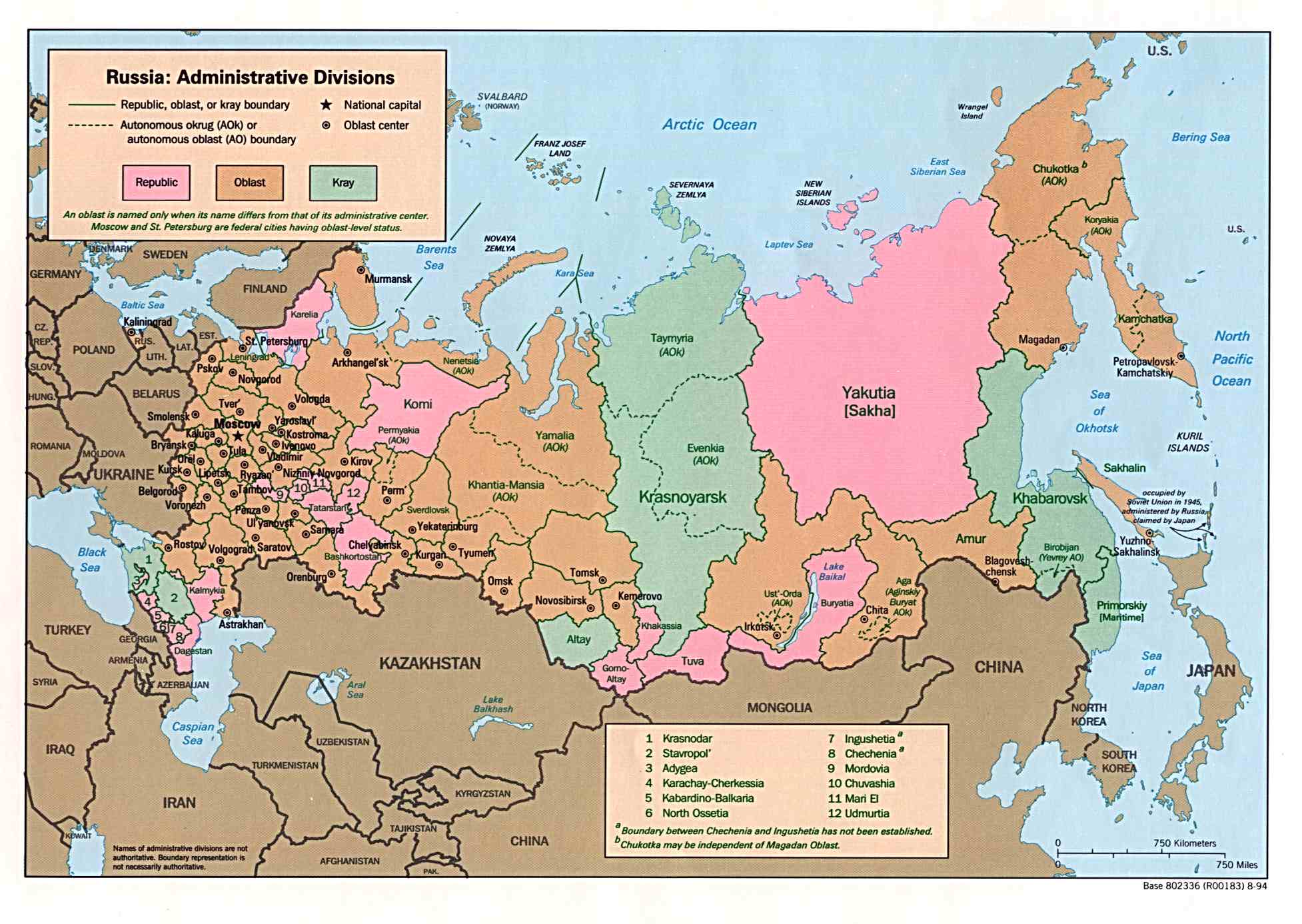
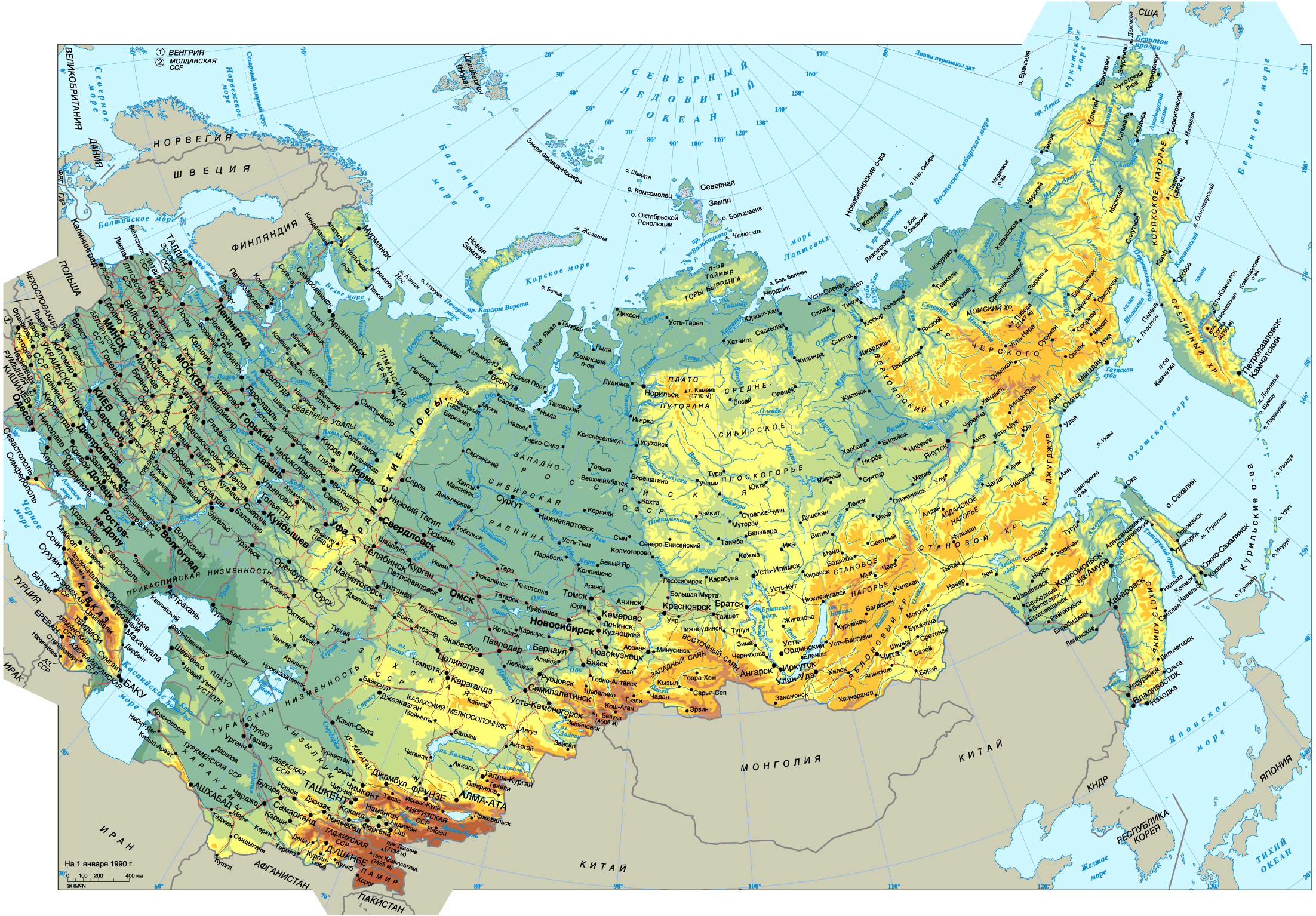

|
USPS Name ISO Car City Line Format City Line Example ARMENIA AM ARM nnnnnn town 375010 YEREVAN AZERBAIJAN AZ AZ nnnnnn town 370139 BAKU BELARUS BY BY nnnnnn town(-zone) 220050 MINSK-50 ESTONIA EE EST nnnnn town 10001 TALLINN GEORGIA GE GE nnnn town 0100 TBILISI KAZAKHSTAN KZ KZ town
nnnnnnALMATY
480012KYRGYZSTAN KG KS nnnnnn town 720001 BISHKEK LATVIA LV LV town, LV-nnnn RIGA, LV-1073 LITHUANIA LT LT LT-nnnnn town LT-14269 Vilniaus r.sav. MOLDOVA MD MD nnnn town 2012 CHIŞINӐU RUSSIA RU RUS town
nnnnnnMOSCOW
103375TAJIKISTAN TJ TJ nnnnnn town 734025 DUSHANBE TURKMENISTAN TM TM nnnnnn town 744000 ASHKHABAD UKRAINE UA UA town
nnnnnKIEV
01055UZBEKISTAN UZ UZ nnnnnn town 700000 TASHKENT
Lithuania switched from a 4-digit to a 5-digit zipcode about 2005, and now offers an English-language postal website, http://www.post.lt/en/, including postcode lookup.
As you can see, the UPU says that Kazakhstan, Ukraine, and Russia put the postal code on a line by itself under the city name. This is a rather new phenomenon, and it might be confusing for USPS postal sorters, which until about 2000 could always expect the name of the city to appear on the line just above the name of the country (the United Kingdom has adopted the same practice), and in any case does not seem to be the form used on most mail pieces.
In the 20th Century, most of these countries wrote addresses backwards from how we write them, e.g. with country name on top, the city line as the second line ("г." stands for "город", meaning town or city), the street line next, and finally the company or person, and the postcode was on the right:
РОССИЯ
г.Москва  125252
ул.Куусинена 21-Б
Междунродный Центр Научной и Технической Информации
Чичикову П.И.
This form fell into disuse about 2000, at least in Russia and Ukraine, which have switched to the same minor-to-major top-to-bottom presentation used in most other places, while other former Soviet republics such as Kyrgyzstan still use the major-to-minor form [more about Kyrgyzstan].
In any case, when addressing mail to these countries, write addresses in the normal USA order, because the USPS looks at the bottom of the address, not the top, for the City line and Country name, and of course write at least the City and Country lines in Roman letters. This form works best (the last two lines are, of course, omitted for mail within Russia):
Чичикову П.И.
Междунродный Центр Научной и Технической Информации
ул.Куусинена 21-Б
125252 г.Москва
MOSCOW
RUSSIA
A transliterated version should work:
P.I. Chichikov
Mezhdunarodnyi Centr Nauchnoi i Tehnicheskoi Informatsii
ul.Kuusinena, 21-B
125252 Moskva
MOSCOW
RUSSIA
And an English translation should work too, but might result in delayed delivery since it requires re-translation of the local parts:
P.I. Chichikov
International Centre for Scientific and Technical Information
Kuusinena Street 21-B
125252 MOSCOW
RUSSIA
At present I do not know if translation or transliteration is more effective nor, if transliteration is preferred, which transliteration system is best.
Where should the postcode go? The examples just above (postcode left of the city name, no prefix) seem to show the prevailaing usage (in 2004), despite the UPU recommends of putting it on a line by itself. All of the following formats have been seen (by me):
125252 MOSCOW        RU-125252 MOSCOW
125 252 MOSCOW	     RU-125 252 MOSCOW
MOSCOW 125252	     RF-125252 MOSCOW
MOSCOW 125 252	     RF-125 252 MOSCOW
Russia, Ukraine, and other former Soviet Republics have subdivisions called (in the nominative singular): Область (Oblast = Region), Автономная область (Avtonomnaya oblast = Autonomous region), Автономный округ (Avtonomnyj okrug = Autonomous province), Город (Gorod = City), Край (Kray = Territory), Місто (Ukrainian: Misto = Independent city), or Республика (Respublika = Republic).
In Russia alone (the largest country on earth, by far), there are
approximately 89 subdivisions. In Ukraine, 25; Belarus: 7, and so on. The
subdivision (oblast, kray, etc) should be included when the mail is not
addressed to a large city (regional center, capital of oblast, independent
city, etc). In Ukraine, for example, mail being sent to Zaporozhye,
Kharkov, Kiev, Chernigov or any other regional center (capital of oblast)
does not require any indication of oblast (nobody addresses mail to Kiev,
Kievskaya oblast
or Vinnitsa, Vinnitskaya oblast
, etc). However, if
mail is being sent to, say, Pology, which is a district center within
Zaporozhye oblast, there should be an indication of oblast (Zaporozhskaya
oblast). Examples:
Latin Cyrillic A.P. Federenko
P.O.Box 987
72319 Melitopol-19
Zaporozhskaya obl.
UKRAINEА.П. Федеренко
а/я 987
72319 Мелитополь-19
Запорожская обл.
UKRAINEA.P. Federenko
ul. Timoshenko, 26-17
04212 KIEV-212
UKRAINEА.П. Федеренко
ул. Тимошенко, 26 кв. 17
04212 Киев-212
UKRAINE
"ul." stands for úlitsa
(улица) = street.
There are no official abbreviations for subdivisions in Russia or Ukraine
like those for states of the USA. However, shortening for some regions
(oblast) are accepted and understood, e.g. Moskovskaya oblast
-
Mosk. obl.
or MO
. Postal codes are required everywhere.
Latin Cyrillic Izdatelstvo Inostrannyi Yazik
ul. Myasnitskaya, 10 str. 1
101000 MOSCOW
RUSSIAИздательство Иностранный язык
ул. Мясницкая, 10 стр.
101000 Москва
MOSCOW
RUSSIAIvan Sidorov
ul. Prorizna, 29 kv. 6
01001 KIEV-1
UKRAINEИван Сидоров
ул. Прорезная, 29 кв. 6
01001 Киев-1
KIEV
UKRAINE
When addressing in Cyrillic, you should include the city name in English
(e.g. MOSCOW, KIEV). I do not know for a fact that mail pieces from America
to (say) Russia are flown to any destination besides Moscow, but just now
I noticed that the latest
USPS Internation Mail
Manual includes a large table,
Areas
Served Within Russia, listing hundreds of cities by postal code!
(Follow the link and then scroll down.) Furthermore, the IMM states
HERE that
"Addresses in Russian, Greek, Arabic, Hebrew, Cyrillic, Japanese, or Chinese
characters must bear an interline translation in English of the names of the
post office and country of destination. If the English translation is not
known, the foreign language words must be spelled in roman characters (print
or script)." The IMM, however, does not give any examples for Russia or
other former Soviet republics, or define what it means by post office
in
the sentence just quoted (e.g. whether the oblast is included). Nor does
it show how to write the interline translation; for example:
or:10 Main Street/10 Главная улица Moscow/Москва
10 Main Street    Главная улица
Moscow            Москва
Personally I suspect that "interline translation" is likely to confuse the postal scanners and sorters in the destination country (thanks to Bill Conerly for asking about this).
A piece of Russia, the Kaliningradskaya Oblast,
or Kaliningrad Free Economic Zone, lies on the Baltic coast, about 500km
west of contiguous Russia
, with Latvia, Lithuania, and Belarus in
between, and sharing a border with Poland. The city of Kaliningrad is the
former Königsberg, once capital of East Prussia and later part of
Germany, and was incorporated into the Soviet Union in 1945, becoming the
USSR's main Baltic port. Today it is the Hong Kong
of Russia. It is
addressed like any other Russian city:
I.F. Shponka
City Hall
Pl. Pobedy 1
236040 Kaliningrad
RUSSIA
Another piece of Russia, the villages of Sankova and Medvezhe, lies inside Belarus.
Although the Cyrillic alphabet was used throughout most of the Soviet Union, some of the former Soviet republics are converting to Roman or Arabic script. Georgia and Armenia each have always had their own unique scripts.
Links:
- Почта России (Russia Post).
- База данных почтовых индексов России (Russia Postcode lookup)
- 15 Republics - 15 Sisters (former Soviet Republics)
- Letter
to Russia with
крокозябра
- More Cyrillic Mojibake
- Armenia postcode lookup

ASIA
[ Next ] [ Top ] [ Contents ] [ Index ] [ Home ] [ Map ]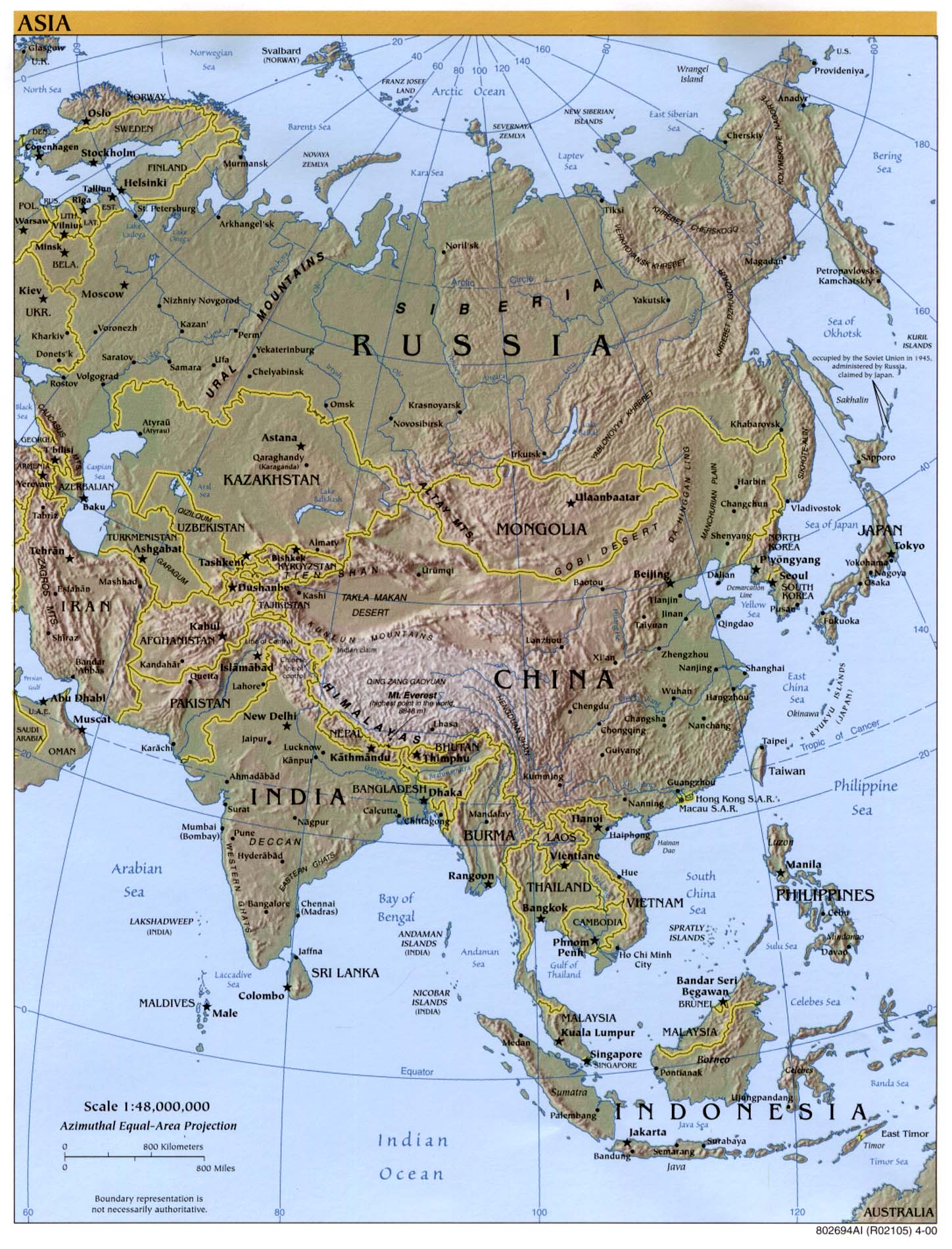
Of course Asia also includes much of the former Soviet Union (Kazakhstan, Tajikistan, Turkmenistan, Uzbekistan, Eastern Russia), but that has its own section.
USPS Name ISO Car City Line Format City Line Example AFGHANISTAN AF -- town KABUL BANGLADESH BD BD town - nnnn DAKHA - 1340 BHUTAN BT -- town TIMPHU BRUNEI DARUSSALAM BN BRU town LLnnnn BANDAR SERI BEGAWAN BB3510 CAMBODIA KH K town nnnnn PHNOM PENH 12203 CHINA CN RC nnnnnn town, province 310027 HANGZOU, ZHEJIANG EAST TIMOR (*) TL -- town HONG KONG (*) HK HK town KOWLOON INDIA IN IND town-nnn nnn NEW DELHI-110 034 INDONESIA ID RI town nnnnn BANDUNG 40115 JAPAN JP J locality
nnn-nnnnBunkyo-ku, TOKYO
112-0001KOREA KR ROK town nnn-nnn SEOUL 110-700 LAOS LA LAO nnnnn town 01000 VIENTIANE MACAO (*) MO -- MALAYSIA (*) MY MAL nnnnn town
state88990 KOTA KINABALU
SABAHMALDIVES MV -- town nn-nn MALE' 20-05 MONGOLIA (*) MN MGL nnnnnn town-zone 210152 ULAANBAATAR-52 MYANMAR (*) MM BUR town, nnnnn YANGON, 11181 NEPAL NP -- town nnnnn KATHMANDU 44601 NORTH KOREA KP -- town PYONGYANG PAKISTAN PK PK town-nnnnn ISLAMABAD-44000 PHILIPPINES (*) PH RP nnnn town 1050 MANILA SINGAPORE SG SGP SINGAPORE nnnnnn SINGAPORE 408600 SRI LANKA (*) LK CL nnnnn town 00100 COLOMBO TAIWAN TW -- town nnnnn TAIPEI 10636 THAILAND TH T town nnnnn BANGKOK 10150 VIETNAM (*) VN -- town nnnnn HANOI 10000
Notes:
- EAST TIMOR: Newly independent from Indonesia. From Ken Westmoreland:
"East Timor's capital is Dili. Indonesian postcodes have fallen into disuse.
Dili post office was 88010. Mail is sent to PO Boxes (e.g. Apartado 123,
Correios de Dili, DILI). I don't know if street deliveries have resumed
since 1999." And later
The UN contact said that East Timor would be reintroducing post codes, but that was three years ago.
- INDONESIA: Postcode lookup page is
HERE.
- HONG KONG: Reverted from Britain to China in 1997, maintaining a
semi-independent status. Hong Kong has automated sorting but no postal
codes. However, to satisfy the need for postal codes in Internet Web forms,
package tracking, etc, China post has
introduced a single postcode for Hong Kong, 999077.
- MACAO (Macau): reverted from Portugal to China
in December 1999. Addressing has not changed. Macao is addressed as if
it were a country; the line above
the Country Name is not the City Line, but the street address or P.O. Box.
This might play havoc with your record keeping or database software, so
you might want to insert a dummy City Line of MACAO. As with Hong Kong,
China post has
http://www.cpi.com.cn/cpi-eng/code/HangKong.asp">
introduced a single postcode for Macau, 999078.
- MALAYSIA: The state name is omitted for KUALA LUMPUR because,
although Kuala Lumpur is geographically surrounded by the state of Selangor,
it is not part of it; rather, Kuala Lumpur is part of the Malaysian Federal
Territory (similar to the capital cities of Australia, the Dominican
Republic, Mexico, the USA, and some other countries that also have a special
"federal district" for their capital cities).
Postcode lookup is available
HERE.
- MONGOLIA: The UPU says the postal code should go on the country line,
but that conflicts with USPS rules, so either put it on the left of the
City Line (because a numeric zone can go on the right) or on a line by
itself.
- MYANMAR: Formerly known as Burma; YANGON formerly known as RANGOON.
- PHILIPPINES: Postcodes (called ZipCodes) can be looked up
at the
PHILPOST website and also --> at HERE.
For more
about Philippine addresses, see An Approach in
Pre-processing Philippine Address for Geocoding by Caslon Chua, De La
Salle University, Manila.
-->
- SRI LANKA: The UPU says
5 digits above the locality name
(i.e. City Line) but then shows the postcode below the City Line; let's compromise and put it on the City Line. - VIET NAM: The link above is to the Vietnam Posts and Telecommunications
Group (VNPT), which does not have a lot of postal content. There is a page
of Postal and Newspaper Distribution Services and Rates HERE. And here
is the Ministry
of Information and Communication (MIC) of the Socialist Republic of
Vietnam; it has a link to
Postal Area Code
which at this writing (Oct 2008) doesn't do anything, but perhaps later it will. There is also a Wikepedia page of unknown provenance with a list oftop-level
Vietnamese postcodes for each province HERE. All pages on these sites are available in English as well as Vietnamese.
THE TWO CHINAS
[ Next ] [ Top ] [ Contents ] [ Index ] [ Home ] [ Map ]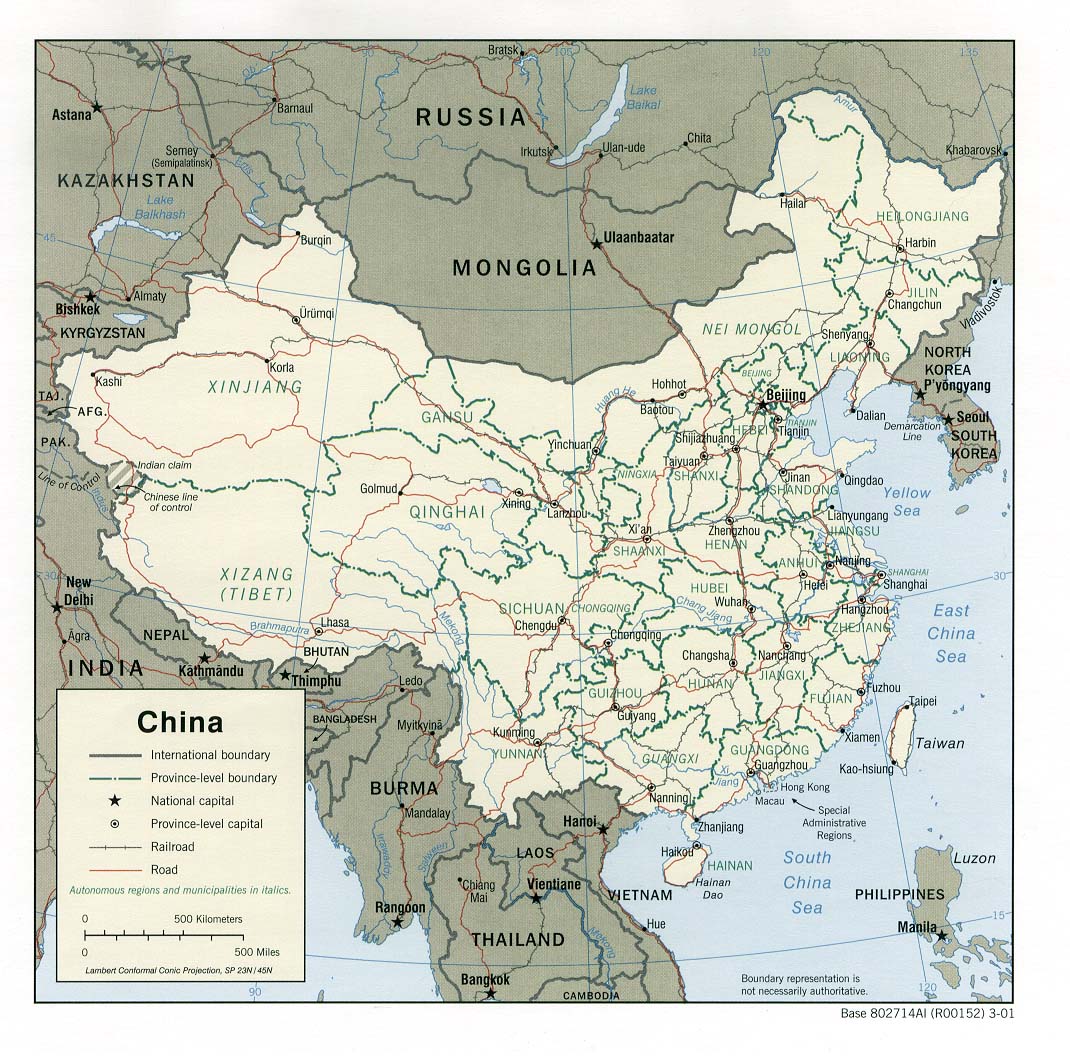
(June 2017) THIS ENTIRE SECTION IS OBSOLETE. The Peoples Republic of China has a completely new addressing scheme, described HERE (at the Universal Postal Union). Taiwan seems to have disappeared from the UPU listings; Taiwan address format is described in this Wikipedia page.Don't mix them up. The Peoples Republic of China is the big ("mainland") one. The Republic of China (ROC) is the little one, also known as Taiwan or (a long time ago) Formosa (from when it was a Portuguese colony).
The 2017 USPS IMM lists only the short names, CHINA, TAIWAN, and FORMOSA (obsolete synonym for TAIWAN that should not be used since it is likely to offend). The USPS does not recognize PEOPLES REPUBLIC or REPUBLIC or P.R. as part of the country name.
The Peoples Republic of China has provinces like Shanxi, and address are written as in the examples below, which I have seen on actual letters. The full form is town, province postcode, except for Beijing, Shanghai, Tianjin, and Chongqing, which do not fall under the jurisdiction of any province-level administrative region. Recent UPU addressing recommendations are vague about the Chinese province and other address parts (such a prefecture); certainly it should be included if the postal code is not known, and I'm sure it can't hurt even when the postal code is included. In the absence of clear addressing guidelines, the more information the better.
WUHAN, HUBEI Postal code unknown TAIYUAN, SHANXI (ditto) 310027 HANGZHOU, ZHEJIANG Full address line 100081 BEIJING Big city 200052 SHANGHAI (ditto)
As in Japan (next section), Chinese addresses in Chinese are written major-to-minor, but for Roman transcription the USU gives the following example, which is not major-to-minor, but not exactly minor-to-major either:
13 West Chang An Street
Directorate General of Posts
100804 BEIJING
CHINA
When I last looked (May 2012) the China Post website did not furnish any addressing guidelines.
Taiwan does not appear in the USU listings, and Taiwan Post does not offer addressing advice. Addresses I have seen go like this:
TAIPEI  10636                HSIN-CHU  31015
TAIWAN                       TAIWAN
Note that there was a big spelling reform
(for Romanization of Chinese
names) in Peoples China in 1979, but not in Taiwan. Thus Peoples China uses
Pinyin transcription, and the ROC uses Wade-Giles. Some examples:
New (Pinyin) Old (Wade-Giles) Beijing Peking Sichuan Szechuan Mao Zedong Mao Tse Tung Yijing I-Ching
Native (Han) scripts also differ; Peoples China uses a simplified form, Taiwan uses the traditional form. It should be noted that Chinese (Han) writing is mostly language-independent, and therefore can be used all over China, where dozens of languages are spoken (to name just a few: Buyei, Gan, Hakka, Jinyu, Guanhua (Mandarin), Min Nan, Xiang, Yue (Cantonese), Hmong, Yi, Zhuang, Korean, Mongolean, Tibetan). However, Romanized transcriptions are based on a particular language such as Mandarin, and therefore lack the same degree of universality.
The Provinces and Autonomous Regions of Peoples China are listed in the following table, as they are used in addresses. Provinces are in regular type; autonomous regions are shown in italics. The Pinyin spelling is given on the left with the traditional English form on the right (often Wade-Giles, but not always). Use the Pinyin form.
Pinyin Traditional Pinyin Traditional Anhui Anhwei Jilin Kirin Beijing Peking Liaoning Liaoning Fujian Fukien Nei Mongol Inner Mongolia Gansu Kansu Ningxia Hui Ningsia Hui Guangdong Kwantung Qinghai Tsinghai Guangxi Zhuang Kwangsi Chuang Shaanxi Shensi Guizhou Kweichow Shandong Shantung Hainan Hainan Shanghai Shanghai Hebei Hopeh Shanxi Shansi Heilongjiang Heilungkiang Sichuan Szechuan Henan Honan Tianjin Tientsin Hubei Hupei Xinjiang Uygur Sinkiang Uighur Hunan Hunan Xizang Tibet Jiangsu Kiansu Yunnan Yunnan Jiangxi Kiangsi Zhejiang Chekiang
For postal purposes, Tibet (བོད) is a province of China called Xizang, but this is a touchy political issue.
Hong Kong (Xianggang) became a Special Administrative Region (SAR) of the Peoples Republic of China July 1, 1997, but addressing conventions have not changed (but check HERE for any recent changes). Here's a sample Hong Kong address:
(Name)
(Company)
10/F Tower One,
Cheung Sha Wan Plaza
Kowloon
HONG KONG
Hong Kong is still listed in the USPS IMM, and in fact (as of May 2004, and checked again in June 2009) Hong Kong Post still lists its own address as:
HongkongPost Headquarters
2 Connaught Place
Central
HONG KONG
Similarly for Macao (Macau, Aomen). According to the IMM, mail from the USA is still addressed to MACAO or MACAU.
Although postcodes are not needed for Hong Kong and Macau, a single postcode has been assigned to each region to satisfy the growing requirement for postcodes:
Hong Kong 999077 Macau 999078
Links:
China China Post also see the UPU page on China Taiwan Chunghwa (Taiwan) Post Taiwan Zip Code (Postcode lookup) Taiwan Taiwan English Postal Addresses (Dan Jacobson - use at your own risk)Hong Kong Hong Kong Post Macao http://www.adminet.com/world/mo/ Shanghai http://www.sta.net.cn/
JAPAN
[ Next ] [ Top ] [ Contents ] [ Index ] [ Home ] [ Map ]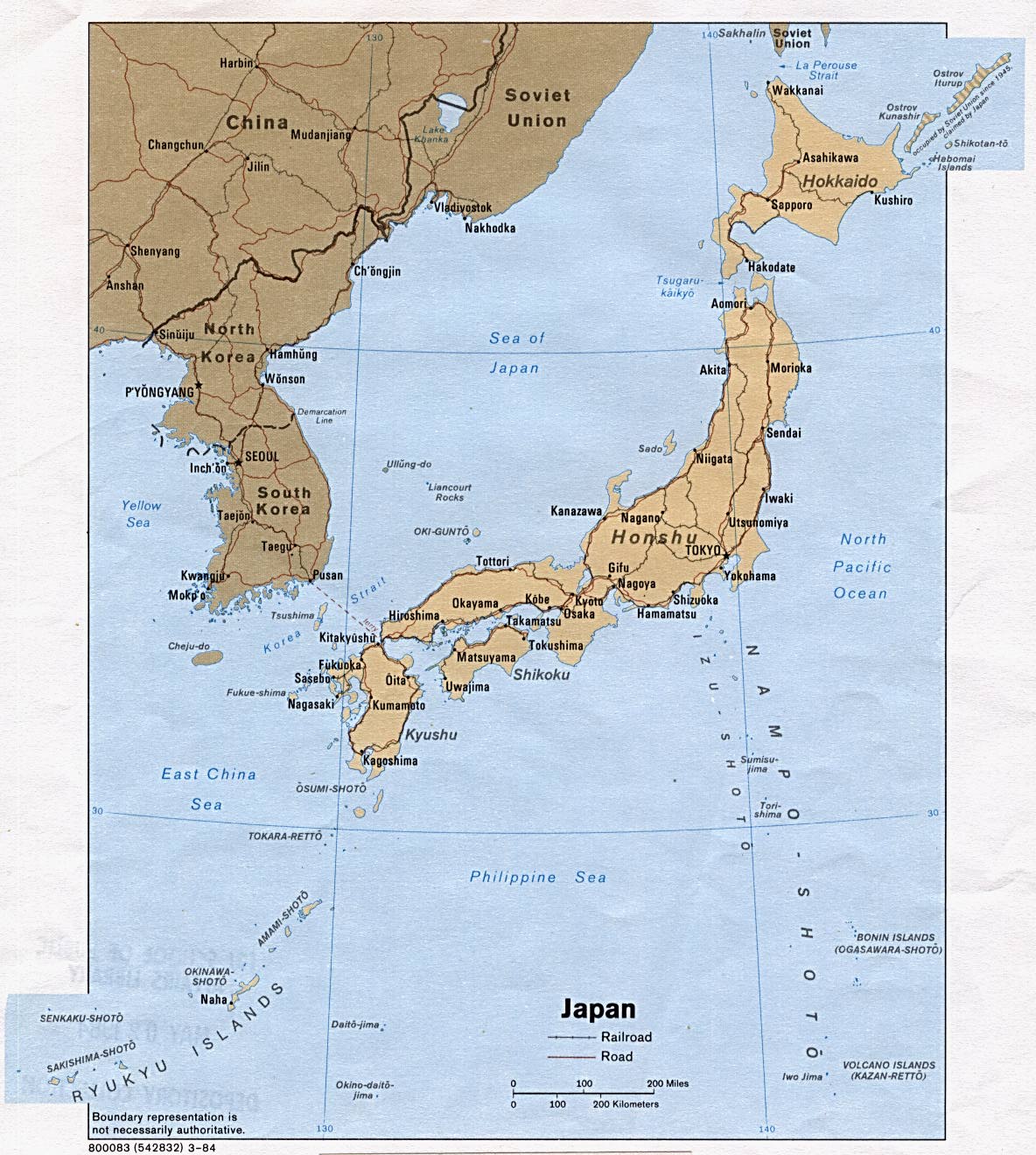
Mail to Japan can be addressed in Roman letters, with address lines written top to bottom in minor-to-major order. These mail pieces are sorted by hand upon arrival to Japan, where postal scanners handle only Kanji and Kana addresses written in major-to-minor order. A typical romanized address looks like this:
Mr. Taro Tanaka Person's name Fujitsu Limited Company name Optical Network Systems Development Department 4-1-1 Kamikodanaka Street Nakahara-ku "ku" = Ward Kawasaki-shi "shi" = City Kanagawa-ken "ken" = Prefecture 211-8588 Postal code JAPAN Country
Other suffixes include -cho
(district within a town), -chome
(zone within a district), -ban
(block within a zone), -go
(house within a block) or -biru
(large building). These subdivisions
are numbered; the street address above means 4-chome 1-ban 1-biru. Tokyo is
so big, it is called Tokyo-to
and contains -shi
of its own.
The prefecture can be omitted for large cities, as can the -shi
or
-to
suffix; thus the address above could also be written:
Mr. Taro Tanaka
Fujitsu Limited
Optical Network Systems Development
4-1-1 Kamikodanaka
Nakahara-ku, KAWASAKI
211-8588
JAPAN
Until a few years ago, the postal code was just three digits. Now the first three digits are the area and the last four are the district within the area; the 7-digit code denotes a post office.
Links:
- Japanese Postal Service
- Japan Postal Code Search System (English)
- Japan Postal Code Search System (Japanese)
- Japan Postal Information (English, Japan-Guide.Com)
SINGAPORE
[ Next ] [ Top ] [ Contents ] [ Index ] [ Home ] [ Map ]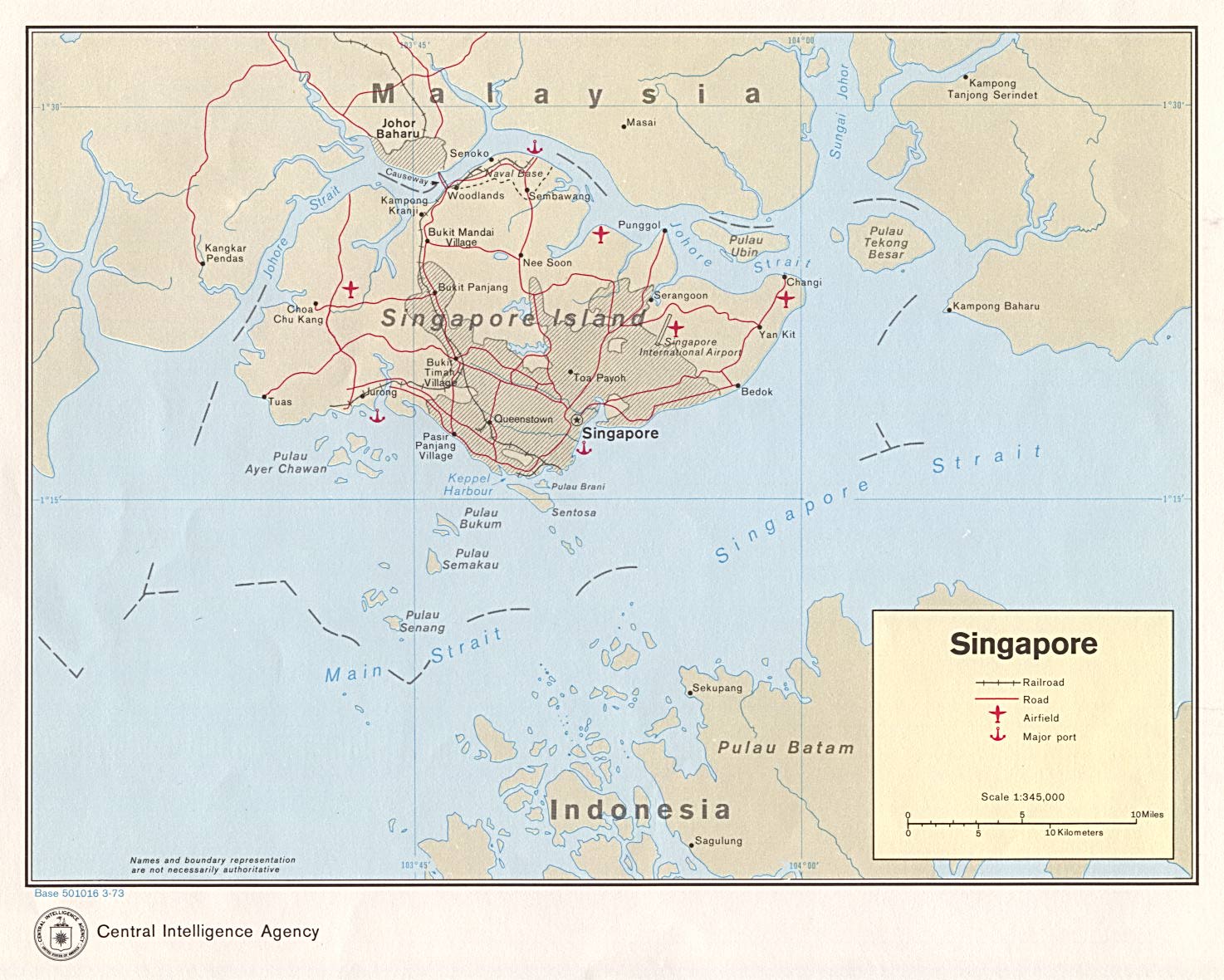
Singapore is a bit unusual in that it is a city that is also a country. And it has postal codes. (Vatican City is another such city/country.) Logically we would write Singapore addresses like this:
Person's Name
Dept of Info Systems and Computer Science
National University of Singapore
Lower Kent Ridge Road
SINGAPORE  119081
But the USPS does not want postal codes on the country line, so instead we pretend that Singapore is the city name as well as the country name:
Lower Kent Ridge Road
Singapore  119081
SINGAPORE
Singapore postal codes were changed from 4 to 6 digits in 1995. All the street signs also had to be changed, since they had 4-digit postcodes on them. Under the new system, each building in Singapore has its own unique postcode.
Link:
INDIA
[ Next ] [ Top ] [ Contents ] [ Index ] [ Home ] [ Map ]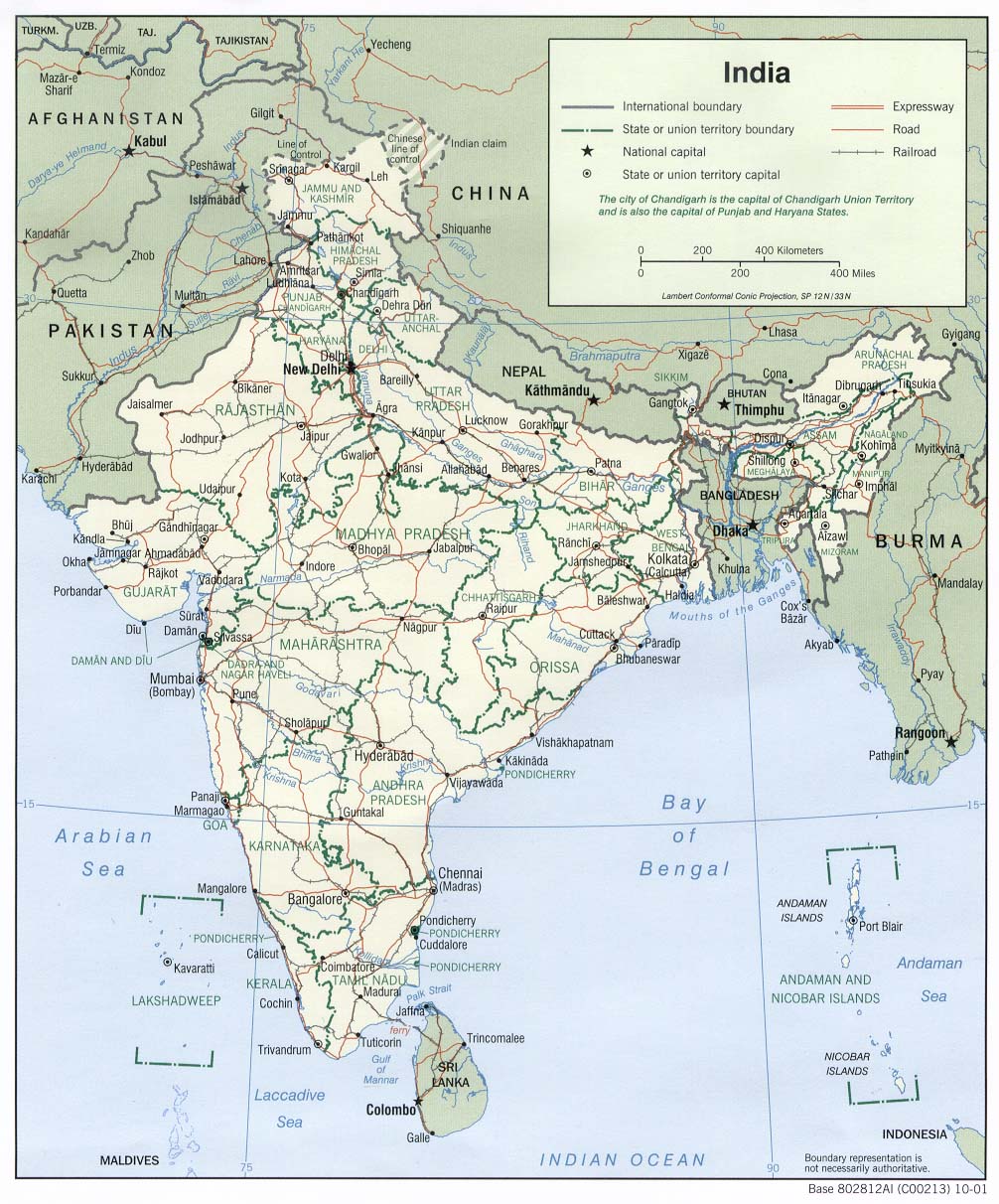
Addresses in India have city lines like town postalcode
. The postal
code (PIN, Postal Index Number) has six digits with a space in the middle:
HYDERABAD 500 032
BANGALORE 560 012
India Post recommends using BLOCK CAPITAL letters for the postal town. The state names are not used. According to Yateendra Joshi of New Delhi, "State names are totally redundant and are not required in the address at all. The post code and the delivery post office go together, as in Hyderabad 500 032 or Bangalore 560 012. Nothing but a space, ideally a dash, should come between the two. If you need to specify the state, it should come after the postal code, as in Hyderabad 500 032 Andhra Pradesh (or AP)." This was explained in more detail at the Maharashtra Postal Circle site, which shows contradictory examples such as these:
Of course when addressing mail to India from the USA, write INDIA as the final line. For the record, India has the following states (postal abbreviation shown):
AP Andhra Pradesh AR Arunachal Pradesh AS Assam BR Bihar CG Chhattisgarh GOA or GA Goa GUJ or GJ Gujarat HP Himachal Pradesh HR Haryana JK Jammu and Kashmir ?? Jharkhand KRN or KA Karnataka KER or KL Kerala MP Madhya Pradesh
MAH or MH Maharashtra MNP or MN Manipur MEG or ML Meghalaya MIZ or MZ Mizoram NLD Nagaland OR Orissa (now also called Odisha) PU or PB Punjab RAJ or RJ Rajasthan SKM or SK Sikkim TN Tamil Nadu TRP or TR Tripura UP Uttar Pradesh UA or UK Uttaranchal (now also called Uttarakhand) WB West Bengal
Plus the following union territories:
AN Andaman and Nicobar Islands CHD or CG Chandigarh DNH or DN Dadra and Nagar Haveli DD Daman and Diu DEL or DL Delhi LKP or LD Lakshadweep PDY or PY Pondicherry
Links:
- India Post
- Addressing Guidelines for India (Maharastra Postal Circle)
THE MIDDLE EAST
[ Next ] [ Top ] [ Contents ] [ Index ] [ Home ] [ Map ]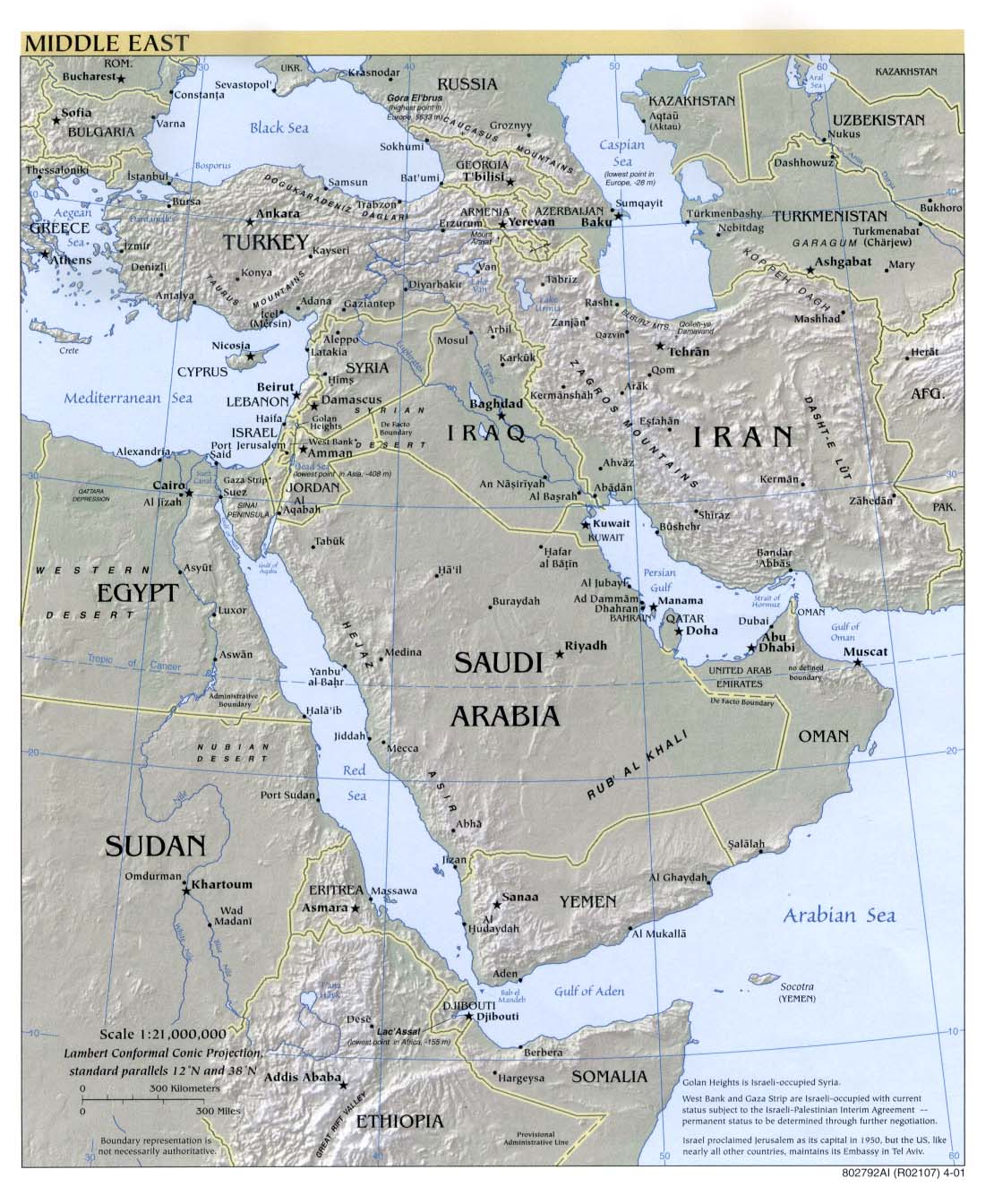
Here is a table of countries in the geographic Middle East (the Arabian Peninsula east of the Bosporus, south of Georgia, Armenia, and Azerbaijan (which are listed in the Former USSR section), plus Iran, but not including Egypt, which is listed in the Africa section because most of it is on the African continent), showing the USPS name for each country, the ISO and Car codes (as in the table for Europe), the City Line format (L stands for an uppercase letter, n stands for a numeric digit, italic words such as town are to be replaced appropriately, and punctuation and non-italic characters are literal), and a sample City Line taken, in most cases, from the Universal Postal Union. For long and other forms of the country names, see the Index. Links from country names are to postal authorities, if known, otherwise to other postal information pages for the country.
USPS Name ISO Car City Line Format City Line Example BAHRAIN (*) BH BRN nnn town 317 AL-MANAMAH IRAN (*) IR IR town nnnnn nnnnn TEHRAN 12345 67890 IRAQ IQ IRQ town BAGHDAD ISRAEL (*) IL IL nnnnnnn town 61002 TEL-AVIV JORDAN JO HKJ town nnnnn AMMAN 11937 KUWAIT KW KWT nnnnn town 54551 KUWAIT LEBANON (*) LB RL town nnnn nnnn RIAS EL SOLH BEIRUT 1107 2810 OMAN OM -- nnn town 133 MUSCAT PALESTINIAN TERRITORY (*) PS -- town GAZA CITY QATAR QA QA town DOHA SAUDI ARABIA SA SA town nnnnn RIYADH 11187 SYRIA (*) SY SYR nnnn town 0100 DAMASCUS TURKEY (*) TR TR nnnnn town 06101 ANKARA UNITED ARAB EMIRATES (*) AE UAE box
emirateP.O. BOX 111
DUBAIYEMEN YE YEM town SANA'A
Notes:
- BAHRAIN: Postcodes can be three or four digits, 100 through 12xx.
- UNITED ARAB EMIRATES: The emirates are Abu Dhabi, Ajman, Dubai, Fujairah, Ras al-Khaimah, Sharjah, Umm al-Qaiwan. Delivery is only to post office boxes.
- IRAN: Prior to 1997 Iran had 5-digit postal codes; now is converting to 10-digit codes (the code shown in the table above is made up, for lack of a genuine example). Iran's postcode page is HERE. Mail to Iran can be addressed as in this hypothetical example:
- ISRAEL: Israel postcodes went from 5 to 7 digits in March 2012 [see Wikipedia article]. The USU says the postcode goes on the left; the Israel Post website offers no guidance. Searching the Web for Isreali postal addresses written in the Roman alphabet shows examples with the postcode on the left, and others with the postcode on the right.
- IRAN: Iranian addresses are written in
major to minor
order, town at the top, followed by street address, then addressee. The postal code is important because there are many cases of duplicate street names in the same city, even a few duplicate building numbers in the same street. 10 digit postcodes are needed to identify the correct location in such cases.تهران خیابان آزادی، خیابان خوش شمالی کوچهی گلافشان، پلاک ۱۲، شبقهی ۲ آقای کامران شفیعی کد پستی ۱۲۳۴۵۶۷۸۹۰ IRAN
- LEBANON: The post code can be either four digits (rural areas)
or two groups of four digits (cities).
- PALESTINIAN TERRITORY: Perhaps it will be helpful to specify not only
the name of the city or town, but also WEST BANK or GAZA.
Update
(July 2017):
All mention of Palestine was dropped from the IMM at some
point since I wrote the previous sentence. The USPS now offers no guidance
whatsoever as to how to send mail from the USA to the West Bank or Gaza.
This is evidently the result of USA-Israeli politics in action; see
this
article from 2011. It should be noted that the USA recognizes Israel's
authority over the Palestinian territories and therefore from the US
government's point of view, those territories simply do not exist as
independent political entities. This leaves us with several possibilities:
- Mail addressed to PALESTINIAN TERRITORY is delivered as before.
- Mail addressed to PALESTINIAN TERRITORY is returned to the sender.
- Mail addressed to PALESTINIAN TERRITORY is thrown away.
Another possibility is to put ISRAEL at the bottom of the address:
WEST BANK (or GAZA)
PALESTINIAN TERRITORY
ISRAEL
Or perhaps without PALESTINIAN TERRITORY:
WEST BANK (or GAZA)
ISRAEL
The same three possibilities exist in both of these cases. I would suggest that someone in the USA who has contacts in the West Bank and/or Gaza try sending mail using these address formats and see what happens; report back to me, and I will update this material.
- SYRIA: Information about postcode system is preliminary (from UPU).
- SYRIA, IRAQ, AFGHANISTAN, YEMEN, etc:
Due to wars and blockades in many areas mail delivery is problematic.
- TURKEY: Might also be considered European or Asian. The TURKISH REPUBLIC
OF NORTHERN CYPRUS currently must be addressed through through
Mersin 10, TURKEY
, Mersin being the neighbouring Turkish province, with the10
implying that Cyprus is its tenth county.
AFRICA
[ Next ] [ Top ] [ Contents ] [ Index ] [ Home ] [ Map ]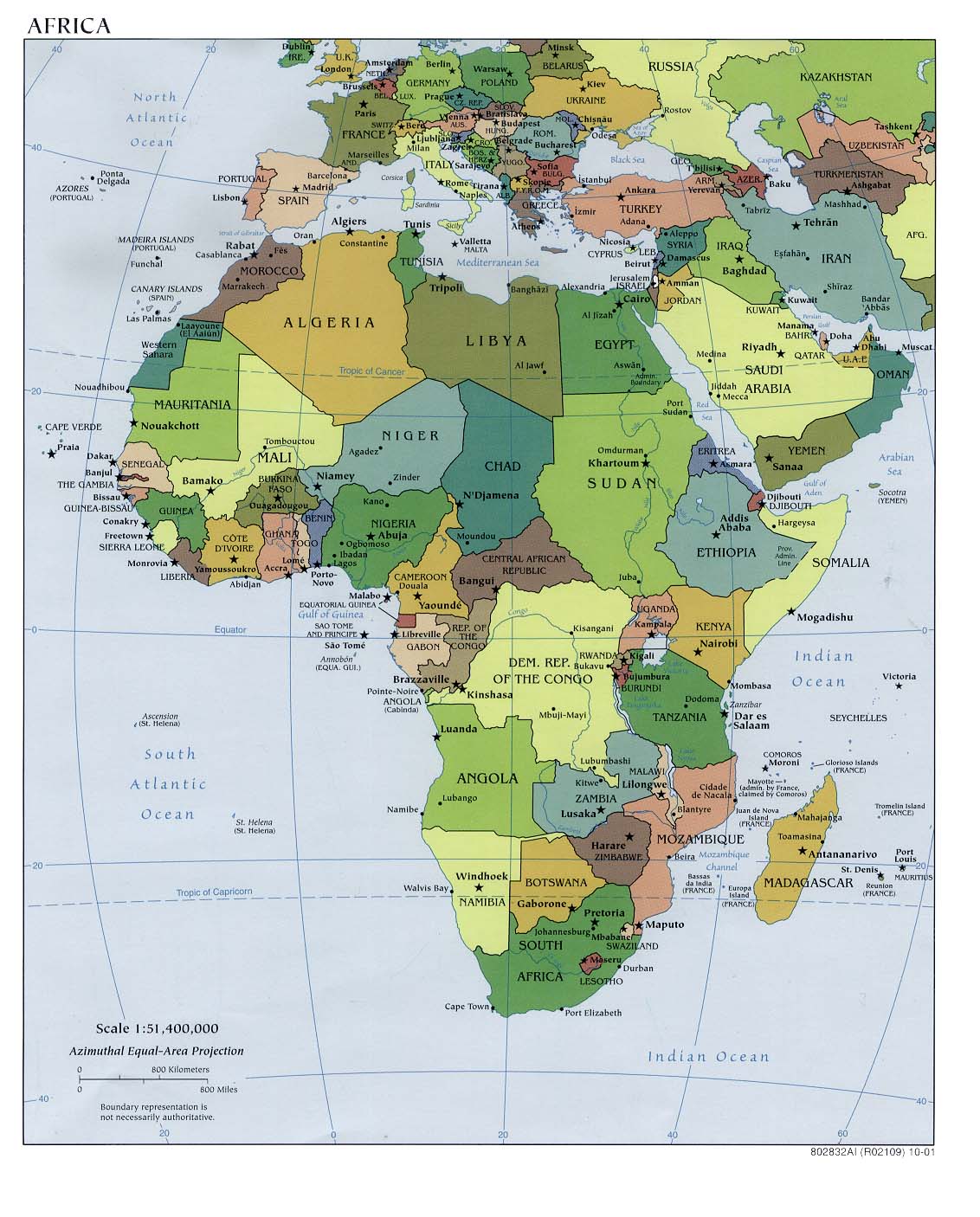
A table of countries of continental Africa and nearby island nations follows, showing the USPS name for each country, the ISO and Car codes (as in the table for Europe; these codes do not seem to be used in African postal addresses), the City Line format (L stands for an uppercase letter, n stands for a numeric digit, italic words such as town are to be replaced appropriately, and punctuation and non-italic characters are literal), and a sample City Line taken, in most cases, from the Universal Postal Union. For long and other forms of the country names, see the Index. Links from country names are to postal authorities, if known.
USPS Name ISO Car City Line Format City Line Example ALGERIA DZ DZ nnnnn town 16027 ALGIERS ANGOLA AO -- town LUANDA BENIN BJ DY nn BP nnnn
town03 BP 1000
COTONOUBOTSWANA BW RB town GABORONE BURKINA FASO BF -- town nn OUAGADOUGOU 01 BURUNDI BI RU town BUJUMBURA CAMEROON CM CAM town YAOUNDE CAPE VERDE CV -- nnnn town
island7600 PRAIA
SANTIAGOCENTRAL AFRICAN REPUBLIC CF RCA town BANGUI CHAD TD TCH town NDJAMENA COMOROS KM -- town MORONI DJIBOUTI DJ -- town DJIBOUTI CÔTE D'IVOIRE (*) CI CI BP nn.. town zone BP 37 ABIDJAN 06 DEMOCRATIC REPUBLIC OF THE CONGO CD RCB town zone KINSHASA 1 EGYPT EG ET town
nnnnnCAIRO
11511EQUATORIAL GUINEA GQ -- town MALABO ERITREA ER -- town ASMARA ETHIOPIA ET ETH nnnn town 1000 ADDIS ABABA GABON GA GA nn town zone 05 TCHIBANGA 01 GAMBIA GM WAG town BANJUL GHANA GH GH town ACCRA GUINEA GN RG town CONAKRY GUINEA-BISSAU GW -- nnnn town 1011 BISSAU KENYA KE EAK town
nnnnnNAIROBI
00100LESOTHO LS LS town nnn MASERU 100 LIBERIA LR LB nnnn town zone 1000 MONROVIA 10 LIBYA LY LAR town TRIPOLI MADAGASCAR MG RM nnn town 101 ANTANANARIVO MALAWI MW MW town BLANTYRE MALI ML RMM town BAMAKO MAURITANIA MR RIM town NOUAKCHOTT MAURITIUS MU MS town nnnnn 73120
HenriettaMAYOTTE YT -- nnnnn town 97610 DZAOUDZI MOROCCO MA MA nnnnn town 20050 CASABLANCA MOZAMBIQUE MZ MOC nnnnn town 00300 MAPUTO NAMIBIA NA NAM town
nnnnnSWAKOPMUND
13001NIGER NE RN nnnn town 8001 NIAMEY NIGERIA NG WAN town nnnnnn ABUJA 900001 REPUBLIC OF THE CONGO CG -- town BRAZZAVILLE REUNION (*) RE -- nnnnn town 97410 SAINT PIERRE RWANDA RW RWA town KIGALI SAO TOME AND PRINCIPE ST -- town RIBEIRA AFONSO SENEGAL SN SN town 12524 DAKAR SEYCHELLES SC SY town MAHE SIERRA LEONE SL WAL town FREETOWN SOMALIA SO SO town MOGADISHU SOUTH AFRICA ZA ZA town
nnnnCAPE TOWN
7945SOUTH SUDAN* SS SSD town JUBA SUDAN SD SUD nnnnn
town11111
KHARTOUMSWAZILAND SZ -- town
LnnnMBABANE
H100TANZANIA TZ EAT town DAR ES SALAAM TOGO TG TG town LOME TUNISIA TN TN nnnn town 1030 TUNIS UGANDA UG EAU town KAMPALA WESTERN SAHARA EH -- (Address through Morocco) ZAMBIA ZM RNR nnnnn town 10101 LUSAKA ZIMBABWE ZW ZW town HARARE
Do not write AFRICA next to or under the country name.
According to the Universal Postal Union, the following African countries write the postal code on a line by itself: BENIN, CAPE VERDE, EGYPT, KENYA, MAURITIUS, SOUTH AFRICA, SUDAN, and SWAZILAND, as shown in the table. This is OK with the USPS, but in case it conflicts with your record-keeping or database requirements, it is probably OK to include the postal code in the City Line.
Notes:
- CÔTE D'IVOIRE city lines include a post office box (BP) and a
delivery zone. The length of the PO Box number is variable. The zone is two
digits for regular post-office box delivery, or 3 digits (starting with 1) to
indicate direct building delivery. Note that CÔTE D'IVOIRE (complete
with circumflex accent) is the USPS spelling for this country, but it's OK
(and perhaps even safer) to omit the circumflex, since I doubt the USA
postal sorters are programmed for accents.
- EGYPT POST...
This site does not work well except with Internet Explorer. A previous
version of the site had a postcode lookup area (Arabic only) but if the new
site has one, I can't find it. (November 2011, this link doesn't work any
more, I can't find any English pages on the site.)
- MAYOTTE is a Territorial Collectivity of France and uses French postcodes.
It is the island in the Comoros that voted to stay French when the others
voted for independence, but the UN supports the Comoros' claim to the island.
MAYOTTE is recognized as a country name by the USPS.
- NAMIBIA does not have postal deliveries. People have PO Boxes and
institutions have Private Bags. Mail to street addresses is returned to
the sender. Examples of valid addresses:
Dr E.W. Lisse
PO Box 1684
Swakopmund
NAMIBIADr E.W. Lisse
Oshakati State Hospital
Private Bag X5501
Oshakati
NAMIBIANOTE: Postcodes were instituted after these examples were given. The 5-digit postcode goes on a line by itself between the town name and the country name.
- REUNION is a Department of France and uses French postcodes.
- SOUTH SUDAN became an independent country July 9, 2011, and was admitted to the United Nations on July 13, 2011. As of July 2017, SOUTH SUDAN is still not listed in the USPS International Mail Manual, it's not clear if mail can be sent there from the USA, and if so, whether the name of country should be SOUTH SUDAN, SOUTHERN SUDAN, or something else.
Links:
- South Africa Post Code Lookup
- Namibia Post Code Lookup (Namibia Post Limited: Nampost)
- Namibia postal address format (Universal Postal Union)
Quiz Question 2: If a person from Nigeria is a Nigerian, then what is someone from Niger?
ATLANTIC AND PACIFIC
[ Next ] [ Top ] [ Contents ] [ Index ] [ Home ]The following table shows localities in the Atlantic and Pacific oceans that are listed in the USPS International Mail Manual as primary destinations. Those which lack an ISO code are not listed in ISO 3166, and therefore are not countries by the ISO's definition, but some that have codes (e.g. French Polynesia, New Caledonia) are not countries either, but parts or dependencies of other countries such as France. See INDEX for full and other country names.
Not listed are the following United States territories and possessions, which are addressed as if they were states of the USA: Baker Island, Eastern Island, Guam, Howland Island, Koror, Manua Islands, Marshall Islands, Micronesia, Midway, Navassa Island, Northern Mariana Islands, Pago Pago, Palau, Saipan, and Tinian.
USPS Name ISO Car City Line Format City Line Example ASCENSION -- -- town
uk-postcodeGEORGETOWN
ASCN 1ZZAZORES -- -- nnnn-nnn town 9500-310 PONTA DELGADA CANARY ISLANDS -- -- nnnnn town - island 35008 Las Palmas - Gran Canaria FIJI FJ FJI town SUVA FRENCH POLYNESIA PF -- nnnnn town - island 98714 PAPEETE - TAHITI KIRIBATI KI -- town, island BAIRIKI, TARAWA NAURU NR -- district DISTRICT YAREN DISTRICT NEW CALEDONIA NC -- nnnnn town 98841 NOUMEA CEDEX PAPUA NEW GUINEA PG PNG town nnn province BOROKO 111 NCD PITCAIRN ISLAND PN -- post-office-box P.O. BOX N SAINT HELENA -- -- town
uk-postcode JAMESTOWN
STHL 1ZZSOLOMON ISLANDS SB -- town HONIARA SOUTH GEORGIA GS -- town
uk-postcode GRYTVIKEN
SIQQ 1ZZTONGA TO -- town NUKU'ALOFA TRISTAN DA CUNHA -- -- town
uk-postcodeEDINBURGH
TDCU 1ZZTUVALU TV -- town FUNAFUTI VANUATU VU -- town PORT VILA WALLIS AND FUTUNA ISLANDS WF -- nnnnn town 98600 UVEA WESTERN SAMOA WS WS town APIA
Don't write SOUTH PACIFIC, SOUTH ATLANTIC, or any similar hints under the country name (despite advice to the contrary from addressees in those localities).
Notes:
- ASCENSION (Ascension Island) and TRISTAN DA CUNHA are dependencies of
SAINT HELENA (where Napolean Bonaparte was exiled in 1815). Saint Helena and
its dependencies are a South Atlantic overseas territory of the British Crown.
As of May 2003, Saint Helena has UK postcode STHL 1ZZ and Ascension
ASCN 1ZZ.
- Locations in the AZORES can be addressed as if they were in Portugal,
complete with Portuguese postcodes. If you write PORTUGAL instead of AZORES
as the country name, the mail is delivered through Portugal. If you write
AZORES, presumably it goes direct to the Azores (which are in the
mid-Atlantic). Other Portuguese islands in the area such as Madeira,
however, must be addressed through Portugal.
- Locations in the CANARY ISLANDS (Las Islas Canarias) can be
addressed as if they were in Spain, complete with Spanish postcodes. If you
write SPAIN instead of CANARY ISLANDS as the country name, the mail is
delivered through Spain. If you write CANARY ISLANDS, presumably it goes
direct to the Canaries (which are in the mid-Atlantic). The island name
can be omitted for Las Palmas. You can also write
de
between the town and island names instead of a hyphen. - FRENCH POLYNESIA islands are Borabora, Gambier, Hivaoa, Huahine,
Marquesas, Moorea, Nukahiva, Raiatea, Rapa, Society Islands, Tahaa, Tahiti,
Tuamotou, Tubai.
- KIRIBATI (formerly the Gilbert, Canton and Christmas Islands) has three
units (Gilbert Islands, Line Islands, Phoenix Islands), six districts (Banaba,
Central Gilberts, Line Islands, Northern Gilberts, Southern Gilberts, Tarawa),
and 21 inhabited islands (Abaiang, Abemama, Aranuka, Arorae, Banaba, Beru,
Butaritari, Kanton, Kiritimati, Kuria, Maiana, Makin, Marakei, Nikunau,
Nonouti, Onotoa, Tabiteuea, Tabuaeran, Tamana, Tarawa, Teraina).
- MICRONESIA (THE FEDERATED STATES OF MICRONESIA) – Pohnpei
(Ponape), Chuuk (Truk) Islands, Yap Islands, and Kosrae – is/are
addressed through the USA postal system as FEDERATED
MICRONESIA (FM).
- NEW CALEDONIA and WALLIS AND FUTUNA use the French postcode system.
- PAPUA NEW GUINEA provinces:
Bougainville, Central, Chimbu, Eastern Highlands, East New Britain, East
Sepik, Enga, Gulf, Madang, Manus, Milne Bay, Morobe, National Capital, New
Ireland, Northern, Sandaun, Southern Highlands, Western, Western Highlands,
West New Britain.
- PITCAIRN ISLAND (a British Overseas Territory and home of the descendents of the Bounty mutineers
and their wives) normally receives mail through New Zealand about four
times a year. Yet it is listed as a primary destination by the USPS; I
suppose the mail is simply delivered to New Zealand. There is only one town
– Adamstown – so town names or street addresses don't seem to be
needed or used; you can address people by name or PO Box. Ted Cookson (who has visited every country
in the world, and who has been to Pitcairn three times) reports:
Adamstown is the only settlement on Pitcairn. The longboats are kept at Bounty Bay, which is down the Hill of Difficulty from Adamstown. But no one lives at Bounty Bay. Actually, there are only about 45 people on the island these days anyway. In spite of all the talk over the years, there is still no airport on Pitcairn and will not be one in the short-term. And there is no shipping service from the U.S. to Pitcairn. Cruise ships call from four to six times a year. Expensive yachts also go to Pitcairn now and again from Mangareva in French Polynesia. The islanders arrange for freight to be delivered to the island once or more annually on ships which normally originate in New Zealand and stop off en route to the Panama Canal. Mail is carried on all of these vessels.
- SOUTH GEORGIA is the USPS name for South Georgia and the South Sandwich Islands, a British Overseas Territy in the South Atlantic.
The Pacific islands are sometimes assigned to three groups: MELANESIA (Papua New Guinea, Bougainville, the Solomon Islands, Vanuatu, New Caledonia, Fiji), MICRONESIA (the Federated States of Micronesia – Pohnpei, Kosrae, Chuuk and Yap – plus Guam, Palau, Saipan, the Marshall Islands, Kiribati), and POLYNESIA (Samoa, Tonga, Tahiti, Hawaiʻi, Cook Islands, etc, and by some accounts New Zealand). The three groups together are known as OCEANIA. These classifications have nothing to do with postal addressing and should not be used in postal addresses.
New Caledonia and Tahiti are Overseas Territories of France, not Overseas Departments, and are slightly more autonomous. Hence the fact that they have their own postal administrations from La Poste, and issue their own stamps – French postcodes are comparatively recent introductions. They even have their own currency, the French Pacific Franc.
Also see:
BRITAIN AND IRELAND
[ Next ] [ Top ] [ Contents ] [ Index ] [ Home ] [ Map ]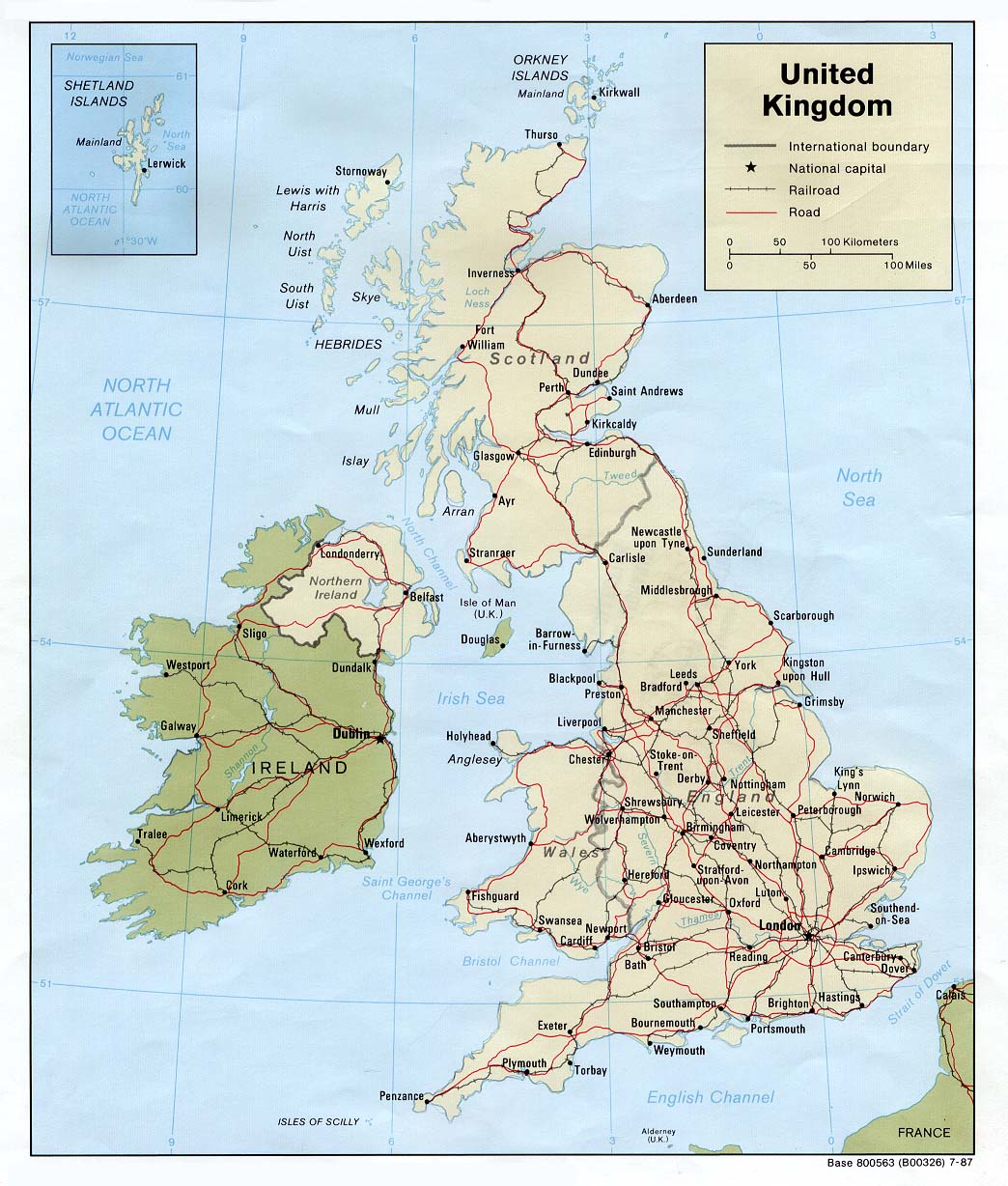
King George, You Have Mail!
Where to find the most confusing addresses on earth...
What should be the name of this section? THE UNITED KINGDOM AND IRELAND (as it was once labeled), while technically correct if IRELAND is taken as the name of the country and not the island, can easily be misconstrued. THE UNITED KINGDOM AND THE REPUBLIC OF IRELAND would not be correct since there is no country whose name is REPUBLIC OF IRELAND. THE UNITED KINGDOM AND ÉIRE is correct (two non-overlapping countries) but it contains a mixture of languages. Hence BRITAIN AND IRELAND (two non-overlapping islands) – perhaps not quite adequate either since it might not encompass the various associated outlying islands.
Let's begin by reviewing the terminology:
- BRITAIN, the largest island in the archipelago just north of France; the
island of Britain contains three countries: ENGLAND, SCOTLAND, and WALES.
- ENGLAND is one of the countries of Britain.
- SCOTLAND is one of the countries of Britain.
- WALES is one of the countries of Britain.
- NORTHERN IRELAND is a jurisdiction having approximately the same status as
England, Scotland, and Wales, but on a different island.
- The UNITED KINGDOM is the union of England, Scotland, Wales, and
Northern Ireland, including whatever islands are also included in those
countries. The full name of the United Kingdom is THE UNITED KINGDOM OF
GREAT BRITAIN AND NORTHERN IRELAND. The United Kingdom itself is a country.
Thus it is a country that is made up of four countries. A country made of
countries might seem a paradox, yet the countries that make up the UK,
especially England, Scotland, and Wales, do not think of themselves as
anything less; Scotland has its own Parliament and banknotes, Wales has its
own language and National Assembly, all three have national identities going
back more than a thousand years, and the Encyclopedia Britannica calls them
countries (next item). Perhaps more to the point, ENGLAND, SCOTLAND, WALES,
and NORTHERN IRELAND are listed in the USPS Index of Countries and
Localities. The name UNITED KINGDOM was first used in 1801 and the full
name was THE UNITED KINGDOM OF GREAT BRITAIN AND IRELAND. In 1922, after
Irish independance, the name changed to UNITED KINGDOM OF GREAT BRITAIN AND
NORTHERN IRELAND.
- GREAT BRITAIN is a term that means different things to different people.
Canada Post uses it as their only recognized name for the United Kingdom.
Webster's dictionary defines
Britain
asthe island of Great Britain
, and defines Great Britain as(a) island comprising England, Scotland, and Wales, or (b) United Kingdom
(which in turn is defined to include Northern Ireland). The Encyclopedia Britannica says "Technically, Great Britain is one of the two main islands that make up the British Isles. By this definition it includes the countries of England, Scotland, and Wales. Popularly, Great Britain is the shortened name for the United Kingdom of Great Britain and Northern Ireland." The OED says that Great Britain isthe whole island containing England, Wales, and Scotland, with their dependencies
. William Wallace says, however, that the termis actually a remnant of the Norman Conquest times, and was used to distinguish between Large Britain (Grande Bretagne) and Little Britain (Petite Bretagne, Brittany). It has nothing to do with Empire or world domination and simply refers to the time when the island was administered and fought over by the French.
In any case, the ambiguity of the term Great Britain – is it a country, an island, or a group of islands? – suggests it is best avoided. - BRITTANY is a region and former province of northwestern of France,
mentioned here only to add to the confusion. It is home to the Bretons,
Britons who fled from the Anglo-Saxon invasion of Britain in the 5th and 6th
centuries and who renamed the place
Little Britain
, and who speak a Celtic language, also called Breton, similar to Welsh and Cornish. The French name of Brittany is Bretagne; the Breton name is Breiz. Bretagne became part of France in 1532. Some say that Breton and Welsh fisherfolk can chat with each other in their closely related languages. - The BRITISH ISLES is another unclear geographical term denoting
(according to both Webster and the OED) Great Britain, Ireland, and the
adjacent islands, including the Isle of Man
and the Channel Islands. Another term to avoid, since the Irish do not
consider their island a British isle. A better term would be
The Islands of Britain and Ireland
. BRITISH ISLES is sometimes used in postal addresses, but only within the UK postal system, e.g. when sending mail from England to the Isle of Man (the USPS does not recognize the term, and does not need it, as explained below). - The CROWN DEPENDENCIES include the Isle of
Man and the Channel Islands, which are self-governing, and not part of the
UK. Opinions are divided as to whether these and other
adjacent islands
such as the Scottish islands (Outer Hebrides) are alsoBritish Isles
or part ofGreat Britain
(see conflicting definitions above). - The UNITED KINGDOM AND ISLANDS refers to England, Scotland, Wales,
Northern Ireland, the Isle of Man, and the Channel Islands.
- The BRITISH ISLANDS, as (re)defined in the Interpretation Act 1978, is
synonymous with UNITED KINGDOM AND ISLANDS. (But be careful: in the Western
Hemisphere, sometimes this term is used to refer to the British Virgin Islands
and possibly other Caribbean Commonwealth countries such as Jamaica, Bahamas,
and Bermuda, and territories such as the Cayman Islands.)
- The BRITISH EMPIRE is a historical term –
The sun never sets on the British Empire;
the monarch was... Britt. Omn. Rex (or Regina) F.D. et Ind. Imp.
(King or Queen of All the Britons, Defender of the Faith, and Emperor/Empress of India). Included in the British Empire, at one time or another, were Ireland, Canada, Australia, New Zealand, parts of the USA; Guyana (as British Guyana), Belize (as British Honduras), the British West Indies, Jamaica, Bermuda, the Bahamas; Egypt, Iraq, Israel (as Palestine); Sri Lanka (as Ceylon), India, what are now Pakistan and Bangladesh, Myanmar (as Burma), Hong Kong, Singapore, Malaysia (as Malaya), Brunei Darussalam, Malawi (Nyasaland), South Africa, Zambia and Zimbabwe (as Rhodesia), Nigeria, Sierra Leone, Ghana, Kenya, Tanzania (as Tanganyika and Zanzibar), Uganda, ... you name it. Most of these countries gained their independence after World War II (some earlier) but many of them remained in the Commonwealth (next item). - THE COMMONWEALTH ("a unique
family of 54 nations", formerly known as the British Commonwealth) includes
the United Kingdom, plus the Crown Dependencies (the Channel Islands, the
Isle of Man), plus former colonies Canada, Australia, New Zealand, the
Bahamas, Barbados, Jamaica, India, Pakistan, Bangladesh, Belize, Ghana,
Grenada, Kenya, Nigeria, South Africa, Uganda, etc, as well as at least one
country – Moçambique (Mozambique) – that was never a
British colony. The non-UK, non-Dependency parts of the Commonwealth do not
use UK postal codes because they are independent countries.
- The BRITISH OVERSEAS TERRITORIES are Anguilla, Bermuda, British Antarctic
Territory, British Indian Ocean Territory, British Virgin Islands, Cayman
Islands, Falkland Islands, Gibraltar, Montserrat, Pitcairn, Saint Helena and
its Dependencies, South Georgia and the South Sandwich Islands, and the Turks
and Caicos Islands. The Overseas
Territories are not members of the Commonwealth because they are not
independent countries. Each Overseas Territory is a separate jurisdiction
with its own postal addressing arrangements; some of them participate in
the UK postcode system.
- IRELAND is an independent country, since the proclamation of the Irish
Republic in 1916 and the ensuing struggle. Prior to that Ireland was ruled by
England (and before that, like much of England itself, by Vikings, but
unlike England, never by the Romans or Normans). Ireland's capital is Dublin.
Ireland is not part of the United Kingdom or the Commonwealth. IRELAND is
also an island presently containing two countries: IRELAND (ÉIRE) and
NORTHERN IRELAND. Some might prefer to say that IRELAND is an island
and a country which happens, at present, to be artificially divided.
- ULSTER is a region (formerly a kingdom) containing all of NORTHERN
IRELAND, plus Counties Cavan, Donegal, and Monaghan in IRELAND. Thus
contrary to popular belief,
Ulster
is not a proper synonym for Northern Ireland.
Here's a summary table for the Islands of Britain and Ireland, the Crown Dependencies, and the British Overseas Territories. The notation and formats used are the very latest recommended by Royal Mail (except Ireland, which has nothing to do with Royal Mail). As always, links are to the appropriate postal authorities. British Antarctic Territory is not included because "you can't get there from here" (the USPS does not recognize it as a destination). Similarly for the British Indian Ocean Territory (Diego Garcia, etc), Akrotiri and Dhekelia (on Cyprus), etc, which are SBAs (Sovereign Base Areas) under British military jurisdiction, so use BFPO numbers. Akrotiri is BFPO 57 and Dhekelia BFPO 58. BFPO has assigned a number of 485 to Diego Garcia as a part of a numbering system for Royal Navy ships; the "ship" is Naval Party (NP) 1002. NP 1002 is not an actual vessel, but the the name for the group of Royal Navy and Royal Marines who run the civilian government on Diego Garcia. They are headed by a Royal Navy officer who represents Britain on the island. The US Navy describes the situation better here. The BFPO number is here.
USPS Name ISO Car City Line Format City and Country Line Example ALDERNEY GB GBA island uk-postcode ALDERNEY
GY9 3UX
CHANNEL ISLANDSANGUILLA AI -- town THE VALLEY
ANGUILLAASCENSION ?? -- town
uk-postcode TWO BOATS VILLAGE
ASCN 1ZZ
ASCENSIONBERMUDA BM -- town LL nn Hamilton HM 12
BERMUDABRITISH VIRGIN ISLANDS VG -- town, island Road Town, Tortola, VG1110
BRITISH VIRGIN ISLANDSCAYMAN ISLANDS KY -- po-box
island KYn-nnnnP.O. Box 123 SAV
Grand Cayman KY1-1010
CAYMAN ISLANDSENGLAND GB GB town
uk-postcode MANCHESTER
M8 8LG
ENGLANDFALKLAND ISLANDS
(Las Malvinas, also claimed by Argentina)FK -- town
uk-postcode PORT HOWARD
FIQQ 1ZZ
FALKLAND ISLANDSGIBRALTAR GI GBZ town IRISH TOWN
GX11 1AA
GIBRALTARGUERNSEY GB GBG town
islanduk-postcode ST. PETER PORT
GUERNSEY
GY1 1FD
CHANNEL ISLANDSISLE OF MAN GB GBM town uk-postcode DOUGLAS
IM99 1PB
ISLE OF MANIRELAND IE IRL town, Co. county BALLINROAMIN, THURLES
CO. TIPPERARY
A65 TF12
IRELANDJERSEY GB GBJ town
islanduk-postcode ST. HELIER
JERSEY
JE4 8NF
CHANNEL ISLANDSMONTSERRAT MS -- town OLD TOWNE
MONTSERRATNORTHERN IRELAND GB GB town uk-postcode BELFAST
BT6 9HQ
NORTHERN IRELANDPITCAIRN ISLAND PN -- post-office-box P.O. BOX N
PITCAIRN ISLANDSARK GB GBG island uk-postcode SARK
GY9 OSF
CHANNEL ISLANDSSCOTLAND GB GB town
uk-postcode GLASGOW
G21 2LH
SCOTLANDSAINT HELENA SH -- town
uk-postcode JAMESTOWN
STHL 1ZZ
SAINT HELENASOUTH GEORGIA GS -- town
uk-postcode GRYTVIKEN
SIQQ 1ZZ
SOUTH GEORGIATRISTAN DA CUNHA -- -- town
uk-postcodeEDINBURGH
TDCU 1ZZ
TRISTAN DA CUNHATURKS AND CAICOS ISLANDS TC -- town Providenciales
TURKS AND CAICOS ISLANDSWALES GB GB town
uk-postcode CARDIFF
CF23 6DS
WALES
Also see:
- What is the UK? by Don Aitkin
- Know Britain: Great Britain, the United Kingdom, the British Isles
- About Ireland
- Find Postcodes and Properties Across UK (zestate.co.uk)
ENGLAND
Mail to England proper, by the definition above, is sent to ENGLAND. Traditional English addresses tend to have lots of parts that we are not used to seeing, like:
Person's Name
Eden Cottage
May's Green, Harpsden
Henley-on-Thames, Oxon  RG9 4AJ
ENGLAND
Eden Cottage (Name of House) is in May's Green, which is a Hamlet (or in Royal Mail terminology, a Double Dependent Locality Name: a collection of 5-20 houses) in the Village of Harpsden, which is served by the Postal Town, Henley, which is on the river Thames, in the County of Oxfordshire (CLICK HERE for a table of counties, and to find out why Oxon is an abbreviation for Oxfordshire) and the Post Code is RG9 4AJ. The postal town should be written in uppercase and, as noted above, current practice seems to favor omitting the county, since counties are a moving target anyway. (It's difficult for Americans to comprehend the constant reshuffling of British counties, given the immutability of our own states, not to mention the fanatical cultural nationalism surrounding statehood :-) (Apparently, it is also difficult for some Britons.)
Recently Royal Mail (the British postal service) has been updating its
addressing standards and recommendations.
The Royal Mail website includes an Address Management
page (referenced
below) that summarizes the new format. Since it is a web page, it is likely
to disappear at any moment, so I've taken the liberty of reproducing its
summary table, titled What Is a Correct Postal Address?
:
Information Required? Example Name of addressee (Title, initials, surname) As applicable Mr. A. Smith Company/organization As applicable Acme Plc Building name Yes (except if it has a number) Acme House Number of building and name of street or road Yes 3 High Street Additional locality information Yes (only where similar road name exists within a post town area) Hedle end Post town (capital letters) Yes SOUTHAMPTON County A County address isn't required, provided the post town and postcode are included. Hampshire Postcode (capital letters) Yes SO32 4NG
Thus the example address given previously would now be written like this:
Person's Name
Eden Cottage
May's Green, Harpsden
HENLEY-ON-THAMES
RG9 4AJ
ENGLAND
…except that…... for our purposes (sending mail from the USA to these other places), we have to follow the guidelines of our own postal system, the USPS, which, as noted at the beginning of this document, prefers to have the City Line immediately preceding the country line:
Person's Name
Eden Cottage
May's Green, Harpsden
HENLEY-ON-THAMES  RG9 4AJ
ENGLAND
This can be seen in Issue 37, June 2010 (the current issue when this sentence was last edited) of the International Mail Manaual, Section 122, which shows this example:
MR THOMAS CLARK
117 RUSSELL DRIVE
LONDON W1P 6HQ
GREAT BRITAIN
(Recall that USPS treats ENGLAND, GREAT BRITAIN, and UNITED KINGDOM as synonyms.)
A source at Royal Mail comments as follows: "Your 'what is a correct postal address?' is a good find. In fact, I could be pedantic and point out that it's possible to have two levels of street information, and two levels of additional locality information. It's even possible to have two levels of building name, but that's rare indeed! All this might amount to information overload, but if you want the definitive list of bits that make up an address as far as Royal Mail is concerned, it goes:
Item Remarks Name details In fact Royal Mail takes no interest in the name and keeps no record on its address database Organisation Name Department Name Name of Building Possibly two lines thereof Building Number and name of street or road There can be two street names, one so-called 'secondary thoroughfare' which, if present, comes first) Additional locality names (possibly two thereof, each on its own line) Post Town ALL UPPERCASE County Royal Mail doesn't recommend the use of county, and in addresses from Royal Mail including the database extracts we sell it is never used. Postcode ALL UPPERCASE Country ALL UPPERCASE
"There is also a different format of address when there is a PO Box. In such cases it is:
Item Remarks Name details Organisation Name Department Name PO Box nnnnnn Post Town ALL UPPERCASE Postcode ALL UPPERCASE Country ALL UPPERCASE
"In both cases, the only mandatory elements of the address are Post Town and Postcode. Of course without some sort of street or PO Box details the address is incomplete and some of them must be present, but the rules for valid combinations are exceptionally complicated - as you imply with your wonderful 'where to find the most confusing addresses on earth' introduction."
Royal Mail's recommendation to omit the county from the address is not without controversy; some Britons prefer to keep it, and in fact insist on doing so.
The UK postcode system is shared by England, Scotland, Wales, the Crown Dependencies, and certain of the Overseas Territories. UK postcodes follow these patterns (A = Alphabetic Letter, N = Numeric Digit):
AN NAA
AAN NAA
ANA NAA
ANN NAA
AANN NAA
AANA NAA
Note that all start with a letter, have at least one digit in the first part, and all end with a space and then NAA. These are the rules, and the following are the exceptions that prove them:
GIR 0AA Postcode for a national bank conceived in the 1960s/1970s called GiroBank. SAN TA1 Postcode for Father Christmas at Reindeerland. ASCN 1ZZ Ascension Island BIQQ 1ZZ British Antarctic Territory FIQQ 1ZZ Falkland Islands. STHL 1ZZ Saint Helena. SIQQ 1ZZ South Georgia and the South Sandwich Islands
Here are some sample city lines using traditional English addressing (i.e. before about 2001, when counties were included in the address):
London  WC2R 1JP                       (no need for a county)
Manchester  M27 2OO                    (no need for a county)
Oxford  OX2 7DE                        (no need for a county)
Colchester, Essex  CO4 3SQ             (full form)
Canterbury, Kent  CT2 7NF              (full form)
Coventry, West Midlands  CV6 5RW       (full form)
Hayle, Cornwall  TR27 4LN              (full form)
Harpenden, Hertfordshire  AL5 1PW      (full form)
Harpenden, Herts  AL5 1PW              (abbreviated)
Nottingham, Nottinghamshire  NG4 3AJ   (full form)
Nottingham, Notts  NG4 3AJ             (abbreviated)
These are now rendered with the postal town in uppercase, the county omitted, and the postcode on its own line:
LONDON             COLCHESTER          HAYLE
WC2R 1JP           CO4 3SQ             TR27 4LN

MANCHESTER         CANTERBURY          HARPENDEN
M27 2OO            CT2 7NF             AL5 1PW

OXFORD             COVENTRY            NOTTINGHAM
OX2 7DE            CV6 5RW             NG4 3AJ
Here is your secret decoder ring for UK postal codes, courtesy of George
D
(which by now might be slightly obsolete).
- The first letter or pair of letters identifies the city or town
which contains the main sorting office for the area. The larger cities
have one letter and the smaller ones have two (eg, G for Glasgow but EH
for Edinburgh and AB for Aberdeen). See also the exceptions below.
(prior to the introduction of postcodes in
Glasgow, Scotland, the city had geographical postal districts, which were
simply redesignated with the same boundaries. So W1 to W5 became G1 to G5;
SW1 to SW5 became G51 to G55; S1 to S4 became G41 to G44 and so on, all plus
the postman's walk.)
- The next figure or pair of figures [or digit and letter, or possibly
even pair of letters]
identifies the postal district (eg, G1
covers part of the centre of Glasgow, G2 covers a different part and so on).
Greg Boettcher offers a list of initial letter(s) of British postal codes in CSV format, which in all but 7 cases pinpoint the postal district. In the exceptional cases postal districts straddle the England/Wales or England/Scotland boundary; for these you have to consult the more detailed information at the end of the table. The fields are: British postal code, Main sorting office, Region. The table (version of 9 April 2003) is HERE.
- When you add in the next number, you get a postcode sector (eg, G20 6
or EH3 5). Each sector is served by a delivery office where the postal
workers who actually deliver the mail get hold of it.
- Add in the next letter and you get what's called the
postman's walk
(eg, EH11 2A). One worker will deliver all of the mail to the addresses covered by this designation. - Finally comes the full postcode (called the 'unit postcode') which on average contains 15-20 'delivery points', ie, letterboxes which the mail gets put through (e.g. EH11 2AQ - my own unit postcode).
There are a couple of exceptions worth mentioning. London postal codes have starting letters which use the points of the compass (eg N4 6BQ for an address in the north of the city or SW1 4AB for one in the south-west). Also, what the post office calls large users have their own postcodes - mainly organisations which get 50+ items of mail per day - although these look like normal postcodes. (End quote from George D)
Mark Brader adds, There are 8 of these, but not the eight 45-degree points.
S and NE are not used (and those codes were given to Sheffield and Newcastle
instead); EC and WC (east/west central) are used.
Ben Watson adds, The reason London postcodes 'areas' are based on points of
the compass is not because the city is so large, but because postally, London
has been divided this way for well over a hundred years. Around London, you
can see that some of the very old street name signs have NW or whatever after
or below the street name (modern London street signs state the full postal
district - eg. NW1).
Mark Brader observes that the system has been extended twice – from
the original NW to NW1 in the first half of the 20th century, then to NW1
1AB in the second half as your other submitters have mentioned. Some of the
street signs with 'NW1' would date from before there were postal codes.
Ben Watson continues, “As an aside, the numbering of districts within a postal area (at least in London) looks illogical, as NW1 may not be adjacent to NW2. However, there some sort of logic behind it! The district of the main office in an area is always 1, then the rest of the numbers were assigned sequentially to an alphabetically ordered list of the rest of the districts in the area..”
Related to this, another assumption of mine is that the reason the UK national postcode system is somewhat weird is that when they introduced postcodes across the country in the sixties, they basically adopted the London system as-is (or as-was) and expanded it across rest of the country.
Which is confirmed by Hugh Dunne: When British postal codes were first
introduced, they only covered London and were of the form W1, SE9, etc
– but this was in the 1800s. Thus 'London W1', although seen in
literature, is archaic and should not be encountered in modern addresses.
Mark Brader states, however, that This is wrong. There were no numbers back
then. The term for notations like 'London NW1' and 'New York 22', where the
coded part is meaningful only with respect to the particular city, is 'postal
zone', not 'postal code'. In some places when postal codes were introduced
they were designed to incorporate the existing postal zones, such as London.
I believe some other UK cities had numbered postal zones and these became the
numerical part of the postal code, e.g. Birmingham 2 would now have B2 as the
first part of all its codes, but this is partly only my conjecture
[Ken Westmoreland says this is correct:
Interestingly, in UK phone
directories for Birmingham,
Bristol, Leeds, Liverpool, Manchester, Sheffield, Glasgow, Edinburgh and
Belfast, it is common to see the old zones used in addresses- previously
they did have the full postcode; hence St Mary's University College in Belfast
would be listed as 191 Falls Road, 12, not BT12 6FE.
].
Similarly, I believe New York 22, N.Y. became NEW YORK NY 10022 [true but
only for Manhattan]; I don't know about other US cities with postal zones.
In Canada, all postal zones were obsoleted when postal codes came into use.
The British armed forces have their own mail delivery system and addressing conventions (British Forces Post Office), just as the US armed forces do (APO, FPO). See the links below.
Bernard Treves Brown adds (in April 2003) that “You might care to note that the post office has invented 'Virtual Post Towns'; thus my address is:
(street address omitted)
Whaley Bridge
HIGH PEAK
Derbys
SK23 7JG
“I use the old style, including the county, since HIGH PEAK will not appear on any list of towns, and you would need a detailed atlas to find Whaley Bridge. The postcode indicates that mail is delivered via Stockport, and indeed up to 6 years ago the HIGH PEAK line replaced STOCKPORT in the address. Since Stockport is some 17 miles away (different county &c.&c.) this regularly caused confusion. In HIGH PEAK we now use the name of an area, not the name of a large settlement. I say 'an area' because to everyone except the post office HIGH PEAK includes a number of large towns like Buxton and Glossop which are their own post towns.”
Links
Here are some links to Royal Mail and other official websites. Most of the links that were here before are defunct or have turned into commercials; c'est la Web. Starting in April 2003, the Royal Mail website began to require registration and login for some services (perhaps to restrict the number of address/postcode queries), and also to employ popup ads. As of 2006, the restrictions have eased a bit; you can make a certain number of inquiries without login, but you must log in to make more (marked * below). The address lookup service that was once online must now be ordered on CD.
Site Login Required Verified Royal Mail No 2013-01-13 Postcode Lookup * 2013-01-13 Royal Mail A to Z No 2013-01-13 British Forces Post Office. No 2013-01-13 Street Maps No 2006-12-23
Other Links of Interest (verified 2015-11-09):
- Clear Addressing (Royal Mail)
- British Postal Museum and Archive
- Bath Postal Museum
- UK Postcode Map
- UK Counties Table (local)
SCOTLAND AND WALES
Scotland and Wales are separate countries within the United Kingdom, on the island of Britain. They use UK postal codes. You can write SCOTLAND or WALES as the bottom line of the address, since these are country names recognized by the USPS (Authority: IMM Issues 23-28, July 2000 - January 2003).
According to Finlay Smith, Scottish postal codes are based on
postal towns: EH (Edinburgh) G (Glasgow) IV (Inverness) AB (Aberdeen) PH
(Perth) PA (Paisley) KW (Kirkwall) DG (Dumfries) TD (Tweeddale) FK (Falkirk)
and HS (Harris), which cover the whole of Scotland except a small part near
the border which has a CA (Carlisle) postcode which annoys the locals
(especially when they shut the local sorting office and their mail started to
be franked with a Carlisle frank). These regions can cover vast areas and are
not necessarily close to the named town.
(Scotland also includes the Outer
Hebrides, which also have UK postal codes.)
Ken Westmoreland adds, Berwick-upon-Tweed in England is covered by the
Scottish postcode area TD, much to the annoyance of locals there.
Although Scotland and Wales have counties just like England does (e.g. Clackmannanshire, Stirlingshire, West Lothian, etc, in Scotland), we don't necessarily write them. They are not essential for addressing, and in Scotland especially, using a county name might do more harm than good, since there are old and new county names and boundaries and much confusion about which town is in which county. From Chris Cooke in Scotland:
The big thing to realise about counties is that in 1974, most English and Welsh counties were changed, and Scottish and Northern Irish counties were abolished completely. The Northern Ireland counties were later reinstated I think, but Scotland remained divided intoregions(yeuch) until 1996, when they were all abolished and the counties reinstated - but with different boundaries to the pre-1974 ones! England kept its counties throughout, but in 1974 and 1987 (?) and 1996 there were quite a few changes.
As to Wales, Alan Perry reported in July 2001, There was yet another change
to county names in Wales [in 1994]; places like Gwynedd and South Glamorgan
etc no longer exist! The former 8 counties have been replaced by 22 county
borough councils (and a few newly-named county councils)
. Addressing
conventions from the Royal Mail Postal Address Book for Wales
indicates addresses should be:
- For an address inside a county borough:
name of street
name of town
name of county borough council
post code
- For an address inside a county council:
name of street
name of town
name of county council
post code
Alan says, Most folk use the full address for a county borough but often
leave out the county council name in the second case. I don't know why.
I suspect, however, that this information is dated – I can't find any
material on this at the Royal Mail site, which makes sense now that counties
have been deprecated
.
Links:
Quiz Question 4: Who is the queen of Scotland?
THE CROWN DEPENDENCIES
These include the Isle of Man and the Channel Islands (Jersey and Guernsey, where the cows come from, Sark and Alderney). None of these are part of the UK, but all of them are British Islands (strictly defined). According to IMM, the country names are CHANNEL ISLANDS and ISLE OF MAN.
Ken Westmoreland reports: The Channel Islands and Isle of Man didn't have their own postal administrations until the late 1960s, when the UK let them set up their own ones. Previously they were covered by the UK's GPO, just as Puerto Rico, USVI, etc, are still covered by the USPS. Guernsey now has blue pillar boxes, the only British territory I know that does. Hence they didn't become part of the UK postcode system until the early 1990s. Channel Islands and Isle of Man postcodes begin as follows:
JE Jersey GY Guernsey, Alderney, and Sark IM Isle of Man
Here is a sample Isle of Man address:
Communications Commission
Winchester Court
Second Avenue
ONCHAN
IM9 5DS
ISLE OF MAN
and a sample Channel Islands address – note in this case both the town and the island must be included:
Cheshire Guernsey Ltd
2/3 Rue du Pré
ST PETER PORT
GUERNSEY
GY1 3NZ
CHANNEL ISLANDS
More on the Isle of Man from Michael T Farnsworth (who lives there):
We do indeed tend to refer to the Isle of Man as being within the British Isles. Although unfortunately in these days of internet ordering and fill in boxes I find myself needing to go with an address like:More info on the Crown Dependencies (all links OK as of 20 June 2003):
16 Woodbourne Sq Address DOUGLAS City IM1 4DB Postal Code ISLE OF MAN USPS Country Name (Original address modified for mailing from the USA - ed.) Rather annoying, but some people (eg Network Solutions Inc) have been known to turn Isle of Man into IM when sending a letter. A letter I never got as a result, so it is better to play it safe.
The other difficulty is that with the Isle of Man administrating its own postcodes they aren't sold as part of the default database and some UK websites refuse to recognise them as valid as a result.
Jersey Government http://www.gov.je Jersey Post http://www.jerseypost.com/home.html Guernsey Government http://www.gov.gg Guernsey Tourist Board http://www.guernseytouristboard.com/ Guernsey Post http://www.guernseypost.com/ Isle of Man Government http://www.gov.im Isle of Man Post http://www.iompostoffice.com/ Isle of Man Guide http://www.iomguide.com/ Isle of Man Tourism http://www.isle-of-man.com/
THE OVERSEAS TERRITORIES The British Overseas Territories are Anguilla, Bermuda, British Antarctic Territory, British Indian Ocean Territory, British Virgin Islands, Cayman Islands, Falkland Islands, Gibraltar, Montserrat, Pitcairn, Saint Helena and its Dependencies, South Georgia and South Sandwich Islands, and the Turks and Caicos Islands. Most of these are covered in the CARIBBEAN and ATLANTIC AND PACIFIC sections. Some of these territories (Saint Helena, South Georgia, the Falkland Islands) or their dependencies (such as Ascension Island) participate in the UK postcode system; Ken Westmoreland sends the following clipping from the Gibraltar Chronicle, 20 May 2003:
Residents of the Falkland Islands now have a postcode similar in format to those used in the UK. The new postcode is expected to help reduce delays in the direction of mail to the Islands. (Islanders have also found that many shopping websites refuse orders without a postcode.)Falkland Islands inhabitants often find that their letters have transited the postal systems of places such as the Faroe Islands, Iceland or the most popular destination for lost Falklands mail, Falkirk in Scotland. The postcode should also make on-line shopping easier for Falklands residents, given that most Internet-purchasing services require a post or zip code before transactions can be completed. Postcodes are simultaneously being introduced today for South Georgia and the South Sandwich Islands, and British Antarctic Territory. Other UK Overseas Territories in the South Atlantic, namely Saint Helena and Ascension Island, have had postcodes since March 2002. The project was created with the help of the International Division of Royal Mail and the Universal Postal Union in Berne, Switzerland.
The following territories or dependencies have postcodes as of 2010:
The others don't (well, in 2010,
Anguila AL-2640 Ascension Island ASCN 1ZZ British Indian Ocean Territory BBND 1ZZ British Antarctic Territory BIQQ 1ZZ Falkland Islands FIQQ 1ZZ Pitcairn Islands PCRN 1ZZ South Georgia and the South Sandwich Islands SIQQ 1ZZ Saint Helena STHL 1ZZ Tristan da Cunha TDCU 1ZZ Turks and Caicos Islands TKCA 1ZZ
the other one doesn't) and therefore have their own addressing conventions, or lack of them. Here's an example of each kind:
With postcode Without postcode
Gibraltar
Gibraltar addresses might also contain aSuiteas well as a PO Box number:
Guide Line Promotions Ltd.
Imossi House,
Irish Town,
Suite 6377
PO Box 561
GIBRALTAR
The 'Suite' is actually a Private Mail Box (PMB), but the local post office does not deliver mail directly to PMB addresses, meaning that the PMB number is often called a Suite number. To confuse matters further, the PO Boxes and Private Mail Boxes are just next door to one another on Irish Town. People say that postcodes and automated sorting aren't needed in a place only 2.5 square miles, but local mail in Gibraltar can often take several days to be sorted and delivered. Reportedly the Gibraltar Government is considering options to introduce a postcode system; see this discussion.
In February 2010 a reader offered the following clarification:
The 'City Line Format' should be blank in the case of Gibraltar. At just 3.5 square miles, Gibraltar is considered to be a single city [Although district/suburb names are sometimes (optionally) given, see below if interested.]Now, given the example you have on the page, it is easy to see how the mistake migth have happened – 'Irish Town' is actually the name of a street in Gibraltar, not a town!
Valid (international) address for a place in Gibraltar would be:
213 Main Street, Gibraltar,5 Europa Road, Gibraltar,3 Scud Hill. etc. Or in this case say13 Irish Town, Gibraltar. Domestic mail could simply be addressed213 Main Street,12 Tuckey's Lane, etc (although people will frequently write Gibraltar below even for domestic mail as they are far more acustomed to using the post in an international mail context).Below is some extra explanation - if you have a sample address that 'appears' to disagree with the above!)
You do get addresses that are longer, but they are not towns in the postal sense. All falls within the street address strictly speaking, or is optional and unnecessary.
Firstly you simply get some roads where people sometimes give the names relative to others. E.g.
12 Example Lane, Europa Road- just to geographically place a very small street. Indeed, you will see examples given relative to streets with confusing names (such as 'Irish Town') which adds to foreign confusion!Next you get developments and urbanisations. E.g. '23 Britannia House, Marina Bay, Gibraltar' where the Marina Bay is the name of a development to avoid confusion with other buildings with the same name elsewhere (which there are). However, in such addresses the development name forms part of the street element, although would generally be given on the next line.
[To confuse things, you get developments with streets in them, e.g.
12 Admiral's Walk, Marina Bay, Gibraltar. Also here the Marina Bay is technically not required because all the streets would be recognised postally. However it is convention to include them, as buildings would (generally) include them.]Next you get districts and suburbs, etc: Again, these however are only used for descriptive clarity and have no official definition, etc. And although given after the street address, they are not required.
While convention is that examples such as 'Upper Rock' or 'South District' are less rarely given, others such as 'Europa Point' or 'Catalan Bay' are generally deemed as always part of the address. Indeed 'Europa Point' and 'Catalan Bay Village' are the closest things to towns in Gibraltar, as they are geographically distinct from the rest. They are given for geographical placing only, and are not postally towns. So should be viewed as a third line of street address.
Note: Some websites will erroneously say the capital of Gibraltar is 'Gibraltar town' or 'Gibraltar city' etc. But the whole of Gibraltar is Gibraltar and that always means the whole place. While there is a city centre, and slight geographical separation of Europa Point and Catalan Bay from the rest, they are still inside 'Gibraltar' (which is always the name of the country).
On international order forms we often have to write Gibraltar many times, but it is the country we are repeating upwards, not some fictional main town called Gibraltar city:
Street: 26 Main Street, Town: Gibraltar, (in reality, name of country) State: Gibraltar, (in reality, name of country) PostCode: Gibraltar Country: Gibraltar. Indeed, even PO Boxes are numbered continuously in Gibraltar. So,
PO Box 166, Gibraltaris a perfectly valid international address.If optionally given along with a street address, a PO Box number would go after all parts of the address before the country (because it is the street address of the user of the postbox, not the PO Box itself. So, if you were optionally including a geographical area you might have
5 Example street, Catalan Bay Village, PO Box 789, Gibraltar.
More on Gibralter and other British Overseas Territories
From Ken Westmoreland, 3 May 2019:[I visited Gibraltar two months ago], getting to visit the sorting office and PO Box unit, which are now in separate locations. This is the UPU document - http://www.upu.int/fileadmin/documentsFiles/activities/addressingUnit/gibEn.pdfAnd these are the fourteen postal districts - https://web.archive.org/web/20130630035343/http://www.post.gi/products-and-services/gibraltars-postal-districts/
The Post Office in Gibraltar first proposed the introduction of postcodes in November 2004, which was nearly fifteen years ago, the same length of time it took to cover the whole of the UK. By contrast, Canada took only three!
Another British Overseas Territory, Montserrat, introduced a postcode system in 2014, despite having only 5000 people, and only covering the northern part of the island, as the central and southern part are still in the exclusion zone, a legacy of the volcanic eruption in 1995. It has some splendid place names, meaning that you can ask the question 'what's the postcode for Gerald's Bottom?' MSR1230, in case you were wondering, as it is for Dick Hill.
http://www.gov.ms/wp-content/uploads/2014/02/Postal-Code-Guide-pamphlet.pdf
And if you ever wondered what the postcode for Hell was, it's KY1-1401 - at least in the Cayman Islands.
Falkland Islands and Other Territories
The Falklands are also claimed by Argentina, who call them the Malvinas, as are South Georgia and the South Sandwich Islands; a war was fought over these islands in 1982. About 2200 people live in the Falklands, plus lots of penguins. Gibraltar is claimed by Spain and negotiations are presently underway as to its future.
Note that South Georgia and the South Sandwich Islands
is called simply
SOUTH GEORGIA by the USPS (and apparently is treated as a synonym for
Falklands, which is some 1300km distant). The USPS does not recognize
the British Antarctic Territory as a destination at all.
The UK also has British Forces Post Office (BFPO) numbers. Gibraltar is BFPO 52, used when addressing armed forces personnel.
Links:
- British Overseas Territories and The Commonwealth
- Gibraltar
- Falklands
- South Georgia and the Subantarctic Islands
- British Antarctic Territory
- NASA aerial view of South Georgia Island

Quiz Question 5: Which countries have a picture of the Queen on their money?
NORTHERN IRELAND
Like England, Scotland, and Wales, Northern Ireland is a country of the UK that uses UK postal codes.
Northern Ireland has six counties. County names can be included, as in the
country of Ireland (next section), in which case the word County
(abbreviated Co.
) appears before the county name in the address. The
county name is optional, however; usually just the postal town and postal
code are sufficient, provided the postal code is on the city line.
Even though Northern Ireland is part of the UK, you should write its name as if it were its own country, rather than writing UNITED KINGDOM, to avoid offending those who oppose its current status (NORTHERN IRELAND can be offensive too, but this is the designation used in the USPS International Mail Manual so at least it gets US mail delivered to the right part of the island).
Examples:
BELFAST
BT6 9HQ
NORTHERN IRELAND

CRAIGAVON, CO. ARMAGH
BT67 0EY
NORTHERN IRELAND
The counties of Northern Ireland are Down, Antrim, Armagh, Londonderry,
Tyrone and Fermanagh (6) plus Belfast as a County Borough. Derry –
the city – is the principal town in Co. Londonderry but until recently
it was also called Londonderry. Since the removal of London
is a
political issue an apolitical vernacular compromise name is now Stroke City
(as in Derry / Londonderry).
The counties also have Irish names but I don't know if they can be used in North Ireland addresses. For reference, here they are:
English Irish Antrim Aontroim Armagh Árd Mhacha Derry (Londonderry) Doire
English Irish Down An Dún → Contae an Dhúin/Co. an Dhúin Fermanagh Fir Manach Tyrone Tir Eoghain
David Gowdy writes (Oct 2000), “Rural townland names predate modern postal thinking. In Fermanagh for many years the Council refused to allocate roadnames or postcodes and insisted in retaining these traditional names. Naturally these townlands also had little relationship to the road layout, and houses had no actual numbers – the address was like:
Mr William Jones
Ballysomething (Bally meaning Townland of....)
Kesh (the nearest main village)
Co. Fermanagh
“This approach supposes that the postman knows the people rather than their address, which would have been the case in low population rural areas until the 1950's.”
Counties are a much stronger and clearer concept in Ireland than in Britain; it is not clear to me the degree to which county names have been expunged from Northern Ireland addresses, as they have been elsewhere in the UK.
IRELAND
THIS ENTIRE SECTION IS (mostly) OBSOLETE because after many decades of proposals, counterproposals, arguments, protests, and fistfights, Ireland adopted a postcode system called Eircode in July 2015. CLICK HERE for an introduction, CLICK HERE for details, CLICK HERE for the history (in Wikipedia); CLICK HERE to search Google for current information. This important things to remember are:
- Postcodes are not compulsary, the traditional address format still works.
- The situation is likely to be chaotic for some time.
- An Eircode identifies an individual mailbox rather than an area.
- Eircodes look like LNN CCCC, where L is a letter, N is a digit, and C is any letter or digit, and a letter is defined to be any of A,C,D,E,F,H,K,N,P,R,T,V,W,X,Y. The first part of the Eircode is the Routing Key and the second part is the Unique Identifier. There is also a special Routing Key D6W (the traditional Dublin 6W) that breaks the rule.
Ireland is an independent country completely separate from the United Kingdom and the Commonwealth. Never write UNITED KINGDOM on an Irish address. For the country of Ireland, use, simply:
IRELAND
According to the Irish constitution, The name of the state shall be
Éire or, in the English Language, Ireland
(another form is
Éirinn). We use the English-language name, as we do for all other
countries, so our post office will recognize it (in fact, the USPS IMM lists
EIRE as an alternative name but it lacks the accent so is misspelled). Note
that there is no country called the Republic of Ireland; that name was once
used, but was abolished long ago; now it is the name of a football team. I
have received every assurance that mail addressed to IRELAND is always
delivered, even if it should somehow arrive at London or Belfast, rather than
Dublin or Cobh. (I don't know, however, what would happen to mail addressed
to, say, BELFAST, IRELAND.)
Ireland has never had postal codes (but Dublin – and recently also Cork -- have postal zones). The lack of postal codes makes Ireland unique among European countries. Implementation of postal codes for Ireland has been an on-again off-again project for years. This section previously contained discussion and links to announcements and de-announcements but all those links have gone stale. A 2009 announcement says a location-based postcode system will come into effect in 2011, such as the Loc8 Code (see launch announcement, 15 July 2010) Traditionally, an Irish city line looked like this:
town, Co. name-of-county
(where Co.
means County
), or for Dublin:
Dublin zone
Dublin postal zones are numbers 1-24
(odd numbers north of the River Liffey and even ones on the south),
plus a special one, 6W
. Examples:
Galway                               (no county needed)
Dublin 4                             (no county needed)
Dublin 6W                            (no county needed)
Athlone, Co. Westmeath
Bandon, Co. Cork
Ballyragget, Co. Kilkenny
Cobh, Co. Cork
Dun Laoghaire, Co. Dublin
Monivea, Co. Galway
Shannon Airport, Co. Clare
Tipperary Town                       (*)
(*) Tipperary Town means Tipperary, County Tipperary
.
However, advice found at a now-defunct website in 2004 stated that for addresses outside of Dublin, the County should go on its own line as shown in these examples:
Ballincollig                Birr
Co Cork                     Co Offaly
You can write the county name in English or Irish. Presumably, should postcodes be instituted, they would go on the county line, as in this example from a GPS Ireland article (in which a PON Code is used):
The Village Inn
Partry
Claremorris
Co. Mayo KTQ 02F3
IRELAND
The 26 counties of Ireland are listed below. Cian Brennan pointed out in October 2020 that "some Irish county names always include a definite article in the Irish language. Somewhat more confusingly, they also often take the genitive case when preceded by Co." These are now noted. He also points out that "there is a further exception to Irish postal addresses, which can be in English or Irish, except in a Gaeltacht (an area officially recognised as a primarily Irish speaking region), where they notionally must be in Irish, unless the address is in Dingle in Kerry. Although practically, An Post the national post office is entirely capable, and normally does, deliver post to entirely English language addresses in the Gaeltacht."
English Irish Carlow Ceatharlach Cavan Cabhán Clare An Clár → Contae an Chláir/Co. an Chláir Cork Corcaigh Donegal Dún na nGall Dublin Baile Átha Cliath Galway Gaillimh Kerry Ciarrai Kildare Cill Dara Kilkenny Cill Chainnigh Laois Laois Leitrim Leitroim Limerick Luimneach
English Irish Longford An Longfort → Contae an Longfoirt/Co. an Longfoirt Louth Lú Mayo Maigh Eo Meath An Mhi → Contae na Mí Monaghan Muineacháin Offaly Ua Fáilghe Roscommon Ros Comán Sligo Sligheach Tipperary Tiobraid Arainn Waterford Port Lairge Westmeath An Iarmhí → Contae na hIarmhí Wexford Loch Garman Wicklow Cill Mhantáin
Here is a sample Irish address (minus the addressee's name) in Irish, with its English translation, which probably would not be used :-)
Cnoc na Sceiche
Leac an Anfa
Cathair na Mart
Co. Mhaigh Eo
ÉIRE
The Hill of the Thorn
The Flagstone of the Storm
The City of the Beeves
The County of the Plain of the Yews
IRELAND
The resident of this address (OK, it's Michael Everson) says:
Amazingly, some people have asked if they could write postcards to [the English] address. Of course such a postcard would never, ever, ever reach me. Though, since I am the only Everson in the country, you might as well write:Michael Everson
IRELANDIt's your stamp.
The translation of [the Irish address], given above, is just exactly that, a translation. Irish placenames have had Anglicized forms since the Ordnance Survey went round respelling them, but those are not the
Englishnames, and when one askswhat is that in English?, well, it is the wrong question, I'll just put it that way.
Maigh Eois meaningful. It meansThe Plain of the Yews. A plain full of mature yew trees must have been an awesome sight, once upon a time.Mayoisn't meaningful, though it refers to the same place. And to a tasty sandwich condiment.P.S. A beef is a slaughtered bovine carcass.
Irish mail delivery is modern and highly automated. The full address is scanned for routing and delivery. Postcodes are not used because they are not needed; all delivery points are in the postal database. In 2002 there was a plan to set up an Irish postcode system but it seemed to have been dropped (ComReg was for it, and An Post against), but then revived again in 2003.
Links:
- An Post
- Commission for Communications Regulation
- UPU Ireland Address Format (PDF)
- Postal Addresses in Ireland
- Presort Lookup
COUNTRY INDEX
[ Next ] [ Top ] [ Contents ] [ Index ] [ Home ]The following list is keyed to the names in the USPS International Mail Manual (IMM). The ISO column shows the ISO 3166-1 Alpha-2 Code Element (which is also the Internet top-level domain, except GB, which is replaced by UK on the Internet). The third column shows full, native-script, alternative, and/or former names. Former names are in italics. While the IMM allows two or more names for certain countries (e.g. Netherlands and Holland; Taiwan and Formosa; Malaysia and Malaya, Iran and Persia), we should always use the same (and most current) name for each country, since country names can be used as database keys. Links from country names are to the relevant section of this document, where you can find postal code format, address information, examples, stories, and further links. If you need a list of just the current country names, I have one HERE. Daniel Schwarz created a new list from the IMM current in March 2019; you can see it HERE. NOTE: I haven't been checking the IMM all the time like I once did.
* Indicates countries that might not be recognized by the USPS.
Name to Use (USPS) ISO Other or Old Names (don't use, even if correct) AFGHANISTAN AF افغانستان, Afghānestān, Islamic State of Afghanistan ALBANIA AL Shqiperia, Republika e Shqipërisë, Republic of Albania ALDERNEY -- See: CHANNEL ISLANDS ALGERIA DZ الجزاير, al Jaza'ir, الجزائر, al-Jazairiya, الجمهورية الجزائرية الديمقراطية الشعبية, Al Jumhuriya Al Jaza'iriya Ad Dimuqratiya Ash Shabiya, People's Democratic Republic of Algeria AMERICAN SAMOA AS (Use USA address) (Also see WESTERN SAMOA) ANDORRA AD Principat d'Andorra, Principality of Andorra, Andorra la Vella ANGOLA AO República Popular de Angola, Republic of Angola ANGUILLA AI Saint Christopher and Nevis, Saint Kitts and Nevis ANTIGUA AND BARBUDA AG ARGENTINA AR República Argentina, Argentine Republic ARMENIA AM Հայաստան (Hayastan), Հայաստանի Հանրապետութիւն (Hayastani Hanrabedut'yun), Republic of Armenia, Армения, Армянская ССР, Armenian SSR, Transcaucasian SSR ARUBA AW ASCENSION AC AUSTRALIA AU Commonwealth of Australia, Oz, New HollandAUSTRIA AT (Republik) Österreich (Oesterreich), Republic of Austria AZERBAIJAN AZ Azərbaycan (Respublikası), Азәрбајҹан, Азербайджан, Azärbaycan, Азербайджанская ССР, Azerbaijani SSR, Transcaucasian SSR BAHAMAS BS (Commonwealth of) The Bahamas, Lucayas BAHRAIN BH البحرين, Al Bahrayn, دولة البحرين (Dawlat al Bahrayn), مملكة البحرين (Mamlakat al-Baḥrayn) Kingdom of Bahrain, State of Bahrain BANGLADESH BD গণ পরজাতনতরী বাংলাদেশ, Gaṇa Prajātantrī Bā̃lādesh, People's Republic of Bangladesh, East Pakistan BARBADOS BB BELARUS BY (Республика) Беларус, (Рэспублiка) Беларусь (Respublika Belarus), Republic of Belarus, Belorussia, Bielorussia, Byelorussia, Белорусская ССР, Belorussian SSR, White Russia BELGIUM BE (Koninkrijk) België, (Royaume de) Belgique, Kingdom of Belgium BELIZE BZ British Honduras BENIN BJ République du Bénin, Republic of Benin, Dahomey BERMUDA BM BHUTAN BT འབྲུག་ཡུལ། (Druk Yul), Kingdom of Bhutan BOLIVIA BO República de Bolivia, Republic of Bolivia BONAIRE BQ Bonaire, Saint Eustatius, and Saba; Bonaire, Sint Eustatius, en Saba; Boneiru, Sint Eustatius, i Saba; Netherlands Antilles BOSNIA-HERZEGOVINA BA (Federacije) Bosna (i) Hercegovina, Босна и Херцеговина, former Yugoslav republic BOTSWANA BW Botswanaland, Republic of Botswana, Bechuanaland BRAZIL BR (República Federativa do) Brasil, Federative Republic of Brazil BRITISH VIRGIN ISLANDS VG Tortola, Virgin Gorda BRUNEI DARUSSALAM BN نڬارا بروني دارالسلام, Negara Brunei Darussalam, Brunei BULGARIA BG Република България, Republic of Bulgaria, Народна Република България, People's Republic of Bulgaria BURKINA FASO BF Upper Volta, Haute Volta, French Sudan BURUNDI BI Republika y'Uburundi, Republic of Burundi, Urundi, German East Africa CAMBODIA KH ប្រទេសកម្ពុជា, (Preah Réachéanachâkr) Kâmpuchéa, Khmer Republic CAMEROON CM Camaroun, Republic of Cameroon, French Cameroon, Kamerun CANADA CA Dominion of Canada CANARY ISLANDS -- Las Islas Canarias CAPE VERDE CV (República de) Cabo Verde, Republic of Cape Verde CAYMAN ISLANDS KY CENTRAL AFRICAN REPUBLIC CF République Centrafricaine, Bêafrîka, Ubangi-Shari, Central African Empire CHAD TD (République du) Tchad, تشاد, Republic of Chad, French Equatorial Africa, French Kongo CHANNEL ISLANDS GB Used for addressing ALDERNEY, GUERNSEY, JERSEY, and SARK. CHILE CL República de Chile CHINA CN 中国 (Zhonghua, China), 中华人民共和国 (Zhonghua Renmin Gongheguo, Peoples Republic of China), Mainland China COLOMBIA CO República de Colombia, Republic of Colombia COMOROS KM جمهورية القمر الاتحادية الإسلامية, Jumhuriyat Al-Qumur Al-Ittihadiya Al-Islamiya, République Fédérale Islamique des Comores, Federal Islamic Republic of the Comoros CONGO See: Republic of the Congo, Democratic Republic of the Congo COSTA RICA CR República de Costa Rica, Republic of Costa Rica CÔTE D'IVOIRE CI République de Côte d'Ivoire, Ivory Coast (1), French West Africa CROATIA HR Republika Hrvatska, Republic of Croatia, former Yugoslavia republic CUBA CU República de Cuba, Republic of Cuba; Cubao, Coabana, Nueva España CURACAO CW Curação, Land Curação; Netherlands Antilles CYPRUS CY Κύπρος (Kýpros), Kıbrıs, Κυπριακή Δημοκρατία (Kypriakḗ Dēmokratía), Kıbrıs Cumhuriyeti, Republic of Cyprus (Greek Cyprus). Also see: Turkish Republic of Northern Cyprus. CZECH REPUBLIC CZ Česko, Česká republika, Czechia, Èeská republica, Czech part of Former Czechoslovakia DEMOCRATIC REPUBLIC OF THE CONGO CD République Démocratique du Congo, DROC, Congo/Kinshasa, Zaïre, Belgian Congo, Congo/Leopoldville DENMARK DK (Kongeriget) Danmark, Kingdom of Denmark DJIBOUTI DJ جيبوتي, (Territory of the) Afars and the Issars, French Somaliland DOMINICA DM Commonwealth of Dominica, Leeward Islands DOMINICAN REPUBLIC DO República Dominicana, Quisqueya, Santo Domingo, Saint-Domingue EAST TIMOR TL Repúblika Demokrátika Timor Lorosa'e, República Democrática de Timor-Leste, (Democratic Republic of) Timor-Leste, Portuguese Timor ECUADOR EC República del Ecuador, Republic of Ecuador EGYPT EG جمهورية مصر العربية, Jumhuriyat Misr al-Arabiyah, مصر, Misr, Arab Republic of Egypt, United Arab Republic EL SALVADOR SV República de El Salvador, Republic of El Salvador ENGLAND GB United Kingdom, Great Britain, Britain, UK EQUATORIAL GUINEA GQ (República de) Guinea Ecuatorial, Republic of Equatorial Guinea, Spanish Guinea, Guinea Española ERITREA ER ኤርትራ, إريتريا, Dewlet Eritrea, (Hagere) Eretra, State of Eritrea ESTONIA EE Eesti Vabariik, Republic of Estonia, Эстонская ССР, Estonian SSR ETHIOPIA ET ኢትዮጵያ, Ityopia, People's (or Federal) Democratic Republic of Ethiopia, Abyssinia FALKLAND ISLANDS FK Malvinas FAROE ISLANDS FO Føroyar, Faeroe Islands FIJI FJ Viti, Republic of the Fiji Islands, Matanitu Tu-Vaka-i-koya ko Viti FINLAND FI Suomen Tasavalta, Suomi, Republiken Finland, Republic of Finland, Карело-Финской ССР (2) FRANCE FR République Française FRENCH GUIANA GF Department of Guiana, Guyane FRENCH POLYNESIA PF (Territoire de la) Polynésie Française, Borabora, Gambier, Hivaoa, Huahine, Marquesas, Moorea, Nukahiva, Raiatea, Rapa, Society Islands, Tahaa, Tahiti, Tuamotou, Tubai; Archipel des Marquises, Archipel des Tuamotu, Archipel des Tubuai, Îles du Vent, and Îles Sous-le-Vent; Oceania, French Oceania GABON GA Gabón, Gabonese Republic, République Gabonaise, French Equatorial Africa, French Kongo GAMBIA GM Republic of the Gambia, The Gambia GEORGIA GE საქართველო (Sak'art'velo), საქართველოს რესპუბლიკა (Sakartvelos Respublika), Republic of Georgia, Грузния, Грузинская ССР, Georgian SSR, Transcaucasian SSR GERMANY DE (Bundesrepublik) Deutschland, Federal Republic of Germany, Deutsche Demokratische Republik, East Germany, West Germany GHANA GH Republic of Ghana, Gold Coast GIBRALTAR GI GREECE GR Ελληνική Δημοκρατία (Ellinikì Dimokratìa), Ελλάς, (Ellas), Ελλάδα (Ellada), Hellenic Republic, Ἑλλάς (Hellas) GREENLAND GL Grønland, Groenlandia, Kalaallit Nunaat GRENADA GD GUADELOUPE GP Département de la Guadeloupe (France), French West Indies GUAM GU (Use USA address) GUATEMALA GT República de Guatemala GUERNSEY GG Also see: CHANNEL ISLANDS GUINEA GN République de Guinée, Guinée, Republic of Guinea, French West Africa, French Guinea GUINEA-BISSAU GW República da Guine-Bissau, Republic of Guinea-Bissau, Portuguese Guinea GUYANA GY Co-operative Republic of Guyana, British Guyana, British Guiana HAITI HT République d'Haïti, Republik Haïti, Republic of Haiti, Ayiti HONDURAS HN República de Honduras, Republic of Honduras HONG KONG HK 香港 (Xianggang), 中國香港 (China Hong Kong), 中華人民共和國香港特別行政區 (Zhonghua Renmin Gongheguo Xianggang Tebie Xingzhengqu, Hong Kong Special Administrative Region of the Peoples Republic of China) HUNGARY HU Magyarország, Magyar Köztársaság, Republic of Hungary ICELAND IS (Lýðveldið) Ísland, Republic of Iceland INDIA IN भारत गणराजय, الهند, (Bhārat Gaṇarājya), Republic of India INDONESIA ID Republik Indonesia, Republic of Indonesia, Dutch/Netherlands East Indies IRAN IR جمهوری اسلامی ایران, Jomhūrīye Eslāmīye Īrān, Islamic Republic of Iran, Persia IRAQ IQ الجمهورية العراقية, Al Jumhuriyah al Iraqiyah, العراق, Al Iraq, Republic of Iraq IRELAND IE Éire, Poblacht na hÉireann, Éirinn, Irland, Eire, Irish Free State, Republic of Ireland, Hibernia ISLE OF MAN IM Ellan Vannin ISRAEL IL إسرائيل, ישראל, Yisra'el, מדינת ישראל, Medinat Yisra'el, State of Israel, Palestine ITALY IT Italia, Repubblica Italiana, Italian Republic JAMAICA JM JAPAN JP 日本, Nihon (Koku), Nippon JERSEY JE Also see: CHANNEL ISLANDS JORDAN JO المملكة الأردنية الهاشمية, Al Mamlaka al Urduniya al Hashemiyah, الأردن, Al Urdun, The Hashemite Kingdom of Jordan, Trans-Jordan KAZAKHSTAN KZ Қазақстан Республикасы (Khazakhstan Respublikasy), Казахская Республика (Kazakhskaja Respublika), Qazaqstan, Republic of Kazakhstan, Казахская ССР, Kazakh SSR KENYA KE Republic of Kenya, British East Africa KIRIBATI KI Republic of Kiribati, Gilbert, Canton, and Christmas Islands KOREA KR 대한민국, Taehan Minguk, Republic of Korea, ROK, South Korea; Also see: North Korea KUWAIT KW دولة الكويت, Dawlat al Kuwayt, الكويت, Al Kuwayt, State of Kuwait KYRGYZSTAN KG Кыргызстан (Kyrgyzstan), Кыргыз Республикасы (Kyrgyz Respublikasy), Кыргызкая Республика (Kyrgyzskaja Respublika), Kyrgyz Republic, Киргизская ССР, Kyrgyz SSR LAOS LA ສາທາລະນະລັດ ປະຊາທິປະໄຕ ປະຊາຊົນ ລາວ, Sāthālanalad Pasāthipatai Pasāson Lāw, Lao Peoples Democratic Republic, French Indochina LATVIA LV Latvijas Republika, Latvija, Lettland, Republic of Latvia, Латвийская ССР, Latvian SSR LEBANON LB لبنان, Lubnan, الجمهورية اللبنانية, Al Jumhuriyah al Lubnaniyah, Liban, République Libanaise, Lebanese Republic LESOTHO LS Kingdom of Lesotho, Basutoland LIBERIA LR Republic of Liberia LIBYA LY ليبيا, الجماهيرية العربية الليبية الشعبية الاشتراكية العظمى, Al Jumahiriyah al Arabiyah al Libiyah ash Shabiyah al Ishtirakiyah al Uzma, Socialist People's Libyan Arab Republic LIECHTENSTEIN LI Fürstentum Liechtenstein, Principality of Liechtenstein LITHUANIA LT Lietuva, Lietuvos Respublika, Republic of Lithuania, Литовская ССР, Lithuanian SSR LUXEMBOURG LU Grande-Duché de Luxembourg, Lëtzeburg, Luxemburg MACAO MO 澳門 (Aomen), 中國澳門 (China Macau), 中華人民共和國澳門特別行政區 (Zhonghua Renmin Gongheguo Aomen Tebie Xingzhengqu, Macao Special Administrative Region of the Peoples Republic of China), Macau MADAGASCAR MG République de Madagascar, Malagasy Republic MALAWI MW Dziko la Malaŵi, Republic of Malaŵi, Nyasaland, British Central Africa MALAYSIA MY Negara Malaysia, Persekutuan Tanah Malaysia, Federation of Malaysia, نڬارا مليسيا, Malaya MALDIVES MV ދިވެހި ރާއްޖޭގެ ޖުމްހޫރީޔާ, Dhivehi Rājjēge Jumhūriyyā, Dhivehi Raajje, Republic of Maldives MALI ML République de Mali, French Sudan MALTA MT Repubblika ta' Malta, Republic of Malta MARSHALL ISLANDS MH (Use USA address) MARTINIQUE MQ Département de la Martinique, Department of Martinique (France), French West Indies MAURITANIA MR موريتانيا, الجمهورية الإسلامية الموريتانية, Al Jumhuriyah al Islamiyah al Muritaniyah, Islamic and African Republic of Mauritania, French West Africa MAURITIUS MU Republic of Mauritius, Île de France MAYOTTE YT Comoros MEXICO MX México, Méjico, Estados Unidos Mexicanos MICRONESIA FM Federated States of Micronesia (FSM): Pohnpei (Ponape), Chuuk (Truk) Islands, Yap Islands, and Kosrae: Use USA address. MOLDOVA MD Republica Moldoveneasca, Moldavia, Moldavija, Republic of Moldova, Молдавия, Молдавская ССР, Moldavian SSR MONACO MC Principauté de Monaco MONGOLIA MN ᠮᠣᠨᠭᠣᠯ ᠤᠯᠰ, Монголия, монгол улс, Mongol Uls, Монгольская Народная Республика, Peoples Republic of Mongolia, Outer Mongolia MONTENEGRO ME Црна Гора, Crna Gora. MONTSERRAT MS MOROCCO MA المغرب, Al Maghrib, المملكة المغربية, Al Mamlakah al Maghribiyah, Kingdom of Morocco MOZAMBIQUE MZ (Republica de) Moçambique, Republic of Mozambique, Portuguese East Africa MYANMAR MM မ္ရန္မာ, (Pyidaungzu) Myanma Naingngandaw, Union of Myanmar, Burma NAMIBIA NA Republic of Namibia, South West Africa, German Southwest Africa NAURU NR Republic of Nauru NEPAL NP नेपाल, नेपाल अधिराजय, Nepāl Adhirājya, Kingdom of Nepal NETHERLANDS NL (Koninkrijk der) Nederland(en), Kingdom of the Netherlands, HollandNETHERLANDS ANTILLESANDe Nederlandse Antillen, Dutch West Indies(dissolved 10 Oct 2010; see BONAIRE, CURACAO, and SAINT MAARTEN).NEW CALEDONIA NC (Territoire des) Nouvelle-Calédonie et dépendances Territory of New Caledonia and Dependencies NEW ZEALAND NZ Aotearoa NICARAGUA NI República de Nicaragua NIGER NE République du Niger, Republic of (the) Niger, French Sudan NIGERIA NG Federal Republic of Nigeria NORTH KOREA KP 조선 민주주의 인민 공화국, Chŏson Minjujuŭi Inmin Konghuaguk, Democratic People's Republic of Korea, DPRK NORTH MACEDONIA MK (Republika) Severna Makedonija, (Република) Македонија; (Republika) Makedonija, Makedonia; поранешната Југословенска Република Македонија, (Former Yugoslav) Republic of Macedonia. NORTHERN IRELAND GB United Kingdom, UlsterNORTHERN MARIANA ISLANDS MP (Use USA address) NORWAY NO (Kongeriket) Norge, (Kongeriket) Noreg, Kingdom of Norway OMAN OM سلطنة عمان, Salṯanah °Umān, Sultanate of Oman PAGO PAGO AS (See American Samoa) PAKISTAN PK اسلامى جمهوري پاکستا, Islami Jamhuriya e Pakistan, Islamic Republic of Pakistan PALAU PW Belau (Use USA address) PALESTINIAN TERRITORY* PS فلسطين, Falastin, السلطة الوطنية الفلسطينية, Al-Sulta al-Watanieh al-Filistinieh, الأراضي الفلسطينية Palestinian Territories, Palestinian National Authority, Palestine PANAMA PA (República de) Panamá PAPUA NEW GUINEA PG New Guinea, New Ireland, New Britain, New Hanover PARAGUAY PY República del Paraguay, Republic of Paraguay PERU PE (República del) Perú, Republic of Peru PHILIPPINES PH Philippine Islands, Republic of the Philippines, Republika ng Pilipinas PITCAIRN ISLAND PN POLAND PL (Rzeczpospolita) Polska, Republic of Poland PORTUGAL PT República Portuguesa PUERTO RICO PR Commonwealth of Puerto Rico, Borinquen, Borikén (Use USA address) QATAR QA قطر, دولة قطر, Dawlat Qatar, State of Qatar REPUBLIC OF THE CONGO CG République du Congo, Congo/Brazzaville, Middle Congo REUNION RE (Département de la) Réunion, Reunion Island ROMANIA RO România, Rumania, Roumania RUSSIA RU Россия (Rossiya, Rossija), Российская Федерация (Rossiyskaya Federatsiya, Russian Federation), CIS, Soviet Union, Union of Soviet Socialist Republics, СССР (USSR), Российская Советская Федеративная Социалистическая Республика (РСФСР, RSFSR), Рус (Rus), Muscovy RWANDA RW Ruanda, Republika y'u Rwanda, German East Africa SABA BQ Bonaire, Saint Eustatius, and Saba; Bonaire, Sint Eustatius, en Saba; Boneiru, Sint Eustatius, i Saba; Netherlands Antilles SAINT CROIX VI See: US VIRGIN ISLANDS SAINT HELENA SH SAINT JOHN VI See: US VIRGIN ISLANDS SAINT KITTS AND NEVIS KN Federation of Saint Kitts and Nevis, (Federation of) Saint Christopher and Nevis SAINT LUCIA LC SAINT MAARTEN SX Sint Maarten, San Martín; Netherlands Antilles SAINT PIERRE AND MIQUELON PM Saint-Pierre-et-Miquelon SAINT THOMAS VI See: US VIRGIN ISLANDS SAINT VINCENT AND THE GRENADINES VC SAN MARINO SM Repubblica di San Marino (inside Italy) SAO TOME AND PRINCIPE ST (República Democrática de) São Tomé e Príncipe, Democratic Republic of Sao Tome and Principe SARK -- See: CHANNEL ISLANDS SAUDI ARABIA SA السعودية, As Sa'udiya, المملكة العربية السعودية, Al Mamlaka Al Arabiya As Sa'udiya, Kingdom of Saudi Arabia SCOTLAND GB United Kingdom, Great Britain, Alba, Caledonia SENEGAL SN République du Sénégal, French Sudan SERBIA RS Srbije, Србија, Kosovo (Косово), Vojvodina (Војводина); Државна заједница Србије и Црне Горе, Državna zajednica Srbije i Crne Gore (State Union of Serbia and Montenegro); Србија и Црна Гора, Srbija i Crna Gora (Serbia and Montenegro); (Савезна Република) Југославија, (Savezna Republika) Jugoslavija, (Federal Republic of) Yugoslavia SEYCHELLES SC Republic of Seychelles SIERRA LEONE SL Republic of Sierra Leone SINT EUSTATIUS BQ Sint Eustatius, Netherlands Antilles SINT MAARTEN SX Land Sint Maarten, Netherlands Antilles SINGAPORE SG 新加坡共和国 (Xinjiapo Gongheguo), Republik Singapura, சிங்கப்பூரா குடியரசு (Ciŋkappūrā Kuṭiyaracu), Republic of Singapore SLOVAK REPUBLIC SK Slovenská republika, Slovensko, (Republic of) Slovakia. Czechoslovakia SLOVENIA SI (Republika) Slovenija, Republic of Slovenia, former Yugoslav republic SOLOMON ISLANDS SB British Solomon Islands SOMALIA SO الصومال, Somali Democratic Republic, Soomaaliya, Italian Somaliland SOUTH AFRICA ZA Republic of South Africa, (Republiek van) Suid-Afrika, Iriphabhuliki Igizimu Africa, Sewula Afrika, Afrika Borwa, Ningizimu Afrika, Afrika-Dzonga, Afurika Tshipembe, Mzantsi Afrika, Union of South Africa SOUTH GEORGIA GS South Georgia and the South Sandwich Islands SOUTH SUDAN* SS Republic of South Sudan, Southern Sudan, (before July 2011) Sudan. SPAIN ES (Reino de) España, Kingdom of Spain SRI LANKA LK ශෘිලංකා (Ṣrilãka), இலங்கை (Ilaŋkai), Sri Lanka Prajathanthrika Samajavadi Janarajaya, Democratic Socialist Republic of Sri Lanka, Ceylon SUDAN SD السودان, As-Sudan, جمهورية السودان, Jumhuriyat As-Sudan, Republic of the Sudan, Anglo-Egyptian Sudan SURINAME SR Republiek Suriname, Republic of Suriname, Netherlands Guiana, Dutch Guiana SWAZILAND SZ Umbuso weSwatini, Kingdom of Swaziland SWEDEN SE (Konungariket) Sverige, Kingdom of Sweden SWITZERLAND CH Schweiz, Suisse, Svizzera, Confœderatio Helvetica SYRIA SY سوريا, Suriya, الجمهورية العربية السورية, al-Jumhuriya al-Arabiya as-Suriya, Syrian Arab Republic, United Arab Republic TAIWAN TW 臺灣 (Taiwan), 台灣 (Taiwan), 中華民國, 中华民国 (Zhonghua Minguo), Republic of China, ROC, Formosa TAJIKISTAN TJ Тоҷикистон, Таджикистан, تاجيكستان, Todhzikiston, Таджикская ССР, Tajik SSR TANZANIA TZ Jamhuri ya Muungano wa Tanzania, United Republic of Tanzania, Tanganyika and Zanzibar THAILAND TH ประเทศไทย, Prathet Thai, Kingdom of Thailand, Siam TINIAN MP (See Northern Mariana Islands) TOGO TG République Togolaise, Togolese Republic, French Togoland TONGA TO Kingdom of Tonga, Friendly Islands TRINIDAD AND TOBAGO TT Republic of Trinidad and Tobago TRUK FM Chuuk (See Micronesia) TUNISIA TN تونس, Tunis, الجمهورية التونسية, Al Jumhuriyah at Tunisiyah, Regency of Tunis TURKEY TR Türkiye Cumhuriyeti, Republic of Turkey TURKISH REPUBLIC OF NORTHERN CYPRUS -- (Address through Turkey) TURKMENISTAN TM (Республика) Туркменистан (Respublika Turkmenistan), Türkmenistan, Türkmenistan Jumhuriyäti, Republic of Turkmenistan, Туркменская ССР, Turkmen SSR, Turkestan TURKS AND CAICOS ISLANDS TC TUVALU TV Ellice Islands UGANDA UG Republic of Uganda UKRAINE UA Україна (Ukrainian), Украина (Russian) (Ukrayina, Ukrajina), The Ukraine, Ukrainia, Ukrainian National Republic, Украинская ССР, Ukrainian SSR, CIS UNITED ARAB EMIRATES AE الإمارات العربية المتحد, Al Imarat, دولة الإمارات العربية المتحدة, Dawlat Al Imarat Al Arabiya Al Muttahida, Trucial Oman. The Emirates are: Abu Dhabi (أبو ظبي), Ajman (عجمان), Dubai (دبي), Fujairah (الفجيرة), Ras al-Khaimah (رأس الخيمة), Sharjah (الشارقة), and Umm al-Qaiwain (أم القيوين) UNITED KINGDOM GB See: England, Scotland, Wales, Northern Ireland URUGUAY UY República Oriental del Uruguay, ROU, (Eastern) Republic of Uruguay US VIRGIN ISLANDS VI (Use USA address) USA US United States, United States of America, EEUU, США USSR SU Союз Советских Социалистических Республик (СССР), Советский Союз, Union of Soviet Socialist Republics, Soviet Union. See: ARMENIA, AZERBAIJAN, BELARUS, ESTONIA, GEORGIA, KAZAKHSTAN, KYRGYZSTAN, LATVIA, LITHUANIA, MOLDOVA, RUSSIA, TAJIKISTAN, TURKMENISTAN, UKRAINE, UZBEKISTAN. UZBEKISTAN UZ Ўзбекистон, Узбекистан, O'zbekiston (Respublikasi), Узбекская ССР, Uzbek SSR VANUATU VU Ripablik blong Vanuatu, Republic of Vanuatu, New Hebrides VATICAN CITY VA Holy See, Vaticanum, Santa Sede, (Stata della) Città del Vaticano VENEZUELA VE República Bolivariana de Venezuela, Bolivarian Republic of Venezuela VIETNAM VN Viet Nam, Cộng Hòa Xã Hội Chủ Nghĩa Việt Nam, Socialist Republic of Viet Nam, Indochina, Annam WALES GB Cymru, United Kingdom, Great Britain WALLIS AND FUTUNA ISLANDS WF WESTERN SAMOA WS (Independent State of) Samoa Also see: AMERICAN SAMOA WESTERN SAHARA* EH Spanish Sahara, Spanish West Africa. Not recognized by USPS, address through Morocco. YEMEN YE اليمن, Al Yaman. الجمهورية اليمنية, Al-Jumhuriya Al-Yamaniya, Republic of Yemen YUGOSLAVIA YU (Федеративна Народна Република) Југославија (ФНРЈ); Socialist Federal Republic of Yugoslavia; Federated (or Federal) Peoples Republic of Yugoslavia; Kingdom of the Serbs, Croats, and Slovenes. See: SERBIA-MONTENEGRO (2). Also see: BOSNIA-HERZEGOVINA, CROATIA, NORTH MACEDONIA, SLOVENIA. ZAMBIA ZM Republic of Zambia, Northern Rhodesia ZIMBABWE ZW Republic of Zimbabwe, Southern Rhodesia, Rhodesia, Zimbabwe-Rhodesia
- The USPS IMM lists the French name, CÔTE D'IVOIRE (complete with circumflex) and not the English name.
- The Finnish region of Karelia became the Finno-Karelian SSR, part of the USSR, in 1945. It is still part of Russia.
QUIZ ANSWERS
- Some of the Aleutian Islands, by Japan, as well as the French West Indies; in the period 1940-1943, Martinique's Vichy government was technically at war with the USA and its allies. This was the setting for the Howard Hawks / Humphrey Bogart / Lauren Becall film, To Have and Have Not, as well as the coming of age of Franz Fanon.
- Nigerien or Nigerois.
- Queen Elizabeth I (who is the same person as Queen Elizabeth II of England) (of course this is controversial).
- The flag of England is:
 The Union Flag is:

- The UK of course, and...? Ken Westmoreland sent the best answer so far: "Australia (on coins and perhaps certain notes), New Zealand (on coins), Canada (on coins and the $20 note). Fiji (on both even though it became a republic in 1987!!). Papua New Guinea, Kina, and Solomon Islands Dollar, at least on coins. Scottish and Northern Ireland banknotes don't; Jersey, Guernsey and Isle of Man ones do. Gibraltar, Falklands, and Saint Helena do and still use sterling (although they're considered 'foreign' by UK banks!). Bermuda (dollar on par with greenback since 1970). British Virgin Islands use US Dollar, other Overseas Territories in the region use Eastern Caribbean dollar; not sure if they have the Queen on their coins (they do), although all except Dominica still have the Queen as head of state. Jamaica and Barbados still have the Queen as head of state, but don't have her on their money, although the Bahamas may do (like Bermuda, local dollar on par with greenback). All notes and coins with HM's portraits in Hong Kong were withdrawn from circulation before the handover in 1997." [Andy Bell points out from Hong Kong in 2008 that pre-1997 coins are still in circulation, as noted HERE (entry dated 19 February 2006.] Also: Belize banknotes and coins have the Queen's portrait. Somalia recently issued a 25 shillings coin with Queen Victoria's portrait. In January 2006, Mark Brown of Augusta State University reported that a definitive answer to this question, at least for banknotes, can be found in P.J. Symes' The Portraits of Queen Elizabeth II as they appear on World Banknotes.

[ Top ]
(End)