|
|
by Joseph Brennan. Copyright 2001, 2002. |
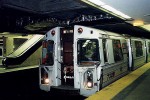
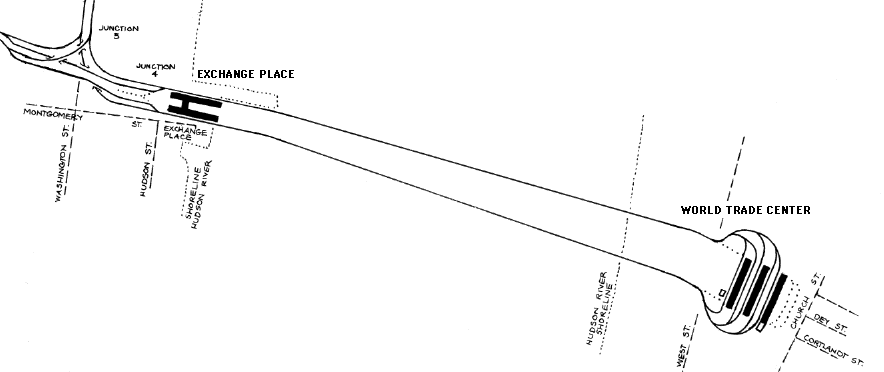
World Trade CenterPassenger service: July 1971 - September 2001. Existing abandoned portions: 3 island platforms on 5 tracks not in service. It is not clear how much was destroyed. Touring: There is no way to view this station. Exchange PlacePassenger service: August 1909 - September 2001. Existing abandoned portions: 2 connected side platforms on 2 tracks not in passenger service. Touring: The entrance can be seen at street level, but otherwise there is no way to view this station. construction and operationThe Hudson and Manhattan Railroad route from Hoboken to Hudson Terminal opened in August 1909, the year after the first portion of the railroad from Hoboken to 33 St. The new route served the Erie Railroad terminal (at what is now Pavonia / Newport station) and the Pennsylvania Railroad terminal at Exchange Place. The station at Exchange Place is deep below the surface, where the two single-track tunnels begin to cross under the Hudson River. The original downtown terminal, Hudson Terminal, was replaced in 1971 by the World Trade Center terminal. For more background see the Hudson Terminal page. The Pennsylvania Railroad diverted part of its train service away from Exchange Place in 1911, when the long distance runs began using the new Penn Station in Manhattan. Local and commuter trains continued to run to Exchange Place, which was more convenient for lower Manhattan. For a time, the Hudson and Manhattan ran special trains just between Exchange Place and Hudson Terminal, connecting with Pennsylvania trains, which reversed in "Penn pocket", a stub track located between the main tracks west of Exchange Place. Over the years, more and more local trains were shifted to Penn Station. Midtown Manhattan became increasingly a center for offices, shopping, and theater, and the electrification of the Pennsylvania main line in 1935 eliminated the engine change that made it costly to run locals to Penn Station. By 1940, only certain peak hour trains ran to Exchange Place, but they held on until the last few were discontinued in 1961. The reduced railroad business was paralleled by reduced business from the cluster of surface lines, trolley routes converted to bus, as Jersey City declined after World War II. Exchange Place became a quieter station until the revival of the waterfront area began around 1985. World Trade Center station however continued to be busy, and usage rose throughout the 1990's as ridership increased on the NJ Transit rail lines that connect with PATH at Newark Penn Station and at Hoboken Terminal. Fewer people used Exchange Place station, but more passed through it. Space for passenger movement at World Trade Center terminal, while generous, was looking less and less adequate in rush hours. Even Exchange Place got a spark of redevelopment of its own. While the former railroad properties at Pavonia became the Newport Centre residential development, the former railroad and industrial properties at Exchange Place were built with office towers for an overflow of workers from Wall Street companies. PATH and the new ferries became the vital connection, and the new Hudson Bergen Light Rail passes through the new office district as well. It was as this momentum built that the September 2001 terrorist attack on the World Trade Center towers destroyed much of the World Trade Center PATH station, which forced closing of Exchange Place as well. When the planes hit the World Trade Center towers on 11 September, PATH trains were immediately stopped from entering the river tunnel. Two were en route already: the first stopped to take passengers at World Trade Center, and the second did not stop at all but ran round and back to Exchange Place. Lastly, a rescue train with no passengers was sent in to collect anyone left in the station. Another train that had been standing in the station was left there. Not long after the rescue train left, one and then the other of the towers collapsed to the ground and cut off access to the station from above. Water from broken mains and firefighting in New York entered the river tunnel and flowed as far as Exchange Place, where at its peak a few inches were on the tracks. In the days after the attack, firefighters went in by boat to look for anyone who had tried to escape through the tunnel, but found no one. PATH was pumping water successfully by the end of September. It was proposed to build a concrete and steel plug in the tubes east of Exchange Place to prevent any possible flooding in New York from filling the system, most of which is below sea level. These were installed on 30 September (south tube) and 8 October (north tube). According to the Engineering News-Record of 8 October 2001, the PATH tubes are in good condition under the river up to the Trade Center foundation, and the north side of the station is intact. Work on the Ground Zero site exposed the station and the trapped train in January 2002, and by mid February the clearing had reached the level of the platforms. The "bathtub" foundation around the site is damaged, and some of the PATH structure is lost between the station and the place where it enters the bathtub. The train left at World Trade Center was removed by crane after excavation work reached the level of the PATH station in February 2002. Some of the cars should be in usable condition once they are cleaned. The portion of original tube within the bathtub has been removed. The Hudson River tunnel is intact and in excellent condition from New Jersey to the edge of the bathtub, but the flooding damaged electrical equipment and left debris throughout the tunnel. In April 2002, work was underway to remove all the old wiring and equipment in preparation for its replacement. The Port Authority announced at the start of 2002 that some sort of station would be opened in two years. By April, the plan was to build a temporary terminal out of what remains of the World Trade Center station, with a shed roof, and stairs and escalators running up four stories to the street. The permanent new terminal may be located closer to Church St and at higher level, essentially on the old Hudson Terminal site. Exchange Place station is closed because there is no way to terminate trains in its two single tracks without wrong-way running for some distance that would seriously interfere with the intensive service PATH needs to run. Plans are to build a short section of new tube to permit a crossover track, using in part the old "Penn Pocket", a dead-end track between the main tubes, once used for short runs just between Exchange Place and Hudson Terminal. In the meantime, passengers for the many office towers there are being advised to walk from Grove St or use the new Hudson Bergen Light Rail from Pavonia / Newport. Extension of the light rail to Hoboken, expected to open in 2002, will draw off the riders between Hoboken Terminal and Exchange Place. PATH remains terribly overcrowded with all service running to 33 St. |
diagram |
|
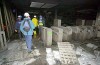
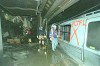
A few reporters were allowed access to the World Trade Center basement areas on 14 November 2001. The Newark Star Ledger ran several photos the next day including two images of the station. The interior spaces shown here were completely gone three months later, when clearing of the site reached down to this level.
Photos copyright by the Star Ledger. Linked by kind permission. |

|
|
|