|
|
by Joseph Brennan. Copyright 2001, 2002. |
|
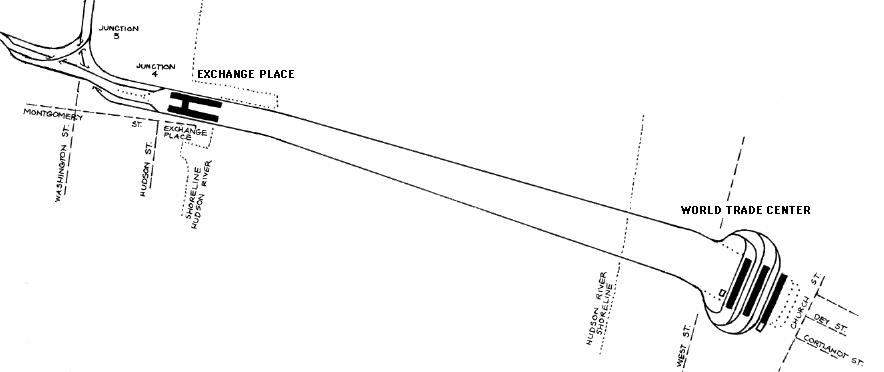
SCHEDULED TO REOPEN IN NOVEMBER 2003 World Trade CenterPassenger service: July 1971 - September 2001. Existing abandoned portions: Track floor, abandoned track, extreme northern portion of platforms and possibly parts of the station mezzanine. Touring: The site can be seen from street level at locations around the perimeter. construction and operationThe Hudson and Manhattan Railroad route from Hoboken to Hudson Terminal opened in August 1909, the year after the first portion of the railroad from Hoboken to 33 St. The new route served the Erie Railroad terminal (at what is now Pavonia / Newport station) and the Pennsylvania Railroad terminal at Exchange Place. Hudson Terminal, the original downtown terminal, was replaced in 1971 by the World Trade Center terminal. For more background see the Hudson Terminal page. Despite the closings of the Pennsylvania and Erie terminals in the 1960's, World Trade Center continued to be busy with the remaining commuter rail traffic at Hoboken Terminal and Newark Penn Station, and with local Hudson County passengers. Usage rose steadily in the 1990's, with the building boom in Jersey City and increased NJ Transit rail ridership. Space for passenger movement in the station, once considered generous, was now barely adequate, and the ill conceived mall at street level was jammed. It all changed on 11 September 2001. The station was directly under Tower 2, the southern tower, and very close to Tower 1. As soon as the first plane hit Tower 1, PATH trains were stopped from entering the river tunnel. Two were en route already: the first took passengers at World Trade Center, and the second did not stop at all but ran round and back to Exchange Place. Lastly, a rescue train with no passengers was sent in to collect everyone left in the station. Not long after the rescue train left, the towers collapsed over the station and cut off all access from street level. A train that had been standing empty in the station, out of service with no crew or passengers, was left behind. According to the Engineering News-Record of 8 October 2001, the PATH tubes are in good condition under the river up to the Trade Center foundation, and the north side of the station is intact. Work on the Ground Zero site exposed the station and the trapped train in January 2002, and by mid February the clearing had reached the level of the platforms. The train left behind was removed by crane after excavation work reached the level of the PATH station in February. Some of the cars may be in usable condition once they are cleaned. All of the old and new tunnel was removed by April within the the area of the bathtub, the foundation wall around the portion of the site west of Greenwich St. The Hudson River tunnel is intact and said to be in excellent condition from New Jersey to the edge of the bathtub, but the flooding damaged electrical equipment and left debris throughout the tunnel. In April 2002, work was underway to remove all the old wiring and equipment in preparation for its replacement. Site clearing was declared complete on 30 May 2002. At that time, much of the World Trade Center station still existed at track level. Most of it was open to the sky and even the platforms had been removed, leaving only the track floor. But the northern end was still under what had been underground levels of the center, which had not collapsed. In that portion the platforms are still there and possibly parts of the mezzanine. The Port Authority announced at the start of 2002 that some sort of station would be opened in two years. By April, the plan was to build a temporary terminal at approximately the site of World Trade Center station, with a shed roof, and stairs and escalators running up four stories to the street. Late in 2002, reopening was rescheduled earlier to November 2003. The station will still be called World Trade Center. It has been completely enclosed, so there will be no view to the sky as had been suggested at earlier dates. Access to the street will be through the same escalator passages as before and then by temporary enclosed walkways to the street. The permanent new terminal may be located closer to Church St and at higher level, essentially on the old Hudson Terminal site. An extensive underground transportation hub is being planned, running all the way from World Trade Center PATH to the subway complex under Fulton St between Broadway and William St, with a wide corridor and clearer orientation to the train services available. PATH reopened the Exchange Place station in June 2003. |
diagram |
|
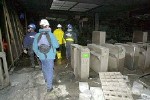
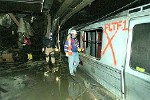
14 November 2001: Reporters tour Ground Zero. They pass the turnstiles deep underground and see the abandoned train, marked by rescue workers with an X indicating no one inside. Photos from the Star-Ledger, 15 November 2001. For much larger images and additional images see archived copies of the paper in libraries. |
|
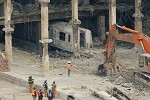
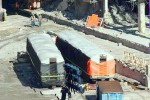
17 February and 24 February: Excavation reaches the abandoned train, and it is removed. Louis Lanzano, AP, from Yahoo news. |
|
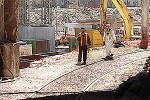
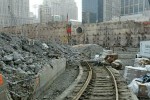
2 May and 16 April 2002: Tracks curve into an emptiness where the station should be. Left, the New York-bound track curves to the right as it enters the bathtub. Right, farther along the same track, one of the station tracks curves to the left. The round hole in the rear wall at Greenwich St is where the old tube ran to Hudson Terminal, located in the block beyond. Left, photo by Bill Bayer, from the Jersey Journal tunnel tour. For a full-size image and additional photos, please go to http://www.nj.com/photos/jjournal/tunnel/. Right, Yahoo news. |
|
|

|
|
|