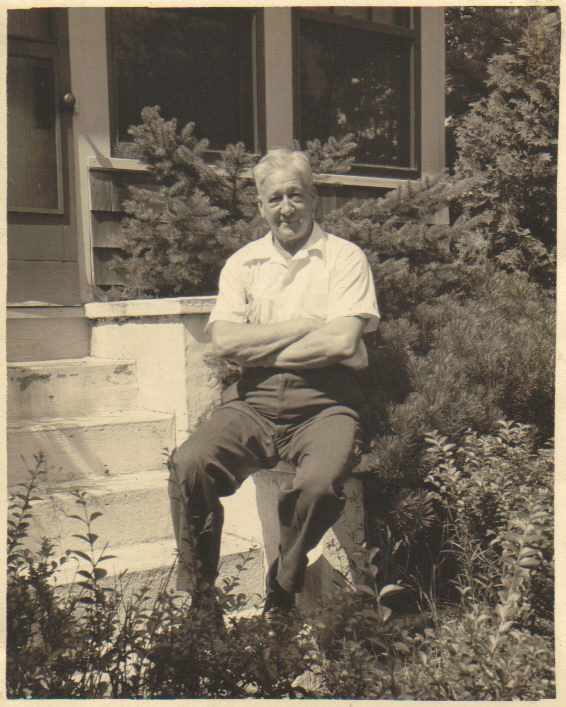
This report covers the calendar years 2008 and 2009. There are several reasons for combining the two years rather than reporting each year individually. Many issues begun in 2008 were not resolved until 2009. Personal illness, personal problems and other life situations were overwhelming. No area of my life remained untouched. As events relate to family matters, I will report them here. Concerning other matters (personal, religious, professional), I choose to write little or nothing, as these matters are still ongoing, though with happier (or at least, quieter) circumstance.
The above paragraph written, a preliminary reading of my note-books for the two years indicates significant work undertaken and finished. Indeed, the outline of topics to cover in this report comes to thirteen handwritten pages (though I should note again: see with what large letters I write my notes!). As in the 2007 report, it is not easy to separately report activities as either "Felbinger" or "Prahl", for both sides of the family were worked on simultaneously. Therefore, I will report projects and research primarily by month.
****************
January 2008 began well. I spent this month transcribing the Ickelheim Armenkasse records obtained in Nuremberg in October. This work continued into February. At the end of January I decided to redo the entire Armenkasse file as a text document rather than as a Word document. Correcting typographical errors and inputting pictures became a constant struggle to delete the original file on the website, make the necessary changes to my computer copy, and then to upload the revised version: an extremely frustrating task. The switch to .txt became just so much easier; made uploading the pictures easy too.
During the month Alice and I exchanged several photos and documents. From Alice I received a copy of the photograph of GF John George Felbinger Jr. in his bicycle shop at 42 Albany Ave. in Brooklyn. The actual photo was most probably taken just after the shop opened; therefore a date of 1899-1900 for the photo is appropriate. The copy of the photo hung on the back porch of the family home in Valley Stream for many years. When Mom sold the house in 1987 to move with Aunt Chris to Cambridge Square condominiums in Copiague, she undertook the tremendous project of cleaning out the accumulations of forty-six years. Unfortunately, Mom did not tell either Alice or me about how many family mementos, especially photos, she chose to toss out. Happily, Alice was present for some of this activity and was able to ask for this particular photograph directly, so it has remained in good hands to this day. Yet I must say here that several of Dad's photo albums, including photos taken during his time in the National Guard after World War I must have thrown away at this time, for we did not find these albums when cleaning out the Copiague condo in 2000. This fact explains why history gets written with whatever is left over, rather than with a complete record. Back to Albany Avenue: as I remember the original copy of the photo, it had gained a brownish-yellow patina of age over the years (the back porch could be sunny enough, receiving the morning sun). Given its condition, Alice scanned the copy into the computer without removing it from the frame for fear the photo and its cover glass had effectively become one. The copy of the picture is therefore unfamiliar to me as it is in black and white, but still happy to have it. In return, I sent Alice a copy of the photo of JG Jr. with his granddaughter, cousin Lorraine Stewart; the Albany Bicycle Shop business card; and JG's World War I draft registration. To see the original Albany Avenue photo, see Alice's report listed below.
It is appropriate to relate here the one story Dad occasionally told about the Albany Avenue bicycle shop. The story itself most likely relates to a time when Dad was free to go places on his own for periods of time. Dad was an avid fan of the Brooklyn Dodgers while they were in Ebbetts Field. One day his father made Dad an offer of a quarter (yes, 25 cents; big money in those days) to clean up the shop. O boy, money to go see the Dodgers. Dad was zealous in his cleaning of the shop. Unfortunately, a little too zealous perhaps. Grandfather Felbinger had a habit of smoking small cigarillos and had devised a system of having them positioned about the shop, so that all he had to do was pick one up, light it and smoke for a while as he moved around. Dad not only cleaned out the shop, but all the cigarillos as well. Grampa was furious; Dad did not get his quarter.
Alice also sent me a list of several Blaicher and soundex-sounding Felbinger names she had culled from the New York City death index and the Greenwood Cemetery files, for search either by me or by us together when she came to New York. As the 25th anniversary of Dad's death came on January 28th, I took the day off to visit the Municipal Archives to do research. Most of the soundex-sounding Felbingers did not pan out. But I did find Lina Fellinger [sic] (listed in the MA index as Linor Felbinger). Daughter of GGP Johann Georg and Margaretha Barbara Felbinger, she died February 28, 1872 of varioloid, a form of smallpox that develops after vaccination and that can prove fatal (certificate no. 1906). We are now up to nine children for our great-grandparents, but at this point I cannot figure out who the tenth child might be, whether in Brooklyn or Germany. Next, I found the death certificate of John M. Zimmermann. First child of John and Anna Margaretha (Felbinger) Zimmermann, John M. died July 12, 1884 of cholera infantum (certificate no. 6934). The following day Alma Felbinger, child of Johann Georg and Margaretha Barbara Felbinger, died of asphyxia from the same disease (certificate no. 6899). JG and MB lost both a child and first grandchild within 24 hours. I also retrieved the death certificate for Uncle Alexander Meyer, d. May 17, 1908 at age 31, St. John's Hospital in Brooklyn, of a skull fracture by falling off an automobile (certificate no. 10147). I have the image that he fell off the running board that autos had in those days, but whether the car was moving or stock still is not indicated on the certificate; perhaps an obituary in the Brooklyn Eagle might indicate this. The Blaicher records that Alice sent also did not yield any new information. Before leaving the Archives for the day, I did look at the Atlas of the Brooklyn Borough of the City of New York, 1898, vol. 1, pt. 1, for the 100 Wolcott St. address in Red Hook where GM Cenie (Meyer) Felbinger was born; it confirmed that the specific house number would be on the north side of the street just west of the intersection with Van Brunt. There is an alley there now between the Van Brunt buildings and the Pentecostal church on Wolcott.
Notes for February 2008 indicate little work undertaken during the month. This inactivity probably relates to some business difficulty with Flushing Manor Care Center surrounding Mom's Social Security statement. This business matter took some time to clear up, and little doubt absorbed much of my energy. The notes further indicate that visiting Mom on February 23rd, I thought how empty the room seemed without Aunt Chris present, and realized that Aunt Chris had died this date five years previous. For a brief instant there was some presence of her in the room. That night, I started work on transcription of the Ickelheim Pfarrbuch records brought back from Germany the previous October. This work continued into March, and went fairly quickly. Only two pages (pp. 33-34) of Section I of the Pfarrbuch were not transcribed in Nuremberg. These pages were in the hand of Pastor Frommel, successor to Pastor Häusslein, and I had brought home copies of the original pages on a CD made by the Archives. Frommel wrote a most idiosyncratic script, its only virtue being the regularity of his letter formation which ultimately allowed me to make a transcription.
The other significant event in this month was receiving a note from Alan Hagedorn, who turns out to be the great-grandson of Adelaide Prahl (Eck) Hagedorn, oldest daughter of 2GGP Charles/Friedrike Prahl.
March 2008 began with another visit to Mom on the 1st, Aunt Chris's 89th birthday and the 5th anniversary of her funeral. After the visit, I returned to the subway by a different route to stop at the Queens Historical Society on 37th Ave. in Flushing, a few blocks from Flushing Manor. I made an initial inquiry, whether they might have any maps of Ridgewood while grandparents Prahl, Mom and Aunt Chris were living there (1910-1940). Seemed an appropriate thing to do, considering the day.
Saturday, March 15th, I was up at 4 in the morning to head out to SUNY Stony Brook for the genealogy conference held by the Long Island Genealogy Society. Very tired, but listened to a couple interesting presentations, and assisted a few GGG members with transcription of their material.
Also in March, Alice sent me some information about the Bessel side of Bob's side of the family. Heddie Korfman, my brother-in-law Bob Korfman's mother, was a Bessel. The Bessels (Heinrich, Katherine and Albertine) came on the ship Darmstadt from Russia in June 1892. The family appears to be among the Volga Germans who settled in Russia at the invitation of Catherine the Great, and left a century later as their rights were slowly eroded. Many of these Volga Germans went to the Dakotas, others to the prairie provinces of Canada. I sent Alice a copy of the passenger manifest for the Bessels. My reading of it was they had come from Kazan (now capital of Tartarstan, Russia, at the confluence of the Volga/Kazanka Rivers. Additionally, I sent some information on the American Historical Society of Germans from Russia, the Society for German Genealogy in Eastern Europe, and another website on the Germans from Volhynia and Russian Poland, as the Bessels must have spent some time in Volhynia. From this information, I also report here: Lehmann, Heinz. The German Canadians, 1750-1937: immigration, settlement, culture. St. Johns, N.F., Jesperson Press, 1986 (translation of: Das Deutschtum in Westkanada. Berlin: Junker & Dünnhaupt, 1939).
The last note for March (the 25th) indicates I spent the evening making corrections to Felbinger Documents nos. 7, 8 and 9 on the webpage. I also expressed my frustration of letting notes sit so long, as I can barely make sense of the corrections.
April 2008 begins with a note to myself that I received from Frau Marianne Amann in Nuremberg (a distant cousin by marriage) a large selection of Meldebogen (report sheets) from the Fürth municipal archives. The sheets arrived in Holy Week, so there was no looking at them until after the Easter festivities. They report the settlement of various Felbingers in Fürth, including (I add here) the report of Frau Amann's step-great-grandmother, Barbara Felbinger (b. 1852), from Ickelheim (came to Fürth in 1880).
Later in the month (April 15-16th) I worked on transcription of the Johann Michael Hörber - Maria Barbara Felbinger April 18, 1764 marriage entry from Oberdachstetten (see Document no. 8 "Marriages", under Oberdachstetten for transcription). Apart from the serendipity of doing the work near their anniversary, this is another case of wretched handwriting that takes much time to transcribe.
The following week (April 23rd) I started working on the Baier material (GGM Maria Henrietta Blaicher) brought home from Nuremberg. These transcriptions continued into May, setting up tables in Word so I could input the material as I received it. The Helmbrechts registers are in tabular form (Helmbrechts being a substantial town/small city), not in the narrative forms I have found in small places like Ickelheim. Setting up the tables was no small task either: the format of the tables varies from register to register, and must be set up so they all fit on an 8 1/2" by 14" piece of paper. This work was also frustrated by the fact that, being now seven months past the actual transcription, I found I had somehow misnumbered the pages and could not tell whether all the information was complete. A later logbook entry notes that I came to the conclusion that I had only misnumbered my notes and that, as far as I had gotten, they were complete. Another note: I did not find the marriage record for 3GGP Baier. All this simply proves that the work-up must be done as soon as possible to avoid confusion. Obviously another trip to Nuremberg is in order.
Alice arrived for her annual visit May 14, 2008. Visit to Mom the next day. There were heavy rain storms on the 16th, so I suggested to Alice we go to the Map and Genealogy/Local History divisions of New York Public Library to do map work in preparation for a visit to Ridgewood. Both of us are clear that the street names and house numbers in Brooklyn have remained remarkably stable over the years. In Queens the situation is substantially different: sometime in the late teens and 20's of the 20th century there was a significant renaming of streets, from names to numbers, and renumbering of houses. How any non-native might find anything would border on the miraculous. Before heading downtown, we cruised the databases to see if there are any books and atlases that might be helpful. We found the following books:
Our community, it's [sic] history and people: Ridgewood, Glendale, Maspeth, Middle Village, Liberty Park / by Walter J. Hutter ... [Brooklyn, N. Y.] : Greater Ridgewood Historical Society, c1976.
Schubel, George. Illustrated History of Greater Ridgewood. Ridgewood, N.Y.: Ridgewood Times Publishing Company, 1913, 1975.
Norwood's guide, first and second wards, Queens best street directory, Corona, L.I. City, Woodside, Elmhurst, East Elmhurst, Jackson Heights, Maspeth, Glendale, Ridgewood, Forest Hills, Kew Gardens, Middle Village. Woodside, N.Y., C.W. Norwood, 1931.
And for atlases:
Atlas of the borough of Queens, city of New York: based upon official plans and maps on file in the various city offices; supplemented by careful field measurements and personal observations ... Brooklyn, E. Belcher Hyde, [several dates].
Off to the main building of NYPL on 5th Avenue at 42nd Street. When we got there, first order of business was to go to the Map Division. I have never been in the Map Division. It has a stunningly beautiful reading room with long, large tables just fine for laying out large atlases.
Of the Belcher Hyde atlases, we found several editions appropriate to our purposes: 1908, 1915 and 1929. I note here that several pages in the atlases were revised by paste-overs on the original maps, not always accurately placed.
1) First we looked at the 1908 ed., vol. 2A, published just before Grampa and Gramma Prahl moved to Ridgewood after their marriage. We were looking for several addresses:
a) 2049 Gates Avenue (map no. 34), where Mom was born, March 20, 1911. We found Gates Avenue had been cut through to allow for this house number, but the house numbers only went up to no. 1842 in 1908. Such evidence indicates that Grampa and Gramma moved into brand-new housing when they got to Ridgewood rather than older buildings in less than perfect condition. Grampa's fortunes took a bad turn during World War I when an assignment of typewriters he was preparing for shipment to South America was embargoed by the American government on the outbreak of hostilities. So the 1920's became a search for cheaper housing. How cheap? Our community indicated housing of 5-6 rooms for $12 a month. Of course, beer was 5 cents, and 25 cents for shave and a haircut (2 bits). Germania Real Estate & Improvement Co. was listed as the developers for this particular property at Gates Avenue.
b) Public School 88 was listed as being at Elm Street (now Catalpa Avenue) and Halsey Street fronting on Fresh Pond Street. Alice was more interested in this school (as according to her, Mom graduated from it for high school) than in Public School 91 from which Mom graduated primary school.
c) No mention of Schley Street (where Aunt Chris was born) in the 1908 ed. (map no. 37).
2) In the 1915 edition, again vol. 2A, we found an index to new street names.
a) The Gates Avenue address lay between Fairview Avenue (west) and Grandview Avenue (east): No. 2027 NE corner of Gates and Fairview; No. 2061 NW corner of Gates and Grandview. No. 2049 Gates is the 12th building from Fairview, 7th building from Grandview, on north side of the street (map no. 24).
b) We found Schley Street in the 1915 edition. Today 65th Place: laid out and running north two blocks (with Central Avenue then, as now, the street in the middle) to Edsall Avenue (now 70th Avenue) at the north end. In this edition the street is still under development. On other maps, we found it also listed as Sheridan or Sherman Street (obviously couldn't make up their minds which Civil War general to honor). Also, we found P.S. 91 between Central and Myrtle Avenues between 68th Place and 69th Street (Folsom and Fosdick Avenues at the time). Also found 2428 Cornelia Street (at the time also Jefferson Street), where Grampa, Mom and Aunt Christ were living at the time of Aunt Chris's marriage to Uncle Gus (August Louis Oechsli) September 9, 1939 in St. Matthias R.C. Church (Catalpa Avenue). Also found: 1829 Stephen Street, where Grampa, Mom and Aunt Chris were living in 1932-1935, between Forest (west) and Seneca (east) Avenues. We also found all the street names as they appeared in 1915 (from north to south):
* Cornelia Street, now 67th Avenue;
* Hughes Street (Hancock Street), now 68th Avenue;
* Silver Street (Halsey Street), now 68th Road;
* Elm Avenue, now Catalpa Avenue;
* Foxall Street, now 69th Avenue;
* Halleck Avenue (Edsall Avenue), now 70th Avenue;
* Van Cortlandt Street, now 71st Avenue; and
* Myrtle Avenue, still Myrtle Avenue.
3) The 1929 edition of Belcher Hyde was not particularly helpful, but from it we learned that all the new numbered streets and house-numbers were in place, so we could deduce that the changes came fairly early in the 1920s, yet the old names may well have continued to be used among the local populace.
By now Alice was tired, but I insisted we go down the hall to the Genealogy/Local History Division to look at Norwood's guide, Our community, and the 1920/1930 Federal census maps. The Norwood helped us to determine that 103 Schley Street, where Aunt Chris was born) is now no. 70-03 at the north end on the east side of the street. A quick read of Our community turned up a few interesting contemporary facts. And the 1920 census map indicated that Schley was already named 65th Place, so it was renamed very shortly after Aunt Chris's birth.
Altogether a very successful day in the library, and necessary for our expeditions to Ridgewood.
Unlike the day before, May 17th dawned bright and clear, no clouds, cool air: perfect day for an outing. But not to Ridgewood: Alice and I chose to go to Brooklyn instead, to look at various Felbinger family addresses. Rather than tell it in my own words, I will stop my usual efforts and introduce my sister Alice to visitors of this site. For several years now Alice and I have been working together to expand the story of our several ancestral families. We have tried to make a reasonable division of labor, to be considerate of our divers talents. Therefore, Alice has concentrated on our families here in metropolitan New York, while I have concentrated on the German material. Alice lives far away, but knows more about Brooklyn than I, who lives right across the River and a subway ride away. So to expand our family story, I will point here to Alice's report of our tour in Brooklyn, to be found at The Felbinger family tour in Brooklyn, May 17, 2008, both here and under the corresponding link on the Index Page under "Felbingers and related families in Brooklyn/Queens, New York".
The logbook notes that the next few days Alice and I continued to watch the weather reports for the best time to go out on field trips. Nothing so dampens journeys of exploration than having to do them in the teeth of inclement weather. Additionally, we were aware that to get to Ridgewood in Queens, we would have to travel the subway "L" line in the direction of Canarsie and transfer to the "M" line to get to Ridgewood. "M" line service can be sporadic on weekends, so a weekday trip would be better.
Our good fortune with weather continued to hold. On Monday May 19th we decided to go to Ridgewood, and the weather held steady (if occasionally overcast) for the entire day. As with our expedition to Brooklyn, so too with our travels to Ridgewood/Glendale: I commend readers of this report to read Alice's report of The Prahl family tour in Ridgewood/Glendale 2008, to be found here both here and under the corresponding section on the Index Page under "Prahl documents transcribed by John Felbinger". In this report Alice not only relates our adventures in Queens, but gives some insight as to what it's like to have to do the research at a distance rather than "on the ground". Good stuff.
As our luck with weather had held for the 19th, so it held for the 20th as well: it rained. Perfect day to visit the New York City Municipal Archives. Unlike previous visits, we did not find much material. Alice found this disappointing, but ever ready to be a comfort, I told her there are times when nothing is found, other times it's the mother lode.
Still, we found a few items that opened up new research for us. We did not find the 10th child of GGP J.G. Felbinger/M.B. Fichtelmann, at least not in the time-frame of 1867-1872, by turning the microfilm reels by hand through all the "F"s in the Brooklyn birth/death records for those years. We did find Augusta Fichtelmann (listed in Greenwood Cemetery records as "Maria A. Fichtelmann), died October 4, 1870 of typhoid fever. We also found the marriage record for great-aunt Adelaide Prahl and great-uncle William B. Dickinson on July, 24, 1907 in the Bronx (certificate no. 1295). The big surprise here was finding Giorgio Salvatore Cangiolosi as one of the witnesses. In connection with the Prahl family, this record is the earliest evidence of George (Engish version of name) that we have found. George and aunt-aunt Mathilda Prahl were married two years later in 1909. But as Alice and I both noted, she finds no record of their marriage in the Municipal indexes. Obviously a hand search is needed. Alice also ran some Blaicher/Prahl searches that intrigued her, but turned up nothing. And last: if it is at all possible, a search of the WPA photos at the Archives for all the places visited would be appropriate. Perhaps this year, perhaps next: could be expensive.
After another visit to Mom on the 21st, Alice headed home to Vancouver.
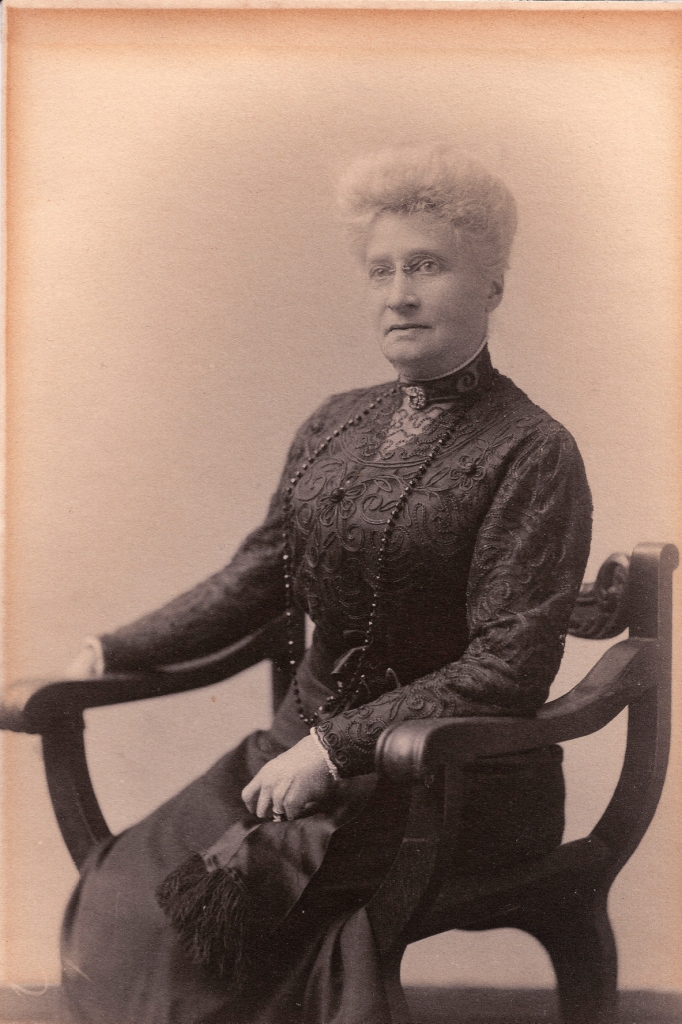
June 2008 started with a very pleasant surprise: from Alan Hagedorn in California I received a photograph of great-great-aunt Adelaide Prahl Eck Hagedorn. Whenever he spoke of his aunt, Grampa mentioned her name in a way that suggested considerable formibility. After seeing her photograph, I can understand why. It is a stunning formal portrait, taken probably in the last decade, perhaps fifteen years of her life. I am impressed by the remarkable resemblance between her and Grampa (aunt-nephew) at approximately the same ages.
Much of the rest of the month was spent
doing that most dreaded of all spirit-killing activities:
filing. Still, some small work was
completed: 1) transcribed the Windsheim J.G. Sturm
baptismal record for the webpage; 2) added the picture
of the Oberdachstetten Hörber-Felbinger wedding;
3) made a complete transcription of GGF Carl Blaicher's
baptismal record from Unterreichenbach,
Württemberg. Midst all of the filing, I found a
note to myself, of books of interest on the
Schleswig-Holstein uprising, 1848-1850. Rather than
simply file the note, I went to Worldcat (OCLC) to
download a long list of materials and added them to the
Prahl bibliography. When I did get to the bottom of
the filing I found the last folder had all the output
from the GFF in Nuremberg. I really need to go through
this material to upgrade my files and to plan what I
may want to do this year in Nuremberg.
July 2008 took me back to the FHC in Woodside, Queens, that I have not visited in six months. I thought of several projects right away: 1) see if I might find the record for J.G. Sturm born in Windsheim; and 2) look through the Sturm records to see if I might find the birth record for Johannnes Sturm, husband of 3GGM Sybilla Schmidt Sturm Felbinger. From the Westheim/Sontheim birth records I know he was not born there. According to the record of his first marriage in Westheim/Sontheim in 1781, Sturm's father Georg Sturm died in Ge(r)bersdorf near Weihenzell; a little map work led me to think it is *Gebersdorf* near Weihenzell near Ansbach. Indeed, in the Brenner Archiv there is one record for a Johannes Sturm born of a Georg Sturm, Hutmann, in Gebersdorf in 1748, not 1751; but after all, there is no guarantee Sturm's age in his Ickelheim death record of 1799 is correct as well; 3) finish looking through the Brenner Archiv for all other related families; 4) go through the Unterreichenbach birth registers to see if GGF Carl Blaicher had siblings born there and potentially a marriage of 2GGM Blaicher, though I doubt this; and 5) look through the Danish census records for 2GGF Charles Prahl, his parents and siblings.
I sent off copies of the Prahl-Dickinson wedding to Alice and Robert Prahl. A few days later I received a note from Bob thanking me for the certificate and saying that the reason why his grandfather was known to the Prahls was because he had been dating Adelaide (!) before she met Bill Dickinson, and then he (George) hung around, dated Mathilda and finally married her. Mmmm, major revelation.
This note from Bob sent me off on another tangent. I could not for the moment find the group portrait that shows the Cangiolosis and the Prahls among all the photographs in my possession. Happily, Alice had scanned the photo and could send me back a copy. The photo appears below.
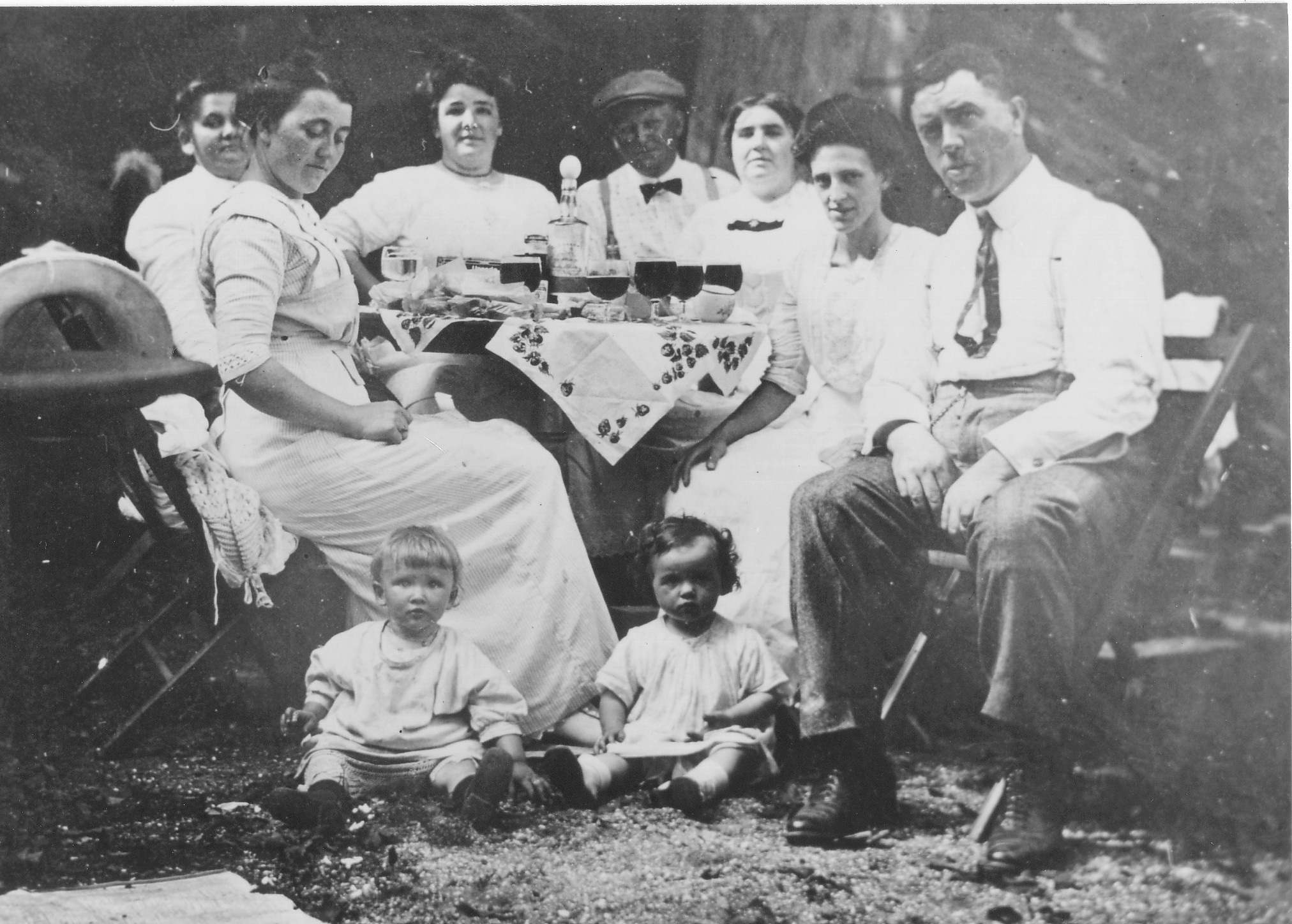
In addition to sending a copy of the photograph to Bob,
I also sent him copies of the following census records:
* Federal census 1900: shows the Merkels, Prahls and Kuhlmanns living at 507 Lenox Ave., and the Cangialosis ("Cancialote" on the census form) living at 527 Lenox Ave., one-and-a-half blocks away. This fact was confirmed by Bob a few days later, so there is strong evidence the Prahls and Cangialosis knew one another as teenagers at the turn of the century. This fact may also account for the family story (related by Alice) that at this time the Prahls learned to eat (and love) sphagetti: staple meal in the Felbinger household for many years.
* Federal census 1910: shows the George and Mathilda Cangialosi now married and living at an address now under the Cross-Bronx Expressway.
* Federal census 1920: shows the Cangialosis living in the Bronx at 865 Cauldwell Ave. - George and Mathilda, children Anthony, George, and Robert. George is unemployed, Mathilda is working as a sales clerk.
* Federal census 1930: Mathila, now Prahl again, is living with son Anthony and his wife Dorothy at 1241 Bradford Ave. in the Bronx, while sons George and Robert are living down the block at 1253 Bradford Ave. George Cangialosi is nowhere to be found, though I did find a reference that might be he, dying in 1930.
I found no ship record for the Cangialosis, but given the fact George was born in Italy in 1885 and the Cangialosis seem to have obtained their citizenship in 1888 would put them on a tight timetable for arrival in the U.S. By accident (my hand slipped on the mouse while looking at records) I found George Cangialosi's parents had by 1930 moved to Brooklyn. Running their names through the NYC Death Indexes on the German Genealogy Group website, I found George's father Antonio, died 88 years, October 31, 1941 (certificate no. 20451), and George's mother Grace (Grazia), died 92 years, April 26, 1947 (certificate no. 8957).
Also of interest are a couple minor notations in my workbook in this time: 1) Charles E. Prahl (son of Charles E. Prahl (1854-1892), his wife Maude and daughter Valerie were living at 398 201st Street in the Bronx in 1930. On a hunch, I took a look for him in the 1910 Federal census ... and found him, living with his mother Julia, now remarried to a John Seymour, and living at 330 West 18th Street in Manhattan. I found no subsequent records for John Seymour and Julia (Ittig Prahl) Seymour. A later note in my workbook indicates I found this information on November 15th, and made the additional notation in the July notations.
A preliminary look at the material brought home from Nuremberg from the GFF indicates that Ludwig Wendel had pursued several other lines of Felbinger families, so this is material I will have to study at some other point.
The rest of July and most of August 2008 was spent writing the annual report for 2007. Completing the report so late in the year gave me the thought to change the reportage from January/December to July/June, but of course one can see that idea died a-borning.
In the last of August, I pulled out of the archives a box of records that Alice had tucked away at some point. Most of the material were Mom's and Aunt Chris's financial records, principally from the 1980s. As records of lives past, I might guess this material particularly important (many the times I have thought what it would be like to see the financial records of my ancestors), but as it is unlikely they would be of interest to any beyond the immediate family, they were thrown out. Of greater interest were the following items:
* The original copy of Dad's will. Mom never probated the will, but kept it to prove her ownership of the house in Valley Stream. Of interest to Alice and me were the will's stipulations that Aunts May and Chris were named as Alice's guardian and mine should Mom and Dad predecease our majority.
* Material relating to Dad's military service in World War II.
* Copy of Dad's death certificate, and the memorial book for his funeral.
* All the material from the funeral of Anna Winsrieth (Uncle Gus's mother), and Uncle Gus's Social Security card (original).
* Papers relating to the burial of great-uncle Arthur Blaicher's ashes in the cemetery in Rockville Center, Long Island.
The month of September 2008 began with a review of my previous goals, and a look at the Wendel papers brought home from the GFF in Nuremberg the previous September. In those papers it is clear Wendel had undertaken research of the Bayerlein branch of the family, starting with Anna Katharina Bayerlein of Eschenbach, married to Friedrich Felbinger in Trautskirchen November 11, 1790. About this I will have more to say later. Here it is enough to note that my research in the Brenner Archiv did not reveal any Bayerleins coming from this particular town, nor from Neuhof/Zenn as Wendel's information indicates. A quick look at German Wikipedia indicates Neuhof/Zenn are close to Eschenbach, and currently Eschenbach is a section of Markt Erlbach, so it would be good to trace this line, but the Lutheran Archive in Nuremberg does not have these records, so the task is more difficult.
Upon a return to the FHC in Woodside, I did a quick search of the Unterreichenbach records to see if GGF Carl Blaicher had any siblings, whether he had been confirmed there (between 1875-1877, the appropriate years), or a marriage of his mother Friedrika M.E.J.H. Blaicher. No, on all counts. Still, this was a quick search, so a closer search would be appropriate.
Unfortunately, work on my computer was interrupted when I came home September 2nd to discover my computer was infected with a virus. I called Gordon Shaffer, my computer guru, but sadly the virus, trojan horse, or malware (whatever), had effectively fried the computer's hard drive. Happily, the drive was still under warranty and I obtained a new unit. As for data, only the most recent data and pictures that I had not backed up were lost, the most important being the project for the Prahls, searching WorldCat for materials on the Schleswig-Holstein uprising of 1848-1850, Chancellorsville/Gettysburg, and German participation in the Civil War. Otherwise, about 90% plus of all data was retrieved from backup files; several lost pictures I found in copies of emails I had sent to Alice. Lesson learned: back up all data assiduously. In the event, getting the computer back up and functioning took nearly the whole month of September.
This computer crash, though troubling, allowed me to work on various projects not requiring a computer. One project was to go through one folder in my boxes that I had dubbed "The Archive". This was a collection of my earliest family reseaches, and original papers and documents. There were essentially four groups of material:
* Felbinger: GF JG Jr's baptismal and confirmation certificates; all the correspondence between Dad and Dorothy Felbinger in California, and other family members in Illinois; copy and photos of the original research I did in 1979 and some manuscript versions of letters I sent to Wendel.
* Prahl: 2GGF Charles Prahl's letter to great-aunts Adelaide and Mathilda about the battle of Sehestedt; the doctor's receipt for Grampa's (Edward L.S. Prahl's) birth December 5, 1882 ($15 - big money in those days); his baptismal certificate 1886 (the letter I got from Emmanuel Lutheran Church on East 87th Street went missing years ago, but I remember them saying that great-aunts Adelaide and Mathilda were baptized at the same time); GP Prahl/Blaicher's marriage certificate from St. Peter's Episcopal Church in Westchester, April 10, 1910; pictures of Gramma Christina Prahl's niche in Cypress Hills Cemetery and the Prahl/Dickinson grave in Flushing Cemetery. I had hoped to find Grampa's confirmation certificate, but did not. Perhaps I have only imagined it, but I dimly remember seeing the document, that he and his sisters were confirmed in the Episcopal Church in 1896, but perhaps I have confused it with the baptismal information.
* Miscellaneous Felbinger material that relates mostly to me. This material I put into the "Miscellaneous Felbinger" file.
* Sympathy cards received at the time of Dad's death.
* All this documentation I packed away, either in my file boxes marked for the various families, or in other containers in the archives.
Off to Brooklyn the evening of September 12th. A few weeks previous I received a rather odd e-mail inviting me to a guitar concert in the Zion German Evangelical Lutheran Church on Henry Street in Brooklyn Heights. And why would I receive this email, I thought. Of course, I have material about the church all over my website. So thought it a good opportunity to visit the church. I haven't been in the church in forty years when I visited with friend William Longworth, and at that time I had no idea of the family connection with Gramma Cenie. On this day I also obtained a book on interlibrary loan: Kropp, Heinrich Arend. Hundert Jahre Deutsche Evangelisch-lutherische Zions-Gemeinde in Brooklyn: in Wort und Bild. Brooklyn Heights, NY : 1955. This is a Festschrift for the hundredth anniversary of the congregation, and what made the interlibrary-loan copy interesting is that it comes from the Lutheran Theological Seminary in Gettysburg, PA with an inscription from the author to the Rev. Dr. Edmund A. Steimle, grandson of Zion's founder, Friedrich Wilhelm Tobias Steimle. Nice concert. Also good to sit in the church when I could actually *see* it. When I visited forty years ago, it was daytime and the lights were off, even for the service. I would guess seating for 500-750 people easily; I can guess the church hasn't been that full in some time. It's good they try to keep up the German, but it's also clear the majority of the congregation has no grip on that language.
September 22nd was a trustees' meeting for Woodland Cemetery. During the conversation, Wayne Miller mentioned "Valhalla Cemetery", and my ears perked up. "How can this be?", I asked. "Valhalla" was the original name for Ocean View Cemetery in Staten Island, because of the number of Norwegians and other Scandinavians buried there. It was subsequently named Ocean View Cemetery as the ethnic element petered out (saying "died off" would be a bad pun in this context). Subsequent research on rootsweb.ancestry.com confirmed the earlier name, though it is specifically "Valhalla Memorial Park". Also, Salamon, P.M. Realms of history : the cemeteries of Staten Island. New York : SI Museum, c2006, notes a booklet from the time Uncle Charles Meyer was buried (1927) that the founders took the name "Valhalla" (aka "Valhalla Burial Park") because " ... it was the blessed abode of the gods and the divine resting-place of Viking heroes". See there: pays to be in touch with the natives who know more of the local history. Of course, I wrote a letter to the Cemetery (Ocean View Cemetery, 3315 Amboy Road, Staten Island, NY 10306) asking for confirmation and grave location of Uncle Charles' grave, and received an affirmative reply on October 9th. Both he and his wife Anna (d. September 6, 1959; age 89 years) are buried in grave K-73-C-8. This would mean she was a widow for approximately 32 years. Any children? Were they ever in contact with their nephew, my father? When married? Why buried in Staten Island, not Brooklyn? This shows family research often raises more questions than provides answers.
On September 24th I received from work colleague Zak Lane the gift of a photograph of the Brooklyn Dodgers as they appeared in 1955, the only year they won the World Series. I'm surprised how many of the team members I can still actually identify in the photo. Particularly poignant is the fact that this date in 1957 the Dodgers played their last game in Ebbetts Field: beat the Pittsburg Pirates, 2-0.
While working on goals, I took a quick look for "Pfortner" on the GEOGEN website. Not that many in Germany, and as usual scattered throughout the country. If the website is to be believed, the highest concentration of them is around Saarbrücken in the Saarland.
By the beginning of October 2008 I completed writing up my "Goals for 2008". Hah! With three months left in the year it would be better to name them "Goals for 2008-2009", so I did. Then in a moment of complete frustration, I decided to change the name to "Projects for 2008-2009". This change seems much more positive. As "Goals", my efforts always seem a formidible mountain to climb, Sisyphean both in labor and results. As "Projects", I acknowledge I have more than a few irons in the fire at any time: pick up one, work on it for a while, put it back, work on another.
I photocopied a number of pages from Hansen, Kwan M. Map guide to German parish registers : "Kingdom of Bavaria III, Regierungsbezirk Mittelfranken". These page particularly, as they target the villages mentioned in the Felbinger records. One particular note of correction: from the marriage record of 4GGP Johann Paul Felbinger/Anna Barbara Sieber (1760) it notes that 5GGF Georg Leonhard Felbinger died in "Dorff Kemmathen". I have read this as "the village of Kemmathen". But the index in Hansen indicates the existence of several "Kemmathen", and more specifically "Dorfkemmathen", south of Ansbach, and west of the Heidenheim/Dittenheim area. If the information is correct, it would mean the Felbingers wandered from Heidenheim/Dittenheim *west* to Dorfkemmathen and then *north* to Ansbach/Oberdachstetten, rather than directly northwest from Heidenheim/Dittenheim. This may also put Wendel's research prior to Johann Paul Felbinger in question, for it is only on the testimony of others, and therefore weaker than direct evidence.
Following up on my visit to Zion GELC in September, I went to NYPL to look at Kraeling, E.C.J. Unser Zion : die Geschichte der Zions-Gemeinde in Wort und Bild : eine Jubiläums-Gabe der Gemeinde dargereicht. Mt. Vernon, NY : Druckerei des Wartburg-Waisenhauses, 1905. This is the Festschrift for the 50th anniversary of the church. Written by the third pastor, a fast read indicates more history than the one hundredth anniversary Festschrift; Pastor Kropp chose not to make an extensive repetition of what Kraeling wrote in the first book. The first book relates in much detail the efforts to maintain a German-speaking congregation in the face of the Americanization of the third/fourth generations of children born here.
October 12th I was visited by cousin Travis Paul and his companion from Chicago. Sat in the Hungarian Pastry Shop for two hours and talked family history. Good to finally meet some of the Illinois Felbingers. The following day I went across the Bay to Staten Island to visit trustee Luann Martin, who has new photographic copies of the Woodland Cemetery record books (the originals now in a safer place) to look for "Eck", the first husband of Adelaide Prahl Eck Hagedorn. I reasoned that as the Prahls were on Staten Island at the time of her first marriage, and as her second husband Hermann C. Hagedorn was according to the marriage certificate resident in Thompkinsville, it was worth a look for Eck's burial in Woodland. Looked in the period from 1865 to 1880, when great-great-aunt Adelaide was married. Though I found a few entries for the name "Eck" (two children buried in Lot no. 764 on December 12th and 16th, 1879, and disinterred four days later into Lot no. 765, no reason given; also sale of Lot no. 656 1/2 to Gudo Eck for $30.00 in 1880), I did not find any entry for an adult "Eck" burial in this period. No good luck, but at least eliminates one possibility.
Late October I pulled citations for John Bachelder, The Bachelder papers : Gettysburg in their own words. Dayton : Morningside, 1994-1995, 3 vols. Also, his Gettysburg : what to see, and how to see it. 10th ed., Boston : c1890. Both books in NYPL. In the 19th century, Bachelder (1825-1894) was the expert on the battle of Gettysburg, and kept up a voluminous correspondence with veterans and Washington. He also served as a director for the Gettysburg battlefield mounuments association at the time when many of the monuments were being placed on the grounds. Bachelder was actually commissioned to write an official history of the battle (a modern edition is in my possession), and he received a $50,000 grant from Congress to do so, but the work was not well received by the War Department, which chose to make its own version available in its series Official records of the War of the Rebellion (usually cited in Civil War material as "OR"). Bachelder's papers were ultimately contributed to the New Hamphire Historical Society, where they languished for many years until discovered by Edwin Coddington, who used them in his magisterial The Gettysburg campaign; a study in command. Found both books in the Local History Division, and both are interesting, but not of immediate use in looking for information on the 45th New York Infantry. Yet they are on the "should look at it again" list. On the map in the smaller guidebook, Bachelder has the position of the 45th rather more in the middle and rear of the battle-line of the 11th Corps, 3rd Division, 1st Brigade on the first day of Gettysburg, rather than on the extreme left of the line and in skirmish order as 20th century accounts will have it. Need for closer study here.
It is at this point that I will take a break from reporting family research activities, to begin relating those affairs that have made this report biennial. In the last week of June I developed a dry, scratchy throat and some sinus trouble that persisted for about three weeks before I went to the doctor. By the time of my visit the sinus condition had developed into what can only be described as "a perpetual cold", with difficult breathing and constant production of mucus difficult to remove. One round of antibiotics did not clear up the condition, and my internist sent me to an otolaryngologist (if you can say it, you can do it), aka an ears-nose-and-throat specialist. He put me on two subsequent rounds of antibiotics, all without effect. By mid-October we determined that surgery to clear up the condition would be necessary, and I went in for surgery on Election Day, 2008. Of my recovery, I will have more to say below, as it impacts on later events. I will say here that from this point on much family research was accomplished, but because of ongoing concerns my notes from November to the end of February 2009 can be confused.
Back to family research. October 10th Alice sent me a long email about real estate in Ridgewood about the time the Prahls moved there. Alice has more to say about this in her report of the tour to Ridgewood. On the 31st she sent me a note about Herman C. Hagedorn, husband of Adelaide Prahl Eck Hagedorn, from Webb's consolidated directory of the North and South Shores (SI) from 1886; he is listed as a cashier with the Staten Island Savings Bank, home at 28 Harrison St.
November 1st Alice sent an email telling me she remembers Mom saying GGM Delia Merkel Prahl had been married prior to her marriage to GGF Edward Alfred Prahl. She checked the Brides' Index and found: Delia Merkel, married March 17, 1878, to Wilhelm Beppler, Manhattan certificate no. 1363. She suggested that the Bepplers in the grave in Lutheran Cemetery with her and Uncle Ernest Prahl are the first husband and child. From the files I pulled the letter that Lutheran-All Faiths sent me in 2005, and yes: Wilhelm Beppler interred in April 1879 and little Lena in May 1879. Most likely Delia owned the grave and gave a place to grandson Ernest in 1916, and she was interred there in 1928. This would be easy, because Grampa and Gramma were living in Ridgewood at the time, one el stop away and the line ends at the Cemetery. Additionally, the burial of Delia with the Bepplers would account for the notations on subsequent birth certificates of Grampa being the second child, first survived, as well as the similar sequential numberings for the later children with Edward Alfred Prahl. It also explains why Delia was not buried with her (second) husband Edward Alfred Prahl in Woodland Cemetery in Staten Island: best guess is she choose to go with her first husband. I sent a copy of the letter to Alice. After my surgery, I checked the 1880 Federal census to discover Delia, 2GGF Charles Prahl and GGF Edward Alfred Prahl were all living within the tight neighborhood of East 76th / East 79th Streets in Manhattan, from Lexington to 1st Avenues. So probably they attended the same functions, knew the same people, saw one another on the street.
Alice sent her Delia fact sheet on November 7th. I made corrections, using 2GGF Ignaz Merkel's Civil War pension records, the New York State Adjutant General's report on the 45th New York Infantry and the 1900 Federal census that fill out the details for Delia and her parents/siblings. Returned the corrected sheet November 14th. The following day Alice sent a report that Mathilda Merkel married an August Wolfson February 5, 1884, Manhattan, no. 42280. In response I sent the other letter from Lutheran-All Faiths about the Merkel-Moessner-Geldermann grave on the north side of the Cemetery. I thought to send the information I had received from the New York State Archives about Ignaz Merkel's war service, but could not find the letter; spent another three dollars for a duplicate copy. This copy arrived on December 5th (Grampa's 126th birthday). The record is skimpy, but mentions that at a muster on April 10, 1863 he is listed as a "wagoner". This would put him in support services and off the firing line. Good thing: Battle of Chancellorsville and the debacle on May 2th for the 45th New York was only twenty-two days away. In his pension records he listed himself as a "Blacksmith".
Alice responded with a *long* list of Moessners/Geldermanns/Maddalons. I made a few changes and added the listing for Frank Merkel, only son of 2GGP Ignaz/Elisabeth Merkel, as well. There are two: died 1904 and 1917. I have the notion that 1904 is the son, but must check this. In response, I started working on a list of Prahls to search in the Municipal Archives. Most of these would require hand-searches:
* Marriage of Wilhelm Beppler/Delia Merkel, March 17, 1878;
* Death of Wilhelm Beppler, interred April 2, 1879;
* Death of Lena Beppler, interred May 17, 1879;
* Death of George S. Cangialosi, died September 28. 1930;
* Death of George S. Cangialosi, died June 14, 1943 (son?);
* Death of Victoain William Cangialosi, aka Victor Cangialosi, died
December 21, 1915 (Schlegel);
* Death of Antonio Cangialosi, died October 21, 1941;
* Death of Grace Cangialosi, died April 26, 1947;
* Death of Josephine Concialosi, died September 16, 1908
(daughter?);
* Marriage of George Cangialosi/Mathilda Prahl, September 8, 1909 in
SS. Peter and Paul RC Church (Schlegel). No record in in the NYCMA;
Archdiocese of New York website indicates two churches: Church of
SS. Peter and Paul, 833 St. Ann's Ave., Bronx, NY 10456,
718-665-3924; Church of SS. Peter and Paul, 129 Birch Street, Mt.
Vernon, NY 10552, 914-668-9815;
* Birth of Jessie Cangialosi, August 1895, Manhattan;
* Birth of Rose Cangialosi, January 1898, Manhattan;
* Birth of Alma Charlotte Prahl, July 3, 1881, Manhattan;
* Birth of Charles Edward Prahl, September 5, 1884;
* Of the Hagedorn births, according to Schlegel they were all born in
Staten Island: Emil, December 3, 1879; Alexander, September 8, 1881;
Herman, June 6, 1882; Emma, July 15, 1884. According to NYCMA, they
have the pre-Consolidation records for 1847-1849, 1881-1898.
Obviously this does not help me with the Prahls, and misses out for
Emil, but the others may be possible to retrieve;
* Marriage of Emil Hagedorn/Louise Stelter, March 6, 1912 in
Brooklyn;
* Death of Emil Hagedorn, December 3, 1916 (Schlegel); no record in
MYCMA;
* Births of Charles Edward Prahl 1853/4 in Manhattan, and Edward
Alfred Prahl in 1859. I have looked once before and found nothing,
but worth another try. Also, if any births between these two
dates;
* For the Blaicher children births: Arthur, July 31, 1888; Helen
Freda, Janaury 4, 1891; Carl M., May 3, 1893; Joseph Henry, March 8, 1898;
and Violet Lillian, April 7, 1900, I would have to check whether they
were living in Manhattan or the Bronx. I already have the birth and
death records for the twins Henry and William.
While compiling this list, I was using the records in Schlegel and my eyes fell upon the children of 2GGP Charles/Friedrike Prahl. One of the younger girls, Emma, married a doctor. And the doctor? According to Schlegel, "E.H. Lloyd". The entry is corrected in Grampa's hand to "A.H. Lloyd", and they must have moved to Orange County, New Jersey. In 1880 Doctor Lloyd was living at the same address as 2GGF Charles P. (233 East 79th), and was Grampa's attending physician at his birth in 1882. The marriage makes a certain sense: according to the 1880 Federal census, Dr. Lloyd was 29, Emma 19. Cannot say when they married: no record in the online index: worth a hand search.
I set this list aside to work on a Felbinger list as well (November 19th). This list I compiled in part using diagrams Dad had made of the various family members, and that I keep in the bottom dresser drawer. These members include:
* Marriage of Johanna Felbinger (1881-1927) / Arthur Leslie. Only entries
found: Arthur W Leslie, d. April 29, 1924, 66 yrs, Kings no. 9093; Johanna
Leslie, d. May 2, 1923, Manhattan no. 13488;
* Marriage of Lena Felbinger (1873-1942) / George Winters. No record of
the marriage in the NYC marriage index; no record of a Lena Winters that
is close in age; several George Winters in the 5 boroughs;
* Marriage of Anna Margaretha Felbinger (18 years) / John Zimmermann (35
years). Marriage: June 25, 1882, Kings no. 1743: I have the
certificate. Death of John Zimmermann, June 14, 1913, Kings no.
12252, I have the certificate. Children: Johann M. Zimmermann (b. July
12, 1884, Brooklyn no. 14831; I have the certificate. Other children:
Martin Zimmermann, Marie Zimmermann: need to hand search certificates;
* Marriage of Anna Christina Felbinger / Claus H. Kleen. Marriage:
November 12, 1885. Kings no. 3680: I have the certificate. According
to 1900 Federal census, Anna C. Klee living with son Oliver with her
father and mother, GGP JG Felbinger/Maria Barabara Fichtelmann. Death of
Claus H. Klee [sic], 66 years, January 20, 1915, Kings no. 1588. Death of Anna
(Christina) Klee, one possible record, 76 years, July 1, 1945, Queens no.
5350;
* Marriage of Henrietta Felbinger (Aunt Etta) / James A. Cooper.
Marriage: March 5, 1927, Queens no. 629. I have the certificate;
* Marriage of Louisa Henrietta Felbinger (1876-1957) / George Thomas. No
date of marriage, no known offspring.
There are other non-related Felbinger records in the NYC indexes:
* Marriage of Martin Felbinger / Rosina Heninger. May 23, 1891, Manhattan
no. 6314. This is vaguely familiar because of a telephone call I received
in Vermont while visiting in 2003;
* Marriage of Eva Felbiner / John Egerer. February 25, 1895, Manhattan
no. 3878;
* Marriage of Eva Felbinger / Adolf H. Harms. Marriage January 28, 1910,
Manhattan no. 2616;
* Marriage of Mary Felbinger / Joseph Dicker. Marriage June 30, 1907,
Manhattan no. 17680;
* Marriage of Rosina Felbinger / Philip Bremmer. Marriage September 3,
1892, Manhattan no. 11640.
And last, a major surprise:
*** Felbinger, Johann. Marriage: April 14, 1867, Kings no. 370. No record of bride in the index. GGP Johann Georg Felbinger and Maria Barbara Fichtelmann arrived April 1, 1867. Can it be ??????? Since 1980 I have thought they came here with the two children and simply took up housekeeping. But here is an index record. This will be the first record to search when I can get to the Municipal Archives.
Compilation of these lists continued into December 2008.
I write the next lines to relate what else was going on while trying to do family history. Mom recovered after her bout with pneumonia at Thanksgiving 2007, but her progress was slow. One might expect a slow recovery for a woman in her 97th year (yes, even pneumonia can't kill her), but of course this fact as well as her irregular eating gave her nursing home attendants several anxious moments from December 2007 through February 2008. To be sure, I myself had similar concerns through the year. On a visit in July I had a look at Mom in profile, and thought her visage similar to those of Egyptian mummies in profile. On a visit in early November before my surgery, Mom just point-blankly refused food with a shake of her head that in the moment gave me pause for concern for her as much as for my own situation. For all this, however, Mom's annual evaluation had gone well, so except for eating irregularities there was not much to indicate any greater distress to me.
On December 10th I received a call that Mom was not eating again, and the doctor was talking feeding tube. By her own advanced directives Mom had chosen not to have this done, so I decided to go look for myself the following day. My visit indicated to me that Mom's eating was rather more irregular. Eating as an act of will becomes difficult with dementia. Little and no coordination 'twixt mind and mouth, and not too eager to swallow because choking is easy. Add to this the fact that Mom, like every other individual resident, cannot be tended for the long periods of time necessary to get food into her creates a problem. Can the doctor find anything particularly wrong with her? Apart from being in her 98th year: no. Essentially, there is a general sense her end may be approaching.
Discussion with Alice led her to come for a visit mid-December, and we took turns visiting Mom in the week. Additionally, I signed off on advanced directives that effectively took most of the discretion out of the hands of the doctor and put it into my own.
Jammed up with so many things in the days before Christmas, I decided to take time off rather than extra time between Christmas and the New Year. On December 22nd I did manage a visit to the Municipal Archives to retrieve certificates for the citations accumulated in November. Not all at once, to be sure: too many and too little money, but certainly the most critical.
* Johann Georg Felbinger marriage: Kings, no. 370. On April 14, 1867 to
Maria Barbara Fichtelmann. Hooray!!! After thinking for twenty-nine years
that JG Sr. and Maria B. were not married, this certificate was a most gratifying
find. Even more gratifying was the additional information: the witnesses
were the Fichtelmanns, 2GGF Johann Ulrich and the two brothers, Johann
Friedrich and Johann August (wanted to make sure they did it). None of their
signatures on the verso of the certificate, which dearly I would have loved
to have. Service performed by a
Lutheran clergyman Rob. Venmann at 5 Battery Place, New York (just north of
Castle Garden where the Brooklyn Battery Tunnel comes out now), but
registered in Brooklyn where Venmann lived. Either it took JG and MB
fourteen days to clear Castle Garden, or they cleared it, went to Brooklyn to
find Friedrich and August, settled in with just enough housekeeping and
returned to Manhattan for the ceremony. Either way, as I have previously
thought it or now as with document in hand, it is a touching story: they
lived together as Mann und Frau until 1915.
*The Wilhelm Beppler/Delia Merkel marriage certificate, Manhattan, no. 1363,
March 17, 1878. They were married at Immanual Lutheran Church at East 83rd
Street. Wilhelm was a machinist.
* Wilhelm Beppler's death certificate, Manhattan, no. 315,910, March 31,
1879. Cause of death: pulmonary tuberculosis. Notes also that he came from the
province of Nassau. Buried in Lutheran Cemetery.
* Lena Beppler's death certificate, Manhattan, no. 319,290, May 16, 1879.
From the certificate I gathered that little Lena was already sick at the time
of her father's death with caries of both inastoid (mastoid) procession (ear
infection), cheesy pneumonia (also some form of tuberculosis), and ultimately
asthenia. This certificate solves the mystery of Delia's first child, and I
should go back and look for a birth certificate.
* Hermann C. Hagedorn's death certificate, Staten Island, no. 2060, December
3, 1930. Place of death: 100 Stuyvesant Place. Cause of death: myocarditis,
arteriosclerosis; senile decay.
* Emil Eck Hagedorn / Louise Lisette Emilie Stelter marriage certificate,
Kings no. 2307, March 6, 1912. Note here that Emile had mother's first
husband's name.
* Victor Cangialosi, son of George Cangialosi/Mathilda Prahl, death
certificate, Bronx no. 7615, December 21, 1915. Cause of death:
brancio-pneumonia. Record found on December 22, 2008: another one of those
research coincidences that one cannot just make up.
* George S. Cangilosi death certificate, Bronx, no. 7685, September 28, 1930.
I found this record suspicious. Approximately the right age, but born
in the United States (census says born in Italy); single,
living at 456 East 183rd Street in the Bronx (about 2.5 miles from the
Ganigialosi address listed in the 1920 Census); died of significant heart
trouble, and buring in Calvary Cemetery. *Our* George Cangialosi?
Hard to believe that he could be so abandoned by family, but of course that
happens too. Perhaps worth a more extensive search.
December 29th I returned to the Municipal Archives after the Christmas festivities: my workbook indicates it was a compensatory day for having worked the job a couple Saturdays. I continued working through the list I had prepared in November:
* 2GGP Merkel/Stephan marriage on October 15, 1851. No records in the Archives.
I have done this search previously, but it was worth another look. I am clear
they were married by an itinerant German clergyman (mentioned in prior annual
reports) who appears to have been active in New York City at this time.
Little doubt that as he was under no particular ecclesiastical discipline,
so reporting marriages to City Hall was also not to be expected. Of course,
that raises the question of how many people may have married at the time,
but the event was not recorded. Civil registration of births and marriages
were not the routine activity they became later.
* Birth certificate for Lena Beppler. Checked the 1878 Manhattan index: no
record. Now that I sit writing this report, perhaps she was baptized in
Immanual Lutheran Church on Lexington Ave. and 87th St. It would be worth it to
check with them.
* James A. Cooper (Cousin Jim) birth certificate. As with Lorraine Stewart and
Georgine Farish, this would be in the Health Dept. on Worth Street. This raises
the question of obtaining any of these 20th century vital records, for I have
thought to look for the *original* copies of Dad/Mom's and Uncle Gus/Aunt
Chris's marriage certificates. At best I might get a copy that notifies me of the
registration, but not the original paperwork with their signatures. Of course,
if I had time and life enough to wait ...
* Henrietta Felbinger / James A. Cooper marriage certificate: Queens no. 629,
March 5, 1927. Aunt Etta and Uncle Jim. I never realized there was ten years
difference in their ages. Uncle "Doc" (Ulysses S.) Campbell was best man; Aunt
May Felbinger was maid of honor. Knew them all, though much later, of course.
* An Alice request for two: Klee, Alice J., died June 14, 1937, Kings no. 13400,
and Klee, Anna, March 24, 1934, Kings no. 7005. Alice has been looking for a
"cousin Alice", allegedly mentioned by Dad and the source of her name. So:
1) Klee, Alice J.: b. April 26, 1883, Brooklyn; widow of Richard Klee;
missionary, Volunteer America; father, Robert Phillips; mother, Mary Esther
Gibbs; died June 14, 1937, of chronic nephritis, general arterio-sclerosis;
immediate COD, uremia and branchio-pneumonia; buried Carnesis Cemetery.
Not one of ours, I would think; and 2) Klee, Anna Mary: b. June 12, 1908 in
U.S.A.: wife of Oliver R. Klee; father, Ralph Roman (Italy); mother, Mary Morris
(U.S.A.); d. March 24, 1934 of chronic cardio-vascular disease; immediate COD
chronic myo-carditis, pulmonary embolism. Possibly one of ours: wife of the the
son of Klee and Anna Christina Felbinger? Worth a look, but not a high
priority.
The last entry in my workbook for December 30,2008 indicates I sent off three entries to the GFF in Nuremberg. I have been eager to do this for several years, and I think the entries significant:
1) Felbinger, Johann Georg, ev. * 04.061842 in Ickelheim; mit Maria
Barbara Fichtelmann (Linden / Mkt Erlbach) 2 Töchter 1864, 1866; 00 Maria
Barbara Fichtelmann 14.04.1867 in New York, NY, USA (Ehe in Brooklyn angemeldet);
+26.09.1918 in Brooklyn, NY, USA;
2) Fichtelmann, Maria Barbara, ev., *15.8.1844 in Linden (Mkt Erlbach);
mit Johann Georg Felbinger (Ickelheim), 2 Töchter, 1864, 1866;
00 Johann Georg Felbinger 14.04.1867 in New York, NY, USA
(Ehe in Brooklyn angemeldet); + 17.03.1915 in Brooklyn, NY, USA;
3) Bayer, Maria Heinrietta, ev; *01.05.1863 in Helmbrechts;
00 Carl Constantin Blaicher (*17.02.1862 in Unterreichenbach, Württemb.)
vor 1886 in Massachusetts, USA; +24.05.1942 in Bronx NY, begraben in Englewood
NJ, USA.
The year 2009 began with a crisis. It was clear both to Alice and me that Mom was slowly dying. Not suspecting during 2008 that I would find ourselves in this situation, I had arranged midyear to make a research trip to Germany in January for three weeks: never been there in winter. Now I found myself confronted with a dilemma: do I go, do I stay; do I postpone the trip, do I cancel altogether??? What to do??? Certainly Mom's situation was critical, but I report here my own situation was not much better. My physical recovery from the sinus surgery seemed to progress well enough, but the emotional wear-and-tear of waiting on Mom was taking a tremendous toll on me in mental and emotional exhaustion both personally and professionally. No one knows the day or hour of anyone's death, and the dying of loved ones is often as hard and harder on the living as on the dying.
Two workbook entries from December 30th and January 8th that, in consultation with Alice, I determined not to cancel the trip, but rather to shorten it from the planned three weeks to two, repeating the usual journey to Nuremberg to continue work on the Ickelheim Pfarrbuch and Armenkasse records. The extra time at home allowed me to make all necessary arrangements for Mom so that her immediate needs would be provided, and if worse or the worst occurred the nursing home could find me easily.
A reader of these lines might think this rather callous and heartless. Looked at intellectually I might agree, but truth to tell, I was in no fit shape for much of anything. I was reluctant to give up the trip and lose the money (shades of 2006), and removing myself from the situation for a while might actually be a smart thing to do in the circumstance. A few days before the trip I went to the Cathedral for the usual morning prayers. Still ruminating about these decisions as I entered the building, I was filled for about an hour with a tremendous sense of calm about the whole business. My sense of it was that everything was in God's hands, and I was being given a breathing space (appropriate for my sinus recovery) for a time. There would be hell to pay upon my return, but for the moment all was secure.
With that comfort I made final preparations to leave, and headed off to Germany Sunday, January 18th. A better-than-usual flight: the economic downturn severely limited people's travel; the plane was half full, making the night flight much more comfortable. It was strange to arrive so early in the morning and see the sunrise at 8:15 AM while on the train to Nuremberg.
Off to work in the Landesarchiv der evangelisch-lutherischen Kirche Bayerns (LAELKB) in the Veilhofstraße on Tuesday January 20th. Started working on correcting my transcriptions of the Armenkasse records 1871-1895. Again my less-than-stellar transcription skills frustrate me, but I made progress. I returned to the hotel early, to watch Barack Obama's inauguration live on television: one advantage of being six hours *ahead* of the action.
Finished the major transcription corrections of the Armenkasse on the 21st. And then got promptly crazed looking for commas, semicolons and the use of the double-s, or "ß". The record keepers were not particularly consistent, and given the way they actually wrote it all down, it would be difficult for almost anyone to make a faithful transcription, but these are the frustrations of the work. Obviously I will have to go through all of it one more time to have some reasonable level of satisfaction. But not this year anymore. Rather, I chose to concentrate my effort on transcribing the Pfarrbuch, as I had Parts II and III to consider. Part III consists of approximately 10-12 pages, so I chose to do that first; with 60 pages, Part II could require a great deal of time.
Off to the Gesellschaft für Familienforschung in Franken (GFF) in the afternoon. Accomplished a number of things in this visit:
* Paid my annual dues: 25 Euros, a bargain;
* purchased a copy of a new publication by the GFF: Emmert, Hermann.
Burgbernheim : Orts- und Häusergeschichte bis ins 21. Jahrhundert.
Citations for several of the Burgbernheim Felbingers in the index;
* I brought a copy of the JG Sr Felbinger/MB Fichtelmann. Twenty-nine years
ago Ludwig Wendel told me he couldn't find a record in Ickelheim/Linden; twenty-nine
years later I found it in New York (well, Brooklyn actually). Frau Marianne Amann,
a distant cousin by marriage (step-GGM was Anna Barbara Felbinger,
1852-1942?, and her grandmother either Anna Marg. F. 1803 or 1807
(I would have to check more closely). Fr. Amann liked the story;
* pulled up the Felbinger file, but they won't get around to adding the three
citations I submitted until March;
* I did get a copy of the files I submitted to them back in March 2006. They
haven't made a listing of that, either; but at least now I have a copy of the title
page: Kirchenbuchabschriften zur Familie Felbinger:
GFF-Digital Archiv / Sig.: DM0003 / Datum: 2006 / Format: PDF/A;
* I pulled up the Beyerlein records from the Wendel Archiv. Happily,
he made transcriptions of all the entries for the Beyerleins who are the
ancestors of Catharine Beyerlein, who married 3GGF Leonhard Friedrich
Felbinger (1761-1818) in Trautskirchen in 1790, whose son Johann
(Wolfgang) Felbinger went on to found the Burgbernheim Felbingers.
Unfortunately, Wendel notes that the particular Catharina
Beyerlein allegedly born in Eschenbach ... died within a year of birth.
An unknown sister, perhaps? Wendel so noted this in his records.
Could be mistaken identity, or falsity of identification, comments I.
But at the remove of 219 years, who can say? Still, the records get
added to the files.
As a special treat I get invited to dinner by Fr. Amann, as they were having a business meeting to discuss the new 9th version of their CD. This is great: the technical details went over my head, and couldn't hear that well either (times like this a hearing aid might help), but the general conversation was clear enough. Basically, they were adding a map component to the files so that people can go out to the I-net and pull up maps directly from Google, or Geonet, or many of the other online map sites. I am impressed by this, in comparison to what my own German Genealogy Group is doing (but should not complain: GGG is getting so many records indexed on the Web, for whcih I and others are the beneficiaries thereof, like GGP JG Sr/MB Felbinger). And a nice compliment: Herr Keller, 2. Vorsitzender der GFF, thought I might be useul because I am a librarian. Better yet: a cataloger. Well, fine: but not looking to take on a non-paying job 4,000 miles from home; besides, the American ways I know are not as meticulous as the German. Not inherently better, just different, and reflect the differences in cultures. 'Nuff said here.
Back the 22nd in LAELKB, and set to work on the Pfarrbuch. Having made the corrections to Part I yesterday, I made the obvious choice to transcribe the short Part III today. Finished by 3 P.M. and took the opportunity to read through my transcription, not just simply do it, take it home and complain of misreadings in New York. Started on Part II, the topgraphic-statistical section and completed the first page before closing time.
Friday morning the 23rd I completed transcription of pp. 2-9 of Part III. I realize at this point it would be a staggering heroic effort to finish off all 60-odd pages by the time I would leave, and an impossibility because I have signed myself up to do work in the Kirchenbuch section at the Lorenzplatz on Monday-Tuesday of next week. So best to set up a list of what to accomplish there.
Friday afternoon it's off to Munich in the middle of a snow storm for downtime. On the train I meet an Asian couple in my compartment. When they left for a few minutes, I took a peek at their guidebook; the characters were Chinese (I can usually distinguish the difference between printed Chinese, Japanese and Korean). When they returned we struck a conversation. He was a student in Leipzig, she his girl-friend visiting from Taiwan. And the language between us: German, not English.
Usual fun in Munich, but a problem also. After the usual Saturday morning laundry routine, I returned to the hotel to take a nap. Upon rising I had a serious discharge of mucus and blood out of the right nostril that gave me much concern, though the sensation was one of having completely cleared out the right side of my head. Take it easy, John, lest worst befall.
Back in Nuremberg Sunday night the 25th, I made a list of the items I wanted to check and proof in the Kirchenbuch section:
Births
* Oberdachstetten: Anna Kunigunda Eder, 1734;
* Oberdachstetten: Hörber child March/April 1765; other children;
* Westheim: Simon Sturm, 2. November 1785;
* Westheim: Anna Regina, 12. August 1796;
* Westheim: Margaretha Barbara Felbinger, 4. Juli 1804; entry and marginal note;
* Westheim: Johann Michael Felbinger, 1841;
* Ickelheim: Simon Müller, 1821, for the Armenkasse records;
* Ickelheim: Martin Felbinger, 1883;
* Weihenzell: Johann Sturm, 1748.
Marriages
* Ansbach, St. Johannis Kirche: [Johann] Paul F./Aña Barbara Sieber, 30. Juli 1760,
Fornikanten-Reg.: photocopy, definitely!
* Burgbernheim: Johann F./ Eva Barbara Hahnin, 8. März 1829.
Deaths
* Oberdachstetten: Hörber child, 22. Okt. 1765; other Hörber children;
* Oberdachstetten: Leonhard Friedrich F., 1772;
* Oberdachstetten: Johann Felbinger 1773;
* oberdachstetten/Anfelden: Elisabetha S. Felbinger, 1780;
* Westheim: Elisabetha Barb. Sturm, 1793;
* Westheim: Johann Michael F., 1842;
* Weihenzell: Georg Sturm, other children;
* Ickelheim: Simon Müller.
Monday the 26th I went to the Kirchenbucharchiv on the south side of the Lorenzkirche. I wanted to clean up the entries listed above, as in each there were several niggling little words that have not yielded to prior readings. In the day, I did the following items:
* Kunigunga Eder, wife of Leonhardt Felbinger, brother of 4GGF
Johann Paulus Felbinger: I decided to leave this one for the time being.
The issue here is to trace her back to her forefather Abraham, one of the
Exulanten ob der Enns. This will be a serious project;
* The Hörber child. I had both the birth and death records photocopied.
A quick read indicates the child suffered spontaneous abortion.
As usual the pastor's handwriting is difficult; not a *fast* read;
* Simon Sturm, Westheim, b. 1785. One word in the superscription "Nemjed"
has tortured me for seven years. So I starred at it for a while.
It dawns on me there is a small break in the
ductus, not entirely clear in the smallness of microfiche, between
the "e" and the "d". If there is a break, the "d" belongs to the
following date: d.= "den". So that leaves "nemje". As the entry
is substantially Latin, there is a Latin word "nempe". Grab the
dictionary. "Nempe = actually, really". I'm sure this meant
something to the pastor at the time (well, of course you might
think to baptize the child on the following day, *really*!!!),
but now only made my life miserable for a long time, *really*.
No photocopy;
* Margaretha Barb. Felbinger, Westheim, b. 1804. Another photocopy
of both entry and marginal note, and hope to penetrate the darkness
of the note;
* Anna Regina, Westheim, b.& d. 1796. A photocopy of the birth entry,
to read the villages of the two witnesses;
* Johann Michael Felbinger, Westheim, b. 1841. Actually surprised
I could now read the entry with comparative ease, which I could not
do five and a half years ago. More experience since then, of course.
No photocopy. Same for death record;
* Simon Müller, Ickelheim. Birth and death records for the Armenkasse.
Easy read; no photocopy;
* Martin Felbinger, Ickelheim, b. 1883. Marginal note still not clear.
Ignore;
* Johann Paulus F./Aña Barbara Sieber marriage; St. Johanniskirche,
Ansbach, 1760. Photocopy;
* Johann Felbinger/Hahnin marriage, Westheim. Confirmed the reading of her name: no
photocopy;
* Leonhard Friedrich Felbinger (d. 1772) and Elisabetha Sophia Felbinger
(d. 1780) death records. Photocopy;
* And last: the birth record (1748) for Johannes Sturm in Gebersdorf bei
Weihenzell. Photocopy, definitely. Though there is a discrepency between
this record and his death record in Ickelheim, to my mind the father's
occupation of "Hutsmann" ("Herder") is the telling aspect. Took a look
for the death record of Georg Sturm. Actually, there are two Georg
Sturms in Weihenzell at this time. No immediate success, but of course
I used "Gebersdorf" as the key-word. May well have missed him if
he died in another village in the immediate vicinity;
*Ended the work at this point for the day. Good day.
The next day Tuesday, January 27th, was a disaster. Nothing done. During the night I figured out how to turn up the radiator in the room; fine, now I am finally warm. About midnight I woke up because the room is now too warm, and that was the end of that night's sleep. In the morning I awoke unwell (chills, chattering teeth), which is usually not a sign of a cold but a definite sign of exhaustion. Was ready to make a go of it, but couldn't eat breakfast, and the woman tending the breakfast room said I looked unwell. That was the end: went back to the room and slept from 7 to 11 A.M., called the Kirchenbucharchiv and told them I was not coming, and made the date for Wednesday. I decided not to proof the Helmbrechts records: they were fairly straightforward the first time, and can wait.
After eighteen hours of sleep (more or less), I got to the Kirchenbucharchiv on Wednesday the 28th, but someone was already using the Helmbrechts records. So I decided not to press the matter and went to Veilhofstraße. Copied out several citations for books on German scripts that I should place in my online bibliography. In the afternoon, went back to GFF. I obtained the addresses of the two men who have the most records of "my" Felbingers, got a few more Felbingers from Fr. Amann, and took a look at their old catalog files, with several Felbinger in the Bamberg area. This last only proves once again the Felbingers are more widely distributed than one might think. In the evening I went back to the Hauptbahnhof to place a call to New York for an appointment with my ears-nose-throat doctor. On Monday-Tuesday, I started again having discharges of mucus and blood from the sinuses, and these continued through the week. Another dilemma: do I stay, or call Lufthansa to try and go home early??? Unlike 2006, I had additional insurance to cover this kind of emergency, so it was a real possibility. In the event, I was six hours ahead of New York, and by the time I made a decision it would have done me little good to come back early, except to go to the emergency room at Roosevelt. Made the appointment for Monday morning, and hoped for the best.
I went to LAELKB on Thursday the 29th, and continued my transcription of Part II of the Pfarrbuch, completing pp. 10-18. Any thought of completing this section before going home disappeared, as I encountered more difficult scripts than Häußlein's. Rather than transcribe more pages, I thought to go back and make sure my initial transcriptions are correct.
Now, to my happiness, I had forgotten the Kirchenbucharchiv has initiated a "langer Donnerstag", meaning they remain open until 6 P.M. So I retrieved a photocopy of the death record for Elisabetha Barbara Sturm, d. 1793 in Westheim of "Abdorrungsfieber der Blattern", a drying (one might assume, wasting) fever as part of the smallpox. Alice wanted this entry for one of the "old medical terms" websites.
Friday the 30th I was back in the LAELKB. I continued working on the Pfarrbuch and got as far as p. 23 of Part II. And I also went back and read through the more difficult hands encountered the day before, and was successful in deciphering them before packing up the operation to go home.
In this way I came back to New York to face whatever might happen in February 2009. The first order of business on Monday the 2nd was to visit the ENT doctor, who immediately put me on a round of antibiotics to deal with the continuing discharges from my sinuses. Regarding other matters, I find in my workbook the following notation as the first entry in February: "Came home so tired and sick that I effectively took the week off to be ill, doing what is minimally necessary and doing it slowly". I did not take the week off from work; however necessary and appropriate, my employers would not have stood for it. But I am clear I tried to keep my activities to the minimum, though any thought to visit Mom in the first week remained just that. In retrospect, going to Germany under these circumstances was possibly not the brightest idea I have ever had. Certainly my physical state suffered for it, though I also think the sinus discharges were set off by the change from a coastal to continental climate, and could well have happened even if I had stayed home. But at the remove of a year from the events about which I now write, I also think the time away cleared my head mentally for whatever was coming.
February 9th and 10th I made corrections to several records from the Nuremberg Kirchenbucharchiv. These included: Simon Sturm, Westheim, 1785; 2) Anna Regina, Westheim, 1796, name of a witness's hometown that after starring at it for a while ultimately turned out to be "Ottenhofen", a small village near Westheim; 3) Johann Michael Felbinger, Westheim, 1841; 4) Simon Müller birth record, Ickelheim; 5) Martin Felbinger, Ickelheim, 1883; 6) Hörber/Felbinger marriage, Oberdachstetten, 1764; 7) Felbinger/Hahnin marriage, Burgbernheim, 1829; and some other records I did not record.
Monday February 9th I received a call from Mom's doctor that she had a small bowel obstruction, and would I allow her to be put into the hospital, that they might attempt to clear the obstruction. I agreed, and off to the hospital Mom went. The next day Tuesday I went to the hospital to visit and found her slightly out of it, but she smiled at my presence; the doctors informed me they were doing all they could in a gentle way to clear the blockage. On Wednesday the 11th I received a phone call from the hospital at 7:30 in the evening that they had been successful in clearing the obstruction, and were thinking to send her back to the nursing home on Friday. Within 24 hours, at 7:30 Thursday evening I received a phone call from a doctor at the hospital telling me that Mom's system had backed up: some of the material had gone down into her lungs, and she was in respiratory distress. As she had a DNR order in place, what did I as her health-care proxy choose to do? I asked the doctor whether she considered the distress transitory, or was Mom going down for the last time. The doctor was either unwilling or unable to say one way or the other. After a moment's hesitation I chose to rescind the DNR order, that they should intubate her and if at all possible get her through the night. When I started to get an argument from the doctor, I replied she had given me inadequate information to make an informed decision, and that in the circumstance I was obliged to chose life rather than death. Further, I did not think this a permanent course of action, but enough to get us all through the night, and we would reevaluate in the morning. I spent a sleepless night second-guessing myself.
Friday the 13th I went to the hospital and found Mom in intensive care. In consultation with the ICU doctors, it was clear Mom was not going to get better, and we called for the palliative care team. First order of business was to take out the breathing tube, which I left to the palliative care people. I received a phone call at 7:30 in the evening that they had removed the tube, and Mom was breathing on her own.
Saturday the 14th (Valentine's Day) I went again to the hospital, and found Mom in a room by herself, effectively comatose but breathing on her own, with only a morphine drip in place. I read Morning Prayer for her with extra prayers for the dying. We held hands for a while, and when her hand slipped from mine, I kissed her for both Alice and me, said we loved her, and took my leave not knowing whether I might see her again in this life alive. I went home to start my own preparations for what was coming.
Sunday the 15th I did not go to the hospital because of my own exhaustion and need to make necessary preparations: moving slow. If I heard nothing, I would set off for the hospital in the morning. At 7:00 P.M. the hospital called to tell me that Mom had died a few minutes previous. I called Alice immediately to tell her of Mom's passing.
Plans for Mom's funeral went slow because of various difficulties involved. I was sick, and for several days was just numb. Yet because I had used a substantial portion of vacation time, I was obliged to go to work. In retrospect this was probably a good thing, as it meant I had to continue putting one foot in front of the other. Alice was unwell and facing a week of medical appointments, and it would take her a week to make the necessary arrangements to come from Vancouver. Our good friend Rhonda Rubinson, who had brought communion to Mom and Aunt Chris so many times in the nursing home and who would act as chaplain for Mom's funeral, was still involved with treatments for her own medical condition and so needed additional time.
All was ready by Friday February 27th. Alice, Rhonda and I took the train to Amityville where Mom was laid out, and we three conducted the funeral service for her, Book of Common Prayer, Rite I. For lessons:
* Isaiah 61: 1-3;
* Psalm 71: 17-23;
* Revelation 7: 9-17;
* Psalm 23 (KJV); and
* John 5: 24-27;
* select poems by George Herbert, whose feast day is the 27th.
After the funeral service, we drove to Calverton National Cemetery and left Mom's remains with the Cemetery staff to be placed next to Dad's grave.
I find a note in my workbook that even during the two weeks between Mom's death and burial, I spent a little time working on family research. I uploaded the photo of the marriage record for 4GGP Johann Paul Felbinger/ Aña Barbara Sieber to the web-page, made a few corrections to the attendant editorial note, and made a few corrections to the Hörber/Felbinger marriage record.
From February 27, 2009 to September 17, 2009 there are no entries in my workbook.
I was not devoid of activity during this span of months. I was called upon by the German Genealogy Group to make a presentation at the Port Washington Public Library on April 25th, a very basic introduction to German family research. There were some transcription/translation projects for various GGG members. Personal matters pending for some time were finally resolved; other personal and professional matters occurred about which, as I have written here previous, I chose to say nothing further. It is sufficient to write here that my days were filled with things to do and I was happy to see many issues finally resolved. And I was happy to be released from the intense pressure and heavy burden of the last twelve years. Constance Edith Prahl Felbinger (March 20, 1911--February 15, 2009): Mom was the last of her generation. They are all gone now, and I mourn her passing, and theirs. And I am thankful for the peace and quiet for myself.
********
About the middle of August 2009, I began to feel again the stirrings of doing family history. The first order of business should be to visit Calverton National Cemetery and visit Mom's and Dad's graves. In the sense of a visit, I haven't been to Calverton since the 1980s. To make the visit, however, takes rather more effort than thinking about it. Calverton is way out on Long Island, far removed from Manhattan, and there is no easy public transportation for getting there. In bygone days it would be easy to rent a car and head out the Long Island Expressway. Today, renting a car plus all the extra expense for gasoline and incidentals can be quite expensive. Using the I-net I found that Hertz has an outlet in Hicksville. The location is ideal for my purpose. By taking off the first Thursday of September I could travel to Hicksville, pick up a car, visit the Cemetery and return to Hicksville, then go to the Genealogy Group meeting in the evening.
Of course, visiting the Cemetery would only take a morning. What might I do with the rest of the day? Inspiration struck when a book on bungalows in Germany crossed my work desk. Checking maps I found that Mastic lies almost directly south of Calverton on the South Shore of Long Island. A wonderful idea: Grandparents Prahl, Mom and Aunt Chris had had a bungalow there for many years. Indeed, I had seen it myself on a summer's visit in 1953. Might the Bungalow still be there? Relying on my memory, I did a Google search of maps and satellite photos of Mastic that showed a few buildings that might indeed be the Bungalow, a building large in the Prahl family consciousness.
September 3, 2009 dawned sunny and warm enough for the trip. Out to Hicksville, picked up the car at Hertz and off to Calverton National Cemetery. Dad and Mom are buried in Section 10, graves 4722 and 4721 respectively. Stopped at the administration building long enough to get a map, found Section 10 easily, parked on its north side and set off across the section looking for the graves. I brought flowers, and a Prayer Book to say a few prayers over the graves: not easy to do through the tears.
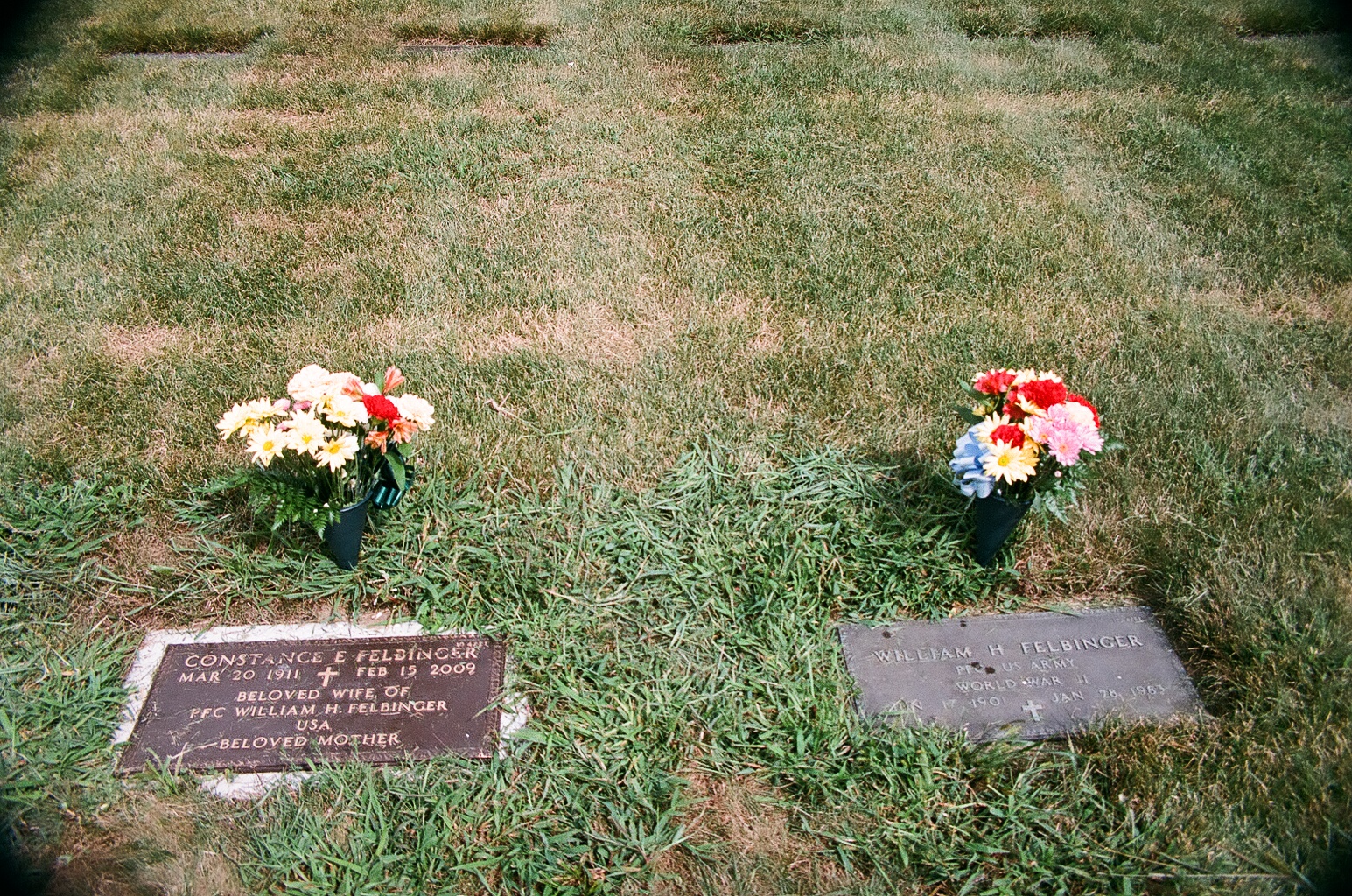
After leaving the Cemetery, I drove down to Mastic along the William Floyd
Highway. Once over the LIRR track past the Mastic-Shirley station, I knew I had
gone too far. Turned around and went back to the Montauk Highway and was
surprised how quickly I got into Moriches. I spent about two hours wandering
around Mastic looking for the Bungalow, stopped and took photos of some buildings
that looked remarkably like my recollection of what the Bungalow looks like, but
realized my memory of the Bungalow is of a building I saw as a child in 1953 that
looked remarkably like the photos in Mom's photo album from the 1930s, and my
memory is fifty-six years old. I was getting nowhere fast. Still, I had the
sense of now knowing spatially where Mastic is on Long Island, and my next thought
was to contact the Suffolk County Clerk's Office for exact information on the
Bungalow's location, with a map if I was fortunate.
The trip unleashed a flood of ideas for various lines of the families' histories to pursue:
* Letter to the Suffolk County Clerk's Office for a title search to find the
exact location of The Bungalow;
* Naturalization records for Charles Prahl and J.G. Felbinger, not just their
index records;
* GM Cenie Felbinger's and Dad's death certificates (at this time I had forgotten
that I actually have a copy of the latter);
* Death certificate for Christine Felbinger, our still-birth sister, sometime
between 1941-1944;
* Grampa Prahl's death certificate, from Islip Township;
* Check all Episcopal churches on the East Side of Manhattan (and maybe West Side)
for Grampa's and great-aunts Adelaide's and Mathilda's confirmation
certificates;
* Check with the Schaumberg Collection on Lenox Avenue and 135th Street, if they
might have a photograph of their property before the present building was built,
to see where 2GGP Merkel had lived;
* and last, write up all the stuff I had brought home from Germany in January.
A quick note here: in this time I had to go into Butler Library's central stacks, and I took a quick look at the annual reports of the New York State Adjutant General, in a search for Charles Edward Prahl in the 71st N.Y. National Guard regiment. No luck. These are the official reports, and they concern themselves only with the officers of the several NG and militia regiments, not the enlisted personnel. Still, I should go back and do a more deliberate read-through when I have time.
The addresses for the several local government agencies I need not record here; they are a matter of public record. Different, however, are the several Episcopal churches in which Grampa and great-aunts Adelaide and Mathilda may have been confirmed. In the time from 1894-1898, Grampa, Adelaide and Mathilda were living at 1685 3rd Avenue (95th St). After GGF Edward Alfred Prahl died in 1896, GGM Delia moved in with 2GGP Merkel at 507 Lenox Avenue. In conducting my search, I realized I need deal with those congregations already in existence in the 1890s and still existing now, and then consider congregations that existed then and may have subsequently disappeared:
* St. Michael's Episcopal Church
225 West 99th St./ 10025
212-222-2700
(This congregation for GM Christina Blaicher Prahl definitely. I have her
confirmation book. Additionally, according to the Rev. Canon Tom Miller at the
Cathedral, St. Michael's was doing half their services in German at the turn of
the 20th century.)
* Episcopal Church of St. Matthew and St. Timothy
26 West 84th ST / 10024
212-362-6750
(Originally a German Lutheran congregation; yetr indefinite because of so many
fires.)
* St. James Episcopal Church
865 Madison Ave / 10021
212-288-4100
* Church of the Resurrection Episcopal
119 East 74th / 10021
212-717-1622
* Church of the Holy Trinity
316 East 88th ST / 10028
212-289-4100
* All Souls' Church
88 St. Nicholas Ave / 10026
212-663-4514
(Congregation was at 775 Madison Ave (66th ST), 1889-1905)
* St. Martin's Episcopal Church
230 Lenox Ave. / 10027
212-534-4531
* St. Mary's Episcopal Church
521 West 126th ST / 10027
212-864-4013
* St. Andrew's Episcopal Church (b. 1872)
2067 5th Ave. / 10035
212-534-0896
* St. Luke's Episcopal Church
435 West 141st St / 10031
212-926-2713
* Church of St. Edward the Martyr
14 East 109th St / 10029
212-369-1140
At this time, I contacted Don Eckele of GGG, as he often volunteers his time at NARA regional office at Varick St. in Manhattan, looking for the naturalization papers for GGF J.G. Felbinger and 2GGF Charles Prahl. Success! Don was able to retrieve photocopies of the original papers for me, and the declaration of intent for Charles Prahl as well. In the intention, 2GGF Charles renounces his allegiance to the Duke of Schleswig-Holstein (aka the King of Denmark), and in the naturalization, to the King of Prussia. And it took him a while to do this: 1865 and 1867 respectively. For GGF J.G. the naturalization is interesting because his brother-in-law Johann A. Fichtelmann stood witness for him, but it is also clear from the signature how the indexer came up with "Furthelman" as his name.
I also found the citations for the following naturalization records:
* Charles Doppman, 21 Oct 1882, Superior Court, NY City, King of Sweden;
* August Dpman [sic], 27 Oct 1882, Kings Cty, NY, Emperor of Germany;
* Bertha Dppman [sic], 19 Jun 1877, City Ct, Brooklyn;
* Charles Doppman, 25 Oct 1867, Kings Cty, NY, King of Prussia;
* Pfoertner, Henry, County Court, Brooklyn, Oct 20, 1876, 74/161;
* Pfortner, Herrm., U.S. Dist. Court, NY, Oct 27, 1862 20/144;
* Pfortner, Charles, Supreme Court, NY, Sept 28, 1863.
I chose to pursue several vital certificates. Called Town Hall in Hempstead for the death records of GM Cenie, Dad and sister Christine. For Cenie they suggested calling Village Hall in Floral Park, where she died. Called Floral Park, and yes, they have the record. Mail in the particulars, a copy of my birth certificate and driver's license, and eleven dollars. I called Valley Stream Village Hall, and yes, they have Dad's death certificate. This leaves only sister Christine, and here it gets sticky. According to Mom, the fetus died in her womb at 23 Gotham Street, Valley Stream. OK, and where did she go from there for the abortion? Mom never said. This was wartime, and the nearest hospitals were either South Nassau County Hospital in Oceanside, Meadowbrook Hospital in East Meadow, or St. Joseph's Hospital in Far Rockaway (now St. John's Episcopal Hospital). Would the record be with the hospitals, in Village Hall Valley Stream, in Town Hall Hempstead, or the Department of Health in Albany? Not quite ready to spend the money to go there yet.
In the meantime, I contacted the Suffolk County Clerk's Office and was put in contact with Sharon Pullen, the archivist. I gave her all the information I had about the Bungalow in Mastic, and Grampa Prahl as owner. About thirty minutes later she contacted me by email with the following information: one deed listing Edward L.S. Prahl as grantee, buying land from John Frost, trustee, in June 1924, Deed Liber 1124, page 95; one deed listing Grampa as grantor, selling the property to Howard Waters and wife as grantees on August 14, 1953, Liber 3563, page 155. This particular information squares with my childhood recollection that Mom took Grampa, Alice and me out to the Bungalow in late summer 1953. At the time I had no understanding why, but now I might guess the trip was to finalize the sale and take care of any other business.
I sent off the necessary letters to Floral Park for GM Cenie's death certificate, and to Riverhead for copies of the deeds for the Bungalow. Doing this, I found the copy of Dad's death certificate in Mom's strongbox (put there by me), so don't have to send to Valley Stream for that, but should call them again about sister Christine.
GM Cenie's death certificate came quickly, arriving October 3rd. She died September 13, 1942, and was buried in Greenwood Cemetery the 16th. Thomas Draper was the attending doctor, mentioned by Cousin Sis in a conversation. COD: chronic myocarditis, due to chronic arterio-scelerosis and nephritis. Nice to see modern diagnoses, but as Alice commented, disturbing to see how often kidney problems keep running through the family: drink more water. Cenie was in the Floral Park Sanitarium for two days. My research indicates the Sanitarium was torn down years ago, replaced by the Floral Park Motel (30 Jericho Turnpike). Her home address, 94-65 224th St. in Queens Village, is a short distance from Jamaica Avenue that becomes Jericho Turnpike once it crosses the Queens-Nassau County line, which would explain the choice of hospitals.
Cenie's home was also a short distance from Belmont Race Track, and in those days probably easier to reach because there were no intervening super-highways. This proximity would also help explain details of the "Blue Larkspur" story.
Blue Larkspur.
From: Thoroughbred champions :
top 100 racehorses of the 20th
century.
Lexington, KY : The Blood-Horse, 1999. p. 248.
So the story goes: Dad and Uncle "Doc" Campbell liked to go to the
racetrack from time to time, and were heading out one day.
Aunt Gene must have known some of the horses running, and asked her
husband and brother to put down a bet of five dollars on Blue Larkspur
(big money in the late 1920s). And why should they bet on Blue Larkspur?
Well, because she liked the flower and the name. This kind of thinking
men summarily dismiss, and off to the track they went. Did they place the bet?
No. And which horse won the race? Blue Larkspur. When they got home,
Dad and Uncle Doc had to get up the winnings for Aunt Gene out of
their own pockets.
I make a short digression here to comment further on the "Blue Larkspur" story. Many family stories are often short on details that can obsess later generations. This story is a good example. Which racetrack? What race? How much the winnings? Well, Dad never said. Alice and I have gone back and forth about Blue Larkspur. Alice did some research, and challenged me on certain assertions I made in an earlier version of this report. Not to be outdone, of course, I undertook my own research ... and promptly came up against the problems Alice encountered. There is information about Blue Larkspur on the I-Net, but information such as what track, which race, times of the runs and winnings are not as easy to come by.
After a frustrating half-hour search in my own reference books and on websites, I thought contemporary accounts would be more helpful and looked at the New York Times index online. Not helpful. Up the hill to the Refrence Department of Butler Library, to look at the old manual indexes of the Times. Less helpful. I found Sarah Wittke, a colleague, on duty and explained my research problem to her. Sarah loved the story (adding that on account of the name, she'd put down two bucks too), and suggested the Proquest full-text databases of historic newspapers. More helpful. Blue Larkspur ran only three years (1928-1930); ran at least four times as a two-year-old at Belmont in 1928, and voted best two-year-old that year; lost the Kentucky Derby in 1929 in the mud; won the Belmont Stakes in the mud, and voted best horse for 1929; ran several races the following year, and was retired to stud service until his death in 1947. Considered one of the best one hundred racehorses of the Twentieth Century.
After more conversation with Alice, we agreed that most likely the racetrack in question is Belmont, as there is little evidence Blue Larkspur ran anywhere else in the New York metropolitan area. The old Jamaica racetrack and Aqueduct are the likely candidates, but they are further away from GM Cenie's house. We have also concluded that *possibly* the race was the 1929 Belmont Stakes. We have several reasons for thinking so. Blue Larkspur was by all account a good horse, but was also known not to like running in mud. At the Derby his trainer Herbert J. "Derby Dick" Thompson was having a bout of appendicitis, and the apprentice trainer left in charge failed to have Blue Larkspur shod for running in mud. Having won the Withers Stakes before the Belmont, Blue was the odds-on favorite going into the Belmont, but the track was muddy again, and before the start of the race he was kicked by another horse. Winning the Belmont Stakes under these conditions is even more impressive. And Dad and Uncle Doc? When they got to the track, they may well have considered Aunt Gene's request and decided against it. These details were never mentioned. The result, however was clear: when they got home they had to get up the winnings.
One other reason comes to mind. Dad never showed any particular interest in racing, except to go to the Belmont Stakes. My own introduction to the thrill of thoroughbred racing came when Dad suggested one day that we (he, Mom, Alice and I) go to Belmont for the running of the Belmont Stakes. The year was 1973, and Secretariat won the the Stakes and the Triple Crown at a distance of twenty-one lengths. Given Dad's pattern of behavior, it is reasonable to assume the Blue Larkspur race in question was the 1929 Belmont Stakes.
In the end however, the *point* of the Blue Larkspur story lies not in the details. Its point, if any, is rather the amusement generated among family members about the interaction between Aunt Gene, Uncle Doc and Dad: an incident illustrating their personalities. If a moral is required, it is this: husbands, pay attention to your wives; brothers, pay attention to your sisters. Alice will appreciate this. (Smirk, laugh, snigger, giggle.)
Back to Cenie's death certificate. The last piece of curious information on the death certificate is that she was born December 15, 1868. This is the date cousins Lorraine and Sis remember as her birthday, for Cenie said it was. The date conflicts with the birth date on her baptismal registration, December 18th. I'm inclined to think the 18th correct. GM Cenie was by reputation notoriously bad about dates, and registration of the baptism was done by witnesses to her birth, namely her parents. Still, it might be argued the baptismal record is wrong, though there is no evidence for this. The only thing about which anyone is completely clear is that GM was born December 1868, one month after Ulysses S. Grant was elected President of the United States. And Grant is a character in the Campbell family history, as Uncle Doc's father Samuel Campbell was a runner for the General after his term in office.
Waiting in October 2009 for other documents to arrive, I turned my attention to preparing the German material I had collected in January. Obviously my great concern was whether I could actually make sense of my notes after so long a period of time. I read my January work notes: helpful, but not entirely clear. So, back to the grindstone here.
* I revised the family tree charts (Document no. 1, English) to reflect I had
found the marriage record of 4GGP Johann Paul Felbinger/M.B. Sieber, and
from that record have the death place of 5GGF Georg Leonhard F.;
* Cleaned up all the little records in Westheim that had plagued me
for so long, and input the photo of 2GGM Barbara Margaretha Felbinger's
marginal note.
* Transcribed Johannes Sturm's record, to have something to write to Don
Bullerman;
* Transcribed the birth/death records for the Hörber/Felbinger child.
Frustrating because the pastor's handwriting is so wretched I mistook the
birth record for the death record. But also learned a new word:
"Gacktaufe". We would say: "emergency baptism", a baptism during in
extreme circumstance (as a newborn dying), often without benefit of
clergy.
* Worked through the other Oberdachstetten records, but even now not every
word was clear, even with benefit of photocopy;
* Corrected my work on the Ickelheim Armenkasse records. The task started
with a tremendous decision on my part. When I first went into the files
to correct them, I couldn't determine *what* version of the records I had
on the web page. This took me a day of comparative reading, and figured it
out in the end. As usual, I saw places where will have to go back to Nuremberg
to correct the text ... again (Sigh!). Additionally, as the last
several entries in the Armenkasse records relate to Ketts, I will have to
go back and redo the Ickelheim school record document (Document No. 10)
to include the Kett children as well;
* Typed up my transcriptions of the Ickelheim Pfarrbuch. In this instance, the
care I took to proof my work before leaving Nuremberg has paid off; I am
amazed how accurate my transcriptions were; only a few minor problems
that I can resolve by a return visit;
* So, for all the problems at the time I am amazed how accurate all my work in
Nuremberg in January has actually turned out to be. A pat on the back to
myself: makes me think the trip was helpful, after all.
I do find a couple cryptic notes to myself in this period. One concerns the birth records of 4GGP Johann Paul/Barbara Margaretha F.'s children. In Brenner there is a death listing for Joh. Felbinger + 26.9.1773 that indicates he lived one year 10 months (or 1 month 10 days), but the actual Oberdachstetten record indicates the Johannes in question is the Johannes born 6.6.1768. Brenner appears most definitely in error, but should check both at FHC Woodside, and Nuremberg.
While working on the German material, the Mastic real estate information arrived from the Suffolk County Clerk's Office. The deeds themselves are very specific as to the location of the property, but not helpful without the attendant maps. From the wording I might guess the Bungalow was on Clement Avenue two blocks south of Montauk Highway, which squared well with my 56-year-old recollection, but this is not certain. Looking at Google satellite photos, I found one building that from above looks as if it might be the Bungalow, but nothing definite. So it's off to the Clerk's Office to make some arrangement to see the corresponding maps, if available.
One reason for a little celebration: I went October 13th to a luncheon presentation at the NARA regional office on Varick Street, for National Archive Month. Basically a program about the history of the National Archives, and a tour of the stacks (Oh right, John, like you've never seen stacks before!!). I won a door prize of a book: Dodd, Monroe. Your land, our land : two centuries of American words and images from the Regions of the National Archives. Kansas City: Star Books, 2009. Nice book of pictures and documents from the various regional branches of NARA. Good program too.
November 2009 started on the 10th with another lunch-time presentation at NARA about using Ancestry to find your genealogical material. I found the presentation very interesting, and very confusing. After a while I realized the presenter was demonstrating the programs available on the commercial version of Ancestry, not the library version I have at Columbia. Of course, I was envied by all for having free access, so it all equals out. Besides, the commercial version is fine if one wishes to put up links and pictures and other things. Again, why should I pay Ancestry several hundreds of dollars a year to do what I can do for free on my own home page, except that Ancestry has a greater exposure?
When I got back to the office I did check out the commercial version to see what it looks like. Got lots of cool stuff, of which I found the option for having one's material published in a paper version intriguing. Having all my research published in a bound volume is something I would definitely consider.
I started playing with it, and decided to run GGF Carl Blaicher's name through it. I always wonder why particular inspirations come along, for occasionally they are right on the money. Up pop the few entries I already know about (1880 ship record; 1900, 1910, 1920 Federal censuses). Fine, but I look a little further. MY eyes fall on an entry in the 1930 Federal census for a Carl Bleicher (variant spelling). Not the name, but the age in intriguing: 68 years old, born in 1862. Too close to be coincidental. I pull up the record: this Carl Bleicher is living upstate New York in Bedford Township, Westchester, working as a gardener; married to a Johanna, 15 years his junior. Age at the time of his first marriage: 22 (1884), in sufficient time to give birth to GM Christina in 1886. Because of the discrepencies in age between him and the present wife (she was 20 at her first marriage), I can guess this is a subsequent marriage for both. He indicates immigrating in 1882. OK, off by two years (1880), but in prior censuses he was also wrong, so I discount this. All this information reminds me of a story. While living in Copiague Mom once told me as we sat at the dining room table about "Grandmother", the drift of which was that the grandparents were having their troubles. One day Grandmother came for a visit, and Grandfather showed up later, he in one room, she in the other, and she completely ignored him. Of course, I did not get all the details at the time, so it is a vague, half-remembered story; and I don't remember Mom telling me that many details anyway. In remembering the story, I concluded at some point that the "grandparents" had to be the Blaichers, as "Grandfather" Prahl was already dead in 1896. Presented with the present information, it was also easy to come to the conclusion that the story was a childhood memory of Mom's, as the 1920 Federal census lists GGF Carl Blaicher living in the Bronx alone, but as "married". GGM Blaicher is nowhere to be found, except in the 1930 Federal census living on West 109th ST with a daughter and son-in-law. No record of Carl Blaicher's death in the Five Boroughs. I had concluded that he moved either somewhere upstate New York or out of state, but before this entry in Ancestry I could not get a handle on this. This record in Ancestry is the first clue I've had about GGM Carl Blaicher since finding his baptismal record.
November 12th I called the Suffolk County Clerk's Office, to be in touch with the Micrography Department. There I spoke with one of the staff, Nancy Booth, who informed me the Office has the original survey maps. I thought to make the trip to Riverhead, again picking up a car in Hicksville and driving out (not much further than the Cemetery), and map in hand to return through Mastic before coming back for a GGG meeting. But renting cars is getting expensive, so perhaps a trip to Riverhead alone. A few days later I also called Bedford Township in upstate New York. They have the necessary forms on their website for vital records, and it would be cheaper to go with them than Albany. Seems governments are getting in on the genealogy craze. I also contacted the Bronx County Clerk's Office to see if they might have records of the Blaicher divorce. A Mark Nusenbaum took the information: send it all in. But of course this could get sticky, becuase all divorce records are sealed for a hundred years: don't need to know the salacious details, just a date. A few days later I received a note from Nusenbaum: no record in the Bronx. Perhaps Manhattan would be the next place to try.
November 22nd I took a few minutes to run a search for sister Christine Felbinger. I did this because Alice suggested Mom might have been taken to Far Rockaway for the abortion. No entry found in the NYC Death Index, so best guess is she was taken to South Nassau County Hospital. In the meantime, I again ran "Felbinger" through the files and came up with the following additional entries:
* Marriage of Martin Felbinger/Rosina Heninger, May 23, 1891, Manhattan, No.
6314 (this may be the entry for a cousin by marriage who called me in
2003, but I find no record of it in the notes immediately to hand);
* Death of Joseph Felbinger, 78 yrs, June 21, 1941, Manhattan, No. 13479;
* Death of Marie Falbinger, 88 yrs, December 12, 1944, Queens, No. 9658 (this
too is intriguing because it would indicate a birth date in 1856).
The following day I called the Hempstead Town Clerk concerning sister Christine Felbinger, to be informed that only Albany keeps track of fetal deaths ("stillbirths", I said, but the term seems to elude them). So it's off to Albany at some point.
At their invitation, I spent the Thanksgiving holiday visiting with the four Cooper sisters (Christine, Martha, Catherine and Susan; granddaughters of Uncle Jim and Aunt Etta Cooper). In addition to the pleasure of their company, another treat was that I brought several photos I had not previously sent them, and they in turn brought out Aunt Etta's photo albums as well. I was stunned at what I found. As would be expected, many photos were the Coopers in their several generations, but many photos were also of the Felbingers. I found a photograph with the notation "Grampa Felbinger" on the back of the photo in a child's handwriting (Aunt Etta's?), and the photo is most definitely of GGF Johann Georg Felbinger as a young(er) man, sometime in the 1870s most likely.
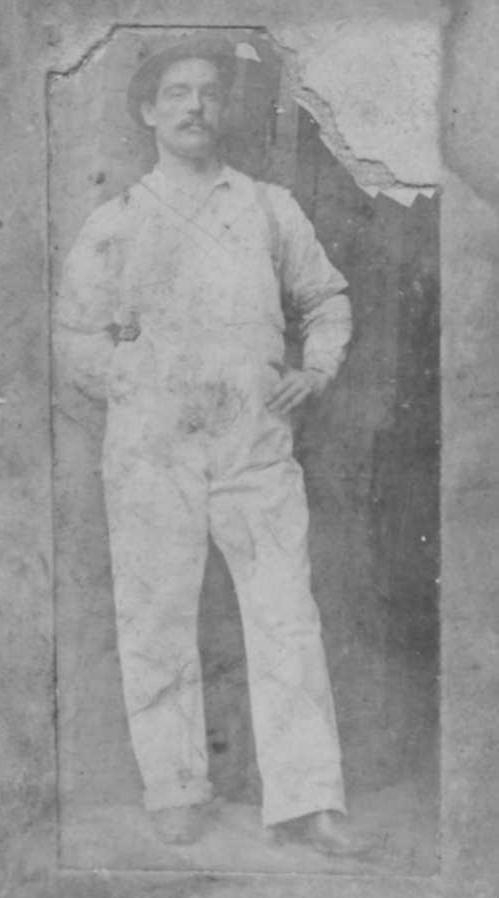 Johann Georg Felbinger as a young man,
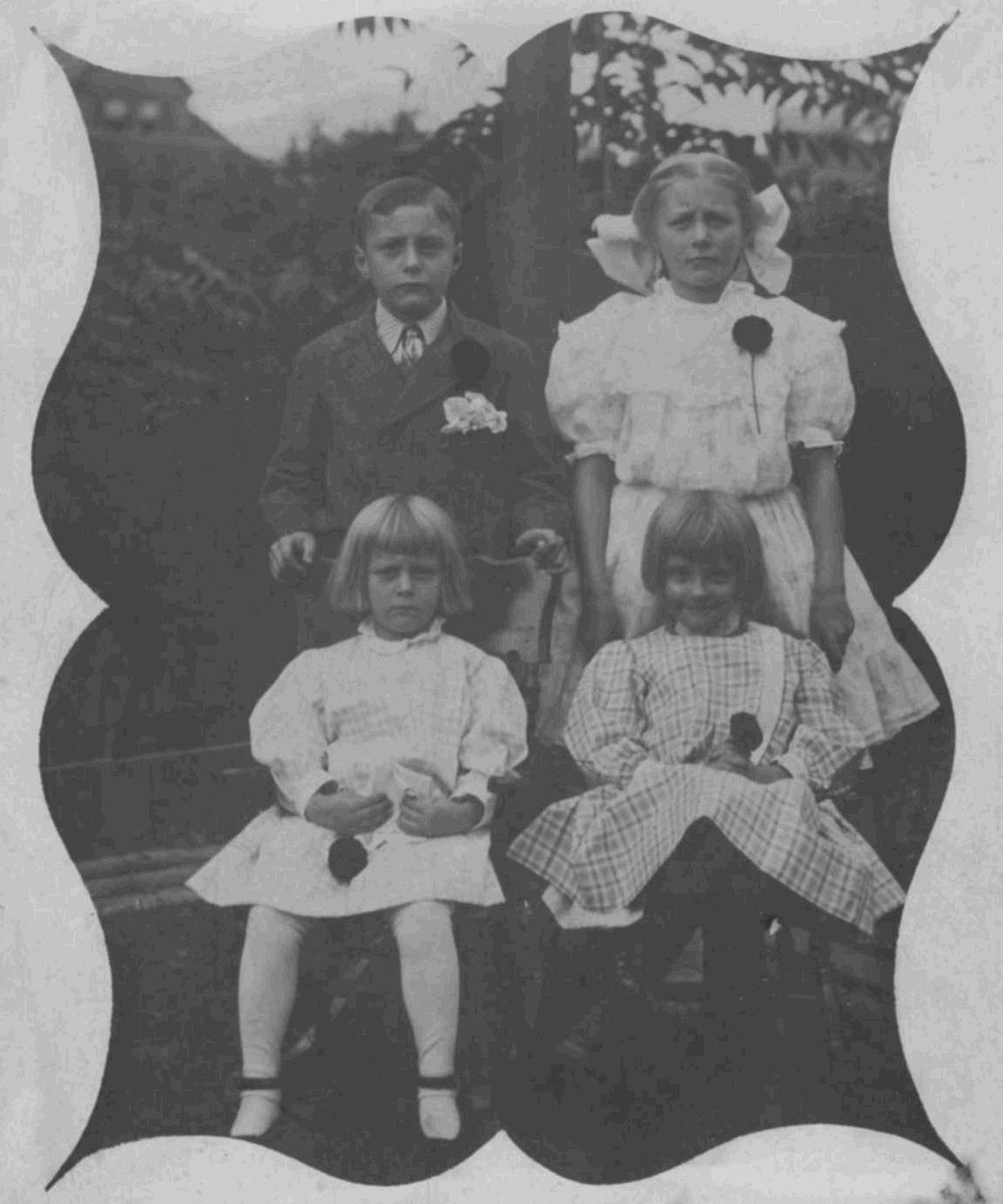
The Felbinger children (clockwise from upper left):
William (Dad); Georgine
(Aunt Gene); May (Aunt May); Henrietta (Aunt Etta).
Photograph was taken ca. 1908
Also found: a baby picture of Aunt Etta in her carriage, and several photos
previously unknown to me of the Felbinger children together (Dad and his
sisters Gene, Etta and May). The most surprising of the latter show the
four children with Cenie sitting on the front porch of their house with the
"32" (of 1632 Pacific Street) clearly visible. Another group of
photos were taken in 1941 and 1942. Some of these photos I have already, but
others were unknown to me, and were taken at Easter 1942. In them GM Cenie is
clearly ill and no longer the robust woman she appears to be in earlier
photos, so these photos were made at what was a final gathering around her.
Chris Cooper's husband Steve Burt scanned these, so I have a set as well.
I also took a look at the Cooper family Bible. In it I found several
generations of Coopers have kept the family vital records. While looking at
it I found a single typescript leaf compiling the informaton in the book plus
additional information. The Coopers didn't know they had this sheet. As it
appears, the Cooper family actually goes back to the 1600s here and were originally
Dutch ("DeKuypers"), the name being anglicized to Cooper sometime in the 18th
century. While at it, I wrote down for my work book much Cooper family
information as well as what relates to the Felbingers. I found two entries
particularly poignant: the first was for James Anderson Cooper
(b. March 23, 1864; d. 11/1951). The entry is memorable for me
because as a six year old I was taken by Dad and Mom for the senior
Mr. Cooper's "laying-out". Of course as a six year old, I had no
particular idea what it was all about. While at the funeral
parlor ( I knew not where), I was approached by a rather formidible man who
asked if I were Bill Felbinger's son. I say "No": I was frightened and
walked away. It was only after Dad made the proper introductions that I
learned it was Uncle Jim, who was James Austin Cooper (b. September 14,
1893; d. April 21, 1968). At that time Dad, Mom and I took a trip in the
pouring rain for Uncle Jim's "laying-out". This time I was clear the funeral
home was in Brooklyn. When we got there I remembered the same hallway where I
had denied him so many years before.
At the beginning of December 2009 I signed up for another NARA presentation later in the month, this one dealing with what happens when you hit the "brick wall" (or "zum Totenpunkt kommen", as the Germans say). While signing up for this presentation, I explored the regional office's own website. I found they have the indexes for the New York State Health Dept. vital records. Good to know: there are several people to look for:
* Death certificate for sister Christine Felbinger: stillborn (fetal
death), sometime between 1941-1944;
* Death certificate for George S. Cangialosi. In New York City, or
outside? Of course, the marriage was within NYC, so that would not
be listed. But the death is still worth a look;
* Certificate of second marriage, and of death for Carl Blaicher, now known
to be living in Bedford Township, Westchester County, in 1930;
* Marriage certificate for GP Prahl/Blaicher. From all account April 2,
1910 in Westchester someplace (and why there? At the remove of 100 years, who
knows?);
* Marriage certificate for GF Edward L.S. Prahl to the woman who lived on
Fordham Street in Valley Stream. Sometime in 1951/1952;
* and incidentially the marriage certificate of a Freda Blaicher to Harry
Hamfeldt, March 30, 1917, Manhattan, no. 15204. Perhaps Helen Freda
Blaicher, b. January 4, 1891 in New York, daugther of GGP Carl and
Henrietta Blaicher. But this from the Municipal Archives.
Thinking about the upcoming presentation I took another stab at finding 2GGF Charles Prahl arriving in the United States. No luck, as usual. But the search brought me back to Ancestry. I cast the net wider and discovered something interesting: a couple citations for tax records while he lived in Staten Island in the 1860s (interesting, but not spectacular), and then for a patent record. This is intriguing, so I check it out. Yes, 2GGF Charles Prahl, living in Cranford, New Jersey in 1884, and working for Stern Brothers and Company in Manhattan. It is a design for a finger ring. The patent is dated April 22, 1994, and it is No. 297,446. I go to the Patent Office website and find the entire specifications for the patent with its attendant drawing. Smart guy, 2GGF Charles Prahl. From the paperwork it is clear that he assigned the rights to the patent to Stern Brothers. I might hope they paid him something for it. I told Alice about the patent, and she informed me that Mom may actually have had the prototype of the design in her jewelry box (at least Alice remembers having seen something like it), but that it was probably tossed at some point. If so, I am sorry for the loss, but then Grampa and Mom never said anything about a patent, so who would know?
Incidentially, I found a couple U.S. passport applications for Henry Dopmann. These I must check against the Doppmann records.
On December 3rd I took the trip out to Riverhead to the County Clerk's Office. For such an extended trip the weather was good, bright, sunny and comparatively warm after a night of rain. Had to catch the early 7:39 A.M. train, as there are only four trains to and from Riverhead in any given day (change at Patchogue). And if I miss the afternoon 3:19 train back to New York, it's hang out in Riverhead until 10:30 for the next one. A long ride, far removed from the civilization I know in Manhattan. I went to the Public Library for directions: good thing, my Google map put me off from the County Clerk's Office by several hundreds of yards. Finally finding the Clerk's Office, I found the Micrography Department, which I had called earlier in the week to have the map ready for me upon my arrival. This map is: "Map of Mastic Park, Section 4, situate at Mastic, Town of Brookhaven, Suffolk County, Long Island, sub-division from original survey certified by May & Smith, Inc. C.E. Patchogue NY, October, 1920 and filed in the Suffolk County Clerk's Office the 21st day of March 1921, File no. 275". I suppose I could have just let them send me the map. But it occurred to me that it would be good to look at the map onsite, so that if there were anything unusual or difficult I could deal with the issue there rather than have to deal it over the distance. The trip was expensive, but two copies of the map cost five dollars.
I checked the map, large in size, easily 36" x 24". Looking for the relevant lots, I found I had been close to the Bungalow; indeed, I probably passed it even, without realizing it. Each lot is 100 feet by 20 feet. According to the deeds sent me, Grampa had purchased lots nos. 3493 and 3494 in April 1925, and sold them to Howard and Claire Waters in August, 1953. As mentioned, this explains the trip out to Mastic at that time. According to the map, the property are on Carlton Avenue, west from Herkimer. OK, but small problem. The lots listed are on the south side of the Avenue, and the Bungalow was on the north side; even as an eight-year-old I had some sense of direction and geography. This fact would explain why we went across the Avenue to look at the property (overgrown and undeveloped). Mr. Waters really couldn't get into it because he was an amputee missing one leg. So the map is accurate, but my information was incomplete: not the Bungalow.
Looking more closely at the map, I noticed the property immediate across Carlton Avenue (lot nos. 3551 and 3552) have two little tic marks extending from them. The tic marks are on the copy, so they would be on the original as well. I asked the staff member, Nancy Booth, about this. She replied that in years past people were given to marking the maps in all kinds of way to help them find things. Uh-huh. Minimally, the two lots in question (3551 and 3552) were of important to someone for some reason at some point, and so marked the map. No way to prove it, of course, but why these spedific lots and what are the chances it was Grampa or someone acting on his behalf? Again, the kind of freaky serendipitous stuff that goes on in family research all the time.
So I asked Ms. Booth if I might speak with Sharon Pullen the archivist, with whom I spoke earlier. Yes, she was in her office at the back of the Liber Room where all the big Liber books are kept. Pullen directed me to the indexes of transactions, and ... well, not so counter-intuitively I started working backwards from the index record for the sale of lots 3493 and 3494, looking for a sale of lots 3551 and 3552. When we visited in 1953 I had the sense the Waters had been living in the Bungalow for some time: looked lived-in. Found the record quickly enough: last name, first initial of given name of grantee, listed by date of transaction. Grampa sold lots 3551 and 3552 to Mr. Waters July 20, 1948. Bingo!!! Exactly as indicated on the map.
I went looking for the original sales. Looking at the records for 1925, I found listing under: "Prabl, Edward", another misspelling, but this was for the south side. I checked further and found the purchase under "Prabl, Christina. *Gramma* had brought the property on which the Bungalow sat, not Grampa! Checking the Liber books for the original documentation, I also found her living at 2329 Van Cortland Avenue in Ridgewood, and Grampa at 4 Martin Avenue in Glendale. When I came home I checked Google for these streets, but of course could not find them; have to wait to visit NYPL. But more immediately: why would they buy properties separately? Perhaps to limit their liability, or as part of an investment strategy; for whatever reason, that is now lost. In any event, the Bungalow property came to Grampa upon Gramma's death in September 1929. I did not look for an actual transfer of ownership, and indeed may be none because Grampa may have handled the matter the same way Mom handled the house in Valley Stream when Dad died. In my excitement I photocopied several documents, went back to the train station to realize I needed to photocopy other documents, so spent a good portion of the day getting my daily exercise. Happily, there was enough time to do this, and left on the 3:19 P.M. train. Also realized that it was two days short of Grampa's 127th birthday.
One question remains: does the Bungalow still exist as a building? I checked the satellite photos on Google at the highest magnification. Yes, I think it does. The garage and garage run are in the same position as the 1938/39 photos. The satellite photo also indicates to me there has been additional renovation, so that to look at the Bungalow at ground level it may bear little resemblance to its 1939 condition. Thus, it is easy to understand how Mom might not easily find it on a subsequent search with Alice, or if she and Aunt Chris went looking and did find it, they would be sorely disappointed because it would not be as they remembered it.
December 6th: the holiday party at NYPL. Got an invitation because I made a contribution. Took the opportunity to go to the Catalog Room and look up entries. Pity the Local History Division wasn't open, but they don't want wine and cheese in the books, either.
December 8th was the "dead end" program at NARA. I was able to put my research question (which is to find the passage of 2GGF Charles Prahl to the U.S.), but again my question has stumped the experts. Sigh! Except to look at all the crew manifests as well as passenger manifests, and write to Bad Oldesloe, I am stumped as to how to proceed. But the visit was not a total waste: I took the time to look for some of the entries available on the New York State Dept. of Health indexes. Results:
* No record for a Felbinger child still-born between 1941-1944. I
checked 1940 and 1945 as well, but no luck;
* No record for GP Prahl/Blaicher marriage; but
* Marriage record for Grampa's second marriage to the Fordham St. woman:
Prahl, Edward L.; Hempstead; Dorl; October 27, 1951; certificate no.
54882;
* Marriage record for Blaicker, Carl; Yonkers; March 15, 1924;
certificate no. 21930.
December 10th I had a major physical exam. As it took place at Madison Avenue and 60th Street, I went downtown to NYPL afterward to look at Norwood's guide to Queens streets for the name changes on the Mastic property deeds. I found the following information:
* p. 167: Van Cortlandt Ave Rid[gewood] now 71st Ave. 59-00 to 62-00;
* p. 125: Martin Ave Glen[dale]; now 88th PL 82-00.
Of course, without a map this is no particular help. Going to Google at the Library, I found 71st Ave. cuts north-east from Myrtle Avenue across Fresh Pond Road, as mentioned in the Prahl family tour of last year. 88th Place is a short side street south from Myrtle in Glendale. More to the point, the streets are not near one another. Using the "Get Directions" function I found they are about 2.2 miles apart. This is a surprise, to say the least. What was happening that Gramma and Grampa listed themselves in this way? Another reason lost in the mists of time. I mentioned this to one of the older reference librarians on duty, who suggested the contemporary telephone books and city directories on microfilm. He also suggested the 1925 New York State census that is listed by assembly and enumeration districts: a thought I have often had, but have refrained from pursuing because the Municipal Archives folks are not terribly knowledgeable nor helpful. Out of time for this visit but definitely a matter to pursue.
Christmas Day was unusual this year: it was the second Christmas I had nowhere to go, and no one to be with (the first was after surgery in 1993). It was a strange day in that sense. But went to church, made sauerbraten for my Christmas meal, and took a ride in the early evening to go look at the tree at Rockefeller Center and called Alice from the spot to wish her the best of the day ... and cried for twenty minutes as I stood looking at it, remembering Christmases past in this place.
The following week I was off to visit Alice and Bob in Vancouver. I was happy for the visit, but of course there is no rest for the weary, and I brought some of the family work with me. My principal task was to start extracting notes for this report: Goodness, I am actually on time. By the end of the year I had actually extracted thirteen pages of notes in outline; one can see how they have expanded. One final item of note: in a conversation with Alice, she informs me that one thought I have had about the Cangialosi/Prahl marriage is correct; it was an annulment, not a divorce; Mom told her as much. I find this confusing only to the extent that it means the civil registration would be expunged as well? Of course, there should be church records, and for these I would have to apply to the Roman Archdiocese of New York for information. That becomes more difficult, because it is unlikely the Archdiocese is willing to part with details, though I might hope for the date of the decree. At the least, this fact explains the reversion of the children to GA Mathilda's maiden name of Prahl: I didn't take the medieval canon law class for nothing.
Here ends the report for years 2008-2009. It is the longest report ever, but it also covers two years. Much work has been accomplished; much more work needs to be done.
--Begun December 20, 2009; finished March 13, 2010; first proof, March 20, 2010 (Mom's 99th birthday); 2nd proof and revisions, March 27, 2010.