Political Science Research
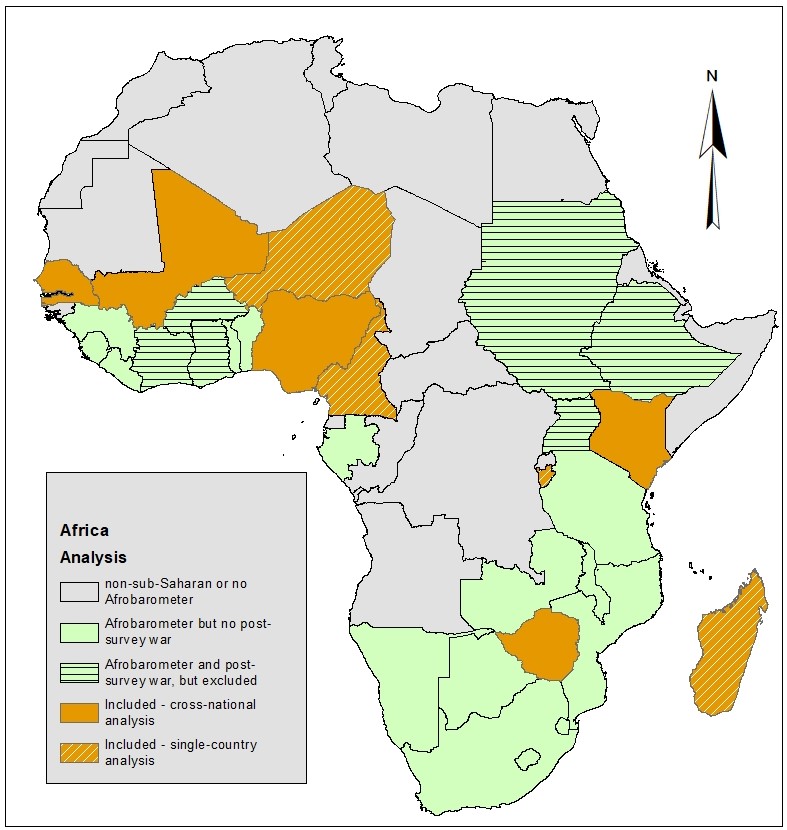 "Horizontal Inequality and Political Violence: A Subnational Analysis": This research takes a novel approach to answering whether the location of new periods of civil conflict correspond with areas of the greatest political, economic, and social inequalities between ethnic groups. I leverage subnational variations in inter-group (or "horizontal") inequality, diversity, and organized political violence. Using geospatial data from a wide range of sources, I construct an original cross-national dataset of individual administrative regions. I test the relationships between political violence events and ethno-linguistic diversity and perceptions of political access, economic wellbeing, and social status. This research contributes to questions around the causes of ethnic violence, the relationship between economic development and conflict, how social divisions mobilize political action, and how to explain subnational variation in the onset of violent conflict. It finds support for a significant relationship between inter-group economic inequality and the location of new civil conflicts. It also shows a relationship between inequality and violence when local levels of diversity are taken into account.
Spatial Analysis
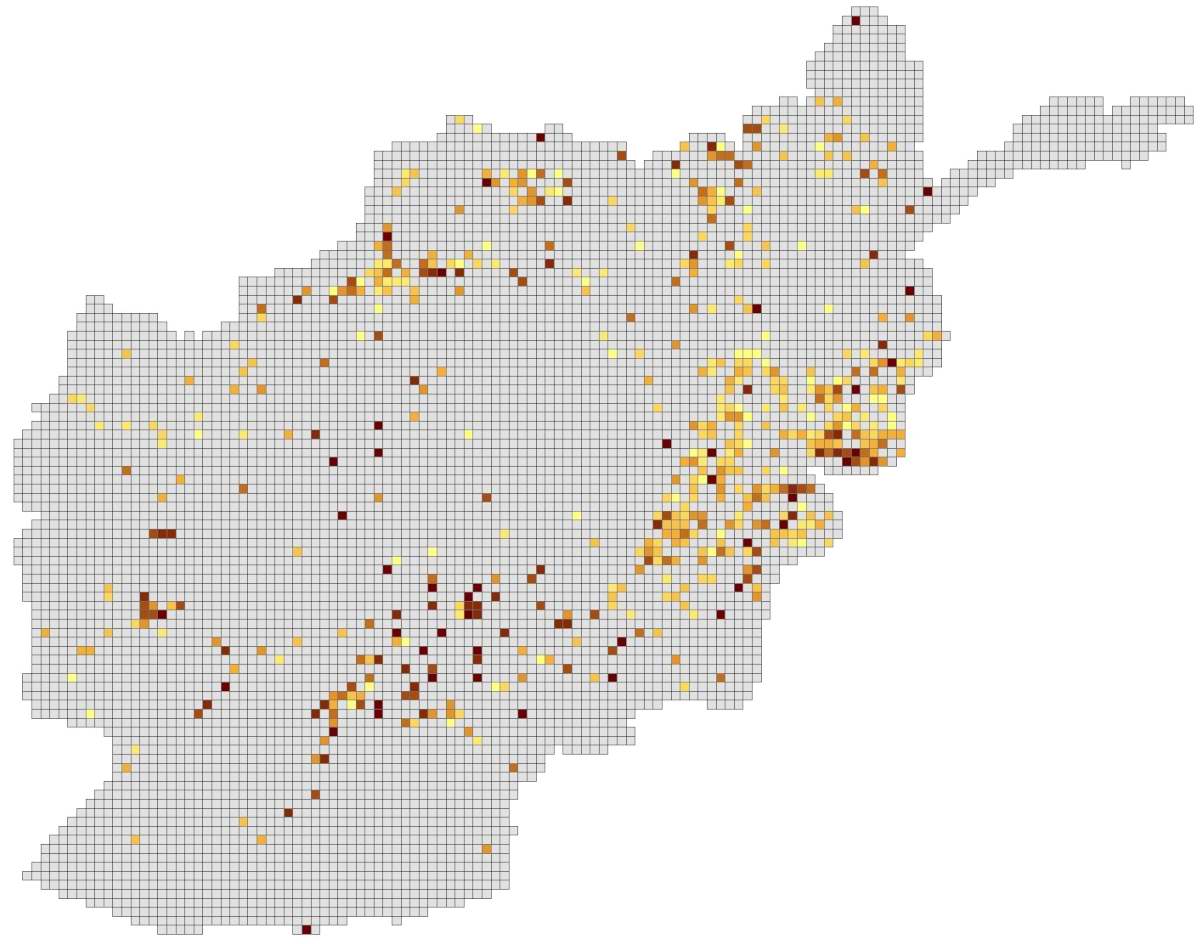 Spatial Analysis of Peace and Violence: I am currently working on a project using spatial analysis of subnationally disaggregated indicators of peace to assess correlation with documented incidents of violent armed conflict. I use the Institute for Economics and Peace "eight pillars of positive peace" to categorize peace indicators. Those pillars are: well-functioning government; sound business environment; equitable distribution of resources; acceptance of the rights of others; good relations with neighbors; free flow of information; high levels of human capital; and low levels of corruption. My goal is to discover the connection between sources of local conflict resilience and violent conflict events.
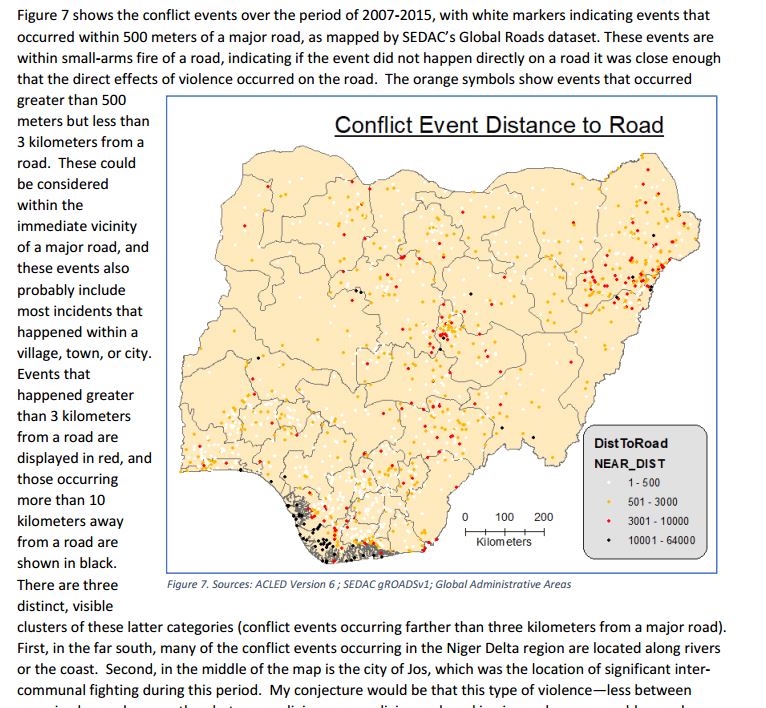 Spatial Exploration of Conflict in Nigeria: My first project using GIS for spatial analysis looked at conflict in Nigeria from 2007 to 2015. I used several spatial statistics methods to show how the location and dispersion of violent conflict-related events changed over time. Additionally, I looked at the location of conflict events in relation to roads and population centers to help visualize how the social geography of conflicts varies in different parts of the country. This project was part of a course on GIS Analysis by Professor Greg Yetman of the Earth Institute's Center for International Earth Science Information Network, at Columbia University.
International Policy Research
 "Military Integration in Peace Agreements": In any given peace process, there could be hundreds of incompatibilities between the belligerents and dozens of necessary provisions for building trust, preventing spoilers, enabling cooperation, providing legitimate security, substituting weak capacities with outside aid, and a host of other needs. Countries and international actors have long recognized the importance of demobilizing and reintegrating belligerents, especially rebel fighters, into society. However, the integration of former combatants into national security forces is less common but equally vital. Peace agreements should include provisions for military integration in order to: optimize military-to-military contact, decrease the post-conflict salience of ethnic identity, and to mitigate the risk of potential spoilers. This paper provided the basis of a Mediation Perspectives blog post.
"Resolving the Conflict in Balochistan": Balochistan, the poorest province of Pakistan, is undergoing its fifth insurgency since the end of British colonial rule. The simmering conflict, which has both sectarian and ethnic roots, is both exacerbated by and contributes to regional instability in South Asia. This essay explores the insurgency and steps to resolve it, and concludes that this conflict, while not ripe for resolution, has a relatively straightforward path to mediation and resolution. The political and economic factors behind the conflict also offer its resolution, and a successful end to violence would greatly benefit most of the relevant actors. This essay first looks at the conflict situation in Balochistan, providing a brief overview of the permissive and immediate causes for conflict. It then considers how to resolve the conflict, looking successively at: the ripeness of the conflict; the prospects for a mutually hurting stalemate, a way out, and valid spokesmen; steps for mediating the conflict; and the form of a peace agreement that could best address the conflict.
"Ideas Matter: The absence of a South Asian security community": South Asia was the site of the “Great Game” of the 19th century, a quintessentially Realist geopolitical competition between external great powers. Today, hard power security concerns, energy politics, and third party great power influence all play a role in regional politics. Do these factors alone explain why the region has not developed a security community similar to the one enjoyed in Europe? Or is insecurity in the region caused by deeper factors? The International Relations framework of constructivism offers the most compelling explanation of the absence of a security community in South Asia for three reasons. Constructivism defines and explains security communities as institutions of states and offers a perspective that considers but also moves beyond hard power. Furthermore, it offers a normative framework which assesses temporal and institutional changes. Finally, it comprehends the role of constructed ideas in security relations among states to comprehensively interpret how identities and ideas are used by state actors. This is a brief exploration of these points, considering the states of Afghanistan, India, and Pakistan.
Peace Operations Research
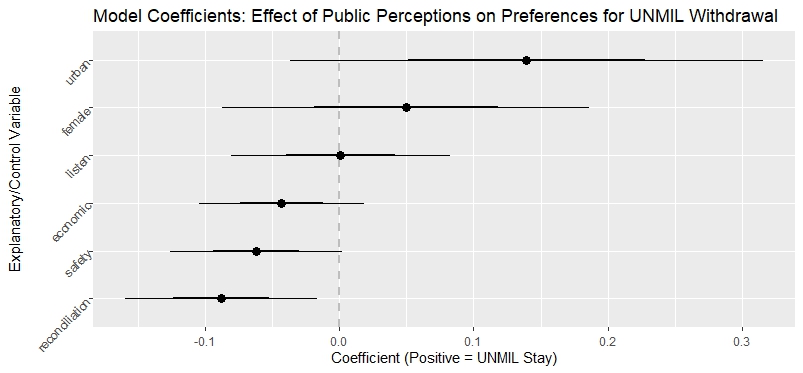 "Public Perceptions of Peacekeeping Mission Withdrawal in Liberia": This project seeks to understand why, after over a decade of peace, Liberians preferred for the United Nations Mission in Liberia to remain in the country. In other words, what factors shape how people in a post-conflict country perceive the withdrawal of a peacekeeping mission? Despite a range of academic and policy research on the necessary conditions for a peacekeeping operation to exit a country while minimizing the risk of conflict recurrence, little is known about how the individuals most impacted by such a decision form their opinions about mission transitions. In this regard, this paper specifically focuses on perceptions of post-war reconciliation efforts in Liberia. UNMIL operated in the country from 2003 until 2018. Using data from a 2015 public opinion survey, my analysis uses logit regression models with ordinal regression robustness checks to determine the relationships between opinions about reconciliation, security, governance, economic recovery, and peacekeeping mission withdrawal. It also considers the role that gender and location have in shaping opinion. This paper finds that survey respondents who felt that the government was not doing very well at managing post-conflict reconciliation were more likely, on average, to prefer that UNMIL stay in the country. This trend was largely driven by women, a finding with implications for peacekeeping mission communication and capacity-building strategies.
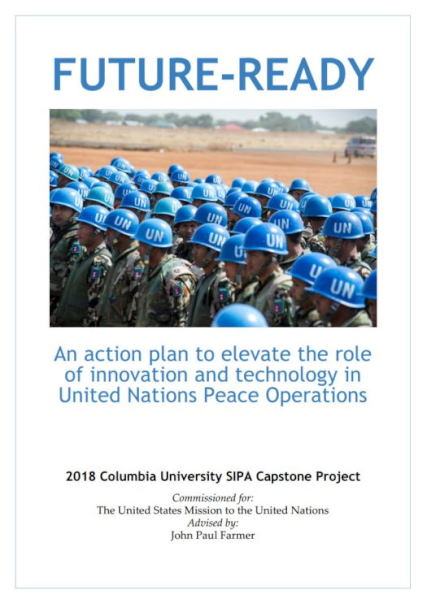 Capstone Workshop for the U.S. Permanent Mission to the UN: In early 2018, I was the Project Manager for my graduate consultant team studying technology and innovation in UN peace operations. Our client, the U.S. Mission to the UN (USUN), tasked us with exploring how peace operations use technology to accomplish their mandates. We analyzed the challenges faced by UN field missions and how they could apply specific technologies to accomplish their mandated tasks more effectively and efficiently. We also considered how innovative approaches could streamline structures, systems and processes at Headquarters and in the field. Some of the areas we researched and analyzed included digital technology, information collection, data analysis, communication technologies, medical and health innovations, transportation, environmental sustainability, and procurement reform. We presented our findings and recommendations to USUN in April 2018.
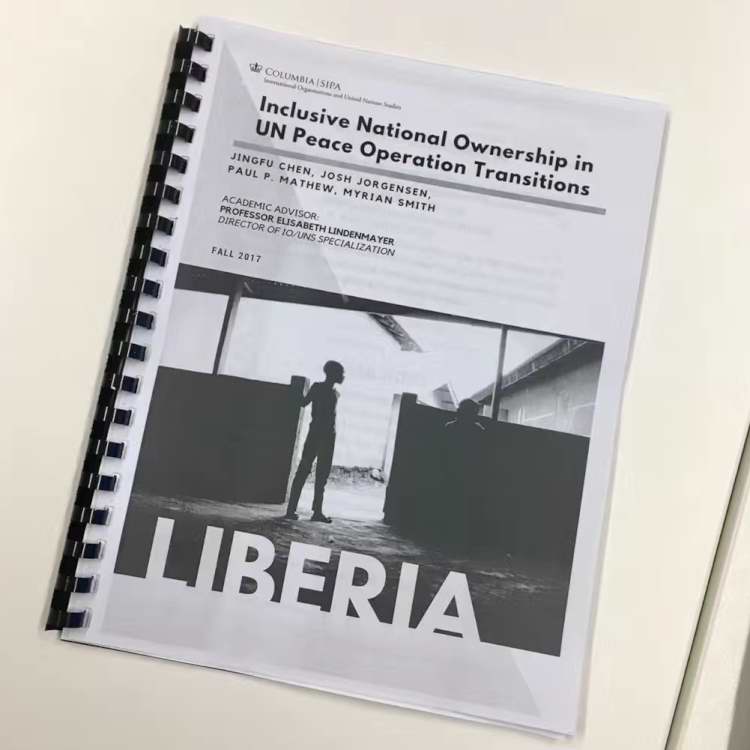 “Inclusive National Ownership in UN Peace Operation Transitions”: For a unique field research course, I studied how UNMIL supported the concepts of sustaining peace and inclusive national ownership throughout the process of planning for mission withdrawal. I was part of a four-person team which conducted a six-week field research trip to Liberia, interviewing over 100 international staff, government officials, and civil society representatives across the country. This research, part of the course The Realities of Peacekeeping: Inclusive National Ownership and the Achievement of Sustainable Peace, was supervised by Professor Elisabeth Lindenmayer, a former Assistant Secretary-General and Deputy Chef de Cabinet for Secretary-General Annan.
"UNAMA’s Atrocity Prevention Efforts: Reacting to the Islamic State in Afghanistan": This research paper examines UNAMA's response to the rising violence of the Islamic State--Khorasan Province (ISKP). It compares the mission's reaction to that of the UN Security Council by studying public Security Council debates over the situation in Afghanistan. The Security Council largely failed to proactively address ISKP, while UNAMA used the means at its disposal--constrained as they are--to raise the alarm as to the unique threat posed by ISKP to Afghan civilians. This paper was written for a class taught by Professor Edward Luck, former Assistant Secretary-General and Special Adviser of the Secretary-General on the Responsibility to Protect.
"The ECOWAS Intervention in Liberia: Challenges and Alternatives": This policy memorandum examines the novel contours of the first Liberian civil war and the interventions (political, economic, and military) by ECOWAS into that conflict. The new political ends (self-enrichment) and military strategies (destabilization) of the main belligerents challenged the military intervention from the beginning. Seven years of fighting despite 14 separate peace agreements show that ECOWAS was not capable of intervening to preserve or strengthen the Liberian state. Alternative approaches could have improved the peace process, built a governing coalition faster, and justified an impartial military intervention. This memorandum recommends a more careful application of military intervention and a long-run focus on restoring the functions of the state.
Undergraduate Research
"Foreign Policy and Identity: Human Rights in the Sino-American and Sino-Canadian Relationships": This paper analyzes the role of human rights promotion in the Sino-American and Sino-Canadian bilateral relationships. I use the constructivist framework of “logics of action” to determine the role of both power calculations (the logic of expected consequences) and identities (the logic of appropriateness) in shaping foreign policy on human rights. Additionally, to aid in interpreting said identities I apply the conflicting concepts of universal human rights and cultural relativism and explore how these fundamental perspectives are applied in states’ foreign policy. The human rights policies of the United States and Canada represent significantly different responses to the conundrum of how to approach a China which is politically and economically important but has a record of systematically violating human rights. I conclude that the logic of consequences influences the U.S. in its relationship with China to the greatest degree, but the logic of appropriateness plays a secondary role. Canada, however, guides its foreign policy along a logic of appropriateness and a conceptualization of its identity as a human rights promoter, though it is influenced by the logic of consequences as well. Moreover, the universality of human rights is an important factor in defining a state's perspective on human rights and has important consequences for both the Sino-American and Sino-Canadian relationships.
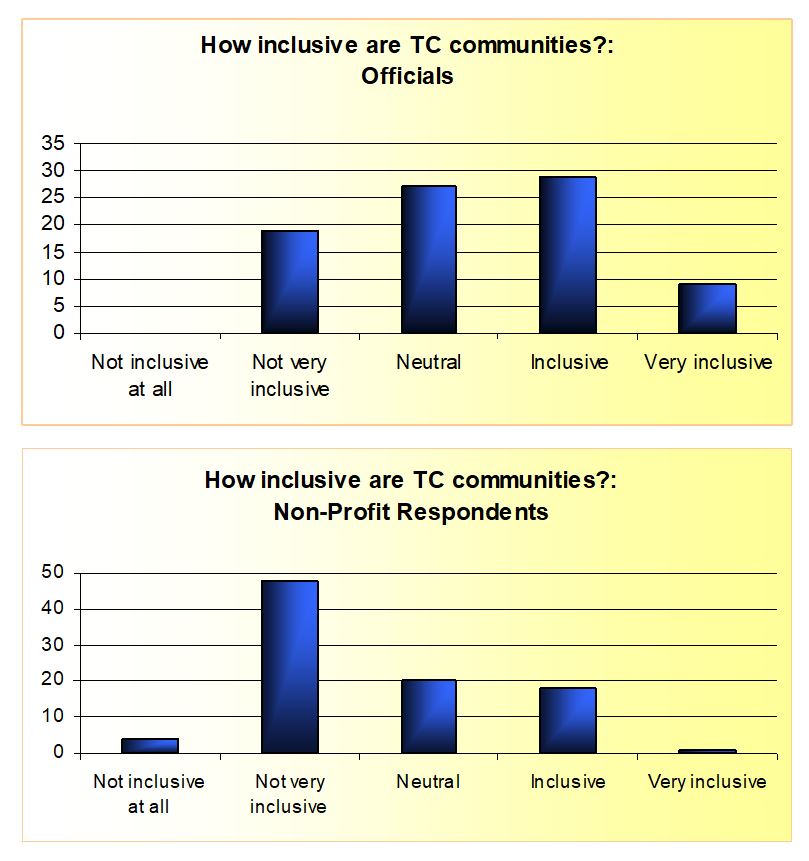 Fostering Inclusive Communities: In 2007, I consulted the Fair Housing Implementation Council on a public education initiative addressing inclusivity in the Twin Cities, Minnesota. I developed, administered, and analyzed a survey of 316 local stakeholders in city and county government, the private sector, legal practice, and non-profit organizations. The main conclusions were that: government officials have very different perceptions of inclusiveness in the Twin Cities from others who were surveyed (i.e. non-profit workers); that action steps in the future should explore the relation between community safety and inclusiveness; and that information and other resources on affordable and fair housing should be made more accessible to a broad range of individuals, preferably through the internet and workshops.
“Las dos propuestas autonómicas de Santa Cruz” (“The two autonomy proposals of Santa Cruz”): Este proyecto de estudios independientes tiene un enfoque en dos propuestas para las autonomías hacia la Asamblea Constituyente boliviana del año 2006. El proyecto es una comparación de estas propuestas, ambas cuales vienen del departamento de Santa Cruz, pero se representan puntos de vista radicalmente diferentes, como resultado de las divisiones culturales y económicas muy profundas en el departamento. Mi asesor fue Adolfo Mendoza, sociólogo de Cochabamba. (This independent study project focuses on two autonomy proposals for the 2006 Bolivian Constituent Assembly. The project compares and contrasts these proposals, both of which come from the Santa Cruz department, but represent radically different point of view as a result of profound cultural and economic divisions in the department. My advisor was Dr. Adolfo Mendoza, a sociologist from Cochabamba.)