- The importance of tracing molecules in biological systems:
Are there enough molecules for a stoichiometric task? At what rate are these reactant
molecules transformed into products? (These tasks include providing required energy,
producing chemicals useful to the organism, and providing the structural material of the
organism.)
How are signaling molecules produced, transported, and recognized? What role do these
molecules play in the regulation and coordination of an organism?
- Only two things can happen to molecules
They can move.
They can react.
- The concept of concentration
Amount (mass or molar concentrations) per unit volume.
Compare with mole fraction, molality, partial pressure
Mass and molar density as
- Control volume: arbitrary region in space characterized by an enclosing surface, e.g.
S(x,y,z) and a the volume interior to that surface.
- "Arbitrary" control volume
- Specific examples: rectangular parallelpiped, cylinder, sphere, hollow cylinder, hollow
sphere.
- Concept of flux, n (mass), N (molar):
Net flow of designated species, reckoned at a point. Flux is a vector. Elements of a
surface, e.g. dS, can also be represented as a vector. Integral of dot product of
flux and dS, over all or part of a surface gives the flow through that surface.
Flux of "a" is velocity of "a" (vector) times concentration of
"a". (All molecules at a perpendicular distance between 0 and v from a surface
will pass that surface in unit time.)
- Concept of ensemble average of molecular velocities:
Zero for quiescent ensemble
Finite for moving ensemble
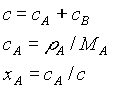
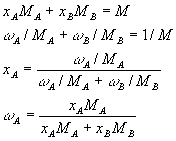
Concentration relationships in a binary (two-component) system (after Bird, et al.):
| Mass density relationships |
Molar density relationships |
 |
 |
| Mole and weight fractions |
Interconversion of mole and weight fractions |
 |
 |
- Conventions in dealing with mathematical descriptions of physical systems.
(Physical systems will "do what they do" irrespective of the physical frameworks
we impose on them, but we will describe the same system differently according to the
coordinates, the units of measurement and the definitions we overlay on it.) Vectorial
quantities are positive when their components point in the positive direction defined by
the coordinate axes.
- The concept of flux: the net flow rate through a unit area of a designated
species, reckoned at a point (e.g. x,y,z). (We do not use the physicist's flux which is
the total flow from a source or into a sink.) The units of flux are thus m/(l2t).
Flux is a vector. A differential area can also be represented as a vector, the direction
representing a normal to the surface and the magnitude representing the extent of the
surface. A flowrate is the integral of the dot product of a flux vector by a differential
vector representing the components of the corresponding area:

- Flux can be related to the velocity of an ensemble of the species represented by the
flux. Molecules are in constant motion. If the concentrations in a problem do not change
much in a region that nonetheless contains many molecules, one can calculate an ensemble
average velocity. If that average is zero, there is no macroscopic flux in the region.
If the average is a vector, it represents the uncancelled, net movement of the center of
mass of the ensemble. This velocity, multiplied by the concentration of the species is the
flux of the species in this region. (Think of a unit area held perpendicular to the flux
vector. In one unit of time a volume v that has a concentration cA
will pass through this area. Note that the units of velocity (l/t) when multiplied
by the units of concentration (m/l3) are equal to the units of flux (m/(l2t)).
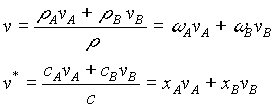
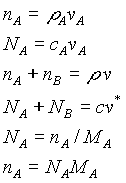
- We use v (no subscripts) to represent the mass average velocity and v*
to represent the molar average velocity. We use nA to represent the mass
flux of A and NA to represent the molar flux of A. Then:
| Definitions of mass, molar average velocities: |
Flux-velocity relationships: |
 |
 |
Note that the average velocities are weighted averages of the species
velocities, in one case weighted by the mass concentration and in the other by the molar
concentration.
- The concept of reaction rate (homogeneous reactions -- those that occur
throughout a volume and not at a boundary or surface): We use the symbol rA
to represent the rate of formation of A per unit volume. The rate is generally a
function of concentrations and temperature as well as the concentration of any catalyst
(enzyme) that may be present. Not that the units of rA are m/(l3t).
As with other quantities the upper case R represents a molar rate of reaction per
unit volume while the lower case r represents the mass rate.
- The concept of catalysis. The marvel of biological systems might be the reactions
that do not occur. If all feasible reactions occurred life could not exist.
Biological systems operate at low temperatures where most reactions are held in check.
Just a small, selected set of reactions occur and these are largely controlled by enzymes,
biological catalysts. It is important to note that enzymes, like all other catalysts, are
not consumed or made by the reactions they catalyze (although they are made and degraded
by other reactions). Any catalyst that accelerates a reaction proceeding in one direction
also accelerates the reverse reaction. Thus the equilibrium (which can be seen as a
balance between forward and reverse reactions) is not affected by a catalyst. This
is a fundamental, unviolated fact. Don't forget it and don't try to reason out an answer
that contradicts the fact.