BMEN E3500, fall 1998

Lecture Notes

Click here for related assignment.

Use your Back button to return to the main course page.

Lecture Number 2

Date: 9/18/98

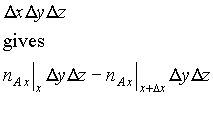
  1. The concept of conservation: In any control volume the rate of input minus the rate of outflow of a species plus the rate of reaction must equal the rate of accumulation of the species within the control volume. Calculating inflow and outflow of species on a rectangular parallelpiped of dimensions
  2. which, when the corresponding terms for the fluxes in the y and z directions are added in, and the sum is equated to the reaction rate and the accumulation gives, for A and for B:

    These equations, even though derived here for cartesian coordinates, apply in all coordinate systems you will encounter. In a binary system rA + rB = 0 because mass is conserved and the rate of disappearance of mass in the form of A must exactly equal the rate of appearance of mass in the for of B. If the two equations are added together one has, recognizing that n = nA + nB = r v:

    The corresponding equations in molar terms are:

    but, here, when the equations are added we cannot expect, generally, that the R's will cancel each other. Thus the summed equation takes the form:

     

    It is important to understand these equations, term by term. For example the species equation in molar terms has three terms. The first is the rate of change of A (or B) per unit volume; the second is the rate of movement out of a unit volume of A (or B); the third is the rate of production of A (or B) per unit volume, all in terms of moles.

  3. The treatment so far has related transport and rates to accumulation. Transport has been treated formally, but how does it occur in reality. There are just two forms of transport: convection and diffusion. Convection is the movement of a species along with (as a consequence) of the medium in which the species is located. Diffusion is the movement of a species relative to (within) the medium in which the species is located. Reaction rates are, as noted above, a function of concentrations. Accumulation is intrinsically a function of concentration. What about transport rates? Yes, they are functions of concentration. For example, if there is a total molar flux N, the molar convection of A can be reckoned as N xA or N cA /c. Relating diffusion to concentration is more complicated. For simple fluids the phenomenological law known as Fick's first law is used. It can be written in terms of either the mass flux, jA or the molar flux, JA . These fluxes are different from n and N in that they are the movement of the species A relative to either the center of mass or the molar centroid of the system.
  4.  

    The negative signs that relate the mass or mole fraction gradients in these equations to the fluxes are important to notice. The flux is always oppositely directed with respect to the gradient. The constant density form of this equation will often be used because densities, both molar and mass don't change much in biological systems. These equations are not very convenient because they are not in the "laboratory" or stationary coordinate system. Using the equalities given above, it is possible to convert them into working equations, expressed in terms of n's and N's:


  5. The equations above are for ordinary, sometimes called 'free', diffusion. It occurs spontaneously. No external forces need to be supplied. Molecules can also be made to move with respect to the medium in which they are placed by the imposition of external forces. Examples include pressure diffusion (e.g. ultracentrifugation), forced diffusion (electrical fields affecting ionic transport, for example). A general equation that includes these phenomena (there are others) is:
  6. The diffusion phenomena listed in this equation, ordinary, forced, and pressure, are additive. The ordinary diffusion term is different from that given above for an important reason: It recognizes, as Fick's phenomenological law does not, the difference between the concentration of a substance and its chemical activity. In ideal systems diffusion is "driven" (see below) by a concentration gradient of the substance diffusing, i.e. the diffusion of A is driven by a concentration gradient of A, and it doesn't make any difference what the concentration of anything else is. In real systems diffusion of A may still be proportional to the concentration gradient of A, but the coefficient of proportionality will depend upon the medium. Example: a given concentration gradient of oxygen dissolved in water will produce a different flux from that concentration gradient of oxygen in air. The difference is produced by interactions between the oxygen and the "other" molecules that affect both the solubility and the mobility of the oxygen. Sometimes these phenomena can be grouped into an effective Fickian diffusivity. Sometimes they cannot. One example is when the chemical activity a is not proportional to the mole fraction x and account is made of that in the partial derivative of the first term.

    When forced diffusion occurs because of a electrical potential (voltage) gradient, one can represent gA and gB by the following expressions:
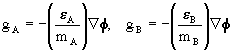
     

    Assuming the activity coefficients to be unity and the concentrations of A and B to be so dilute that the system behaves as "pseudo-binary", i.e. each ion diffuses as if it were alone in water. The coefficients are the quotient of ionic charge by ionic mass. For an ion pair they will have opposite signs.
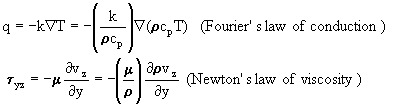
  7. It is noted here, for use later, that ordinary diffusion is an equation that has close analogs in heat and momentum transfer. For each of these other "entities" there is a flux that moves in a direction opposite to a gradient, or "driving force". So the driving force for ordinary diffusion in constant density systems is a concentration gradient. The driving force for heat transfer is a temperature gradient. Momentum transfer is a bit more complicated because momentum (unlike molecular species and heat) is a vector and when it is transported its direction has a second, non-combinable vectorial nature. Thus one can transport x-momentum in the y-direction and the momentum flux is a tensor, a quantity with one magnitude and two associated directions. Here are the equations, in simplest form:

The coefficient k in Fourier's law is called the thermal conductivity. The coefficient m in Newton's law of viscosity is called the (Newtonian) viscosity. The right-most part of each equation is in concentration terms, i.e. the concentration of heat, and the concentration of momentum. In this form the coefficient, for heat the thermal diffusivity, for momentum the kinematic viscosity, have the same dimensions as the ordinary diffusivity, l 2/t. We thus have a general law: The flux of an "entity" (species, heat, momentum) is proportional to the concentration gradient of that entity.


Return to course main page.