BMEN E3500, fall 1998
ii) Thus the basic compartment equation for "A" must be accompanied by at least one other equation: if "A" is the reactant, then there is a product. If "A" is a product, there must be a reactant.
b) There are three ways of avoiding the consequences of having at least one companion to the "A" equation:
ii) "A" is a reactant that is depleted and it is only the depletion that is important in the problem. Product is formed but its presence is not of concern. This simplification also requires that the product does not undergo a reverse reaction that could form a significant amount of "A".
iii) "A" is affected by reaction, but the reaction is fast and reversible so that the relationship between A and the other material is governed not by a rate expression but by equilibrium.
c) If these conditions are not met, a reaction-coupled set of equations results.
ii) Algebraic equations if steady state.
d) Flow of energy and chemical transformation in biological systems is regulated by enzymes.
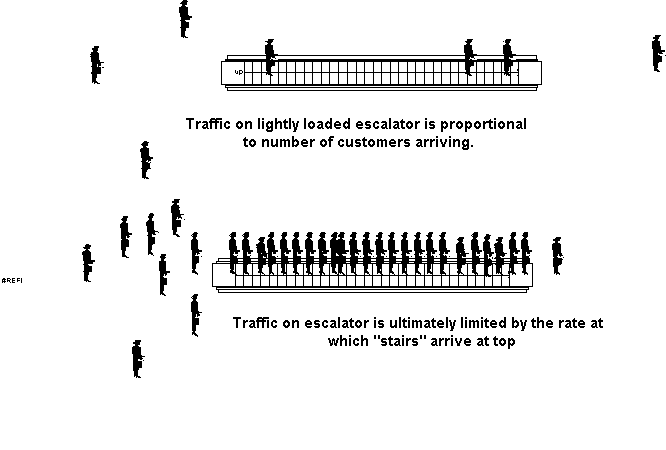
ii) The escalator model of enzyme kinetics.
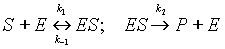
(2) Following Bailey and Ollis (Bailey, J. and Ollis DF, "Biochemical Engineering Fundamentals", 2nd ed. McGraw-Hill, 1986, Section 3.2.1) we designate the concentration of substrate as s, enzyme as e, complex as (es) and product as p and the reaction velocity as v. The dissociation constant and reaction velocity are defined:

The last expression records the fact that the sum of the free (e) and bound (es) enzyme present at any time must equal the amount of enzyme originally provided e0. Note that the reaction velocity is one of the factors contributing to dp/dt. Contributions from convection and diffusion are also possible.
(3) Solving the first expression for (es) in terms of s and e and then substituting (e0 - (es)) for e, we have an expression for (es) in terms of the total enzyme concentration e0 and s.
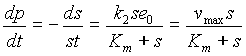
This expression is linear for values of s that are small (compared to the value of Km, which has the units of concentration. The expression becomes asymptotically equal to the constant vmax when s is large. Note that the dependence of rate on enzyme concentration is always simply proportional while the S dependence varies from linear (proportional) to invariant as the concentration of S increases. In terms of the escalator model discussed above, large values of s conform to a "loaded" escalator. Delivering more people to the bottom of the escalator will not cause it to deliver many more people to the next floor. Raising the value of s much above the value of Km will not much increase the amount of product formed.
If the enzyme reaction is reversible, the second reaction (in paragraph 1, above) is reversible. The equation set becomes:
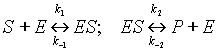
This small change gives a considerably different result (which the student is responsible for deriving):

while the value of vs is vmax and the value of Ks is Km.
Return to course main page.