Research
PDF
of
Research Statement
Research in the Leighton group is focused on
the
development of stereoselective reactions with
relevance to
both medicinal and natural products chemistry,
the development of new
strategies for the efficient synthesis of
polyketide natural products with a particular
emphasis on tandem
reactions, the application of these methods to
the
total synthesis of polyketide natural and
unnatural products, and
finally on the total synthesis of
architecturally
complex polycyclic natural products of
biological significance. The
guiding philosophy for all of these programs
is
that the methods we develop should be
user-friendly and experimentally
trivial, and environmentally and
economically sound, all while providing access
to otherwise
inaccessible targets of structural and/or
biological
significance with exquisite levels of
stereocontrol.
1. Development of Chiral Silane Lewis Acid
Reagents
and Catalysts for the Practical and Highly
Enantioselective Synthesis
of Structurally Complex Carbinols and
Carbinamines (pubs 26, 29, 31,
35, 37, 38,
39, 40, 45). Countless chiral Lewis acid
reagents and catalysts
have been developed for asymmetric synthesis,
but it is often the case
that these involve the use of either toxic
and/or precious metals, and
chiral ligands whose synthesis requires
multi-step procedures. We were
therefore intrigued by the notion that we
might develop a family of silane
Lewis
acid
reagents and catalysts for
a broad range of
transformations. The advantages of using
silanes in this fashion are
readily apparent: silanes are inexpensive,
non-toxic, and generally
environmentally sound, and often are trivially
prepared and
shelf-stable. We have discovered that Lewis
acidity sufficient for
organic synthesis can be induced in silanes
simply by constraining the
silicon atom in a 5-membered ring. We first
targeted the development of
a set of reagents for enantioselective
aldehyde allyl- and crotylation
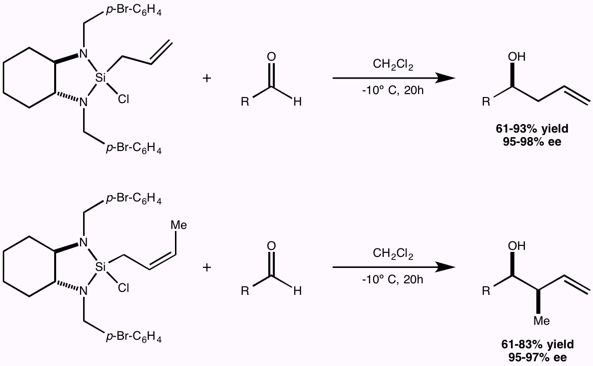
(Figure 1). It was quickly found that a
cyclohexane-diamine-based
system not only provided excellent
enantioselectivities for a range of
aldehydes, but also provided a family of crystalline
solid
reagents. These reagents may thus be readily
prepared in bulk, stored
for long periods of time if minimal
precautions are exercised, and
simply added to the aldehyde of choice at
will.

Figure 1. A new family of storable
crystalline
solid silane reagents for enantioselective
aldehyde allyl- and
crotylation.
Chiral carbinamines play an extremely
important role in
both natural products and medicinal chemistry.
And
yet the development of general methods for the
highly enantioselective
synthesis of a wide structural variety of
such compounds has lagged behind the
development of such methods for
carbinols. We therefore turned our
attention to the use of our silane reagents
with imine electrophiles
instead of aldehydes. After some
experimentation it was discovered that
a reagent derived from the inexpensive and
readily available
pseudoephedrine was effective not only for the
enantioselective
allylation of aldehyde-derived acylhydrazones,
but also for
ketone-derived acylhydrazones (Figure 2). This
success with ketimines
of this type allows one of the few general and
practical methods for tertiary
carbinamine synthesis and is unprecedented in
the long history of Lewis
acidic allylation reagents. A key mechanistic
study revealed that the
hydrazones operate by nucleophilic attack on
the chlorosilane reagent.
This not only renders the process effectively
intramolecular, but also
releases an equivalent of HCl, which acts
to greatly increase the
Lewis acidity of the silane by protonation
of the amino group of the
pseudoephedrine. This built in
activation of the Lewis acid by the
substrate is highly unusual and we expect to
be able to exploit this
discovery for the development of new more
active and more broadly
applicable reagents.

Figure 2. A reagent for
enantioselective
acylhydrazone allylation, and an X-ray
structure that reveals
mechanistic details.
We have recently shown that this chemistry
can be
generalized to different nucleophiles beyond
simple
allylation reactions. Thus, by replacing the
allyl group on the
pseudoephedrine-based reagent with an inert
phenyl
group, a general Lewis acid for the activation
of hydrazones towards
external nucleophiles has been achieved. The
result is two new reactions, the
enantioselective Friedel-Crafts-like
addition of electron rich aromatics, and the
enantioselective [3+2] cycloaddition with enol
ethers (Figure 3). Both
reactions proceed exceedingly smoothly and
provide highly value-added products (unusual
amino acids, and
pyrazolidine rings, respectively) from simple,
readily available starting materials.
Figure 3. A silane Lewis acid for
enantioselective Friedel-Crafts and [3+2]
cycloaddition reactions.
Future Plans. While we are highly excited
about
these results establishing the value of
silicon as a useful Lewis acid
for asymmetric synthesis, this program is
nevertheless in its infancy.
Certainly there are many additional
transformations of hydrazones that
may successfully and enantioselectively be
promoted by our silane Lewis
acids, and we will continue to pursue these
(e.g. imine
Diels-Alder reaction, aza-Darzens aziridine
synthesis, imine reduction,
etc.). More important, however, are the
conceptual advances that will
be necessary to dramatically expand the
scope and effectiveness of this
system. For example, while the
Friedel-Crafts and [3+2] cycloaddition
reactions described above are useful
reactions, the Friedel-Crafts
reaction is limited strictly to the use of
glyoxyate-derived
hydrazones, and both reactions fail with
ketone-derived hydrazones. The
development of a truly general
enantioselective Friedel-Crafts
imine addition reaction would be expected to
have a major impact on
medicinal chemistry, as chiral benzylic
carbinamines are an extremely
important sub-structure in small molecule
drug development. In
addition, it will be important to expand the
substrate pool in a more
general sense to include imine derivatives
other than hydrazones. An
effective, practical, and general system for
ketone allylation and
other ketone addition reactions is an
important frontier in asymmetric
synthesis as well. Finally, the most
important advance of all would be
to render these reactions catalytic
in the silane component.
Should we achieve this, the impact would be
felt not only in the
virtually limitless number of reactions that
we might develop, but also
conceptually as despite decades of effort,
there has never been a
highly effective chiral silane Lewis acid catalyst
for any
transformation.
2. Development of Tandem Reaction
Strategies for the
Synthesis of Polyketide Macrolide Natural
Products (pubs 12, 13, 14,
16, 17, 19, 20, 21, 22, 23, 24, 25, 27, 28,
33, 34, 41, 42, 43, 44).
Polyketide macrolide natural products have a
long and rich history as
both drugs and drug leads. Combined with the
fact that such compounds
are often available from natural sources in
only vanishingly small
quantities, it is frequently the case that
total synthesis is the only
available method to obtain gram-scale
quantities for full biological
evaluation. It is therefore highly desirable
to have access to ever
more efficient methods for the synthesis of
such targets. Shown in
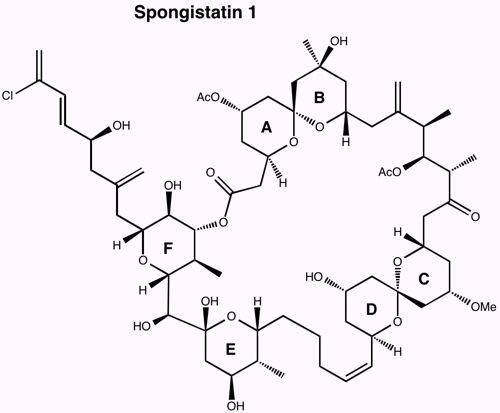
Figure 4 are four natural products that our
group has synthesized. It
is noteworthy that in every case we have
provided either the first
(leucascandrolide A, dolabelide D) or the most
efficient (mycoticin A,
(+)-SCH 351448) synthesis as measured by step
count and overall yield.
For example, our very recently completed
synthesis of the cytotoxic
marine natural product dolabelide D entails a
longest linear sequence
of just 17 steps. It is, we believe strongly,
within the realm of
possibility to devise methods to do even
better and begin to approach
true practicality in the total synthesis of
such targets. This is
certainly a worthy goal in and of itself, but
in addition has already
inspired (as detailed below) and will continue
to inspire new concepts
in reactivity that will have applications in
other arenas of chemical
synthesis.
Figure 4. Polyketide macrolide natural
products
synthesized by the Leighton group.
Our approach to these natural products has
focused on
the development of tandem reactions
wherein multiple
bond formations and the concurrent
establishment of multiple
stereocenters are orchestrated in a single
operationally simple reaction. We have, for
example, introduced the
tandem silylformylation-crotylsilylation
reaction, which employs rhodium-catalyzed
carbonylation chemistry to
provide direct access to aldehydes, which
are then engaged in spontaneous intramolecular
crotylsilylation
reactions (Figure 5). Two carbon-carbon bonds
and
three stereocenters are established in these
reactions, and a second
iteration of the process allows the conversion
of alcohol A to
triol B in just 5 steps and 30%
overall yield. Even more
remarkably, the reagents required to carry out
this highly efficient 5
step synthesis are extraordinarily simple,
and, with only one
exception, commercially available at a nominal
cost.

Figure 5. The tandem
silylformylation-allyl(crotyl)silylation
reaction allows the highly
efficient synthesis of polyketide fragments.
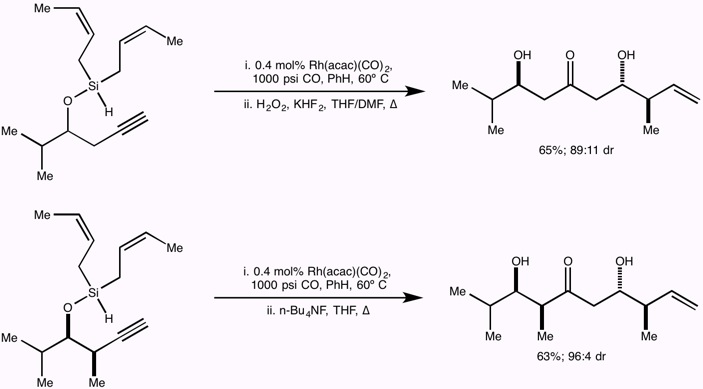
This tandem reaction has been extended to
alkyne
substrates demonstrating the versatility of
the method in
providing access to either highly
functionalized ketones or alkenes,
functional groups that appear in polyketide
macrolide natural products with some frequency
(Figure 6). It will be
noted that these reactions provide the 1,5-anti
diol products
with good to excellent diastereoselectivity.
After establishing the
origin and mechanism of this selectivity, we
have also developed an
unprecedented catalytic asymmetric chiral
silane synthesis which allows
us to access the otherwise inaccessible 1,5-syn-diol
diastereomer.
This latter process was a key component of our
dolabelide
D synthesis and also represents the first
recorded example of the
stereospecific transfer of chirality from
silicon to carbon.
Figure 6. The tandem alkyne
silylformylation-allylsilylation reaction and
catalytic asymmetric
silane alcoholysis.
While these reactions have provided us with
highly
practical tools for the synthesis of
polyketide macrolide
targets, they have also provided us with the
conceptual framework for
the development of many other new
reactions. The key discovery was that silicon,
when constrained in a
5-membered ring, is an effective Lewis acid.
Thus, the spontaneous transfer of the crotyl
group to the aldehyde
products of the carbonylation reaction as
described above owes its success to this
phenomenon. By applying this
concept to two previously attempted but
unsuccessful reactions, we have now introduced
the tandem
aldol-allyation and aldol-aldol reactions
(Figure 7).
These powerful reactions provide, in truly
operationally trivial
processes, polyketide fragments with up to
four
stereocenters in a single reaction. It is
especially noteworthy that
the reactions are well suited to the synthesis
of tertiary carbinols
with high levels of diastereocontrol, an
otherwise highly challenging
task. From a practical point of view, it is
highly significant that
these silane reagents are trivially prepared
in bulk, and may be stored
for long periods of time. As needed, they are
simply heated with the
appropriate aldehyde to generate highly
complex polyol fragments in a
single simple reaction.
Figure 7. The tandem aldol-allylation
and
aldol-aldol reactions allow extraordinarily
efficient access to
polyketide fragments.
While this program could accurately be
described as
being relatively advanced, it is by no means
the case that
its full potential has been tapped. Indeed,
our ultimate goal for this
program is nothing less than the reduction of
the synthesis of complex
polyketide macrolide natural products and
related structures to a
trivial exercise that may be carried out in a
matter of days and weeks
instead of months and years. One direction we
intend to pursue
vigorously with this rather lofty goal in mind
is the development of
triple tandem reactions wherein perhaps as
many as six (!)
stereocenters may be established in a single
trivial reaction. For
example, it may prove possible to develop a
tandem
aldol-aldol-allylation reaction and a tandem
silylformylation-adol-allylation reaction
(Figure 8). The realization
of such reactions will entail more than just
the extension of already
developed methods, as new concepts will almost
certainly be required to
achieve efficient and stereoselective and
broadly applicable methods.
In the case of the aldol-aldol-allylation
reaction, it is noteworthy
that this could be thought of as a “chain
length-controlled
oligomerization” approach to the synthesis of
polyketides, which
themselves may be thought of as
biopolymers. Solutions to this problem in the
polyketide area could
well have implications for the broader problem
of a general solution to controlled
oligomerization of many different
types of monomers.

Figure 8. Two proposed triple tandem
reactions
for the single step assemblage of complex
polyketide fragments.
3. Total Synthesis of Architecturally
Complex
Polycyclic Natural Products (pubs 15, 18,
30). Some years
ago we initiated a project to investigate an
approach to the total
synthesis of the phomoidrides, structurally
complex polycyclic natural
products that displayed activity against both
farnesyl protein
transferase and squalene synthase. Consistent
with the theme of
efficient tandem reactions, we developed a
powerful entry into this
ring system that involves a carbonylation
reaction for the construction
of a strained lactone, which in turn drives a
spontaneous Cope
rearrangement. It should be noted that it was
predicted (and this was
subsequently confirmed in other laboratories)
that traditional
approaches to this Cope rearrangement would
fail, and this work thus
represented a significant contribution to the
literature of this
venerable and important reaction.

Figure 9. A tandem carbonylation-Cope
rearrangement strategy for the rapid
construction of the phomoidrides.
4. New Ligand and Catalyst Systems for
Highly
Practical and Enantioselective Reactions
(pubs 28, 32,
36). We have developed a new class of
ligand for the
copper-catalyzed enantioselective conjugate
addition of
alkylzinc reagents to enones (Figure 10). An
important aspect of the
systems we have developed, in addition to the
simplicity of the ligands and the very high
enantioselectivities, is
the true practicality of these reactions. The
extraordinarily low catalyst loading of the
cyclohexenone reaction, and
the fact that it is best performed in one hour
at ambient temperature,
render this process among the most practical
of its kind. Because of
this, further
investigation into the utility of this ligand
class is certainly
warranted. Candidates for this would extend
not only to other related
copper-catalyzed processes, but also to a
rather limitless range of
rhodium- and palladium-catalyzed (for example)
transformations.
Figure 10. New ligands for practical
and
enantioselective copper-catalyzed conjugate
addition reactions.
In a different copper-catalyzed reaction
discussed
briefly above, we have developed a catalytic
asymmetric
silane alcoholysis (Figure 11). This reaction
was specifically
developed for use in the tandem
silylformylation-
allylsilylation reaction as described above,
but has potential
implications in a much broader range of
transformations. For example,
there are many examples of silicon-tethered
reactions, but essentially
none where the
asymmetry originates from a chiral silane
tether. The ability to induce
high levels of enantioselection in the
reaction that establishes the
silane tether, and then harness effective
transfer of that chirality
in, for example, Diels-Alder reactions would
be a potentially very
powerful addition to the synthetic chemistry
arsenal.
Figure 11. Catalytic asymmetric silane
alcoholysis, and an example of its proposed
use in organic synthesis.
|