
Modified on March 26, 2020
you may need Acrobat Reader to read a .pdf files.
you may need Mathematics Player to read an .nb Mathematica files.
 SummaryCV -- May 2013
A Typo in Courant Paper (1943)
Teaching Evaluation by Students up to August 2009
Professor, Civil Engineering and Engineering Mechanics, 620 Seeley W. Mudd;
Columbia University, Mail Code 4709, 500 West 120 St, New York, NY 10027-6699, USA;
tels: office: 212-854-3102; message: 212-854-3143; fax: 212-854-6267 or email: dasgupta@columbia.edu
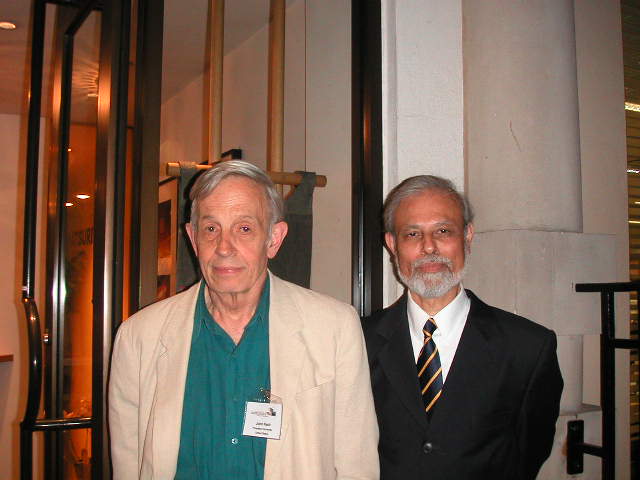
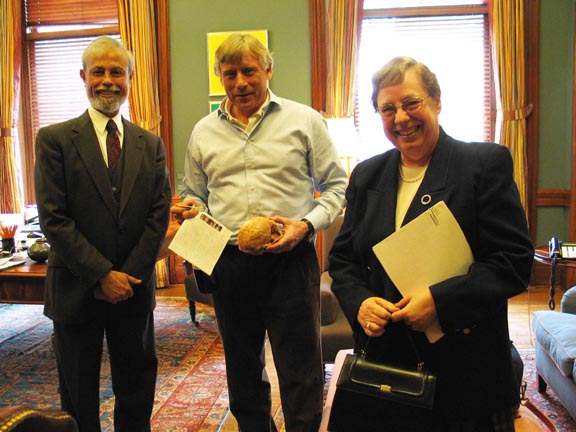
Photo with The Chief Guest of IMS 2003, UK --- (and the Chair of IMS Executive committee)
Photo with The Founder of Fuzzy Logic, September 2007
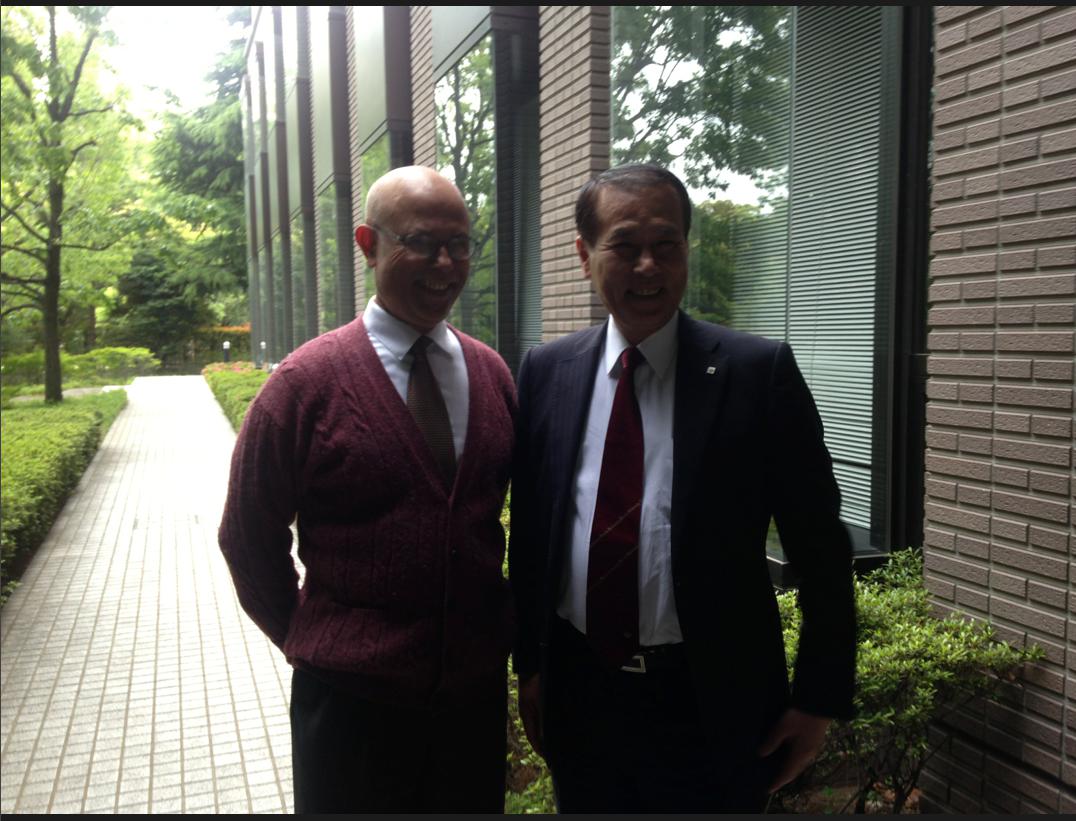
Photo with The President of Waseda University, 2013
Undergraduate and Graduate: Computer-aided engineering graphics (GRAP E2005y and E4005 course outline , E4005y has an additional Projecr requirement
Graduate: Viscoelasticity and plasticity (ENME E8320y): OfficeHrs and ExamSch
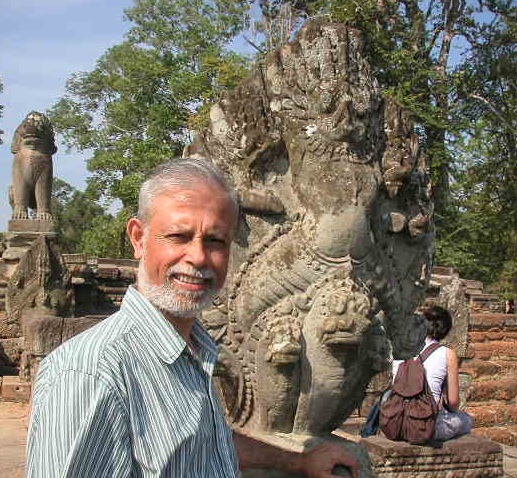
Engineering Analysis of Historical Monuments
Tessellica: Defect-free Finite Element Formulation and Solution
visit: PatentDescription
The following two items are achieved with computer algebra environment Mathematica
(i) four-node elastic elements pass both patch and zero-locking tests
(ii) one computer code handles compressible and plain strain incompressible elements
Columbia University owns the patent:
U.S. Patent No. 6,101,450 of Gautam Dasgupta for "Stress Analysis Using a Defect-Free Four Node Finite Element Technique" -
For further information contact Columbia University Science and Technology Ventures: http://www.stv.columbia.edu (stvinfo@columbia.edu).
Text Book : Finite Element Concepts, Springer Verlag, ISBN 978-1-4939-7421-4