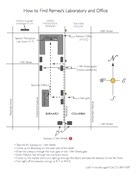
|
Department of Psychology |
Office Hours: Wednesday 2 - 3
pm |
Education:
Ph. D., 1978, University of Connecticut
B. A., 1971, Brandeis University
Research:
My studies examine the perceptual organization of speech, and aim to explain
how the listener finds a speech signal amid the sounds that strike the ear. The
technique of sinewave replication
of speech has figured prominently in these studies. In a second line of
research, my studies assess the perceptible differences between individual
talkers and the phonetic and qualitative aspects of these indexical properties.
Career Trajectory:
Visiting Scholar, Parmly Hearing
Institute, Chicago, 2006-2007
Ann Whitney Olin Professor, 1999-2006
Professor of Psychology, Barnard College,
Columbia University, 1992-present
Chair of Psychology, Barnard College, 1997-2000, 1989-1992
Visiting Scientist, Haskins Laboratories,
1994-1995
Associate Professor of Psychology, Barnard College, 1987-1992
Visiting Research Associate in Cognitive Science, University of California,
Irvine, 1982
Assistant Professor of Psychology, Barnard College, 1980-1987
Visiting Assistant Professor of Psychology, Indiana University, Bloomington,
1978-1980
Visiting Instructor of Psychology, Indiana University, Bloomington, 1977-1978
Visiting Instructor of Psychology, Trinity College, Hartford, Connecticut,
1975-1977
Sponsored Research:
"Sensory and Perceptual Factors in Spoken Communication," National Institute on Deafness and Other
Communication Disorders, 1985-present
"Perceptual Processes Underlying Speech Communication," National
Institute of Child Health and Human Development, 1981-1984
"Simple and Complex Feature Detectors in Speech Perception," National
Institute of Mental Health, 1979-1980
Service &
Societies:
Member, Board of Directors, Haskins
Laboratories, 2000-present
Associate Editor, Journal of
Experimental Psychology: Human Perception and Performance, 1999-2005
Associate Editor, Perception &
Psychophysics, 1996-1998
Consulting Editor, Perception &
Psychophysics, 1981-1988, 1996
Member, Language
and Communication Study Section, Center for Scientific Review, National
Institutes of Health, 2007-present
Member, Study Section on Sensory Disorders and Language, Division of Research
Grants, National Institutes of Health, 1988-1992
Fellow,
Acoustical Society of America
Fellow, American Association for the
Advancement of Science
Fellow, American Psychological
Association
Fellow, Association for Psychological
Science
Psychonomic Society
International Maledicta
Society
International Society of Bassists
(formerly)
Recent Publications:
Remez, R. E. (in press).
Spoken expression of individual identity and the listener. In E. Morsella
(Ed.), Expressing Oneself/Expressing One’s Self: A Festschrift in Honor of
Robert M. Krauss
(pp. 000-000). London: Taylor & Francis. pdf
Remez, R. E., & Trout,
J. D. (in press). Philosophical messages in the medium of spoken language. In
M. Nudds and C. O’Callaghan (Eds.), Sounds and Perception: New Essays on the
Philosophy of Sound and Auditory Experience (pp. 000-000). Cambridge: Cambridge University
Press.
Remez, R. E. (in press).
Three puzzles of multimodal speech perception. In E. Vatikiotis-Bateson, G.
Bailly & P. Perrier (Eds.). Audiovisual Speech Processing (pp. 000-000). Cambridge,
Massachusetts: MIT Press.
Remez, R. E., Ferro, D.
F., Wissig, S. C., & Landau, C. A. (in press). Asynchrony tolerance in the
perceptual organization of speech. Psychonomic Bulletin & Review, 00, 000-000. pdf
Remez, R. E., Fellowes, J.
M., & Nagel, D. S. (2007). On the perception of similarity among talkers. Journal
of the Acoustical Society of America, 122, 3688-3696. pdf
Pardo, J. S., & Remez,
R. E. (2006). The perception of speech. In M. Traxler and M. A. Gernsbacher
(Eds.), Handbook of Psycholinguistics, 2nd Edition (pp. 201-248). New York: Academic
Press. pdf
Remez, R. E. (2005). The
perceptual organization of speech. In D. B. Pisoni
and R. E. Remez (Eds.), The Handbook of Speech Perception, (pp. 28-50). Oxford: Blackwell. pdf
Remez, R. E., Fellowes, J.
M., Blumenthal, E. Y., & Shoretz Nagel, D. (2003). Analysis and analogy in
the perception of vowels. Memory & Cognition, 31, 1126-1135.
Remez, R. E. (2003).
Establishing and maintaining perceptual coherence: Unimodal and multimodal
evidence. Journal of Phonetics, 31, 293-304.
Liebenthal, E., Binder, J.
R., Piorkowski, R. L., & Remez, R. E. (2003). Short-term reorganization of
auditory analysis induced by phonetic experience. Journal of Cognitive
Neuroscience, 15,
549-558.
Remez, R. E. (2001). The
interchange of phonology and perception considered from the perspective of
organization. In E. V. Hume and K. A. Johnson (Eds.), The Role of Speech
Perception Phenomena in Phonology (pp. 27-52). San Diego: Academic Press.
Remez, R. E. (2000).
Speech spoken and represented. In E. Dietrich and A. B. Markman (Eds.), Cognitive
Dynamics: The Cognitive Science of Conceptual and Representational Change (Pp. 93-115). Mahwah, New Jersey:
Lawrence Erlbaum Associates.
Remez, R. E., Fellowes, J.
M., Pisoni, D. B., Goh, W. D., & Rubin, P. E. (1998). Multimodal perceptual
organization of speech: Evidence from tone analogs of spoken utterances. Speech
Communication, 26, 65-73.
Remez, R. E. (1998). Listening
to speech in the dark. Behavioral and Brain Sciences, 21, 281-282.
Remez, R. E., Rubin, P.
E., Berns, S. M., Pardo, J. S., & Lang, J. M. (1994). On the perceptual
organization of speech. Psychological Review, 101, 129-156.

Courses:
University Seminar #681, Language
& Cognition
Fall, 2007
PSYC
BC 1108x, 1110x: Perception
Soothing sounds
Songs to sing
Food Use
Pizza & Ice Cream
Consumed by My Students
Course reviews of
Perception
Spring, 2008
PSYC
BC 3164y, Perception & Language
The Brain Gallery
Would you like to contribute your portrait to The Brain Gallery?
Email it to me as a JPEG and I will happily add it to the exhibition.
Musical and Poetic
Sinewaves
This link
illustrates the bistability of sinewave replicas of utterances, in which the
patterns of individual tones are separately resolved as the Gestalt primitives
warrant, while phonetic integration occurs by virtue of principles of sensory
integration beyond the Gestalt set. Because two alternative modes of perceptual
organization apply concurrently to sinewave replicas of utterances, we have
termed this kind of perception bistable (see Remez, Pardo, Piorkowski & Rubin, 2001).
My Ideal Jeopardy
Categories
•Political Economy of the Leisure
State
•Jazz of the 1940s, 1950s and 1960s
•Gastronomy
•Napping Systems Technology
•Disinfotainment in the Popular Press
•Reverse Psychology
Last revised: March 17, 2008