FWP:
The first line describes the speaker's helplessly paradoxical double allegiance: he feels two entirely incompatible loyalties.
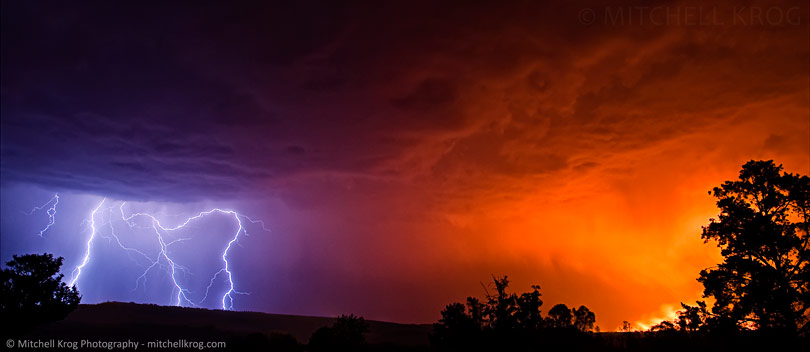
Then in the second line, the nature of his dilemma is explained, or at least illustrated. The speaker either worships lightning, but still grieves for the 'harvest, produce' that is destroyed by its fire; or else he worships lightning, and yet regrets the (more general) 'outcome, result' of his worship. The word ;haa.sil has both generalized positive meanings ('profit, gain'), and abstract and neutral ones ('outcome, corollary, result'); it also specifically refers to the 'produce of land' (see the wide-ranging definition above) in a way most convenient for the present verse, with its evocation of crop-destroying lightning.
For the classic verse about the intimate relationship among lightning, harvest, and human desire, see {10,6}. And in {155,1}, Ghalib himself explains the 'lightning of the harvest'.
For another, more complex, exploration of the vocabulary
of 'pledging', see {228,10}.
Nazm:
In this verse he has given for passion the simile of lightning, and for existence the simile of the harvest. He says, I am pledged to passion, and also my life is dear to me. My duality is as if some fire-worshiper would worship lightning, and also regret the burning of the harvest. In the first line the verb, 'am' [huu;N], is omitted. (13)
== Nazm page 13