FWP:
SETS == KYA; MUSHAIRAH
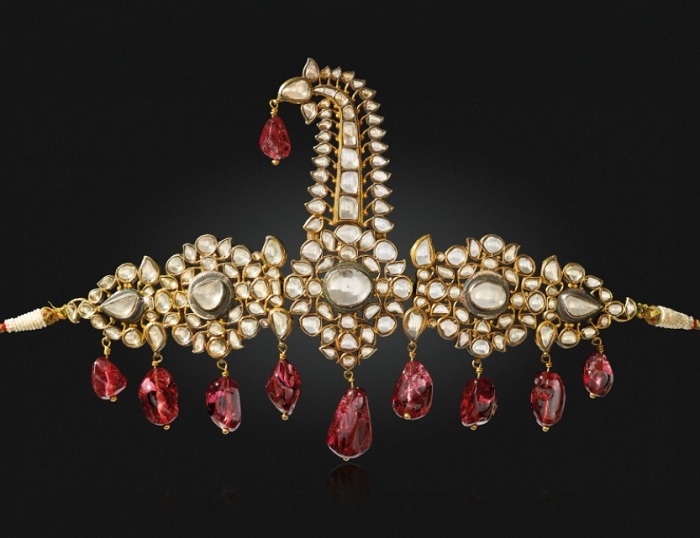
This verse, like {106,1}, plays with paradoxes of seeing. The first line, in proper mushairah-verse style, is strange and puzzling. Even as the lover is obviously seeing, or at least looking at (a distinction impossible to make in Urdu), the jewels in the beloved's elaborate cap or turban, he indignantly denies that that's anything he would do (unusually, kyaa has only its negative exclamatory meaning). After duly waiting in suspense for the second line, we discover that what he's really looking at, or seeing, is the height of the fortune of ruby and pearl.
As the commentators note, the lover sees the jewels not as adornments (and thus in some sense as 'jewels'), but as (unworthy?) recipients of a lofty destiny. Instead of their adorning the beloved, he or she adorns them. Surely it's a loftier destiny than they deserve! They are allowed to be close to the beloved's beautiful head, and to remain there in intimate contact-- which is far more access than the lover may ever be allowed to have. Thus the speaker looks at them not as jewels but almost as Rivals, and can't help but feel envious of their good fortune.
An equally clever meaning, one that the commentators ignore, is a complimentary allusion to the beloved's tall, graceful stature. By being placed atop the beloved's head, the jewels are raised to a literal as well as a figurative 'height' of fortune. (The word :taala(( plays on this idea too.) For more on the beloved's tall stature, see {38,4}.
And speaking of commentators, Shadan is in a class by himself, isn't he? He's a favorite of mine. He so often plaintively laments that he doesn't understand a verse-- and then proceeds to rewrite it, to show how Ghalib could have made it clearer! In his commentary on the present verse, he inserts some formally identical verses of his own-- but only, he says wistfully, because he now realizes that he has no gift for poetry, so his only chance to preserve a few of his verses is through his commentary! For someone who has no pretensions to interpretive talent to spend so many hours of his life writing a commentary-- isn't that a very real labor of love?
The verse cited by Arshi, {169,4},
is in fact very similar; it contains the word auj and
the same cleverness about 'heights' of fortune.
Nazm:
The meaning is clear, and there's freshness in the construction. (111)
== Nazm page 111