FWP:
Among the commentators I've looked at, only Bekhud Dihlavi formally identifies this verse and the next two as a qi:t((ah-e na((tiyah , a verse-set in praise of the Prophet (165). But almost all the commentators consider these three verses to be some kind of a group, unified by their address to the Prophet. In addition to the examples given above, Josh describes them as 'in praise of the Prophet' [na((tiyah] (208), and Chishti calls them a 'stanza' in praise of the Prophet [na((tiyah band] (554).
In the first line of this verse, the subject is omitted. The masculine plural verb [jaante] would permit the subject to be: (1) 'you' (polite singular); (2) 'you' (familiar, tum ); (3) 'he' (polite singular); (4) 'they' (plural). When put together with the reading (2b)-- endorsed by Bekhud Mohani-- the range of possible meaning becomes considerable. Any one of a number of entities (including public opinion, or indifferent patrons of poetry) could be seen as being chastised for failing to value the speaker properly, in view of the fact that he is not, as in (2a)-- or is, as in (2b)-- one of the precious gemstones valued by the worldly. So this verse, read in isolation, is intriguingly (and amusingly) multivalent.
However, the commentarial consensus has a valid point. It's impossible to read this verse together with the next two and not feel that they're a group or set of some kind, conceived along the same lines. And they strike such a wildly cosmic note (especially the latter two), that they seem to demand a religious context. To me they feel like direct, if slightly crazy, addresses to God, whereas the commentators feel that they are addressed to the Prophet. But they're so outlandish that the general effect is the same in either case. So if we read this verse in the context of the following two, we conclude that the the addressee is 'you' in the familiar, since in the following two verses that's made clear.
All three of these verses are querulous, reproachful, (teasingly? poutingly?) injured-sounding claims to greater rank. The speaker claims superiority over precious jewels, then over the sun and moon, then over the sky. What he wants is greater access to the addressee. And he's not submissive about it, either; he sounds distinctly aggrieved. The nominally humble things he claims in the two latter verses (to have the addressee's feet upon his eyes, to be allowed to kiss the addressee's footsteps) register not as supplications, but as rightful demands. The contrast is bizarre, piquant, ultimately unfathomable. How does one dare to speak so peremptorily to a power so manifestly overwhelming and cosmic, even while making such (ostensibly) humble demands? Surely this is more than just the usual 'mischievousness' [sho;xii], but how much more, and more in what way?
On jaan'naa to mean 'consider' (rather than reliably 'know') see {16,5}.
For other such verses that seem to be addressed to a divine Beloved, see {20,10}.
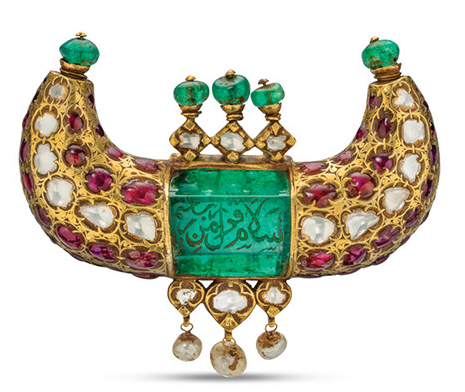
The 125 carat Colombian emerald in this horn pendant from the Kingdom of Mysore is engraved in Arabic with salutations of peace. Mughal Era ▪ Mysore ▪ 18th century ▪ emerald, ruby, diamond and pearl in 22K gold ▪ 6 x 8.5 x 2 cm. Photo by Robert & Orasa Weldon/GIA
Nazm:
It is an address to Hazrat [the Prophet], and the meaning is that you didn't consider gold and pearl and wealth and the world to be precious. If you consider me too like that-- well, I am not gold and pearl. (115-16)
== Nazm page 115; Nazm page 116