A. Transferring a Negotiable Instrument
1. Negotiation and Status as a Holder
2. Special and Blank Indorsements
3. Restrictive and Anomalous Indorsements
B. Enforcement and Collection of Instruments
1. The Right To Enforce an Instrument
2. Presentment and Dishonor
3. Defenses to Enforcement
Turman v. Ward’s Home
Improvement, Inc.
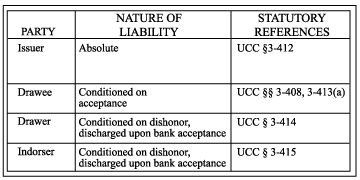
C. Liability on an Instrument
Figure 26.1 - Liability on an Instrument
D. The Effect of the Instrument on the Underlying Obligation
McMahon Food Corp. v. Burger Dairy Co.
Problem Set 26
Figure 26.2 - Reverse of Sample TKO Check
Problem Set 26
26.1. This morning you meet with a new client named Tom Mae. Tom
has operated billiard halls on the west side of town for several years
and recently started to operate a check-cashing business with counters
in each of his billiard halls. The check-cashing business operates as
Tom’s Kash Outlet (TKO). The business has been successful; Tom is
cashing about 150 checks a day. A long-time regular at one of the
locations suggested to Tom that he see a lawyer to make sure that Tom
was handling his checks properly.
Tom tells you that his normal practice requires the customers to sign
the top end of the reverse of the check. Like most check-cashing
services, Tom’s business has a policy against cashing checks for parties
other than the named payee. Accordingly, his clerks always check to make
sure that the name with which the customer signs matches the name of the
payee on the front of the check. Like most check-cashing services, Tom’s
business has a policy against cashing checks for parties other than the
named payee. The clerks then examine a driver’s license to ensure that
the signer is in fact the payee. Finally, his clerks stamp the top end
of the reverse of each check, just below the signature by the customer.
The clerks use a rubber stamp that reads “Tom’s Kash Outlet.” The result
is something like Figure 26.2.
FIGURE 26.2
REVERSE OF SAMPLE TKO CHECK
EPS |
GIF |
WMF |
TXT

(a) Tom first wants to know if his procedures expose him to
any undue risks. What do you think? UCC §§ 1-201(b)(21), 1-201(b)(37), 3-109(c), 3-204(a), 3-205(b) & (c), 3-206(c), 3-401(b),
3-401 comment 2, 3-402(a).
(b) Tom also wants to know what additional risks he would face if
he began accepting third-party checks. He says that customers frequently
try to cash checks that have been indorsed to them by the named payee.
If the check appears to have been specially indorsed by the named payee,
and is submitted for cashing by the person to whom the named payee
indorsed the check, what risk does Tom face in cashing the check? UCC §§
1-201(20), 3-415(a), 3-416(a)(1), 3-417(a)(1), 3-420(a).
(c) What advantages would TKO gain if it altered the stamp
with a line above its name that said either "Pay to TKO" or "For Deposit
Only"?
26.2. While Tom is in your office, you get a call from Doug Kahan,
who wants to follow up on your analysis of Problem 25.5 (the problem
where Doug could not get a taxpayer’s bank to honor a check written on
the back of the taxpayer’s shirt). What Doug wants to know is this: If the
IRS can’t make the bank pay the check, can the IRS at least sue the
taxpayer on the shirt-check? UCC §§ 1-201(b)(21), 3-301(i), 3-310(b)(1) &
(3), 3-414(b).
26.3. While having lunch with your friend Bill Robertson (a
grocery-store operator and real-estate developer that you’ve represented
on a variety of matters), Bill’s assistant Jan Brown
asks you about a problem she has. She has a particularly difficult
tenant that has been complaining constantly about problems with the
space it leases from Bill. Finally, Jan received from the tenant this
morning a check for exactly half of what she believes the tenant owes,
including a notation on the check that it constitutes “Full Payment for
all Past-Due Rent.” In the past, Jan has had a practice of drawing a
line through such a notation and depositing the check. Her view is that
the tenant cannot unilaterally decide that the check constitutes full
payment and that drawing a line through the full-payment notation is
adequate evidence of her rejection of the tenant’s position. Jan wants
to know what you think of her practice. What do you say? UCC § 3-311.
26.4. Pleased with the thoughtful advice that you provided in
Problem 26.1, Tom calls you back a few weeks later to ask whether you
would be interested in doing some work for him collecting checks that
payor banks dishonor after he cashes them. For the first installment of
the project, Tom wants to know whom he could sue on each of the
following three checks:
(a) The first check was written by Dorothea Drawer and payable to
Paul Payee. Tom’s employee took the check in accordance with Tom’s
procedures. Thus, the check bears an indorsement that purports to be the
signature of Paul Payee. It turns out, though, that the person that
cashed the check actually was Ingrid Interloper. Ingrid had mugged
Paul and stolen his wallet, including Paul ’s driver’s
license and the check. Ingrid indorsed the check as requested by
Tom’s clerk. Tom’s clerk did not understand that Ingrid in fact was not Paul.
When Dorothea heard of the attack on Paul, she stopped payment on the
check. Dorothea’s bank dishonored the check, so it eventually was returned
to Tom. Can Tom sue Dorothea on the check? Paul? Ingrid? UCC §§
1-201(20), 3-205(a), 3-301(i), 3-401(a), 3-403(a), 3-414(b), 3-415(a),
3-416(a)(1).
(b) The second item is a check that was written by Dorothea as
“Pay to the order of bearer.” Paul brought the check into one
of Tom’s facilities. Because Tom’s clerk could not figure out whose
signature to get, the clerk simply paid Paul cash for the check and
took possession of it without obtaining any indorsement at all. The bank
dishonored the check and returned it to Tom. Can Tom sue Dorothea? Paul?
UCC §§ 1-201(20), 3-109, 3-301(i), 3-401(a), 3-414(b), 3-416(a)(1).
(c) The third check was written by Dorothea to Paul. Two
signatures appear on the back of the check. The first (at the top) is by
Paul and states “Pay to Tom Mae, /s/ Paul Payee.” Below that
appears a signature by Martin Chuzzlewit. Tom is not sure what happened,
but when he tried to deposit the check it was dishonored, apparently
because Dorothea has closed her account and left town. Can Tom sue Paul?
Martin? If Tom successfully sues Martin, can Martin recover from
anybody else? UCC §§ 1-201(b)(20), 3-205(b), 3-205(d), 3-301(i), 3-414(b),
3-415(a), 3-416(a), 3-419.
26.5. One Friday morning you get a call from Jodi Kay (your
friend and longtime client from CountryBank). She has a question from an
irate customer named Ishmael Chambers. Chambers wrote a $3,400 check to
purchase a new stereo system from Alan’s Stereo Service. When Chambers
put the stereo together the next day, the stereo would not work.
Chambers called Alan’s and asked if Chambers could return the stereo,
but could not get an answer on the phone. Chambers then drove by the
store and observed prominent “going out of business” signs. Chambers
promptly called the bank and asked Jodi to stop payment on the check.
Jodi told Chambers that Jodi could not stop payment because she already
had paid the check. Chambers asked Jodi if he could come in and look at
the check.
When Chambers came in, he looked at the back of the check and saw
that there was no indorsement by Alan’s, only a stamp by BigTown Bank
(which appeared to be Alan’s depositary bank). Bragging of his
undergraduate business-law class, Chambers told Jodi that Jodi had acted
improperly in paying the check. He insisted that BigTown Bank was not
the holder of the check because of Alan’s failure to indorse the check.
Accordingly, he says that Jodi has to give him back the money. Jodi
wants to know if Chambers is correct. What do you say? UCC §§ 1-201(b)(21),
4-205(1), 4-401, 4-401 comment 1.
26.6. Cliff Janeway (your book dealer client dating back to
Assignment 1) calls you with a question about a payment he just received
from one of his large customers named Clydell Slater. Janeway’s normal
arrangement with Slater requires Slater to pay him once a month for all
of the books that Slater bought during the preceding month. Slater’s
recent purchases, however, have been much larger than usual: they
totaled $12,000 during the last two weeks. Accordingly, Janeway called
Slater last week and asked Slater to forward payment immediately. Today
in the mail Janeway received an odd-looking check for $12,000: it
appears to be drawn on the Third State Bank of Yakima, but also is
signed by that bank in the lower right hand corner. In the lower
left-hand corner it lists Clydell Slater as “remitter.” Cliff thinks he
recently heard some negative news about that bank and worries that
Slater might be trying to pull something on him. Cliff asks you what he
should do. What do you say? UCC §§ 3-104(g), 3-310, 3-412, 3-414(a).











![[ suggestions ]](images/suggestions.gif)