A. The Mechanics of Documents of Title
1. Delivering Goods to a Carrier
2. Recovering Goods from a Carrier
(a) Nonnegotiable Documents
Figure 28.1 - Negotiable Bill of Lading
(b) Negotiable Documents
B. Transactions with Documentary Drafts
1. The Role of Documentary Draft Transactions
Figure 28.2 - Documentary Collection: Parties/Document Flow
2. Steps in the Transaction
(a) Preliminaries - Sale Contract, Shipment, and Issuance of the
Draft
(b) Processing by the Remitting Bank
Figure 28.3 - Sight Draft for Documentary Collection
(c) Processing by the Presenting Bank
Figure 28.4 - Form Collection Document
C. Credit Transactions and Banker's Acceptances
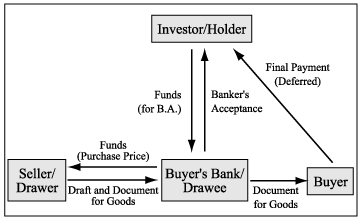
Figure 28.5 - Banker's Acceptance Transaction
Problem Set 28
Figure 28.2
Documentary Collection: Parties/Document Flow
EPS |
GIF |
WMF
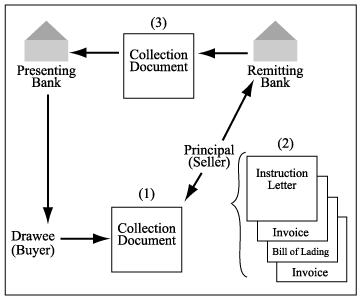
Figure 28.3
Sight Draft for Documentary Collection
EPS |
GIF |
WMF
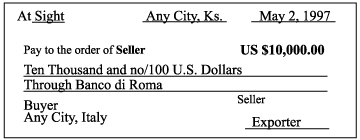
Figure 28.5
Banker's Acceptance Transaction
EPS |
GIF |
WMF
![[ suggestions ]](images/suggestions.gif) Try the suggestions page
on how best to use these figures. Try the suggestions page
on how best to use these figures.
Problem Set 28
28.1. This week you have a new client, Bob Puget from Puget
Shipping Company. His first question relates to Puget’s form bill of
lading, which is identical to the form set out in Figure 28.1. Puget
tells you that a recent audit of Puget’s files indicated that several
recent shipments were made in which the bill was completed by an
inexperienced clerk. Contrary to Puget’s customary practices, the clerk
typed the name and address of the consignee into blank 2 (designating
that party as the consignee). If the bills were completed in that
manner, do they constitute documents of title? Are they negotiable? UCC
§§ 1-201(6) & (16), 7-102(e), 7-104(1)(a).
28.2. Puget’s second question involves a shipment of two
containers of air movers (a type of industrial machinery used to cool
factory workers) from Seattle to a Brasileira Lumber, in Rio de Janeiro.
The seller was Guterson Pneumatic Tools. At the time of the shipment,
Puget issued a negotiable bill of lading stating that the goods were
consigned to the “order of shipper” (that is, to the order of Guterson,
the seller). The vessel on which the goods are being shipped currently
is located in Los Angeles. This morning Puget received an urgent
telephone call from the captain of the vessel. The captain says that an
attorney for Olympia National Bank has just served papers on him
claiming that it has a lien on all of Guterson’s assets. The attorney
wants Puget to hand the goods over to Olympia.
When Puget called Brasileira Lumber and advised it of the situation,
Brasileira told Puget that it intended to pay for the goods as
contracted and that Brasileira (to put it mildly) would be displeased if
Puget did not deliver the goods as agreed. It appears that the original
bill of lading currently is in an overnight mail package on the way to
Banco de Janeiro (Brasileira’s bank). What should Puget do? UCC §§
7-104(1)(a), 7-403, 7-602.
28.3. Later in the day, Puget calls you back with one final
question about the Guterson shipment from Problem 28.2. He is frustrated
because he has just discovered that the check Guterson gave him for the
shipping charges has bounced. When Puget tried to telephone Guterson
about paying for the charges, Puget listened to a recording stating that
Guterson’s number had been disconnected. When he went to Guterson’s
business, he saw that the warehouse was completely boarded up. When you
question Puget about his charges, he explains that he always notes the
charges on the bill, but ordinarily does not insist on payment until he
delivers the goods. In this case, his understanding was that the seller
Guterson would pay him before the goods arrived. Do you have any
suggestions for how Puget can obtain payment? UCC § 7-307, UCC §
7-403(2).
28.4. You get a call this morning from a new client, Giles
Winterborne, who runs a gourmet apple company with customers worldwide.
He came by this afternoon to consult about a shipment of apples that he
sent to one Grace Melbury (in Paris), using a standard documentary draft
transaction to protect his right to payment. When the draft arrived in
Paris, Melbury called up Winterborne, told Winterborne that she had
changed her mind and no longer wanted the apples, and advised
Winterborne that she would not pay for the apples. Later that afternoon,
Safety Pacific (Winterborne’s bank) called to advise Winterborne that it
had been notified by telex that Melbury had dishonored the draft.
Winterborne comes to you confused. Can’t he force Melbury to pay the
draft? If he can’t, he wants to know what the point of all of the
documents and drafts is? UCC §§ 3-401, 3-408. How would his position
differ if he had shipped the apples with a nonnegotiable document of
title consigning the apples to Melbury? {In this problem and the rest of
the problems in this assignment, you should assume that rights on the
drafts in question are determined either under Article 3 or under rules
that are substantively identical to Article 3.}
28.5. Satisfied by the frank advice that you rendered in Problem
28.4, Winterborne returns to you the next day with a new problem. His
question involves another documentary draft shipment, this time to Edred
Fitzpiers in Hintock, England. The collection document was in the
customary form, calling for delivery of the documents “against payment.”
For reasons that are unclear to you and Winterborne, Hintock Bank and
Trust (Fitzpiers’s bank) released the documents to Fitzpiers without
obtaining payment from Fitzpiers. Accordingly, Fitzpiers now has the
apples and Winterborne has not been paid. What can Winterborne do to
obtain payment? Convention on Contracts for the International Sale of Goods 62.
28.6. A week later, Winterborne comes to you with another
problem. This one involves a banker’s acceptance transaction, in which
he sold some apples several months ago to Marty South, drawing a draft
on the same Hintock Bank and Trust. Hintock accepted the draft and sold
it to Barclays Bank on the open market. Unfortunately (for reasons that
should be obvious from Hintock’s conduct in Problem 28.5), British
regulatory authorities recently closed Hintock. Thus, Hintock did not
pay the banker’s acceptance when it came due. Barclays has now
approached Winterborne seeking payment from him as “drawer” of the
draft. Winterborne can’t understand what possible claim Barclays has
against him. “I shipped apples to Marty South. She got the apples. I got
paid. What’s the problem?” Does he have anything to fear? UCC §§ 3-414,
3-415.
Assignment Update
No update is needed at this time.
|