FWP:
SETS == GROTESQUERIE; SYMMETRY
DESERT: {3,1}
MADNESS: {14,3}
For background see S. R. Faruqi's choices. For more on Ghalib's unpublished verses, see the discussion in {4,8x}.
The verse opens with an astonishing claim: 'in the privacy of the blister(s) of the foot' is my 'wandering' or 'coursing around'. Blister-footedness is normally a situation when wandering around is impossible (although {60,9} suggests a remedy). Here, it looks on the face of it as if the speaker actually does his wandering inside a blister, the way one might run on a small private track instead of in the desert (or swim in a small private pool?).
Is this idea grotesque? Yes! The vision of the lover wandering (swimming?) around in the fluid inside a blister, is distractingly gross. Even if we don't think of pus or blood, but of a clear serum, it's still such an unpleasant yet horribly fascinating vision that it both distracts us from, and detracts from, the pleasure of the verse.
No doubt we can invoke the flexibility of the i.zaafat , and take ;xalvat-e aabilah-e paa me;N to mean something like, in the privacy 'pertaining to' blister(s) on the foot'-- that is, in the privacy of the solitude that results from an inability to go out and run around. But that's a rescue job that we undertake by an effort of will; it can't be more than a secondary reading.
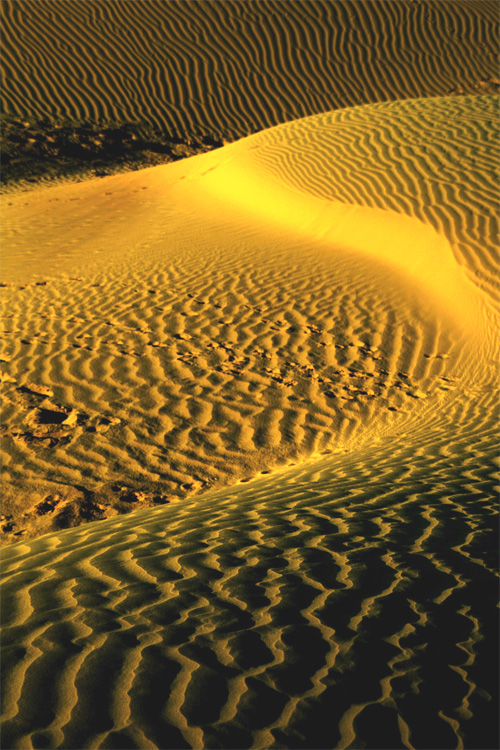
The verse invokes the desert's two essential qualities of expansiveness (so inviting to the mad lover's wanderings) and dryness (here it's literally a bayaabaa;N , a be-aab or 'waterless' place). Then the verse juxtaposes these qualities to their opposites: the tight compression of a 'narrow' or sorrowful heart (and the small size of a blister); and also the wetness of blood and of the fluid inside a blister. There's a certain elegant word- and meaning-play here, undoubtedly.
In the second line, what does meraa modify? It can't modify the feminine dil-tangii , so we're left with a choice between bayaabaa;N and ;xuu;N . If we choose the former, as in (2a), then the lover's desert is 'blood' in the literal sense (the way his wandering is within a blister, perhaps even a blood-blister); or else in the idiomatic sense of 'wasted, squandered' (see the definition above): The lover can't use the desert for wandering in, since his feet are too blistered. Or perhaps 'wildness/madness' itself has even somehow 'murdered' or destroyed his desert (as in {5,4}).
If we take meraa to modify ;xuu;N , as in (2b), then the lover's blood itself becomes a desert, the way his blisters (blood-blisters?) become some kind of wandering-place. This reading works well with the first line, but we have to pull meraa from the very end of the second line, back to the very beginning, which is a stretch when the bayaabaa;N is right there next to it. Still, knowing Ghalib, it doesn't seem at all impossible.
Compare {3,1}, which plays
with the same juxtaposition of expansiveness versus narrowness, and of the
desert with physical imagery of the body, but arouses no distaste.
Asi:
My madness-wandering has become limited to the privacy of the blister on the foot; and, so to speak, my desert has become blood through my 'narrowness' of madness. That is, that desert that was special to my madness-wandering has now come within a blister on the foot. And it's clear that in a blister on the foot there's nothing at all but blood. This is only an imagined [;xayaalii] verse.
== Asi, p. 71