FWP:
What is the speaker-- the lover, we assume-- up to in this verse? There are several possibilities:
=The lover is being generous. Since he knows his enemy (the Rival? the Other?) is a weaker person, he chivalrously asks the Lord to be kind to the poor man, to spare him, to give him a lesser wound, and to give the lover himself the worst kind.
=The lover is being selfish. Since he wants the 'best' kind of wound-- the deepest, the most incurable, the one that produces the most exquisite suffering-- for himself, he urges the Lord to relegate the second-rate wounds, the possibly curable ones, to the enemy.
=The lover is being cruel. Since a wound for which there 'might' be able to be a cure [ho saktii ho] imposes on the wounded person the extra suffering of suspense (will he live, or will he die?), the lover is vindictively wishing on his enemy the worst kind of uncertainty. This is certainly a tertiary reading, but why should we rule it out?
=Or, on the most enjoyable reading, the lover is making a show of generosity and chivalry, while really acting on selfish or even cruel motives. The basic 'pain = pleasure' paradox of the lover's psyche makes many such compexities possible.
Compare {168,3}, which is even more clearly grappling with the ethics of what to wish for one's enemy.
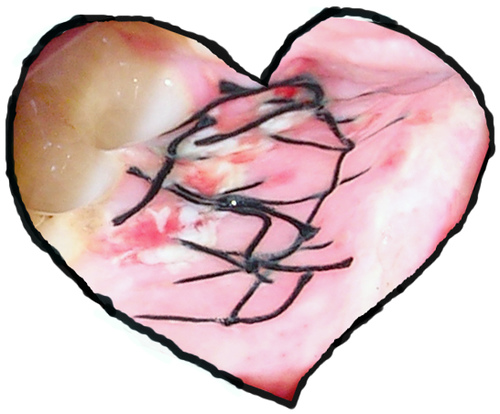
There's a nice affinity between the idea of 'darning' or 'stitching up', and the secondary meaning of qismat as the 'cutting out' of fabric (on this see {17,9}).
Nazm:
That is, I want a wound for which stitching would not be able to be done. (207)
== Nazm page 207