FWP:
SETS == DISRUPTION; FILL-IN;
MULTIVALENT WORDS ( yak ); SYMMETRY
DESERT: {3,1}
ABOUT EXPRESSIONS COMPOUNDED WITH yak- : This is the same 'desertful,' yak-bayaabaa;N , that appears in the title of 'A Desertful of Roses', though actually the title comes from {147,3} (and there are other examples in {220,3x}; {371x,2}; {434x,5}). Other examples: a 'cityful of longing' in {16,2}; both a 'footstepful of madness' and a 'two-world-ful desert' in {18,2}, a 'two-world Doomsday' in {81,11x} (though of course these can be variously translated). For other yak- examples with meanings including wholeness, completeness, suddenness, and/or a very large quantity, see {3,11x}; {4,12x}; {11,5x}; {12,5x}; {12,6x}; {27,10x}; {28,5x}, yak-pardah ; {29,8x}; {37,5x}, two uses; {42,10x}; {50,4x}, yak-dast (in Platts); {61,9x}; {69,2}; {71,7}; {79,6x}; {81,3} (including Faruqi's citation of a parallel verse by Mir); {84,9x}; {96,8x}; {117,6x}; {146,5x}; {190,12x} with its intriguing .sad-shahr and another possible example; {192,5}; {212,2}; {217,4}, straightforward? // {307x,5}; {320x,3}, yak-nashv-o-numaa (?); {361x,3}, yak-inshaa ; {369x,1}, yak-qalam ; {376x,4}, straightforward; {377x,5}; {378x,7}, yak-;xalq ; {418x,5}, yak-qalam ; {420x,3}, yak-qalam ; {424x,5}, yak-suu ; {435x,8}, yak-naistaa;N . A minority of these instances ({4,12x}, {42,10x}, {146,5x}) include an i.zaafat .
Such yak constructions are idiomatic
in Persian, though not in Urdu; perhaps this is why Ghalib omitted most of the verses containing them from the published divan. Apart from the specific wordplay in each context,
the general effect of the yak- constructions is to evoke
great intensity, scope, and/or comprehensiveness. On similar 'two-world' expressions,
see {18,2}. On Mir's use of such expressions, see M{452,2}. On yak versus ek , see {78,6}.
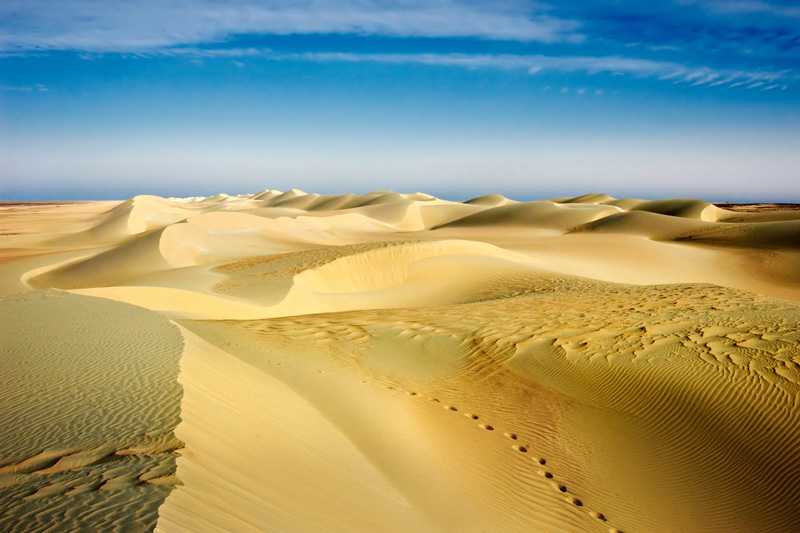
In this verse the desert is not only invoked as a measuring-rod, but also imagined, both genuinely and paradoxically, as an ocean. Waves move in the blowing sand as they do in the sea. The speaker's footprint on the sand has the shape of a bubble (2a), and also the nature of a bubble: it travels ceaselessly along with a large 'wave of movement'. Or perhaps his fatigue eventually renders his travel ethereal: after his body collapses, his relish for travel remains, and his spirit moves along with the waves of drifting sand, so that their ephemeral 'bubbles' are his footprints (2b).
The yak-bayabaa;N also acts as a kind of disrupter, or a false trail. For the crucial image in the second line-- the footprint as a bubble in an ocean-wave-- isn't signaled at all by the 'desert' in the first line. Yet how easily Ghalib could have said yak-samundar instead! If it occurs to me, how could it not have occurred to him (along with many other possibilities)? By saying 'an oceanful' he could have created a smooth and harmonious effect. Instead, by saying 'a desertful' he has made a more jagged, bipolar verse-- one that requires us to do more work, but that also rewards us more richly.
Who speaks in this verse? Presumably it is the lover, but in the verse itself his only defining quality is his unwearying relish for travel, and the endlessness of his quest. Or is it a quest? Might it not be the movement itself that intoxicates him? This is one of those 'do-it-yourself' verses-- the context and content of the journey are left to our own imagination.
The simplicity and punch of the imagery, the powerful visual scene it creates-- all this works wonderfully here; Arshi proposes a comparison with {157,5},
a verse in which an equal degree of abstraction seems to produce a much less
exciting result. I'd prefer to compare the present verse with the eerie {190,1},
another verse about strange footsteps and deserts. And we shouldn't forget the striking effects created 'at every footstep' in {34,6}.
Nazm:
The way the wave's relish for movement never lessens, in the same way my relish for movement won't lessen-- whether there be one desertful of fatigue, or a hundred desertsful of fatigue, it's all the same. (12)
== Nazm page 12