FWP:
SETS == A,B; BASKIH
GATHERINGS: {6,3}
HOME: {14,9}
For background see S. R. Faruqi's choices. For more on Ghalib's unpublished verses, see the discussion in {4,8x}.
And now here's a real winner-- one that truly should have been included in the published divan. I can't think why Gyan Chand omits it from his commentary, unless by accident.
The verse revolves like a wheel on spokes provided by several excellently multivalent words: nashaa:t ('growing; liveliness'); tang ('narrow; vexed'); and havaa ('wind, desire, trifle'); see the definitions above. (For more on havaa in particular, see {8,3}.)
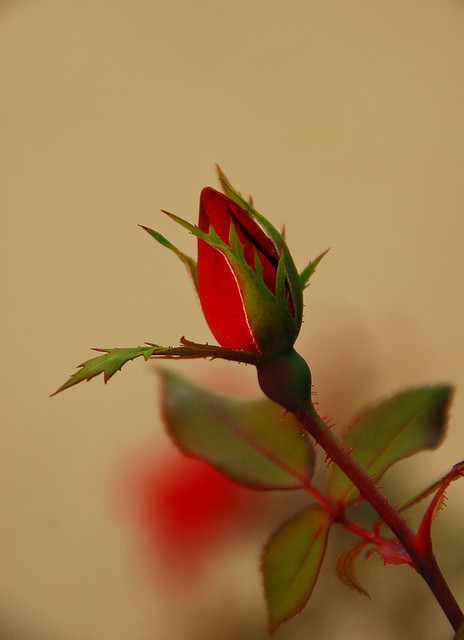
The basic image of the bud as 'narrow' and tight is an obvious one, and invites an extended set of metaphors of the bud's being 'vexed, dejected'. By contrast, as the bud shows 'growth' and/or 'liveliness, joy', it expands into a bloom that is 'smiling' or 'laughing', as though it had attained its 'desire'. But its time of flowering is so brief as to be really an antechamber to its death: the 'wind' then scatters the withered petals around the garden.
In an additional set of metaphors, the bud's petals cluster together like the members of a festive 'gathering', only to then 'scatter' like departing guests. Then, the idea of the bud's holding a party or 'gathering' invites the metaphorical extension of the bud to a person; the idea of the 'narrow' or oppressive 'house' evokes all the metaphors of the body as the inadequate house or home of the spirit.
But the axle at the center of the whole wheel of metaphoric possibilities is the wonderfully exploited multivalence of baskih ; for more on this, see {13,5}. Just look at the possibilities of the second line:
| =although =whereas =to such an extent |
the house/bud/body is |
=narrow =vexed =dejected |
=heedlessly =heedless one |
don't ask for a | =breeze =desire =triviality |
There are really so many readings that it hardly feels worthwhile to start ringing the changes on them. But the chief point, the great Ghalibian miracle, is that almost every permutation will attach itself in its own elegant way to the first line. to make its own unique and particular kind of connection.
For of course it's also an 'A,B' verse, in which we're left to figure out for ourselves how the two lines fit together. Do they both describe the same situation? Does one of them follow from the other? Do they describe similar situations? Do they describe contrasting situations? Ghalib has laid out the buffet, but we have to decide for ourselves how to arrange the delicacies on our plates.
Asi:
'Oh foolish one, why do you do foolish things, and why do wish for wind/desire in a narrow house weakened by troubles? You ought not to do such a foolish thing! Don't you see that when the bud, in the situation of its narrow house, wished for wind/desire, then in one single quiver of joy its joyous gathering was overthrown?' It's obvious that the wind causes the bud to bloom and, after it has bloomed, that blossoming state does not remain.
== Asi, p. 147