Effects of Political Media Control
With the combination of censorship and guidance, the political control over media has indeed contributed to the harmony of Chinese society. Thanks to the media control, the state is able to avoid hostile informational disturbances and achieve its political stability in most circumstances. However, the lack media freedom, from another perspective, leads to citizens’ distrust and dissatisfaction towards official propaganda.
Citizens
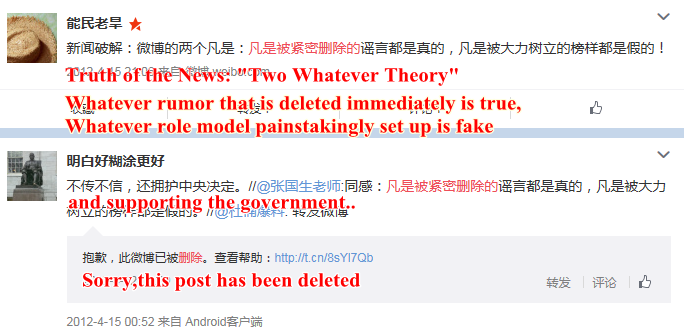
The uniformity of information sources and the limitation on information flow resulting from media censorship triggered people’s distorted interpretation about what they can access. There formed a “two whatever theory” in Weibo, the Chinese version of Twitter, regarding the media control: whatever rumor that is deleted immediately is true, and whatever role model that is painstakingly set up is fake.[27]” Citizens understand rulers’ incentives to conceal negative news, so when no news is released, they infer that negative news has been censored. Although there is a constant struggle in China between the need for informational freedom and the government informational hegemony, people in China are accustomed to the media routine of censorship and do not expect straightforward information from official media.
Journalists
Journalists in China follow the editorial guidelines most of the time, but in some cases excessive censorship can trigger the exposure of their accumulated rancor. Chinese media actors have gone on strikes and protests to fight for a free-speech environment. One high-profile incident occurred in 2012 involving the liberal Guangdong magazine Southern Weekly. Government censors rewrote the paper's New Year's message from a call for reform to a tribute to the Communist Party [28]. The move triggered mass demonstrations by the staff and general public, who demanded the resignation of the local propaganda bureau chief. While staff and censorship agencies reached a compromise that would theoretically relax some controls, much of the censorship remained in place, and the calls for resignation were ignored.
In response to the political intervention in media processes, professional journalists and publishers have adopted the principle of “self-discipline”. The threat of post-publication sanctions for violating rules has resulted in journalists’ voluntary circumvention of politically sensitive topics, and the concern of license removal has forced media agencies to apply internal content supervision[29]. Media actors learn from previous experience and political speeches what topics are forbidden or not as well as how to report certain issues. Up to now, sensitive taboo topics have become “common sense” to all media actors, and the shared avoidance of touching them allows media practitioners to survive while permitting authorities to continue exercising control over information. It is a win-win solution that the media stays within lines of what is allowed through a combination of government directives and self-censorship.
Conclusion
Political control over media itself is a sensitive topic both in China and many Western countries. People hold different perceptions toward China’s media censorship, and its impact is highly debatable. However, as far as I’m concerned, appropriate media control is not autocratic but rather necessary. Thinking on the condition of China, a huge country with a large portion of population uneducated, most people have access to the news but only a minority could fully understand what is happening. People are easily instigated by extreme opinions and the social order would be extremely hard to maintain under an absolute free media environment. From this perspective, political control over media is contributing to the stability and harmony of Chinese society. As long as Chinese media censors implement their power within an appropriate extent, Chinese media consumers as well as the country as a whole will benefit from the media control.
- Yang, “Rethinking China’s Internet Censorship: The Practice of Recoding and the Politics of Visibility,” 7.
- Xu, “Media Censorship in China,” 1.
- Yang, “Rethinking China’s Internet Censorship: The Practice of Recoding and the Politics of Visibility,” 4.