The Relation between Politics and Media Censorship
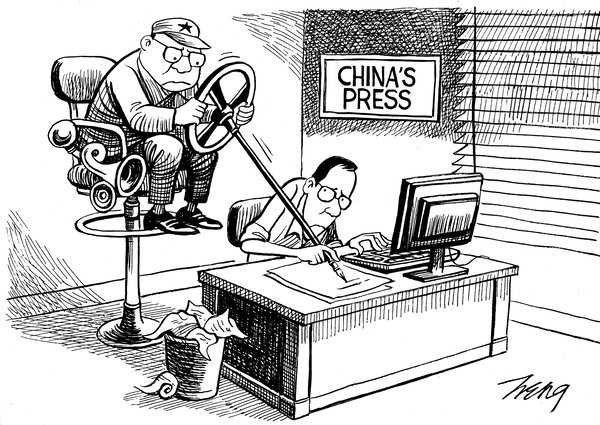
As a single-party state, China is ambitiously pursuing strategies to achieve governor’s power consolidation. Political control, as a result, has become a hallmark permeated into every angle of Chinese society including the media system. Being routinely censored by the Chinese Communist Party (CCP) and the national government, China’s media has limited autonomy and is highly politically oriented. Because almost all far-reaching media institutions are nation owned, China’s media serves as a vehicle of state propaganda and a main channel of opinion guidance. Unsurprisingly, China ranked 173 out of 179 countries in the 2013 index of press freedom [1]. Censorship defines the environment in which China’s media operates.
As a country with a population over one billion, media control is necessary to ensure the stability of the regime and maintain a consistent ideology cross institutions. The authority is intended to tone down sensitive topics and harsh rhetoric toward the party. Common taboo issues include separationist movements, religions, protests and individual dissidents [2] because they are so fundamental that any misguidance will damage the government image and even trigger revolutionary acts.
“Strengthening media regulation is the will of the people”
--- Global Times, December 2012
This website will provide an overview about the history, strategy and impact of Chinese political media control, and will discuss how new media such as the internet is posing challenges to the existing media censoring system.
Let’s start the journey by clicking to the next page.
- Beina Xu, “Media Ceorship in China,” Council on Foreign Relations, September 25, 2014, p.1
- Qiuqing Tai, “China's Media Censorship: A Dynamic and Diversified Regime,” Journal of East Asian Studies, 14 (2014), p. 200.