New Media Challenges
 Despite the great success controlling traditional media, the Chinese government is now facing challenges monitoring the internet. Due to its unprecedented openness and accessibility, new media makes regular censorship difficult to achieve.
Different from traditional media institutions which are mostly owned and managed under the party and the government, internet-based media operate beyond the national ownership. The majority of new media companies in China are privately owned, including the most well-known ones such as Sina, Tencent and Netease; even People.com, the official website of the foremost party press, is partially invested in by international media tycoon Rupert Murdoch [18]. Because new media agencies do not rely on government funding for survival, they have no incentive to follow political instructions as the traditional media did.
In addition to privatization which weakens the control from central-level authorities, the mass participation in new media also made monitoring online contents more difficult. Due to the absence of gate-keepers, people with different levels of morality and education can post contents freely via the digital platform. Not only has the validity of information become ambiguous, privacy and copyright issues are also aggravated in online media[19]. In other words, while the internet offers individuals equal access to consume and report messages, its excessive freedom has created a predicament for media censorship.
Why has Traditional Censorship Failed Online?
 The Economist once described China as “setting an example for other repressive regimes” by blocking undesirable websites and monitoring online users[20]. However, following the maturity of media censorship, China’s netizens are getting increasingly sophisticated about circling around the content restrictions. Not only are they known to be skillful in “climbing” the Great Firewall by installing software and Virtual Private Networks to access otherwise blocked foreign websites, they have also developed tremendous ingenuity in “recoding” to keep sensitive topics alive on the web[21]. For instance, because the two words are homonyms, “river crab” has long served as a code word for “harmonizing the internet,” a well-known euphemism for the online policing of contents[22].
The high updating and spreading rate of new media news also impairs authorities’ ability to block unfavorable messages. Because information spreads rapidly on new media, audiences usually perceive news from online platforms before it appears in the traditional media. As a result, officials will lose credibility if they keep silent in the face of negative reports. Beijing, for example, failed to conceal a car crash that led to 40 deaths, because nearby passengers posted photos and videos of the accident disregarding government edicts, and bloggers left critical comments when censors tried to block the posts[23]. The internet has played an increasingly essential role in leading social consensus. From local accidents to leadership corruption, almost every national hot spot started from, and gained popularity, via new media. Accordingly, many topics that governors used to hide in traditional media have failed to escape from the internet. Instead of a one-way, top-down political control, new media is “interactive” and, to some extent, offers the public a means to monitor authorities and the society they live in.
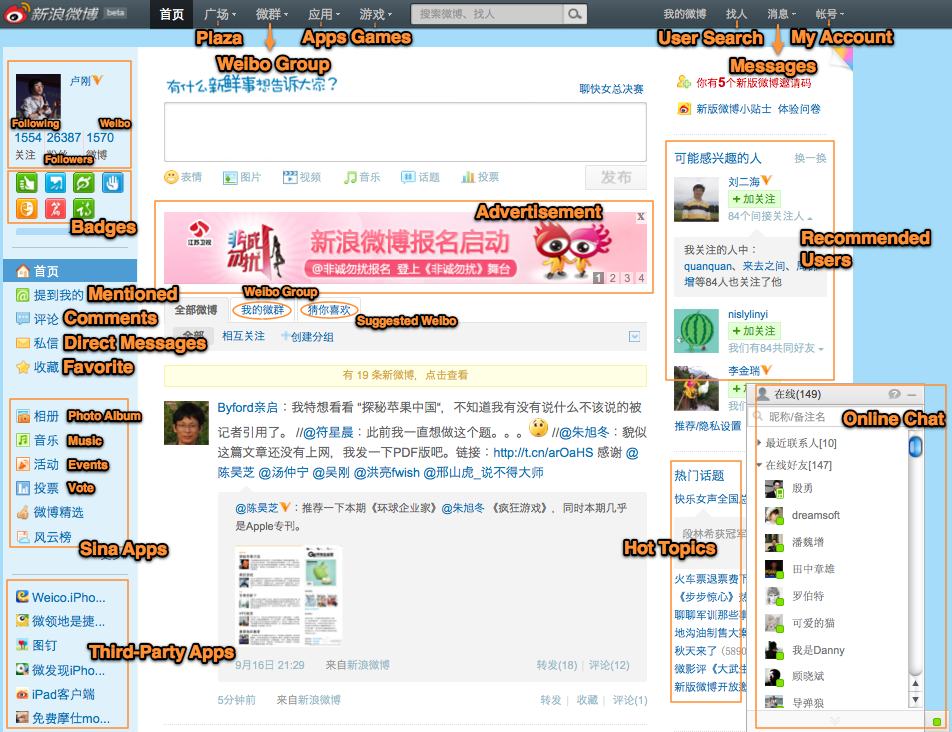
Sina Weibo, the Chinese version of Twitter, becomes the main platform leading Chinese public consensus.
(click on the image to navigate Weibo)
Government Response: Internet Regulation
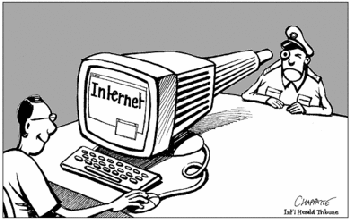
Contrary to the Western perception that China makes every effort to repress online discussions, the Chinese government is actually encouraging appropriate use of new media and trying to grasp the trend of public opinion through the internet. The “network politics,” online forums governors hold to discuss national issues with netizens, is an example of innovated digital channels connecting state leaders to the public[24]. Because online commentaries are anonymous, users are able to go beyond physical limits and participate in political issues without fear. Therefore, the internet becomes a direct reflection of public concerns and enables the party to gauge public reactions toward its policies.
In order to maintain information flow while keeping new media environment “healthy,” Chinese government implements a strategy called "conditional public opinion guidance,”[25] which is a combination of guiding public opinion and banning news reports. Guiding is used to encourage positive and appropriate expression of opinions. The government uses official websites to set topic agendas as well as participating in social networks to lead the discussion direction. More recently, the government “hired” a group of netizens, the so-called “Fifty Cent Party,” to post positive political comments online, which President Hu Jin-tao described as “a new pattern of public-opinion guidance”[26].
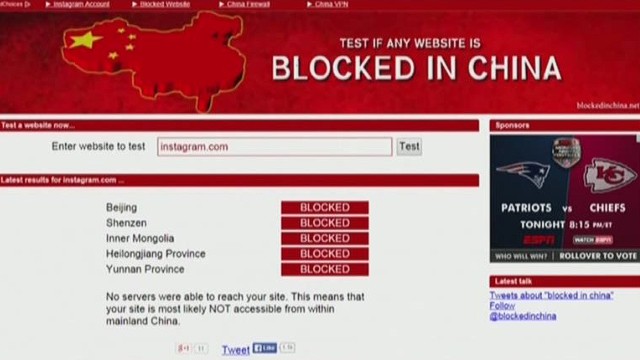
However, if certain content goes beyond the government’s tolerance, censors will apply a direct ban to make the potential harm disappear. The Chinese government has adjusted its strategy to censor online information and strengthened the blocking of undesired foreign webpages. For example, Chinese officials have developed a technological system as a substitute for the human censor when supervising the internet, which largely increased the efficiency of detecting sensitive topics. In addition, China banned the use of VPNs earlier this year (2015) and limited citizen’s opportunity to access foreign websites.
Test if any website is blocked in China
(click on the image and start checking the availability of your website)
- “A Brief Guide to China’s Political Media Situation,” 2.
- Yuxia Chen, “New Media and China’s Political Democracy,” Journalism Study Tribune, August 31, 2012, p.1
- Fan Yang, “Rethinking China’s Internet Censorship: The Practice of Recoding and the Politics of Visibility,” SAGE (2014), 2.
- Ibid., 2-3.
- In Chinese pronunciation, “river carb” and “harmony” have the same sound, both read as “he xie.”
Chen, “New Media and China’s Political Democracy,” 1. - Ibid., 1.
- Tai, “China's Media Censorship: A Dynamic and Diversified Regime,” 186.
- Chen, “New Media and China’s Political Democracy,” 1.