As of 8 May 2024, this site is accessible via HTTPS as well as
HTTP. Prior to that it was inaccessible to browsers such as Chrome that
that allow only HTTPS access, and report "page not found" for existing
pages that are available only via HTTP.
Overview
From the beginning up to about 1960, Columbia University was a major
contributor to the development of electronic computing as we know it today.
But Columbia's role is little known — especially at Columbia itself.
This website, which would be nearly 500 pages long if printed, attempts to
fill in the blanks. Highlights include:
The engineering education of Herman Hollerith,
the "father of automated computing";
the USA's first automated census in 1890 was his
Columbia PhD dissertation.
The first third of this site should be of general interest to anyone
interested in the history computing; the remaining two thirds concern
Columbia as a consumer and user of computing technology... mainframes,
minicomputers, personal computers, and networks.
3 July 2022: Videos of talks given by the first
generation of electronic computer pioneers at the
Los Alamos International History of Computing Conference, June 1976,
restored by the Computer History Museum:
CLICK
HERE to see them.
30 October 2021: A 1986 video
by George Giraldi (35 minutes) of Watson Lab staff and of the CUCCA
machine room and shutting down of our third DEC-20, CU20C, plus a
gallery of screenshots from the video.
As of 7 April 2021, all pages within this site (almost 800 of
them) have been converted to HTML5, validated, and adapted to adjust
automatically to different screen sizes and to make a better first
impression on narrow screens like cell phones. And a random-page viewer
was added.
An Electric Tabulating
System
by Herman Hollerith, The Quarterly,
Columbia University School of Mines, Vol.X No.16 (Apr 1889),
pp.238-255. This was accepted by Columbia as Hollerith's Ph.D. thesis.
Supplement: Grosch
Computer: Bit Slices from a
Life by Dr. Herb Grosch (2003),
500+ pages, including several chapters on IBM's Watson Scientific Computing
Laboratory at Columbia University in the 1940s and 50s. Converted to fluid
HTML5 on 4 March 2021. Also available as a PDF
document. Herb Grosch passed away January 25, 2010, at age 91.
Supplement: Brennan
The IBM Watson Laboratory at
Columbia University - A History by Jean Ford Brennan
(1971). 76 pages, 25 photos. The history of IBM-sponsored
computing research and laboratories at Columbia University, 1928 though
1970. Converted to fluid HTML5 27 February 2021. Now also available
as a PDF document.
Supplement: Hankam
Homeward Bound, the
memoir of computing education pioneer Eric Hankam,
including his escape from Nazi Europe, his time at IBM Watson Laboratory at
Columbia University, and his continuing adventures.
This document gives a chronology of computing at Columbia University, as
best I can piece it together, written mainly in Jan-Feb 2001, updated
periodically since then (time of last update listed above). It does not
aspire to be a general history or museum of computing, but in some ways it's
not far from one either. Corrections, additional information, and more
photos are always welcome. In most cases where the text says "today", that
means 2001; obviously much has changed since then.
If you came here looking for the history of the Kermit protocol, Kermit
software, or the Kermit Project, you can find
some of it below in the 1980-82 timeframe, and a bit more
HERE. Plus some 2012 oral history
transcripts at the Computer History Museum HERE
and HERE
Who am I and why did I write this? Starting around 2000, people
popped into my office all the time to ask "when did such-and-such happen?"
— the first e-mail, the first typesetting, the first networking, the
first PC lab, the first hacker breakins, etc — since I was there for
most of it. So I took some time and wrote it down, and in so doing became
fascinated with the earlier history. I was a user of the Columbia Computer
Center from 1967 until 1977 in my various jobs and as a Columbia student,
and I was on staff from 1974 until 2011. Brief bio: After some early
programming experience in the Army (mid-1960s), the Engineering School and
Physics Dept (late 1960s, early 70s), and Mount Sinai Hospital (early 70s),
I came to work at the Computer Center Systems Group in 1974, hired by its
manager Howard Eskin out of his graduate Computer
Science classes. After a year of OS/360 programming, I was manager of the
PDP-11/50 and the DEC-20s (first e-mail, early networking, the first
campuswide academic timesharing), then manager of "Systems Integration"
(first microcomputers, PCs, Kermit), principal investigator of the "Hermit"
distributed computing research project, then manager of Network Planning for
the University and chair of the University-wide Network Planning Group,
before "retiring" to the Kermit
Project, which had less (well, zero) meetings and was way more fun. I
was laid off from Columbia in 2011 but still have access to this website.
(Note: the Columbia Kermit Project was cancelled and its website frozen July
1, 2011; the new Open Source Kermit Project website
is HERE.)
Capsule Summary
Automatic computing at Columbia University got off to a serious start in the
1920s in the with the installation of large IBM accounting and calculating
machines in the Statistics and Astronomy departments and a close
relationship that developed with IBM that would last 50 years. Columbia
soon developed a world-class reputation for innovation
in scientific computing. As World War II approached,
Columbia astronomy professor Wallace Eckert was
loaned to the US Naval Observatory to
apply the techniques he had developed at Columbia to the production of the
almanacs that guided American air and sea
navigation throughout the war. At the end of the war Eckert returned to
Columbia and founded and directed of IBM Watson
Scientific Computing Laboratory on 116th Street, IBM's first pure
research facility, which also served as Columbia's "computer center."
Eckert also created the
world's first Computer Science curriculum. Several
groundbreaking early computers were designed and/or built at Watson Lab.
In 1963
Columbia opened its own Computer Center on campus
underneath the Business School. From 1963 to 1975 all computing at Columbia
was done on large central IBM mainframes, with a
handful of smaller computers in the departments. Jobs were coded on punched
cards and run by operators in the Computer Center machine room. In 1973 a
public Self-Service Input/Output area (SSIO)
was opened with key punches, card readers, and printers where users could
submit jobs and retrieve the results themselves. Beginning in 1975
interactive timesharing was introduced based on
central Digital Equipment Corporation computers
with public hardcopy and video terminals installed in
the SSIO area and in the Engineering
building. Other terminal rooms were added over time, mainly in
the dormitories. During 1977-80 a lively online
community developed, with email, bulletin boards, and file sharing, while
courses increasingly required the use of the central computers, or took
advantage of them in other ways. In the 1980s public terminals were
gradually replaced by microcomputers, PCs, and workstations connected to the
central computers through their serial ports, like terminals. Columbia
joined the ARPANET
(later to become the Internet) in 1984. The terminal network was replaced
in stages by Ethernet,
which was also extended to dormitory rooms, offices, and even neighboring
apartment buildings. About 1995 the combination of Windows 95 and the
World Wide Web led to widespread migration from centralized timesharing to
distributed desktop computing, wired and then increasingly wireless.
Students began to arrive with their own computers, laptops, tablets, and
mobile devices; the need for public PC labs dwindled. By 2005 or so, the
Computer Center merely provided the infrastructure, mainly the network,
WiFi, e-classrooms, email, and of course the Columbia University website and
servers. Then, as of 2015. even
email was outsourced.
Disclaimers
Obviously this is written from my perspective; others might have
different recollections or views. In particular, at least after 1963, this
turns out to be more a history of centralized academic computing, rather
than all computing, at Columbia, giving short shrift to the departments,
administrative computing, the libraries, and the outlying campuses; a more
complete history needs these perspectives too. I've made every attempt to
check the facts; any remaining errors are mine — please feel free to point them out.
Computers are value-neutral tools that can be used for good
or evil, and it is clear that from the very beginning they have been used
for both. This document does not aim to extol the virtues of computers in
general, nor of any particular company that makes them, but only to
chronicle their use at Columbia University.
IBM, a company featured prominently in this history due to its close
relationship with Columbia University, may have also maintained a
relationship with Nazi Germany before and during World War II involving the
use of its punched-card technology in the Holocaust. This relationship is
the subject of the book IBM and the
Holocaust[47] by Edwin Black (2001), 592 pages
(expanded
in 2012,
and reissued
in 2021). It was controversial at first but more than 20 years later,
as far as I can tell, there has been no definitive refutation of it.
For more on this topic, search Google for IBM and the
Holocaust. IBM's 2001 statement
on the subject has since disappeared from their website. To check for
more-recent statements, search Google
for site:ibm.com
holocaust. Other links:
In any case, if there was a relationship between IBM and the Nazi
government, it had nothing to do with Columbia University as far as I know:
IBM's Watson Laboratory was not founded here until
February 1945, and was initially devoted to defeating the Axis. Pre-war
contacts primarily concerned astronomy. Herman
Hollerith, the Columbian who founded the company that would become IBM,
died in 1929 before the Nazis came to power. On the other hand,
Thomas J.
Watson (IBM chairman 1914-1956) was a Columbia Trustee from 1933 until
his death in 1956.
Acknowledgments
Watson Scientific Computing Laboratory at Columbia University
(with Watson Lab dates)
Columbia Computer Center (Academic, current and former)
Bob Resnikoff,
Walter Bourne,
Maurice Matiz,
Joe Brennan,
Rob Cartolano,
Joel Rosenblatt,
George Giraldi, Christine Gianone, Terry Thompson, Kristine Kavanaugh,
Peter Kaiser (1967-69),
Mike Radow (1960s),
Elliott Frank (1968-70),
Andy Koenig (1960s-70s),
Janet Asteroff (1980s),
Steve Jensen (1980s),
Tom De Bellis (1980s).
Columbia Computer Center
(Administrative/Operations, current and former)
Nuala Hallinan, Stew Feuerstein,
Joe Sulsona
(1957-2001), Raphael Ramírez (1968-199?),
Alan Rice (1960s), Peter Humanik, Ben García.
Columbia Faculty
Joe Traub (Computer Science Department founder and previously Chair),
Steve Bellovin (Computer Science Department, formerly of Bell Labs), Andrew
Dolkart (School of Architecture, Planning & Preservation), Bob McCaughey
(Barnard College History Department). Many of the Watson Lab technical
staff and Computer Center directors were also on the Columbia faculty.
PERSONAL THANKS to Professor Emeritus Leon
J. Lidofsky (Applied Physics and Nuclear Engineering) for getting me
hooked on programming and giving me the run of his 1960s-era computer lab;
without this push I'd probably still be an overeducated taxi driver!
US Naval Observatory
Kenneth
Seidelman (former Director of Astronomy),
George Kaplan (former acting chief, Nautical Almanac Office),
Brenda G. Corbin (Librarian).
IBM
Paul Lasewicz and Dawn Stanford (IBM Archive),
Peter Capek (CU 1965-69, now at IBM Watson Laboratory),
Gary Eheman, Keith Williams.
The Parnassus Club
Nuala Hallinan plus former residents Barbara L. Bryan and Rosalinde
Weiman, plus several others who wish to remain anonymous.
And...
Simon Rackham for the 1968 computer movie,
Ruth Dayhoff (Director of Medical Digital Imaging, US Dept of Veterans
Affairs),
Ed Reinhart (Formerly of RAND Corp, JPL, and Comsat),
Mary Louise McKee (NORC programmer, US Naval Proving Ground Dahlgren VA),
George Trimble (Aberdeen Proving Ground, IBM),
John C Alrich (Burroughs/ElectroData),
Loren Wilton (Burroughs/Unisys),
Ellen Alers (Smithsonian Institution),
Garry Tee (Dept of Math, University of Auckland NZ),
Allan Olley (University of Toronto),
Charlotte Moseley (formerly of the County of San Diego Data Processing
Center),
Pnina Stern (formerly Pnina Grinberg of BASR),
Annette Lopes (CU Associate Registrar, then Associate Director of Student
Services, later Executive Director, Human Resources, Finance and
Administration);
Jocelyn Wilk, Steve Urgola, and Mae Pan (Columbia University Archives and
Columbiana);
Bill Santini (CU Student Services).
I was inspired by Bruce Gilchrist's
Forty Years of Computing article from 1981
[3]
(so that makes it sixtyseventy
80 years!)
Special thanks to Bruce Gilchrist and Nuala Hallinan, each of
whom contributed valuable archive material and considerable time, effort,
and miles to this project; to Herb Grosch for
his awesomebook as well as tons of new
information, corrections, insights, anecdotes, and artifacts; to Eric Hankam
for the loan of his personal archive of photos and materials, his
autobiography, and a wealth of Watson Lab recollections; to Charlotte
Moseley for preserving and contributing a large number of old IBM manuals;
and to Bob Resnikoff who unearthed his long-lost cache of 1980 machine-room
and MSS photos. Herb, in particular, was involved in this project on a
daily basis since he first happened upon it in May 2003 until shortly before
his death at 91 in January 2010. Herb remembered
everything.
And thanks to the editors of
IEEE Annals of the History of
Computing for an announcement and abstract of this site in their
April-June 2002 issue, and for announcing the online version of Herb Grosch's
book in the July-September 2003 issue.
Please report any broken links directly to the author.
At the dawn of the new Millenium, computers and the network are ubiquitous; we
can't live without them. It wasn't always so. How did we get here? A series
of technological innovations including Pascal's adder (the Pascaline, 1600s),
Leibnitz's multiplier (the Stepped Reckoner, about 1700), the Jacquard loom (1804), the Babbage Analytical and
Difference Engines (1820s-30s), electricity and electromagnetism, the
telegraph, the Hollerith tabulating machine
(1890), the relay, the vacuum tube, core memory, the transistor, the laser,
the integrated circuit, and on and on, each resulted in products that
stimulated applications, which in turn stimulated the demand for more and
better products, and before long computers entered the economy and the popular
culture.
A case can be made that the computer industry got its start at Columbia
University in the late 1920s and early 1930s when Professors Wood and
Eckert, to advance their respective sciences, began to send designs and
specifications for computing machines to IBM Corporation, which until then had
been a maker of punched-card tabulating machines for the
business market. From those days through the 1980s, the relationship of
Columbia with companies like IBM was symbiotic and fruitful.
IBM Corporation itself was the child
of Columbian Herman Hollerith.
The early days of invention and innovation are past. Computers and networks
are now well established in the daily lives of vast numbers of people and,
in the 21st Century, they increasingly dominate our lives in the form
of cell phones, social media, video streaming, games, and "smart" consumer
devices, which was perhaps inevitable but not necessarily an improvement.
The story of computing at Columbia is presented chronologically. Most links
are to local documents, and therefore will work as long as all
the files accompanying this document are kept together. There are also a
few relatively unimportant external links, which are bound to go bad sooner
or later — such is the Web.
1754-1897:
Columbia University was established by
King George II
of England in 1754 (HUMOR)
in downtown Manhattan near what is now City Hall. The
campus moved to 49th Street and Madison Avenue in 1857, and from there to its
present site at 116th Street and Broadway in 1897.
1879-1924:
In 1879, Herman Hollerith (1860-1929) received his Engineer of
Mines (EM) degree from the Columbia University
School of Mines
[48]. After graduation he stayed on as an assistant to
one of his professors, W.P. Trowbridge, who later went on to what was to
become the US Census Bureau and took Hollerith with him. This led to
Hollerith's development of the modern standard punch card and the
tabulating machine and sorter that were used to
process the 1890 Census [40]. Hollerith wrote up his
invention and submitted it to the Columbia School of Mines, which granted him
a PhD in 1890 [48].
Hollerith's name is synonymous
with the advent of automatic computing; until about 1940, punched-card
calculators, tabulators, and so on were commonly called "Hollerith
machines", even when they were made by other companies.
1896:
Herman Hollerith founds the Tabulating Machine Company, which was
to become (through various mergers and renamings) the International Business
Machines company, IBM.
1900-1920:
Prof. Harold Jacoby, Chair of the Astronomy Department, in a memo dated
4 December 1909, refers to "Miss Harpham (our chief computer)" [28]. "Computer" was an actual job title in those days,
referring to someone whose job was to compute — usually tables from
formulas — by hand or using a mechanical calculator (more about this in
Herb Grosch's Computer, Bit Slices of a
Life, e.g. on page 4). The
1917-18 Columbia University Bulletin, Division of Mathematical and Physical
Sciences, in the Equipment section, lists "five computing machines" without
further detail (you can find a list of possible candidates at the University
of Amsterdam Computing Museum). Apropos of nothing, professor Jacoby
was a graduate of the Columbia class of 1885, and organized a gift from that
class to the University: the Vermont granite ball
that was mounted on the Sundial on 116th Street (now College Walk) from 1914
to 1946, and now sits in the middle of a field in Michigan [54]. Jacoby died in 1932; Wallace Eckert (about whom
much more below) wrote his obituary in Popular
Astronomy.
The Computing Tabulating Recording Corporation, CTR, is founded by the
merger of Hollerith's Tabulating Machine Company with several others. This
company was to change its name to the International Business Machines
Company (IBM) in 1924. IBM celebrated its 100th anniversary on 16 June 2011.
The Columbia University Statistical Laboratory (location unknown)
includes Hollerith tabulating,
punching, and
sorting machines, Burroughs adding machines,
Brunsviga and
Millionaire
calculators (the latter was the first device to perform direct multiplication),
plus reference works such as math and statistical tables. Prof.
Robert E. Chaddock (Statistics Dept) was in charge. The Astronomy department
(Prof. H. Jacoby) still has the "five computing
machines" [5].
CLICK HERE for a gallery of late-1920s computing
machines.
CLICK HERE for a 1926 aerial view of Columbia
University. CLICK HERE for a 1925 Columbia
University map.
1926:
Wallace Eckert (1902-1971) joins
Columbia's Astronomy faculty, specializing in celestial mechanics and most
especially the moon. In pursuit of these interests, Eckert is to become a
true computer pioneer.
1928:
Benjamin Wood (1894-1986), head of
the University Bureau of Collegiate Educational Research
[5], proposes to Thomas J. Watson Sr., president of IBM,
a method for
automated scoring of examination papers in large-scale testing programs (which
previously involved "acres of girls trying to tabulate ... test results" [45]). After some discussion, Watson sent three truckloads
of tabulating, card-punching, sorting, and accessory equipment to the basement
of Hamilton Hall [9,40].
1928:
Meanwhile in England, L.J. Comrie (1893-1950),
Superintendant of H.M. Nautical Almanac Office, begins a project to calculate
future positions of the moon using punched cards, a sorter, a tabulator, and a
duplicating punch, in what is probably the first use of these machines for
scientific calculation [72]. This work would
shortly inspire Columbia's Wallace Eckert to take the
next historic step: automating these calculations.
As we will see, much of the impetus towards automated scientific computation
(and therefore modern computers) came from astronomers, and its primary
application was in navigation. The same impetus brought us accurate,
portable timepieces in the previous century.
1928:
Columbia's medical school, the College of Physicians and Surgeons, moves
from 10th Avenue and 55th-60th Streets to Washington Heights between
Broadway and Fort Washington Avenue, 165th-168th Streets, the former site
of Hilltop Park
(1903-1912), the baseball stadium of the New York Yankees (known as the
New York Highlanders until 1912).
Jun 1929:
Prof. Wood's operation became the Columbia University Statistical
Bureau (PHOTOS). In addition to tabulating
test results, it served as a "computer center" for other academic departments,
particularly the Dept of Astronomy, which used the equipment for "interpolating
astronomical tables" [9,40].
Previously, Professor Wood had convinced Watson to build special Difference Tabulators, which IBM called
"Columbia machines" and delivered in 1930-31. These machines could process
150 cards per minute and were unique in their ability to rapidly accumulate
sums of products or squares [9].
The Statistical Bureau soon became a service provider to outside
organizations like the Rockefeller and Carnegie Foundations, Yale, Harvard,
and Princeton [9]. (So how much did we
charge? :-)
1931:
Walter S. Lemmon, a Columbia University Electrical Engineering graduate
and president of the Radio Industries Corporation, demonstrated the first
working Radiotype machine, an electric
typewriter coupled with radio transmitting and receiving apparatus. Thomas
J. Watson's contacts at Columbia put him in touch with Lemmon and IBM hired
him. In 1935 Admiral Richard E. Byrd successfully sent a test Radiotype
message 11,000 miles from Antarctica to an IBM receiving station in
Ridgewood, New Jersey.
The Radiotype, originally intended for business applications, was adopted
(after a successful radio connection between Washington DC and Dayton Ohio)
by the US Army Signal Corps for wartime use, allowing radio transmissions
without manual transcription to and also from Morse code. With the
U.S. entry into World War II, the Signal Corps ordered quantities of the
Radiotype machines to equip its stations in New York, San Francisco, Dayton,
Omaha, Seattle, Honolulu, Panama, Puerto Rico and elsewhere. Before the war
was over, Radiotype machines had been outfitted with encryption equipment to
provide almost instant transmission and receipt of secure
messages [40]. Much more about
this HERE.
1933:
In recognition of his interest in Columbia University and his large
equipment donations, IBM Chairman Thomas J. Watson
is appointed Columbia Trustee. In return, Columbia President Nicholas
Murray Butler is appointed to IBM's Board of
Directors [90].
1933-34:
Prof. Wallace J. Eckert (PHOTOS AND
BIOGRAPHY) of the Astronomy Department, a user of the Statistical
Bureau, proposed modifications to IBM machines for advanced astronomical
calculations, and within a few weeks the machines, including an IBM 601 Multiplying Punch (modified to Eckert's
specifications under the supervision of IBM's G.W. Baehne [82] and dubbed the "Astronomical Calculator" [81]) were delivered to the Rutherford Observatory in the
attic of Pupin Hall. Until 1937 (q.v.) this facility was variously known as the Rutherford
Laboratory, the Astronomical Laboratory, and the Hollerith Computing
Bureau (the minutes of the 61st meeting of the American Astronomical
Society, 29-30 Dec 1938, refer to a visit "to the Hollerith Computing
Bureau, where vast computing projects are being carried out under the
Direction of Dr. Eckert"). It was the first permanent IBM installation in
the world to do scientific work (Comrie's Greenwich setup had not been
permanent).
For his work, Eckert designed a control system based
on plugboards and rotating drums to interconnect the new equipment,
eventually incorporating methods to solve differential equations by numerical
integration [9].
The Astronomical Laboratory was the first to perform general scientific
calculations automatically [30]. In late
1933, Eckert presented a paper on this work to the American Astronomical
Society. Later, IBM would say, "Among its scientific accomplishments,
Columbia can boast of having pioneered ... the use of automatic computing
machines for research work" [37]. A seemingly mundane
but significant aspect of this work was the new ability to feed the result of
one computation into the next and print the results of these calculations
directly, thus eliminating the transcription errors that were common in
astronomical and lunar tables [17].
To illustrate with a 1946 quote from Kay Antonelli,
University of Pennsylvania, referring to her wartime work [34], "We did have desk calculators at that time,
mechanical and driven with electric motors, that could do simple arithmetic.
You'd do a multiplication and when the answer appeared, you had to write it
down to reenter it into the machine to do the next calculation. We were
preparing a firing table for each gun, with maybe 1,800 simple
trajectories. To hand-compute just one of these trajectories took 30 or 40
hours of sitting at a desk with paper and a calculator." Imagine the effect
of a transcription error early in the 30-40 hour procedure.
Practical Applications of the Punched Card Method in Colleges and
Universities, edited by George W. Baehne of IBM, published by Columbia
University Press; hardbound, 442 pages, 257 figures. Contains articles by Ben
Wood and Wallace Eckert, among many others. Most of the applications
described are straighforward tabulating and bookkeeping operations; Eckert's
is the exception. CLICK HERE for a more detailed
discussion of this book.
1936:
Wallace Eckert hires Lillian Feinstein [Hausman] as computing lab manager,
placing her at or very near the head of the class of Women Pioneers of
Computing [100].
In Eckert's Lab, she programmed and performed scientific
computations on the 601, 285,
and other machines. She stayed with Eckert until 1948, on loan for a time
to the US Naval
Observatory [88],
and then from 1945 on the Watson Lab technical staff. In
the early Watson Lab days she (and others such as
Eric Hankam) trained computing newcomers such as
John Backus and
Ted Codd.
From the early Astronomical Lab equipment, she moved on to
the 602 (and 602-A), 604, the
Aberdeen Relay Calculators,
and the SSEC, and when Columbia began to hold
academic computing courses in 1946, she ran Grosch's
Engineering 281 Numerical
Methods lab sessions. Much more about Lillian in
Herb Grosch's book
COMPUTER [88]
(in which Herb refers to her as "the senior full-time scientific
punched card expert in the whole world" in 1946).
The roster of Watson Lab technical staff (1945-70) is listed in
Brennan [88]. Out of 207 professional staff
members, 35 are definitely women. Many more are listed with only initials;
some others by Romanized Chinese name (which generally does not
indicate gender). But at least 17% of the technical staff were women, which
isn't bad for the postwar years, in which women were discouraged from
working (or worse, laid off from their wartime jobs).
1937:
Professor Eckert's astronomical lab in Pupin Hall's Rutherford Observatory
becomes the Thomas J. Watson Astronomical Computing Bureau (PHOTO), jointly sponsored by IBM, the American
Astronomical Society, and the Columbia Department of Astronomy [3,9,86],
to serve as a resource for
the entire world astronomical community [38],
making it the world's first center for scientific
computation [84].
"The initial equipment of the Bureau consists of that which has been used by
the Department of Astronomy at Columbia University during the past few years
... modified to make them more efficient for scientific work ...
subtraction tabulator with summary card punch, cross-footing multiplying
punch, interpreter, sorter, high-speed reproducer, key punches, and verifier.
"Some possibiliies of the machines can be
gained from the program now in progress. This consists primarily of (1)
numerical integration of the equations of planetary motion; (2) complete
checking of the lunar theory; (3) computation of precession and rectangular
co-ordinates for the Yale University Zone Catalogues; (4) the
photometric program of the Rutherford Observatory; and (5) problems of stellar
statistics." [86].
Users of the Bureau were charged only for labor and materials (a tremendous
bargain, since the equipment was donated).
The Astronomical Computing Bureau would serve as a model for many of the
wartime computing centers, such as those at Los Alamos, the Naval Observatory,
and the Aberdeen Proving Grounds [30,90].
1938-40:
In 1938, Soviet astronomer Boris Numerov visits Eckert's lab to learn how
punched card equipment might be applied to "stellar research" in his own lab
at St. Petersburg University in Moscow.
Numerov, Boris Vasilyevich:
The
website
of the Tosno Museum of Local History and Tradition (Leningrad Region) says
(as of 12 Sep 2003)
"An exhibit section is devoted to Boris Numerov (1891-1941) - a prominent
astronomer, land-surveyor and geophysicist, a creator of various astronomic
instruments and means of minerals exploring. His family has lived in the town
of Lyuban' not far from Tosno since 1922. In the times of Stalinist
repressions Boris Numerov was arrested and executed in 1941. In 1957 he was
rehabilitated." Numerov is known today for the various algorithms and methods
that bear his name.
In June 1940, a letter arrives for Eckert from V.N. Riazankin on behalf of
the Astronomical Institute of the USSR Academy of the Sciences, asking to
visit Eckert's Lab. Jan Schilt, now in charge of
the Lab, forwards it to Eckert in Washington. In August 1940, I.S. Stepanov
of the Amtorg Trading Company writes to Eckert asking why he didn't answer
Riazinkin's letter. Here's the final paragraph of Eckert's reply (cc'd to
Schilt):
May I take the opportunity to state that one of your eminent scientists, the
late Dr. Numerov, corresponded with me several years ago concerning this very
problem [machine construction of astronomical tables for navigation].
It was his intention to secure a similar installation, and had one in
operation. I sincerely hope that his interest in my machines was not
construed by his government as treason, and that Mr. Riazankin will not meet
the same fate as Dr. Numerov. [88].
Schilt writes to Eckert from Columbia on August 9th:
Concerning the letter of Mr. Stepanov I am shivering a little bit. Your reply
to him is extremely strong and clear, so much so that I would not be surprised
if I wouldn't hear from them at all, and frankly I just soon would not ... if
there is any danger that [the machine] room may prove a death trap to Russian
scientists I think I am in favor of not talking to these people. [88].
(Note: the correspondence places Numerov's death prior to 1941.) According to
David Alan Grier [46], the Amtorg Trading Company was a
spy agency; the proposed visit from Riazinkin, which never actually took
place, is thought to have been an attempted
first case of computer espionage [45]. In
fact, Amtorg was not just a front; it handled the bulk of Soviet-American
trade for many years, but it was also an ideal spot for the placement of
spies. Was Riazankin a spy? We'll never know. In any case he was never
heard from again.
Herb Grosch reports that Soviet
astronomers continued to pay occasional visits to Watson Lab after the War,
e.g. in connection with taking over production of the annual
Kleine
Planeten listing of asteroid positions from Watson Lab,
which did the work in 1946 after the German
Astronomisches
Rechen-Institut was destroyed in the War.
Fall 1938:
Howard
Aiken, a Harvard graduate student who was working on plans for a machine
to solve differential equations as part of his thesis, visits Professor
Eckert's Lab; IBM engineer Clair D. Lake (who built Eckert's
switch box) is also present. Eckert demonstrates
the capabilities of his setup and suggests that he try to interest IBM in
the project [9]. A year later IBM agreed to
develop and construct the machine, an electro-mechanical device called the
Automatic Sequence Controlled Calculator, ASCC
(PHOTO), the first automated general-purpose (but
not electronic or stored-program) computer. The ASCC was built by Lake and
his staff at IBM's Endicott NY facility and presented in 1944 to Harvard,
where it did war work, and eventually became known as the Harvard
Mark 1 [9]. The Mark 1 was soon
outpaced by IBM's Aberdeen Relay Calculator
(also built by Lake) and later the US Army's ENIAC,
the first electronic automatic general-purpose (but still not
stored-program) computer.
Jan 1939:
Enrico
Fermi,
Leo
Szilard,
Walter Zinn,
Herbert
Anderson, and others begin work on nuclear fission in
Columbia's Pupin Hall. Within a few months this work
would become the Manhattan Project, funded by President Roosevelt
(Columbia Law, 1905-07) in response to
Albert Einstein's
letter warning of Nazi research in this area. After Pearl Harbor, the
project moved to the University of Chicago (supposedly to make it less
vulnerable to German attack) and spread to the University of California,
Los Alamos, Oak Ridge, Hanford, and
other locations. Fermi's lab was in the same building as Professor Eckert's
Astronomical Computing Bureau.
I don't know to what degree, if any, Eckert's
computing machines were employed in the early Manhattan Project, but as noted below they played a key role in 1945 in the
final preparations for the first A-bombs [57]. A
number of other Columbia scientists worked on the project, including I.I.
Rabi, Edward
Teller,
John Dunning
(who identified U-235 as the fissionable uranium isotope using the Pupin
cyclotron in Feb 1940),
Harold
Urey (who later left the project on moral grounds), and
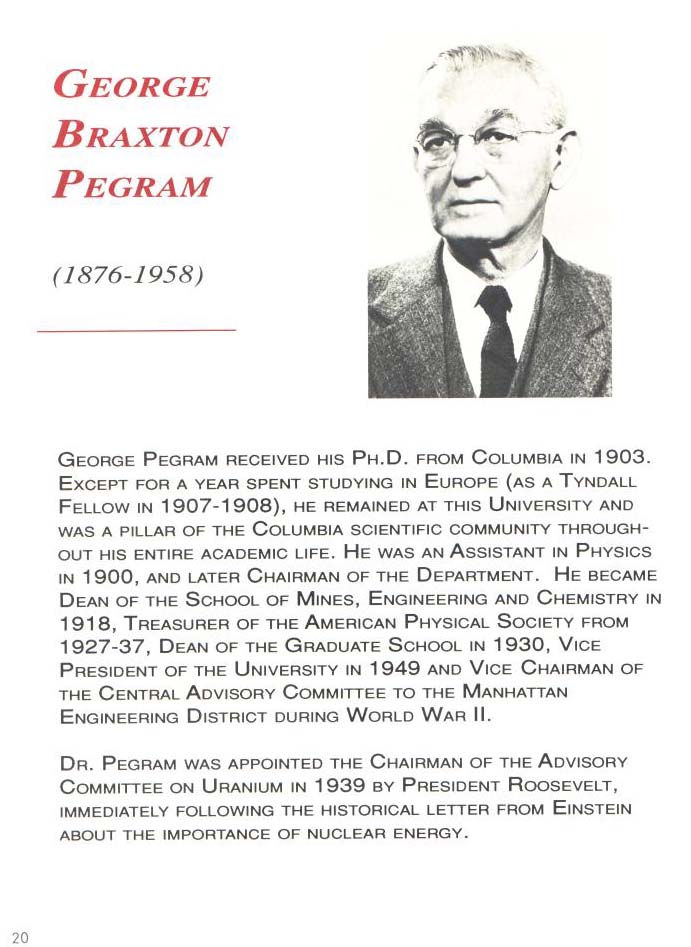
George Pegram
(who assembled the original Manhattan Project team), as well as junior
faculty who would later become well-known physicists, such as
C.S.
Wu and Bill Havens
(both of whom I worked for in my student days),
James Rainwater, Eugene Booth, and Richard Present.
The following is taken from a narrative,
Evolving from Calculators to Computers
on the
Los Alamos
National Laboratory History website (May 2003):
Calculations at Los Alamos were originally done on manually operated
mechanical calculators, which was not only laborious and time-consuming,
but the machines broke down frequently under heavy use. The only
one who could fix them promptly was
Richard
Feynman (Nobel Prize in Physics, 1965), which some thought was not the
best use of his time. "Dana Mitchell, whom Laboratory Director J. Robert
Oppenheimer had recruited from Columbia University to oversee procurement for
Los Alamos, recognized that the calculators were not adequate for the heavy
computational chores and suggested the use of IBM punched-card machines. He
had seen them used successfully by Wallace Eckert at Columbia to calculate the
orbits of planets and persuaded [Stanley] Frankel and [Eldred] Nelson to order
a complement of them.
"The new IBM punched-card machines were devoted to calculations to simulate
implosion, and Metropolis and Feynman organized a race between them and the
hand-computing group. 'We set up a room with girls in it. Each one had a
Marchant. But
one was the multiplier, and another was the adder, and this one cubed, and all
she did was cube this number and send it to the next one,' said Feynmann. For
one day, the hand computers kept up: 'The only difference was that the IBM
machines didn't get tired and could work three shifts. But the girls got tired
after a while.'"
May 1939:
Columbia University's Baker Field (at 215th Street in upper Manhattan)
was the site of the
nation's
first televised sports event, a baseball game between Columbia
and Princeton universities, May 17, 1939, broadcast by NBC. (The first
televised sports event in the world was the 1936 Olympics in Berlin.)
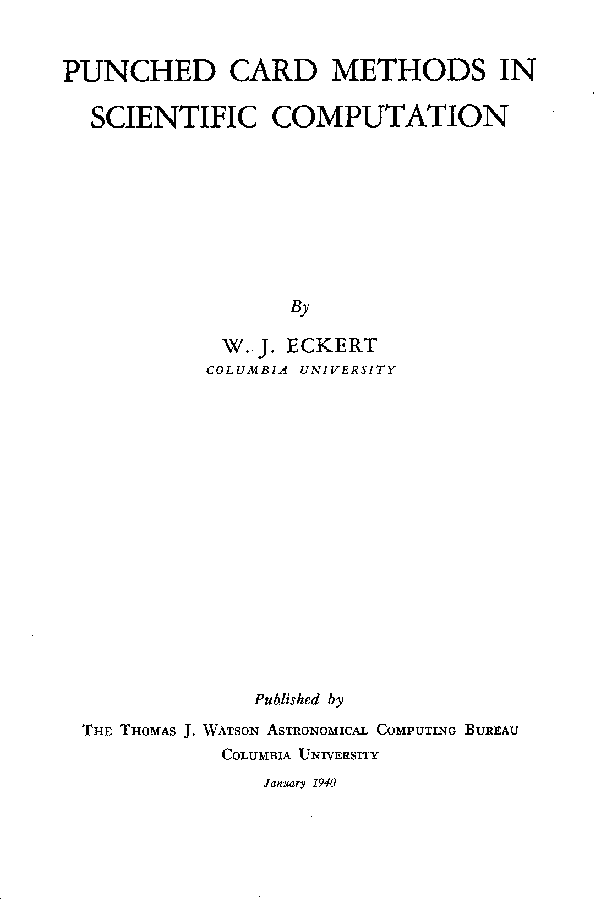
Prof. Eckert publishes Punched Card Methods in
Scientific Calculation [50], the first
computer book. The book "...covers nearly a decade of work by W.J. Eckert
on astronomical calculations by machine processes. Based on firsthand
experience, it describes a gamut of large calculations that could best be
carried out by machines able to process numbers in machine-readable form.
These calculations include the construction of mathematical tables, the
numerical integration of differential equations, numerical harmonic analysis
and synthesis, and the solution of simultaneous equations. ... Often known
as the 'Orange Book' on account of the vividly colored covers of its original
printing, Eckert's book was the bible of many workers engaged in punched card
computing at the IBM Watson Scientific Computing Laboratory at Columbia
University and elsewhere. ... The process of carrying out the integration of
the differential equations is explained in detail. It involves the use of the
multiplier, tabulator, and summary punch in concert, guided by the setting of
a calculation control switch, which acts as a master controller advancing
automatically ... through twelve positions
(Figure 2). This control switch ... was a precursor
of sequential control in electronic
computers" [78].
"Some of the better-known builders of the early computers, like
Vannevar Bush
at MIT, J. Presper Eckert of the ENIAC, and Howard Aiken at Harvard, got their first introduction
in the famous orange book" [90]. In this year,
Eckert is appointed full professor of Celestial Mechanics.
March 1940:
Eckert leaves Columbia for an assignment with the
US Naval Observatory,
which he rapidly "computerizes" to create accurate air and sea navigation
tables for the US Air Corps and Navy using the techniques he devised at
Columbia [17], which allowed design and production
of the
Air Almanac in record time; the first issue of
the Air Almanac appeared December 1st, 1940, produced entirely by machine
methods. The
Astronomical Computing Bureau in Pupin, now
directed by
Jan
Schilt (but with Eckert still running the show from Washington), was
assigned to tasks for the looming war, such as ballistic firing tables, and
trajectory calculations, and later, design calculations for the
B-29
sighting station [57,59] —
"Mathematics Goes to War" [9]. Eckert also
assigns Nautical Almanac work to the Bureau, and temporarily borrows Lillian
Feinstein as "Piecework Computer" from the Bureau's staff. The Bureau
existed until 1951, but by 1948 most of its work had migrated to Watson Lab [88].
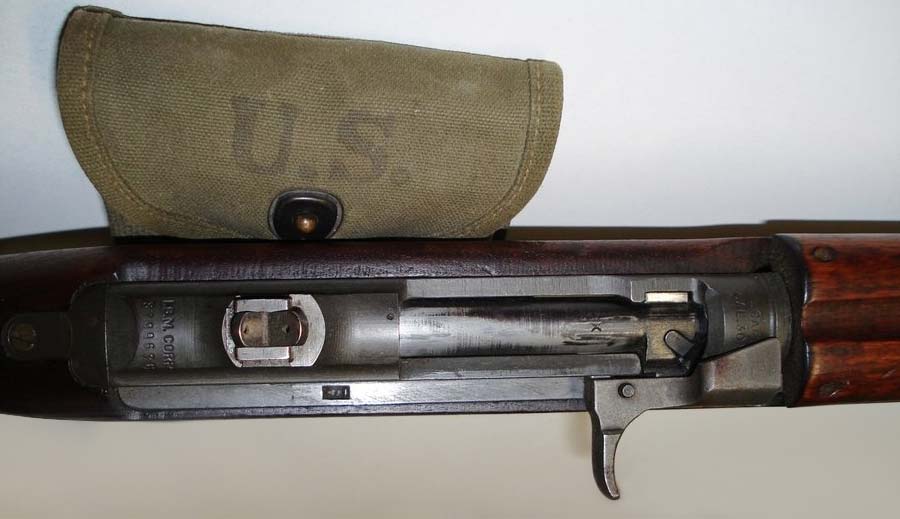
IBM played a large part
in the Allied war effort, supplying all of its products to the US government
at 1% over cost, and taking on new jobs as well, including manufacture of
nearly six percent of all M1 rifles
[see closeups with IBM logo]
(other non-weapons companies made M1s too, including National Postal Meter
Company, General Motors, Underwood [typewriters], and Rock-Ola, a maker of
juke boxes). IBM also evacuated the families of employees in England to
Toronto [85] and assisted the families of US
employees who had gone off to war and held jobs open for all its returning
veterans [57].
According to allegations in 2001 [48] (having
nothing to do with Columbia), IBM might also have played a part in
Germany's war effort, in which widespread use was made of punched-card
technology manufactured by IBM's German subsidiary,
Dehomag[47], which had been
taken over by the Nazi government in 1940. The degree of IBM's involvement
with Dehomag after that is at issue; see
the Wikipedia page.
1940:
The Bureau of Radio Research (founded at Princeton University in 1937),
headed by Paul Lazarsfeld, moves to Columbia University, with quarters at 15
Amsterdam Avenue. In 1949 it would move to 427 West 117th Street, and about
1953 to 605 West 115th Street, the other half of the former Parnassus Club, across from the present Watson Laboratory. Its name would change to
the Bureau of Applied Social Research (BASR) in 1944, and it would live
on until 1977, when it was replaced by the Center for Social Sciences (later,
the Lazarsfeld Center for Social Sciences, and still later the
Institute for
Social and Economic Theory and Research). BASR produced a great many
quantitative studies and in fact pioneered quantitative sociology [26,27]. From its inception in
1940, the Bureau was in possession of IBM tabulating
equipment. "IBM machines" and "tabulating charges" as well as IBM
supplies appear on each annual budget [28]). The
BASR's 1954-56 budgets show $6000 per month for IBM equipment rental, which
suggests a rather massive capacity (compare with the Registrar Proposal of 1957). The BASR Report on
the Year 1957-58 says "The Bureau also maintains its own IBM data
processing laboratory in University Hall, and other IBM equipment for use by
students in Fayerweather Hall. The machine facilities of the Watson
Scientific Computing Laboratory are available for certain highly technical
problems not readily solved by the Bureau's own equipment" [28]. Pnina Stern, who worked at the Bureau until its
demise, says "When I got there in 1966 BASR had [at 605 W 115th Street] IBM 024 card punches, an 085
Collator, an 082 Sorter, and a 403 Accounting Machine that could be wired to produce
cross tabulations and other good stuff. Fred Meier was a whiz at wiring up
this machine. You had to wire it for each thing you wanted to do. It printed
out cross tabulations and maybe even some other statistics. Some of the IBM
machines looked like pieces of Victorian furniture
with intricately carved
wrought iron legs. Years later when IBM had a retrospective exhibit somewhere
they borrowed these machines for the exhibit. Maybe Fred M. owned them at
that time. As for computing, someone at Columbia — possibly at BASR — wrote
the very first computer cross tabulation program. I believe it was written in
IBM 7090 machine language and you had to give it numerical coded instructions.
It was not very user friendly. I think it may have been written by Peter
Graham." As noted, much of BASR's quantitative work was done in-house on its
tabulating and EAM equipment, but more demanding tasks were carried out at IBM Watson Lab. By 1961, BASR was (with Physics and
Chemistry) one of Columbia's leading users of computing, and one of the
reasons the Columbia Computer Center was created [29]. After 1963, BASR was a major user of the Computer
Center mainframes, sending work-study students with massive decks of cards to
the SSIO Area on campus on a regular basis to run jobs.
"We always duplicated the cards before we sent them over because we had
visions of the students dropping the IBM card boxes and the cards floating
across Broadway." In the 1970s, HP terminals were
installed for interactive access to mainframe applications like SAS and SPSS.
The Directors of BASR were Paul Lazarsfeld (1940-1951), Charles Glock
(1951-1957), David Sills (1957-1960), Bernard Berelson (1960-61), and Allen
Barton (1962-1977).
20 December 1944:
Since the 1930s, Columbia had been IBM's main contact with scientific
computing and the academic community [38], and to carry
forward this relationship, Thomas J Watson,
a Columbia Trustee since 1933, wrote to Columbia Provost (and Acting President
1945-47) Frank Diehl Fackenthal [28] agreeing to
establish a computing research laboratory at Columbia University as soon as
space can be secured: "I am confident that this laboratory will be another
major forward step in the long and productive cooperation between the
[sic] IBM and Columbia University."
1945:
The US Naval Observatory produces the 1946 edition of the
Air Almanac in what is arguably the
first instance of "computer"-driven typesetting, using the newly delivered
programmable card-driven table printer that
had been specified by Professor Eckert in 1941, but whose production was
delayed by the War.
6 February 1945:
"To give all possible aid to the war effort and to promote peace through
scientific development, a computing laboratory has been established at
Columbia University by International Business Machines Corporation. The new
laboratory, to be known as the Thomas J. Watson Scientific Computing
Laboratory at Columbia University, will serve as a world center for the
treatment of problems in the various fields of science, whose solution depends
on the effective use of applied mathematics and mechanical
calculations" [23].
Columbia Professor Wallace J. Eckert, now head of
IBM's new Pure Research Department, is appointed to head the laboratory.
Temporarily housed on the tenth floor of Pupin Hall, staffed and paid for by
IBM, with the staff holding faculty appointments and teaching credit courses
in math, physics, astronomy, and other fields. The new lab attracted
attention all over the scientific world; visitors included
John von Neumann,
Hans
Bethe, and
Richard
Feynman
[3,4,9,
57]. The lab was named for IBM's Thomas J. Watson
(Senior), a Columbia Trustee (it is said that Watson is the one who nominated
Eisenhower as Columbia President in 1948, but he meant
Milton! [17]).
Within a year, Watson Lab would become the third most powerful computing
facility in the world, after the US Army's Aberdeen Proving Ground and
Harvard University, and would remain so for some years.
Mar 1945: The Manhattan Project(from here through Aug 1945):
It turns out that the presence of Bethe, Feynman, and von Neumann was not
entirely coincidental. Herb Grosch writes that in
May 1945, calculations at Los Alamos were falling behind. As Dr. Eckert (who
had just hired him to work at the new Watson Lab) explained, "They came to IBM
for help. Mr. Watson and John McPherson
[IBM engineering director]
... thought immediately of the
Astronomical Bureau at Columbia, but it is
heavily engaged in fairly high priority work for another part of the Army*, and
really has no room for physical expansion anyhow. It has only two 601s and an old 285 fixed-plugboard
tabulator, and there is hardly any room to move." New space was needed,
and found, for Watson Lab's first task: solution of temperature-pressure
equations for completion of the A-bombs
at Los Alamos [57] (more about this
HERE and much more in
Chapter 03 of Dr. Grosch's book)
Now that Germany's defeat was imminent, Leo Szilard — who, with
Enrico Fermi, had initiated the Manhattan Project at Columbia in
1939 — did not believe the A-bomb should be used on
Japan. He obtained a
letter of introduction to President
Roosevelt from Albert Einstein so he could present his case against dropping
the bomb. A preliminary meeting with Eleanor Roosevelt was set up for May
8th, but the President died on April 12th and Szilard was blocked from
contacting President Truman.
*
The Army work referred to was for the Army Air Force: test data reduction
for a GE aerial fire control system that later went into production for the
B-29
bomber [57].
8 May 1945:
VE Day, Germany surrenders, the war in Europe ends.
Jul 1945:
Szilard wrote and circulated a petition among his
fellow scientists at the University of Chicago against the use of atomic
weapons and asking President Truman not to use them on Japan. He also sent
copies to Oak Ridge and Los Alamos for circulation (the Los Alamos copy was
buried by Groves and Oppenheimer). Szilard's petition went through several
drafts; the first one (July 3rd) included the following text:
Atomic bombs are primarily a means for the ruthless
annihilation of cities. Once they were introduced as an instrument of war it
would be difficult to resist for long the temptation of putting them to such
use. The last few years show a marked tendency toward increasing
ruthlessness. At present our Air Forces, striking at the Japanese cities, are
using the same methods of warfare which were condemned by American public
opinion only a few years ago when applied by the Germans to the cities of
England. Our use of atomic bombs in this war would carry the world a long way
further on this path of ruthlessness.
Subsequent drafts were toned down a bit but made the same recommendations.
The Oak Ridge
petition urged that "before this weapon be used without restriction in the
present conflict, its powers should be adequately described and demonstrated,
and the Japanese nation should be given the opportunity to consider the
consequences of further refusal to surrender". Watson Lab staff who were
performing calculations for Los Alamos were unaware of the petitions or,
indeed (with only two exceptions, Eckert and Grosch, the only ones with
security clearances), that the calculations were for a
bomb [59]. In any event, the petitions never
reached the President.
6 Aug 1945:
Hiroshima: "Now we knew what we had been working
on" [57]. A second A-bomb was dropped on
Nagasaki August 9th. More than 200,000 people died from the two blasts.
Was the atomic bomb needed to end the war with Japan? The US Strategic
Bombing Survey [94]
says, "Based on a detailed investigation of all the facts and
supported by the testimony of the surviving Japanese leaders involved, it is
the Survey's opinion that certainly prior to 31 December 1945, and in
all probability prior to 1 November 1945 [the earliest possible date
for an invasion], Japan would have surrendered even if the atomic bombs had
not been dropped, even if Russia had not entered the war in the East, and
even if no invasion had been planned or contemplated."
It was known by the Allies [95] that
since May 1945, Japan had been making peace overtures to the Soviet Union,
both in Tokyo and Moscow. This was done at the direction of the Emperor,
who had told his envoy, Prince Konoye, to "secure peace at any price,
notwithstanding its severity" [93]. All
indications (e.g. in Henry
L. Stimson's diaries*) are that the US deliberately prolonged the war,
first by delaying the Potsdam Conference and then by striking the "Emperor
can stay" clause from the Potsdam Declaration, until the bombs could be
dropped, and that this was done to intimidate the Soviet Union.
Former President, Supreme Commander of Allied Forces in Europe, and
Supreme Commander of NATO Dwight D. Eisenhower wrote in his memoir,
Mandate
for Change, (Doubleday 1963), “The incident took place in 1945
when Secretary of War Stimson visiting my headquarters in Germany, informed
me that our government was preparing to drop an atomic bomb on Japan. I was
one of those who felt that there were a number of cogent reasons to question
the wisdom of such an act . . . But the Secretary, upon giving me the news
of the successful bomb test in New Mexico, and of the plan for using it,
asked for my reaction, apparently expecting a vigorous assent. During his
recitation of the relevant facts, I had been conscious of a feeling of
depression and so I voiced to him my grave misgivings, first on the basis of
my belief that Japan was already defeated and that dropping the bomb was
completely unnecessary, and secondly because I thought that our country
should avoid shocking world opinion by the use of a weapon whose employment
was, I thought, no longer mandatory as a measure to save American lives. It
was my belief that Japan was, at that very moment, seeking some way to
surrender with a minimum loss of 'face'.”
FDR's and Truman's Chairman of the Joint Chiefs of Staff and of the Combined
US and British Chiefs of Staff Admiral William D. Leahy wrote in his
book I Was
There (Whittlesey House, 1950),
“It is my opinion that the use of this barbarous weapon at Hiroshima
and Nagasaki was of no material assistance in our war against Japan. The
Japanese were already defeated and ready to surrender because of the
effective sea blockade and the successful bombing with conventional
weapons.”
*
Note: The link to the Stimson diaries seems to go stale from time to
time, and the selection of entries seems to change; as of mid-August 2005,
some independent copies can be found
HERE
and
HERE.
For further detail and analysis see:
"Hiroshima: Historians
Reassess" by Gar Alperovitz, Foreign Policy (Summer 1995)
No. 99: 15-34, esp. Part 4,
"The Preferred Option."
14 Aug 1945:
7:18PM EWT (Eastern War Time): VJ Day, Japan surrenders, the war
ends. The formal surrender was signed September 2. (The US
and many other countries were on permanent daylight savings time throughout
the war; in the US this was called War Time — Eastern War Time, Central War
Time, etc.)
Oct 1945:
Watson Laboratory establishes itself as the cataloger of mathematical
tables on punched cards, meaning that any scientist who needed to obtain
machine-readable tables of mathematical functions such as sin, cos, tan, log,
squares, cubes, inverses, roots, Bessel functions, Lagrangean interpolation
coefficients, spheroid functions, grid coordinates, and so forth, could find
out from Watson Lab where to get them [28].
Of course Watson Lab itself was a major producer of such tables. As these
card decks were freely shared, they might be regarded as an early form
of freeware.
Nov 1945:
Watson Laboratory moves from Pupin Hall (where it had been since
February 1945) into 612 West 116th
Street (PHOTO) (MAP), a former fraternity
house vacated by the War, purchased by IBM and renovated as a laboratory (PHOTOS) with offices and teaching facility [4,9]. A "simple bronze plaque"
was affixed to the building reading "WATSON SCIENTIFIC COMPUTING LABORATORY
at COLUMBIA UNIVERSITY" [28] (WHERE IS THE
PLAQUE NOW?). Watson Lab's early equipment included two experimental
one-of-a-kind relay calculators, two Aberdeen relay
calculators, plus conventional calculators and tabulators inherited from the Astronomy Lab, and
within a couple years would grow to include a IBM 602
and the first IBM 604. Read more about renovation
and equipping of this building in Chapter
09 of the Grosch book. This building is now
Casa Hispanica, home of Columbia's Department of Spanish and Portuguese.
Herb Grosch confirms that Chock Full O' Nuts was open for business on the
southwest corner of 116th and Broadway in 1945, where it remained a fixture
for decades.
Chock Full O' Nuts sightings go back as far as
1944.
When did it close? Mid-1980s I think. A few other establishments that were
here in 1945 are still open in 2004:
Tom's Restaurant (1936), Columbia Hardware (1939), and
Mondel's Chocolates (1943).
Eckert describes Watson Lab to an IBM Research Forum [89]. "It is the intention of the Laboratory to make these
facilities available to any scientist from any place in this country or
abroad, regardless of whether he is connected with a university or a
laboratory. This is our fundamental principle: problems will be accepted
because of scientific interest and not for any other considerations.
Scientific interest can be of two kinds: the problem may interest us because of
the complexity of the calculation, or it may be considered on the basis of
scientific merit of the result rather than the means. While routine
computation is not the aim of the Laboratory, a considerable amount of it will
be done on worthy causes."
Later he describes some experimental machines: "Among the digital machines
which have been developed over the years, there are several based on the relay
network; we now have two of these at the Laboratory [note: he is not
referring to the Aberdeens, which had not yet been
delivered] ... The first one was developed with the idea of seeing how
few relays it is possible to use to produce a calculating machine. This
machine is built on the standard IBM key punch. ... The control is very
convenient... a combination of control panel and master card or program card.
Thus, instead of having twenty control panels for a complicated job, you can
set it up to use one control panel and twenty master cards."
This might very well be the birth of software. The control
panel, which stays in place for the duration of the job, defines the
"instructions" of the machine, in a sense its "microprogram". The sequence
of operations (invoking instructions from the control panel) is on a deck
of cards. It is a PROGRAM. A few years later, IBM would build a
Card Programmed Calculator, and from there it is
a short step to the first general-purpose stored-program computer, which,
arguably, was IBM's SSEC, built under Eckert's
direction (in fact the SSEC was completed before the CPC).
The significance of card programming can't be overstated. A deck of
control cards (along with the specifications for the corresponding
control-panel wiring, at least in these early days) documents the program. It
can be printed, read, modified, duplicated, mailed, kept for future use, and
run again on different data sets. Much of this might be said of plugboards
too, provided you don't have to recycle them, thus destroying the program.
But most important, a program deck can be any length at all, thus allowing
extremely complex problems to be run — problems that might have required a
thousand plugboards. (Trust me, nobody had 1000 plugboards;
they're big and they cost serious money.)
1946:
Watson Lab produces Ephemerides of 783
Minor Planets for 1947 (formerly Kleine Planeten),
the annual asteroid listing for the year 1947, about 100 pages of tables
showing the position of each body at 8-day intervals, calculated on
the Watson Lab Aberdeen Relay Calculators, the
world's fastest computing devices at the time.
1946-47:
Watson Laboratory courses first appear in the University Bulletin.
These are graduate-level credit courses. Among them are courses in
computing machinery and numerical analysis taught by
Wallace Eckert and Herb
Grosch believed to be the first computer science courses offered by
any university [40] or, more precisely, "the
first such courses in the world fully integrated into a university
curriculum and continuing year after year" [59].
Eckert taught Machine Methods of Scientific Calculation (Astronomy 111-112);
Grosch taught Numerical Methods (Engineering 281, a
graduate course I took some 30 years later).
The next year L.H. Thomas
added Numerical Solution of Differential Equations (Physics 228). By 1951,
the curriculum also included EE 275 (Electrical and Electronic
Components of Digital Computers, taught by Watson Lab's Robert M. Walker)
and Physics 255 (Separation of Variables in Mathematical Physics,
L.H. Thomas). Most of these courses included hands-on laboratory sessions
with the Watson Lab machines or (later) the
SSEC downtown.
Graduate-level hard-science courses used the Watson Lab machines too,
including some taught by regular Columbia faculty such as
George
Kimball (Chemistry), among whose students were
Margaret Oakley Dayhoff
(Columbia Ph.D. 1948, the founder of computational biochemistry),
Isaac Asimov
(Columbia B.Sc 1939, M.A. 1941, Ph.D. 1948), and
Maurice
Ewing (Oceanography), the founder of
Lamont-Doherty Earth
Observatory, whose students included
Frank Press (Columbia
M.A. 1946, Ph.D. 1949), who went on to become President of
the US National Academy of Sciences and Chairman of the National Research
Council. More about these courses in the 1951 entry.
1946-47:
It was also during this period that Watson Laboratory began to provide
computer time to Columbia researchers at no charge. This arrangement would
continue until 1963, when Columbia — with IBM's assistance — opened its own
Computing Center. Perhaps the first non-Watson-Lab Columbia researcher to use
the Watson Lab machines was
Martin
Schwarzschild, who used the Aberdeen Relay
Calculators for astronomical
calculations [57].
1947:
Nevis
Laboratory, the Columbia Physics department's primary center for study of
high-energy and nuclear physics, founded in Irvington, New York. There is a
long history of computing here too, which needs to be told, including the many
and varied connection methods to Columbia's Morningside Heights campus.
Sep 1947:
The Association for Computing
Machinery (ACM) is born at a meeting of sixty computer enthusiasts at
Columbia University's Havemeyer Hall [57].
Originally calling itself the Eastern Association for Computing Machinery,
attendees of its first meeting included Columbia Professor Wallace Eckert (who arranged the space), Professor
Hilleth Thomas (Thomas-Fermi Model), Byron Havens
of Watson Lab (chief engineer, NORC),
John Lentz of
Watson Lab (designer of the first "personal computer"),
Watson Lab's Herb Grosch,
and "everybody's favorite computer person",
Grace Hopper.
The meeting was convened by computer pioneer and antiwar activist
Edmund
Berkeley. (CLICK HERE to view documents from the
first ACM meeting.)
Nov 1947:
The "Watson Laboratory Three-Week Course on Computing", taught by
Eric Hankam, the first hands-on computer course (PHOTOS AND DETAILS), in which scientists from all
over the world learned how to apply computing machines to problems in their
disciplines. The course was given here eleven times a year until 1957 — by
which time it had been attended by 1600 people from 20 countries — when it
was moved to IBM education centers around the world [9].
The IBM Selective Sequence Electronic Calculator (SSEC) (PHOTOS AND DETAILS) was designed and built by IBM in
1946-47 under the direction of Columbia Professsor Wallace Eckert and then
installed in IBM HQ at 590 Madison Ave in January 1948. This is one of the
first large-scale electronic computers, and the first machine to combine
electronic computation with a stored program and capable of operating on its
own instructions as data. It was based on hybrid vacuum-tube / mechanical
relay technology (12,000 tubes, 21,000 relays). Fully assembled, it was 140
feet long (60 + 20 + 60 U-shape) (some sources cite different dimensions) and
was used initially for calculating lunar coordinates. Reporters called it a
Robot Brain. Its massive size and configuration established the public
image of computers for decades to come (as in this 1961 New Yorker
cover by Charles Addams).
Aside from solving important scientific problems, it was used
by students of Columbia's pioneering
Machine
Methods graduate course — part of the world's first computer science
curriculum, initiated here in 1946.
Popular descriptions of computers as "brains" and analogies with the human
nervous system were so rampant in the late 1940s and early 50s, that
George Stibitz,
developer of the wartime
Bell Relay
Calculators, was prompted to write an article cautioning against such wild
tales as the one in the Feb 18, 1950, Saturday Evening Post, which
said that computers were subject to psychopathic states which engineers cure
by "shock treatments" consisting of the application of excessively large
voltages [79].
The SSEC was programmed from Watson Lab on standard IBM cards converted to
input tapes on a special device called the Prancing Stallion [57]. Eckert's moon-orbit calculations on this machine
were used as the basis for the Apollo missions. It was dismantled in 1952.
One of the SSEC's programmers was
John Backus (PHOTO AND DETAILS), who had two
Columbia degrees and was at Watson Lab in
1950-52 [9], and who went on to design FORTRAN,
the first high-level machine-independent programming language, and
Algol,
the first block-structured language, and is also known for
Backus Normal Form (BNF), a meta-language for describing computer
languages. Before FORTRAN, almost every computer program was written in
machine or assembly language, and therefore was not portable to any other kind
of machine.
The idea of a high-level programming language was the second step on the road
to user friendliness. The first step was the assembler. Such notions
were not without controversy. John von Neumann, when he first heard about
FORTRAN in 1954, was unimpressed and asked "why would you want more than
machine language?" One of von Neumann's students at Princeton recalled that
graduate students were being used to hand assemble programs into binary for
their early machine. This student took time out to build an assembler, but
when von Neumann found out about it he was very angry, saying that it was a
waste of a valuable scientific computing instrument to use it to do clerical
work. (These anecdotes from a biographical sketch of von Neumann by John A.N. Lee, Dept of Computer
Science, Virginia Polytechnical Institute.)
Another SSEC programmer was
Edgar
F. Codd, originator of the relational database model
[40] (Communications of the ACM, Vol. 13,
No. 6, June 1970, pp.377-387), who was at Watson Lab from 1949 to 1952
[9] and died
April
18, 2003.
1948-54:
The IBM Personal Automatic Calculator was designed by John Lentz
and built between 1948 and 1954 on the top floor of
Watson Lab. Among its innovations was a magnetic
drum for auxilliary storage, automatic positioning of the decimal point,
and the first video terminal. When it was finally
announced in 1956 as the IBM 610 Autopoint Computer,
it was the first "personal computer". [4,9,17]
1949:
Lamont-Doherty
Geological Observatory, Columbia's earth science facility, founded in
Palisades, New York, by Professor Maurice Ewing, a user of the Watson Lab
equipment. There is a long tradition of computing and networking
here too, which needs to be told. See [39] for an
excellent history (albeit with nothing on computing) of what is now called the
Lamont Doherty Earth Observatory.
Herb Grosch devises Grosch's Law
"Computing power increases as the square of the cost" in Watson Lab
[57,p.131].
Dr. Grosch leaves Watson in 1951 to start an IBM bureau in Washington DC.
May 1950:
Edmund
Berkeley (who had founded the ACM at Columbia University in 1947, and
who had written the first book about computers for a general audience
[62] in 1949), William
Porter (a West Medford MA mechanic), and two Columbia graduate students,
Robert Jensen and Andrew Vall, build
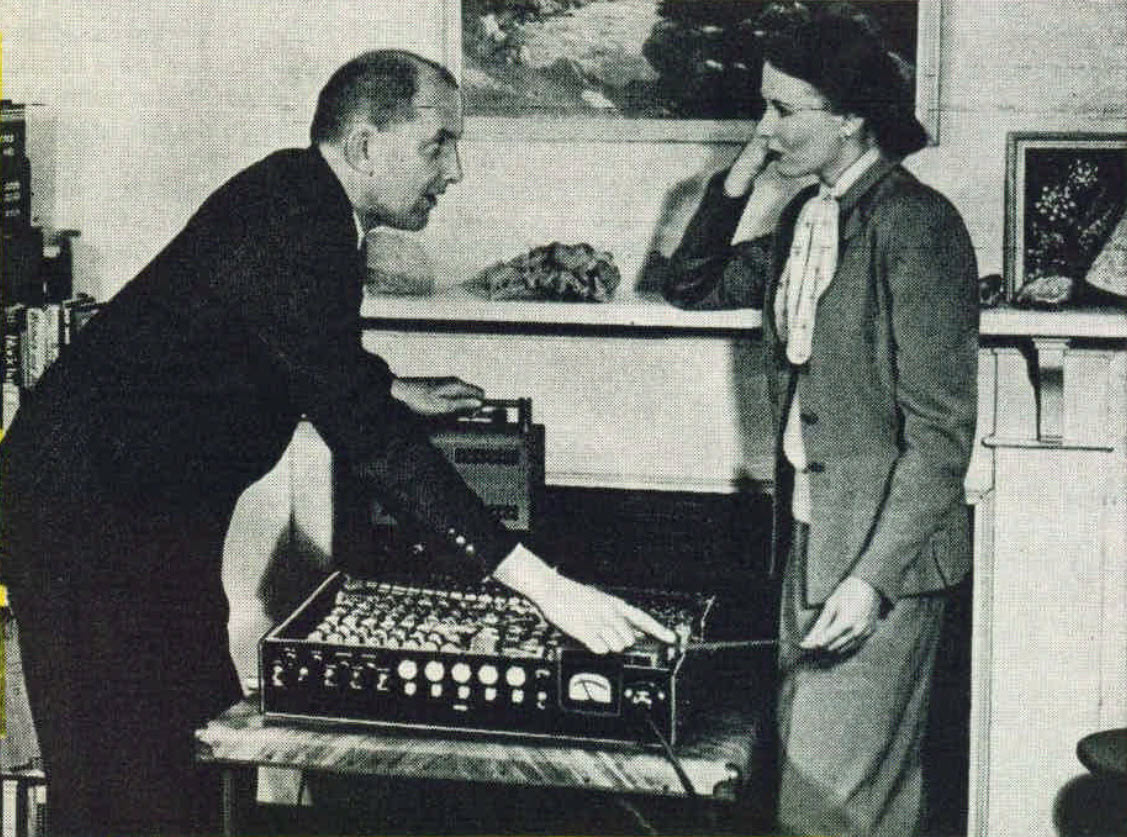
Simon [63], a simple "model electronic brain"
(PHOTO), costing about $600 to construct. Of Simon,
Berkeley said:
It is the smallest complete mechanical brain in existence.
It knows not more than four numbers; it can express only
the number 0, 1, 2 and 3.
It is "guaranteed to make every member of an audience feel
superior to it."
It is a mechanical brain that has cost less than $1,000.
It can be carried around in one hand (and the power supply
in the other hand).
It can be completely understood by one man.
It is an excellent device for teaching, lecturing and explaining.
1951:
CLICK HERE to view some 1951 Watson Lab
Astronomy, Engineering, and Physics course listings from the 1951 Columbia
Catalog. Herb Grosch
recalls [57]:
"... a little about the courses we gave - that is, at Columbia. These were
all part of the regular university curriculum, listed in the appropriate
catalogs - we had our own special one also - and open to any student with the
prerequisites and the money. We did however encourage our own juniors on
116th Street and at the SSEC to attend as auditors if they did not want to
sign up for credit. ... Most of our offerings were unusual. [Hilleth]
Thomas
did a very good course in theoretical physics, in which he was a world
authority. I did a celestial mechanics course one year; it was really a
mélange of spherical trig, practical and theoretical astronomy (meaning
time and position determination, and orbit computing), and brief mentions of
planetary and satellite mechanics. ... None of my subtopics were taught
anywhere else at Columbia; the astronomy department was solid astrophysics.
And they were what was needed for astronomy calculations. ... Most of our
value as teachers, however, came from the computing courses. Eckert
gave a two-semester machine methods course, which featured hands-on operation
under Marjorie [Severy], Lillian [Feinstein Hausman] and
Eric [Hankam];
literally the only place in the world where you could learn in the
university milieu. ... I did numerical methods - classical interpolation
and matrix arithmetic and integration of differential equations. Most of my
examples, and assigned exercises, were at desk calculator level, but I
lectured from the point of view of machine operation ... This was one
semester, once a year, and Hilleth did an advanced course featuring partial
differential equation solutions and error propagation, every other year. ...
My classes were small; this was a very esoteric discipline indeed in the
Forties. But I had interesting students .. like [Stan] Rothman and [Bill]
McClelland and [John] Backus and Don Quarles. ... So
it was my side of the house that carried the teaching. It went on into the
Fifties, always as part - but a small part - of the Columbia offerings. The
hands-on side of the Machine Methods course was unique, not just because of
the equipment but because real use-'em-every-day men and women were running
it."
1952-3:
Watson Lab #2.
When construction of the NORC (see Dec 1954 entry)
exhausted available space in the petite
116th street building (and because
still more space was required by Watson Lab's new physics program), IBM
purchased the building at 612 West 115th Street
(PHOTO)
(MAP), formerly a "women's
residence club", gutted and renovated it, equipped it with physics
laboratories, and relocated to it.
The new Watson Lab was occupied in September 1953. A time clock was
installed (you can still see its mounting today)
but nobody on the professional staff used it (as a corporation, IBM was
obsessed with efficiency but the Watson Lab scientists were notorious
noncomformists). The time clock and all wall clocks were controlled centrally
and set automatically by an IBM master clock (like the
one in the first Watson Lab); the IBM wall clocks in Watson Lab kept on
ticking until about 1999. The Penthouse was outfitted as a lunchroom with a
small kitchen, where coffee and tea could be made and soup or beans heated up;
it had the atmosphere of a World War II canteen, and was the favorite place
for people in different groups or floors to talk and thesis advisors to meet
with their students [17].
Some space was retained in the 116th Street building:
offices for PhD students, classroom space,
and a machine room [4,9,17,66].
The former women's residence on 115th Street was in fact the
Parnassus Club,
a boarding house for young women — students at the
Julliard School of Music, which was then
only a couple blocks away on the current
Manhattan School of Music site
(MAP)
or at Barnard College, a block north
(MAP),
for semi-professional performers. It operated from 1921 to 1955.
CLICK HERE for stories and photos.
The North-facing building was gutted by IBM in 1953 to create Watson
Laboratory. According to a resident, "we all had to move out because some
official body at Columbia had decided the neighborhood had become too
dangerous for us; at least that was the reason given in a letter we all
received that spring" (this refers to the second Parnassus Club
building, which remained in operation until 1955). (Miss Macmillan's 1965
obituary states, however, that the Club was closed due to her poor health.)
The exterior of 612 West 115th Street retains its
original look but the inside contains no trace of the Parnassus Club. In
July 2003, a resident from 1950 appeared on the doorstep with her daughter
and grandson; she was showing them where she used live. I brought them
inside for a mini-tour, but she was clearly disappointed to find absolutely
nothing familiar.
The original Watson Lab at 612 West 116th Street was designed by Thomas Nash
and built in 1906 as the Delta Phi fraternity house. The current Watson
building at 612 West 115th Street was originally an apartment building
called Duncan Hall, designed in 1905 by the prolific firm of Neville &
Bagge, originally built and owned by a Frank Woytisek. The building across
the street, No. 605, was also an apartment building by Neville & Bagge,
called the Bellemore, built in 1903 and originally owned by Moses Crystal
[12]. It was home to the Bureau of Applied Social
Research (BASR) from 1955(?) until it was demolished
about 1970.
1953:
The IBM 650 announced.
This was the world's first mass-produced computer and eventually Columbia
had several of them
[see
IBM page].
1954:
200th anniversary of Columbia University.
1954:
Invention of the cursor:
As part of his work on the first "personal computer" (the
IBM 610), Watson Lab's John Lentz designs a
small video terminal — keyboard and tiny screen — for control and data entry.
in which the "current position" was indicated visually by what came to be
known as a cursor. Lentz applied for a patent on this concept; the
patent was finally granted in the early 1970s.
Dec 1954:
The Naval Ordnance Research Calculator (NORC) (PHOTOS AND DETAILS), the first supercomputer and
the most powerful computer in existence at the time (and for the next ten
years), becomes operational. It was designed here beginning in 1950 and
built in Watson Lab #2, 612 West 115th Street.
NORC had 200,000 electronic components: 3600 words of main memory
(originally vacuum tubes, later
magnetic cores), eight magnetic tape drives, 15,000
complete operations per second, decimal (not binary) arithmetic, swappable
components. Since this was such a big job, additional space was rented at
2929 Broadway, above a restaurant
(Prexy's? Home of the Educated Hamburger?) for building some of the
parts, which were brought to Watson Lab for assembly and eventual startup and
operation. John von Neumann was a team member and gave the
inaugural address on
December 2, 1954. NORC was moved to the Naval Proving Ground, Dahlgren,
Virginia, in 1955 and remained operational until
1968 [4,12,17].
1955:
Stan Poley of Watson Lab creates one of the first programming languages, SOAP
(Symbolic Optimizing Assembly Program), for the NORC, which allowed the use of
symbolic names for machine instructions and data[123].
Around this same time, John Backus made a
presentation to IBM and John Von Neumann
of his idea for a high-level machine-independent programming language which
would become FORTRAN[123].
30 Aug 1955:
The first of two IBM 650 computers is installed
in the first-floor machine room of the
original Watson Lab building on 116th
Street. The 650 was a vacuum-tube-logic decimal computer with 2000 words of
ten decimal digits each plus sign [31] stored on drum
memory. Each had a 511 card reader and a 403 printer. They ran for two
shifts a day, eventually supporting over 200 Columbia research
projects [29]. A 17 Nov 1955 memo from
Dr. Eckert to J.C. McPherson
states that the 650 was installed on August 30 and "much of the work of the
computing group has been concerned with its incorporation into the
Laboratory program of research and instruction." The 650s were soon used in
a series of intensive courses on computing, with [31]
as a text; these courses later resulted in a book: Joachim Jeenel,
Programming for Digital Computers, McGraw-Hill, 1959 [64]. Initally, all programming was in assembly language
punched on cards; eventually languages such as FORTRAN were available. The
legendary SOAP assembler for the 650 was written at Watson Lab by Stan
Poley.
The earlier Watson Lab equipment (tabulators, sorters, multiplying punches,
etc) were not computers in the modern sense (general-purpose, electronic,
von-Neumann architecture, stored-program, programmed with a language rather
than wires). NORC had been the first such computer at Columbia but, although
it was used in one Columbia PhD dissertation [65],
it was not open to the Columbia community for general use [61]. Thus the IBM 650 was the first computer available
to Columbia researchers and we have a 50th anniversary on
August 30, 2005.
Eric Hankam points out [66] that this was not as
dramatic a turning point as it might seem, since the same types of problems
had been solved on non-stored-program calculators at Columbia over the
preceding two or three decades; at the time, the 650 was seen as just another
incremental step in calculator design. However, the 650's power, flexibility,
and ease of use relative to the wire- and card-programmed machines
(601,
Aberdeen,
602,
604,
CPC,
607)
attracted a flood of Columbia research projects. By 1961, 650s were also
installed at Nevis Lab, Hudson Lab, and ERL. As demand oustripped capacity,
it became increasingly clear that Columbia would need a computing facility of
its own, big enough to serve the entire university.
Sep 1956:
Watson Lab begins to award fellowships to Columbia graduate
students [9], including Ken King, who would
become the first Director of the Columbia Computer Center, and Joe Traub,
who, after obtaining his Columbia PhD in 1959, and a distinguished career at
Bell Labs and heading the Carnegie-Mellon CS Department, would become first
Chair of Columbia's Computer Science Department [9, 21] (prior to that, computer
science courses were in the Electrical Engineering department). Watson
Fellows had their own offices at 612 West 116th
Street, that were "appointed with fireplaces and leather sofas, a good
stipend, and unlimited computing time" [38].
Approximately 15 percent of Columbia physics graduate students in the 1950s
did their thesis work at Watson Lab [38].
1956-70:
Watson Lab concentrates on solid state physics. This not-insignificant
period, resulting in many publications, patents, and a Nobel Prize, is
described at length in [4] and
[9]. (Richard L. Garwin of Watson Lab conducted
experiments with Leon Lederman of the CU Physics Department confirming the
suggestion by
C.N. Yang
of Princeton and T.D. Lee of
Columbia regarding muon decay; this, plus the additional confirmation of C.S. Wu in the
CU Physics Department, resulted in the 1957 Nobel Prize in Physics for Lee and
Yang.) Also in this period, Seymour Koenig's research on low-temperature
breakdown of germanium and its application to semiconductors; Triebwasser's
research on microscopic and thermodynamic properties of ferroelectric crystals;
Tucker's research on semiconductors at liquid helium temperatures with
application to biomedical instrumentation [38].
1957:
A proposal was submitted by Columbia University to the National Science
Foundation to install an IBM 701 in Watson
Laboratory, since many of Columbia's research projects now demanded more power
than was offered by the 650s (the sub-microsecond circuits used in the 701
were designed at Watson Lab [37]). While the proposal
was under consideration the 701 was superseded by the
Model 704, so the proposal was
changed to ask for a 704. $145,000 was awarded, but it turned out the
704 was larger than the 701 originally proposed and would not fit in Watson
Lab, so the money had to be returned unused [28] and
IBM Watson Lab continued to cater to all of Columbia's academic computing
needs at its own expense. Projects that couldn't be accommodated by Watson
Lab's Model 650s were allowed to use the more powerful IBM 700-series computers
downtown at IBM headquarters [36].
Oct 1957:
IBM proposes the following arrangement to Charles Hurd, University
Registrar, for student statistics, course registration, permanent records,
and fee accounting:
Less 20% educational discount, plus supplies of cards, coding sheets, control
(plugboard) panels, trays, and brackets totalling another $1810.25. Note: the
links for some of these items are to later (but similar) models. Required
personnel are one supervisor/programmer, two machine operators, and three key
punch operators. Source: AIS archives. This arrangement characterizes
the nature of administrative data processing at the time. There is no true
computer, only unit record equipment and tabulating
machines capable of rudimentary statistics (sums) and report generation.
According to letters of Charles Hurd, 1957-1960 [28],
the funding was found from "the expected decline in enrollment of Public Law
550 [Korean War] veterans" (Veterans Readjustment Act of 1952); in his
proposal to Provost John Krout (29 Oct 1957), Hurd says "I am sure that you
are aware that IBM equipment has been used in the Registrars' Offices in
colleges and universities. large and small, public and private, for many years
and has proven to be a most valuable and efficient tool. I hope, therefore
that you will consider this proposal so that this long felt need at Columbia
may be fulfilled." In other words, registration was still completely manual
in 1957. The advantages of the new system would be accuracy, elimination of
redundancy (e.g. each student writing the same information on many different
forms, up to 23 of them) and transcription errors, and the ability to generate
reports, including class lists, plus ID cards and mailing labels, not to
mention "keeping up with the Joneses", e.g. NYU, where
punch-card registration had been in use since at least 1933.
The new equipment was installed in 307 University Hall and the new system
phased in from 1959 to 1961 (with an IBM 407 installed
rather than a 403 at an extra $250/month).
Computerized registration was seen by some as a step towards
dehumanization of students and turning universities into factories, a major
factor in the rise of the Free Speech
Movement at the University of California at Berkeley, which set the
stage for campus activism, protest, and rebellion throughout the 1960s,
including Columbia in 1968:
"There is a time when the operation of the machine becomes so odious, makes
you so sick at heart, that you can't take part; and you've got to put your
bodies upon the gears and upon the wheels, upon the levers, upon all the
apparatus and you've got to make it stop."
According to Steven
Lubar of the Smithsonian Institution, this sentiment, although directed
primarily at the economy and war machinery, extended to the punched-card
equipment in the registrar's office: "Berkeley protestors used punch cards as
metaphor, both as a symbol of the 'system'--first the registration system and
then bureaucratic systems more generally--and as a symbol of alienation... 'I
am a UC student. Please don't bend, fold, spindle or mutilate me.'"
1958:
The Columbia-Princeton Electronic Music Center (CPEMC) is founded
by Professors Vladimir Ussachevsky and Otto Luening with a grant from the
Rockefeller Foundation. It is the first center for electroacoustic music
in the USA and has a long association with Columbia computing. Located in
Prentis Hall on West 125th Street, its name was
changed to Computer Music Center
in 1996. Some tales have been collected and contributed by
Peter Mauzey of Bell Labs, a
Columbia graduate and former faculty member with a long association with the
Electronic Music Center; CLICK HERE to read them.
Sep 1958:
The equipment of Columbia University IBM Watson
Scientific Computing laboratory is listed [21] as:
Standard punched card equipment
A comprehensive selection of basic punched card machines, with many
special devices. The equipment includes keypunch, sorter, reproducer, and
printer.
Wired-program calculators
The group of electro-mechanical and electronic calculators include the
Type 602-A
Calculating Punch,
the Type 607 Electronic Calculating Punch,
and the Card-Programmed Electronic Calculator.
The 607 is an automatic electronic calculator with pluggable program control
and 146-digit storage capacity, capable of performing most programs at the
rate of 100 cards per minute.
Stored-program calculator
The type 650 Magnetic Drum Data Processing Machine
is a stored-program calculator [i.e. computer] which can store 2000 ten-digit
words, read 200 cards a minute, punch 100 cards a minute, and perform
approximately 100 multiplications a second. The memory capacity can be used
interchangeably for numerical data and operating instructions, which permits
complete flexibility in the elaboration of instructions by the machine itself.
Plus special-purpose devices such as a card-driven lithography printer,
a card-controlled astronomical photograph analyzer, as well as a machine
shop and physics and chemistry laboratories, a highly specialized library,
and access to the big IBM 700 series computers downtown.
Although FORTRAN
— the first high-level, machine-independent programming language
— marked a great leap forward in user friendliness, and was probably
available for the 650 by this time, it's worth remembering how one ran a
FORTRAN job in the early days. First you punched your FORTRAN program on a
key punch machine, along with any data and control
cards. But since the 650 had no disk, the FORTRAN compiler was not resident.
So to compile your program, you fed the FORTRAN compiler deck into the card
reader, followed by your FORTRAN source program as data. After some time, the
machine would punch the resulting object deck. Then you fed the FORTRAN
run-time library object deck and your program's object deck into the card
reader, followed by any data cards for your program. Your program would run
and results would be punched onto yet another deck of cards. To see the
results, you would feed the result deck into another machine, such as an IBM 407, to have it printed on paper. The computer itself
had no printer.
By the early 60s a certain division of labor had become the rule, in which
"system analysts" would make a flow chart, programmers would translate it to
code, which was written by hand on "coding forms" that were given
to key punch operators to be punched on cards. The coding forms and card
decks were passed on to "verifiers" who repunched the source code to catch and
correct any mistakes, signed off on the job, sent the deck to the operator to
await its turn at the computer. Hours later the results would be delivered to
the programmer in the form of a printout and the cycle would continue.
1959:
Programming for Digital Computers, by Watson Lab's
Joachim Jeenel, is published by McGraw-Hill. From the Preface: "The contents
of this book were developed from material presented to courses on programming
for stored-programming calculators held at Columbia University.
Prof. W.J. Eckert, Director of the Watson Scientific Computing Laboratory at
Columbia University, initiated the writing of the book and suggested the scope
of the text." Jeenel also taught Columbia graduate courses such as
Astronomy 111-112: Machine Methods of Scientific Calculation (with Eric
Hankam).
1959:
An IBM 1620 is installed in Watson Lab to
supplement the 650s, and is used in Columbia research projects.
1959:
The Provost's office commissions a study to develop a plan for the future
of computing at Columbia. In view of the failure in 1957 to produce the space
needed for a state-of-the art computer that NSF was willing
to pay for, the study concluded that a new computer center building was
needed [28]. The central administration concurs and
begins to seek sources of funding. Dean Ralph S. Halford, a Chemistry
professor, Dean of Graduate Faculties, and (perhaps most to the point) Vice
Provost for Projects and Grants is in charge. Dean Halford and the University
Committee on Cooperation with Watson Laboratory, which then included
Professors Wallace Eckert (Astronomy and Watson Lab), Samuel Eilenberg
(Mathematics), Richard Garwin (Physics and Watson Lab), and Polykarp Kusch
(Physics, Nobel Prize 1955), plan the future Computer Center.
Algol-60
developed by CU-and-Watson-Lab-alumnus John Backus
and others. This was to be the most influential computer language of all
time, the parent of all other block-structured languages, including (among
many others) Java, C, C++, Pascal, PL/I, and Ada, but not including such
lovable mavericks as LISP, APL, Snobol, and Forth.
IBM Watson Laboratory offers the following Columbia courses in computing:
GSEE 287, Digital Computers I: Programming and Operating.
Astronomy 111-112: The use of High-Speed Digital Computers for Scientific
Calculation.
Engineering 281:
Numerical Analysis for Research Students in Science and
Engineering.
Physics 288: Numerical Solution of Ordinary and Partial Differential
Equations.
Management Games (Industrial Engineering): Market simulations.
Plus short courses in IBM 650 and Fortran programming and the Share
Operating System (SOS) [29,31].
Besides the Watson Lab courses, the Electrical Engineering Department offers:
EE 104: Electric Circuits IV: Digital Circuits and Computing Systems.
GSEE 267: Digital Systems and Automata.
GSEE 269: Information Theory.
GSEE 274: Electrical Analogue Computers.
GSEE 275-276: Logical Design of Digital Circuits.
GSEE 288-289: Digital Computers II and III: System Analysis and Synthesis.
EE 277-278-279: Pulse and Digital Circuits.
May 1961:
Dean Halford writes a Proposal to the National Science Foundation
for Support of a Computing Center to be Established at Columbia
University [29], and shortly afterwards
the NSF approves $200,000 over the first two years [121]. IBM pledges $125,000 for fellowships, and another
$500,000 is obtained from an anonymous donor [30] (who might have been Thomas J Watson Sr or another
Columbia Trustee). Two IBM 7090 mainframe computers are to be acquired at
an education discount, which requires Columbia to devote at least 88 hours
per month for purposes of instruction and unsponsored academic research.
With funding lined up, Dean Halford proposes the new Computer Center to the
University Committee on Finance. The need for a Computer Center was clear.
By this point, about 220 University research projects were being handled on
IBM's computers in Watson Lab and the demands had long since exceeded the
Lab's capacity, resulting in the rental of IBM computers by the following
university sites:
An IBM 1620
at Lamont Doherty Geological Observatory.
An IBM 650 at the Electronics Research Lab of the Engineering School.
The primary needs were in high-energy physics (then accounting about 200 hours
of IBM 650 time per month), sociology (50 hours/month), geophysics (100 hours
of IBM 709 time per month), biochemistry, and
chemistry. "A school of computer science will evolve gradually at the
Computing Center, with an independent line of administration as an educational
organ of the University". The IBM Watson Lab courses would be taken over by
the Computing Center. The initial staff was to be 15 persons covering two
shifts, including a branch librarian [29]. The
Computing Center was to serve "those whose research is sponsored and those
whose research is not. It has been created with the aim of serving all of the
needs of both groups without preference toward either one, with the
expectation that its cost would have to be met in substantial part by the
University" [36].
Sep 1961:
The Columbia Committee on Finance approves Dean Halford's proposal
to create a Computer Center, based on funding pledges from IBM and NSF
[28].
1961-63:
Construction of the Computer Center building. Total cost:
$800,000 [30] (PHOTOS, STORIES NEEDED).
2 Jan 1963:
Columbia University Computer Center (CUCC) opens.
Dr. Kenneth M. King, who received his Columbia Ph.D. in Physics as a Watson
Fellow under Prof. L.H. Thomas
[17] and had managed Watson Lab's computing
facility [20], was the first Director, with a joint
appointment to the faculty of Electrical Engineering and Computer Science
[V5#3]. The original location was 612 W 116th
Street (the first Watson Lab), which still housed the IBM teaching
facility as well as Casa Hispanica, but the new underground Computer Center building between Havemeyer
and Uris halls was soon ready with machine rooms for equipment and offices for
staff ("more space than we'll ever need"). The Computer Center initially
housed the following equipment [10]:
IBM 7090 (PHOTOS AND STORIES) with 32768
(32K) 36-bit words of magnetic core storage. This was
the first commercial computer based on transistor, rather than
vacuum tube, logic (a vacuum-tube
709 was originally
planned [29],
but the 7090 appeared just in time). It is in the direct line of descent from
Watson Lab's NORC. The price was $1,205,000.00 after
60% IBM educational allowance, amortized over 5 years (Letter of John
A. Krout, VP of the University, 4 Oct 1961, AcIS archives). Included:
Two data channels.
Two IBM 1301 Model 2 disks,
total capacity: 9320000 36-bit words.
Access to computing was batch only. Users brought decks or boxes of
punch cards to
the operators and came back the next day to retrieve their cards and the
resulting listings from the output bins. Jobs were paid for out of grants or
funny money. There were no user terminals and there was no user access to the
machine room, which was staffed around the clock by
operators and a shift supervisor.
"During the first six months of the Center's operation, [the 7090] logged
907.55 hours on 158 projects for 101 members of our academic staff. Downtime
ran to thirty hours or so monthly during the first two months, as expected in
a new installation, but fell to acceptable levels for the remainder of the
period. About forty-five percent of the time used was furnished to projects
sponsored by government contracts." [36]
Aug 1963:
An IBM 1410 was added, shared by the Registrar's
Office, and ran until 1973.
IBM Watson Lab continues operation at 612 W 115th Street, concentrating
now on life sciences and medicine.
Among many results from this period was improved analysis of Pap smears, and
there was an alliance with the Urban League Street Academy program,
educating community kids in science.
1965:
Photo gallery of the Columbia Computer
Center in 1965: The IBM 7094/7040 Coupled System, the Hough-Powell Device
(HPD), Tape Library, Key Punch / EAM room. In 1965 the Computer Center
had 25 employees, all housed in the Computer Center building: the director
(Ken King), 8 operators, a librarian, and 15 technical people. Besides the
IBM 7094/7040 system there was also an IBM 1401 and a
1410 computer in the machine room, as well as the unit
record equipment listed in the January 1963 entry.
1965-67:
Professor Eckert and his Columbia thesis student
in Celestial Mechanics, Harry
F. Smith (who was also on the Watson Lab
technical staff as lab manager in the 116th Street
building, helping students (often of Eric
Hankam) debug their IBM 650 programs, assisting
students in other ways with other computers in the building, and responsible
for closing up the lab at 11pm each evening) refine the theory of the moon --
the equations that describe and predict its motion — to unheard-of accuracy,
improving upon the calculations performed by Eckert in 1948-52 on the
SSEC [78] by adding additional terms: 10,000
equations in 10,000 unknowns, 100,000,000 possible coefficients. The
calculations were programmed in assembly language by Smith, who devised
efficient methods for solving these sparse equations with so many
small-divisor terms that were a potential source of instability, and run on
the Computer Center's IBM 7094 over a period of three
years [65,87], resulting in
220 pages of lunar position tables published in Astronomical Papers of
the American Ephemeris, plus several papers in astronomical journals
(see Eckert's bibliography). This was the
culmination of Eckert's life's work. Smith is now on the Computer Science
faculty at University of North Carolina.
1965:(Month?)
The Administrative Data Processing Center (ADPC) was established.
The newly established Computer Center was primarily for academic
computing (in those days, research and very little instruction).
Administrative computing was done independently by individual departments
such as the Registrar's Office and the Controller's Office. The new,
separate ADPC drew programmers from the Registrar's and Conroller's offices
as well as the Computer Center, including York Wong, previously the Computer
Center programming supervisor, who became director of the new administrative
group. The equipment (IBM 1401s and
IBM 1410s) was in the Controller's office in Hogan Hall
on Broadway and in
Prentis Hall, 632 West 125th Street, with
applications written in AUTOCODER [20].
(The story of administrative computing prior to 1965 is still largely
a mystery. Dorothy Marshall, VP for ADP, upon her retirement in 1988, wrote a
reminiscence in the ADP Newsletter [11],
where she recalls that "ADP actually originated in the Controller's Office,
the first [administrative] department to use a punch-card system. The first
large system ADP acquired is still with us — the Alumni Records and Gift
Information System (ARGIS) — and I recall
very clearly the accusations that we were using all the tape drives and all
the system resources at the expense of the University researchers." (This was
to be a recurring theme.) Unfortunately Dorothy did not mention dates or
places.)
(Coincidentally, some clue was provided on the front page of the Columbia
University website, 18 Jan 2001, and subsequent University Record
article
[18] announcing the
retirement
of Joe Sulsona, shift supervisor of the Computer Center machine room,
after 42 years: "Sulsona, a New York City native, went from high school
directly to the military. When he returned from Korea in 1957 at the age of
23, he studied the latest in computing, gaining experience as a board
programmer, which involved the manipulation of
wires and plugs on a computer
board, much like the original telephone operating systems. He was hired at
Columbia's alumni faculty records office as a machine operator and spent his
time punching out data cards using a small keypunch machine.")
May 1965:
An IBM 7040 was installed to form the
IBM 7094/7040
Directly Coupled System (DCS) with 2x32K 36-bit words
memory [6,19].
The 7040 freed the 7090 from mundane input/output and scheduling tasks so its
power could be focussed on computation.
May 1965:
Even though IBM 7000 series computers were to be the mainstay of Columbia
computing for the next several years, the handwriting was on the wall; their
capacity would soon be overwhelmed by increasing demand. IBM proposes the
new System/360 architecture for the Computer Center on May 21. This was
to be the basis for IBM's mainframe line into the next millenium. Unlike
previous IBM mainframes, the 360 was available in a range of compatible
models, from small slow machines such as the Model 20 (suitable mainly for
printing decks of cards) to the Model 92
supercomputer that they proposed to Columbia, with many in between (IBM's
proposal was for a coupled Model 92 and Model 75). Each model could use the
same peripherals, and 360-series computers could also be connected to each
other in various ways and even share main memory. The 360/92 that IBM
proposed, with its thin-film memory technology, turned out to be too
expensive. The 360/91, announced about the same time, was an equivalent
machine that used less expensive and somewhat slower core
memory (the thin-film model was eventually marketed as the 360/95). To
achieve supercomputer speeds, the 360/9x models pioneered new concepts such as
instruction pipelining and lookahead, branch prediction, cache memory,
overlap, and parallelism. The 360/9x series is optimized for scientific
calculation and lacks a hardware decimal arithmetic capability (which is
simulated in software). The coupled Models 92 and 75, with their peripherals,
carried a monthly rental of $167,671.00 (after a 36% educational discount),
which works out to over two million dollars a year, and about 22 million over
what would be the 11-year lifetime of the system. [32]
Nov 1965:
The blackout of 1965. The lights went out for about 12 hours
in Manhattan, most of the US northeast, and large parts of Canada.
Interestingly, I can't unearth any stories about the blackout's impact on
computing at Columbia. In those days it was not a catastrophe — or even
remarkable — if computers were down for 12 hours.
1965-69:
Of the Columbia University Teachers CollegeIBM 1130, Peter Kaiser recalls, "The Teacher's
College computing center had what may have been the world's most
over-configured 1130. It had not only a 2250 but also
the additional hardware to make an 1130 into a 1500, the special version
designed for interactive instruction; and therefore it could also drive
multiple 2260-like terminals. The then director of
the TCCC had ambitions use the 1130/1500 for research to improve on the
Minnesota Multiphasic Personality Inventory by timing the responses to
the test administered through one of these terminals. When I left to take a
real-world job in 1969 that project was in abeyance."
1966-67:
Ken King offers a course in "computer appreciation". Demand was high
and half of the 60 students who tried to enroll had to be turned away.
Popular computer courses are also offered this year in Engineering,
Mathematics, and Sociology [38].
1966:
Watson Lab gets one of the first APL terminals (an IBM 1050), hooked
to the M44/44X system in Yorktown, which is a 7044 computer coupled with a
7055 computer that controls a number of terminals. "This system is used to
simulate a number of 44X computers, including one per 1050 terminal; the 44X
is the computer seen and programmed by the user operating from a 1050
terminal. It is primarily for users of FORTRAN IV" but the 1050 can also
be used to run "APL (Iverson Language) programs" on Yorktown's 360/50
(Iverson worked at the Yorktown facility) [88].
APL soon becomes quite popular, both at Watson Lab and CUCCA. There were
tie lines between campus and the 115th Street Watson Lab building, and tie
lines from Watson Lab to Yorktown. The Watson receptionist (Annie Hall)
could, upon request, connect the two, allowing campus
2741 data terminals to access APL at Yorktown [106].
Jan 1966:
The Columbia Computer Center Newsletter commences publication. It would
continue in one form or another until November 1994.
Oct 1966:
ADPC staff moves to Casa Hispanica at 612 West
116th Street (around the corner from Chock Full O' Nuts and a couple doors
west of Campus Deli), sharing the small building with the Department of
Spanish and Portuguese [20] and the IBM teaching
facility [17]. Staff from the academic Computer Center
also begin to move into this tiny building. Soon it is crammed beyond
capacity and offices spill over into neighboring apartment buildings (520 W
114th Street plus a long-gone building on West 117th Street, itself (the
street) also just a memory).
1967:
Dr. Seymour H. Koenig (PHOTO), who received his
Ph.D. in Physics from Columbia in 1952 (and his BS in 1949) and joined Watson
Lab the same year, is appointed its Director [9]. By
this time Watson laboratory has RJE access to the big IBM 360s in Yorktown,
but when then the link is down they use the CUCCA facilities [9].
1967:
Library automation begins about here. I remember some form of
automation starting in the 1966-68 timeframe when I was a student assistant in
Butler — there was already a Library Systems Office on the Mezzanine then; I
used to schlepp decks of cards and listings back and
forth to the Computer Center for them. By 1967, circulation was already
computerized in Central Circulation and Burgess-Carpenter (where I worked at
the time), and a collaboration was underway with Stanford and the University
of Chicago regarding cataloging and acquisitions [24];
perhaps this was the origin of RLIN. CLICK HERE
for more about library automation.
AND
HERE.
Mar 1967:
In response to IBM's May 1965 proposal, and after lining up sources of
funding for it, the Computer Center announces its plan to upgrade and
modernize its equipment and to unify academic and administrative computing in
a Computer Center Newsletter article written by (of all people) President
Grayson Kirk [V2#2-3]. In the first stage, October 1967, an IBM 360/50 was rented [19,
20,
24], to allow the 7090-to-360 conversion to begin.
Aug 1967:
Second stage: An IBM 360/75 was purchased
and linked to the 360/50. In the ensuing months, staff learned OS/360, JCL,
and some new programming languages like PL/I and SNOBOL, as well as new
versions of old ones like WATFOR (the University of Waterloo version of
Fortran), and then quickly began to modify the operating system for purposes
of accounting and resource limitation, and also to add support for IBM 2741 and other terminals that were not supported yet
and then to create a conversational monitor called CLEO to allow job
submission and retrieval from terminals [24].
Aug 1967:
The US government mandates a chargeback scheme for computer time,
launching the Computer Center on a neverending series of increasingly baroque
charging schemes involving "hard currency" and "funny money." The first
such scheme was a simple $150 per hour of CPU time (which, in those days, was
the same thing as elapsed time), with some grandfathering of existing
unsupported projects (Letter of Warren Goodell, 1 Aug 1967, AcIS archives).
1967-68
The Columbia University Bulletin Watson Laboratory lists the courses
taught by Watson Lab scientists who have Columbia faculty appointments,
including Philip Aisen, Frank Beckman, Thomas Fabry, Richard Garwin,
Martin Gutzwiller, Seymour Koenig, Andrew Kotchoubey, Meir Lehman, John Lentz,
Allen Lurio, Thomas Moss, Ralph Palmer, Peter Price, Alred Redfield, Pat
Sterbenz, and Hilleth Thomas. After the Computer Center opened
in 1963, Watson Lab is no longer the focus of computing; its course
offerings concentrate on biology, mathematics, and physics, but several
computing courses are still listed, including EE E6827x-E6828y Digial
Computer Design (Prof. Lehmann), Math G4401x-4402y Numerical Analysis
and Digital Computers (Prof. Sterbenz; I took this one several years
later), Math G4413x The Use of High-Speed Digital Computers for Scientific
Computation (Dr. Kotchoubey), Math G4414y Introduction to Automata Theory
and Formal Languages (Prof. Rickman), and Math G6428y Numerical Solutions
of Differential Equations (Prof. Thomas).
1968:
The Department of
Electrical Engineering
becomes the Department of Electrical Engineering and Computer Science. This
was to be the locus for computer science instruction and research until the
establishment of a separate
Computer Science Department
in 1979.
Jan 1968:
Raphael Ramírez starts work as an operator in the machine room.
CLICK HERE to read his reminiscences of the
early days.
Feb 1968:
The IBM 7040 was removed
[19]. CLEO, an interactive terminal monitor developed
here, was released and announced [24].
Apr-May 1968:
The Columbia student uprising of
1968. Computer Center management and some of the staff feared the
worst — invasion, occupation, wreckage -- but nothing happened to the
Computer Center at all. Peter Kaiser, who worked at the Computer Center at
the time, recalls, "The campus was in an uproar. So was much of America,
and the political powers that be were frightened and acting ugly; I have
vivid memories of the NYC police lined up ready to do violence to the
students who had occupied the administration building, which they eventually
did by invading the building and beating up everyone in sight. Before the
police stormed the building, though, the computer center's administration
feared that the center itself would be occupied, so there were worried talks
about what to do if that ever happened. In the event it didn't happen, but
the uproar delayed the delivery of the 360." Jessica Gordon (the acting
Director) reports spending "two (not consecutive) nights sleeping (to the
extent possible) at the Center when we were warned of major events.... One
day I was standing on College Walk with a group of others
[including Raphael Ramírez] watching the
special Tactical Police [Force]..., jack-booted thugs, marching onto campus.
As they passed, one of them turned to us and said 'Hi there, sports fans!'".
As a participant, I have no recollection of the Computer Center ever being
considered as a target for occupation or attack, nor does the Computer
Center's Annual report for 1967-68 make any mention of it
[24]. However, there might have been a picket line
afterwards, since picket lines went up in front of most academic buildings.
Jul 1968:
ADPC joins the Computer Center with its new director (yet to be
chosen after York Wong resigned to resume his studies, but who would be Jon
Turner) reporting to Ken King. Now there is One Computer Center. Conversion
of ADP applications from IBM 1401/1410 to IBM 360 architecture begins; this
would take until 1973 [20]. Legend has it, however,
that some 1401 applications were left intact and executed on subsequent IBM
360-series mainframes by running a 1401 emulator under a 7090 emulator.
Warren Goodell's 14 June 1968 letter announcing the change stresses that even
more important than the consolidation of all applications on the new equipment
is "the prospect of increased freedom for interchange of ideas and techniques
of programming and systems analysis between staffs now separated by artifical
organization boundaries" (AcIS archive).
Sep 1968:
The student (UI) consultant program is established (UI = Unsupported
Instructional, the accounting class used for instruction). This program is
still active today. Students with knowledge of Columbia's computer systems
and applications are hired part-time to help users in the public areas.
Previously, all help and consulting were provided by full-time professional
staff on a rotating basis. Afterwards, full-timers continued to take their
turns, but now could devote more time to systems and applications development
and support. For more about the origins of the student consulting system,
READ THIS.
Dec 1968:
The IBM 7094, 1401, and 360/50 are removed. The 1401 is moved to the
Controller's Office [19]. IBM 360 equipment at the
end of 1968 consisted of [24]:
Model 75 CPU 2075 with 2.5 million bytes of memory.
With the exception of the last item, all model numbers are IBM.
Dec 1968:
One of the last gasps of the 7090/7094 system was an early example of
computer-generated film by a participant in the 1968 student
uprising, Denys
George Irving. Here (for as long as the
link lasts) is his film “69”.
Mar 1969:
The IBM 360/91 supercomputer (PHOTOS), one
of the first "third generation" computers and
the biggest, fastest (and probably most expensive)
computer on earth at the time, is installed
and coupled with the 360/75 [19]. Thus for the second
time in 15 years, Columbia is home to the world's fastest computer.
Only fifteen 360/91s
were made and four of them were retained by IBM for their internal use (other
360/9x sites included Princeton University and NASA Goddard Space Flight
Center on West 112th Street, just a few blocks away); the giant computer took
every inch of space in the Computer Center machine room... extensive
renovations had to made to accommodate its sprawling dimensions [20] (this is an understatement; in fact the Computer
Center entrance had to be demolished just to get it in the door and most
interior walls removed to make space for it [V2#6]).
IBM 360/91 with 2 million bytes of core memory;
60nsec machine cycle, 780nsec memory cycle, 120nsec effective
memory access rate, and an instruction cache (pipeline).
An additional drum.
All of the peripherals and equipment listed above for the 360/75.
The 360/75 became the Attached Support Processor (ASP) for the 91, essentially
a job scheduler and input/output controller, freeing the 91 for intensive
computation. I don't have a photo of our own Model 75, but
HERE is one from IBM.
Rather than rent the coupled 360/75/91 system as IBM proposed, the University
purchased it outright for seven million dollars [19],
to be amortized over seven or eight years (whether seven or eight was a point
of much contention, as it affected the chargeback rates levied upon research
grants; in fact it was in operation for more than eleven years; thus the
decision to purchase saved about fifteen million dollars). Of the total cost,
three million dollars was for the 360/91 CPU, memory, and second drum; this
was only half the list price due to the educational allowance that was
negotiated. The rest was for the 360/75 and its peripherals.
My own (perhaps
inflated) recollection is that the 360/91 covered about an acre of floor
space, most of which was devoted to full-size
cabinets each containing 16K of core memory, for a total of 2MB at about
8 square feet of floorspace (and about 48 cubic feet) per 16K, plus
surrounding floorspace for access, times 300. Each memory cabinet had a
glass door so you could look in and see each bit. All the disks, tapes, printers, Teletypes and everything else were in there too,
plus a vast tape library and specialized test equipment such as the BOM
(Byte Oriented Memory) tester.
All this was powered through a gigantic cast-iron motor generator weighing
who-knows-how-many tons (just the flywheel probably weighed a ton) putting out
400-some Volts 3-phase power, and cooled by distilled water trucked in by Deer
Park in big glass bottles in wooden crates. There was a control room in the
basement full of pipes, valves, gauges, pumps, and water jugs and a mammoth
cooling tower upstairs, venting half a million BTUs per hour into the
atmosphere (Alan Rice, a physics PhD student who was also a night-shift
operator, recalls an incident in which a heat alarm summoned the fire
department, who were ready to chop the machine up with axes until he talked
them out of it).
But the most impressive feature of the 360/91 was its control panel
(PHOTO). The operators used to turn off the room
lights and stare it at all night, waiting for the yellow "loop mode" light
came on (executing a loop in the pipeline without accessing core memory);
this was the sign of a well-crafted program.
(For more about loop mode,
READ THIS).
There was an ongoing bubble chamber experiment
in the machine room, which began in the 7094 days. Stereo photographs of
bubble chamber events were digitized using the High-Energy Particle Detector
(HPD) Flying Spot Scanner (HPD might also stand for Hough-Powell Device),
channel-attached to the 360/91, as was a very large
IBM 2250 video display with light pen (this terminal
alone was said to have cost $100,000), to allow scientists to interactively
select interesting events for analysis. This kind of work required physicists
to take the computer standalone for hours at a time, which became problematic
in later years when it was in demand by the general academic and
administrative computing population around the clock, and eventually the
experiment was discontinued: the science for which the computer was originally
acquired, and which provided much of the funding for it, was squeezed out by
the mundane requirements of instruction and administration.
The Stromberg-Carlson "on-line CRT display" was in fact a kind of graphics
plotter, about the size of a panel truck, originally in the machine room but
later parked outside in the hallway where it couldn't hurt the other
machines. Users created graphics images on the mainframe using a package
called IGS, wrote them to 7-track magtape, and had the operators feed the
magtape to the plotter. The images were projected on a screen inside the
box; a 35mm camera — no kidding — would take a picture of the
screen, and then somehow disgorge its film, which would be developed in
chemical baths, washed, and mounted as a slide that would eventually pop out
of the little output slot if all went well, which rarely was the case
— more often the machine leaked acid and/or caught fire. I found a
description in Wikipedia of a very similar, maybe the same
machine, HERE.
Later it was replaced by a Gould 5100 electrostatic
flatbed plotter that could produce 100dpi monochrome plots up to about 2
feet wide on pungent white roll-paper. Various plotting packages (including
one that Howard Eskin and I wrote in Fortran that fitted lines, curves, and
splines to data points) were available for it on the mainframe only.
Apr 1969:
The Columbia Computer Center develops, funds, and conducts a
6-month training course in computer
skills for 23 students from the local Black and Latino communities: key
punching and COBOL programming, with highly successful (96%) post-graduation
job placement and followup. (V4#20).
1 Oct 1969:
The first ARPANET
transmission took place between the University of California at Los Angeles
(UCLA) and Stanford Research Institute (SRI). Shortly thereafter
connections were made to the University of California at Santa Barbara and
the University of Utah. The ARPANET expanded to thirteen sites by January
1971, 23 sites by April 1972, and eventually grew into today's wordlwide
Internet. Membership was limited to US Department of Defense research
grantees until the early 1980s, at which time Columbia University would
join.
Dec 1969:
The IBM 1130 at Lamont Geological (now Earth)
Observatory in Palisades NY is connected to the Computer Center's IBM 360/91
by leased line for remote job entry (see Glossary),
partially replacing the previous
messenger service. This was a first in long-haul networking at Columbia
University (V4#23). (Peter Kaiser reports that Columbia Teachers College
also had an IBM 1130, and it was connected as an RJE station in the same
way prior to 1969, but since TC is just across 120th Street, it's not exactly
long haul networking.)
The IBM Watson Research Laboratory at Columbia University closes after
25 years of operation and a remarkable record of discovery and achievement.
The idea of corporate-sponsored multidisciplinary pure research pioneered
here had proven so successful that IBM built a new and much larger facility
in 1961 in
Yorktown Heights,
NY, with others
soon to follow in San José, Zürich, and elsewhere, but its research
headquarters remained at Columbia,
IBM's first
research laboratory, until 1970.
The Columbia Computer Center offices and the Columbia Purchasing Department
move to the Watson Lab building on 612 West 115th Street. The IBM-Columbia
relationship continues for some time afterward mainly in the form of faculty
appointments (in 1976 I took a graduate-level numerical analysis course in
the Engineering School from one such professor, Pat Sterbenz, author of the
book Floating-Point Computation). IBM left behind a machine
room with raised floor (back of 7th floor, where they had
their 1620), a fully equipped classroom (back of 1),
and lots of furniture including my 1940s-vintage Steelcase desk with metal
Physics Dept ID plate attached, dating from World War II when IBM moved into
Pupin. Steve
Bellovin recalls (Feb 2023) "At some point (I don't remember
when) the 1620 was replaced by an 1130; it had a bisync link to Yorktown."
Anyway, during its residence at Columbia University, IBM Watson Laboratory
staff had been granted 67 patents and published 359 articles in recognized
scientific journals [9].
Dorothy Marshall [11] writes, "The third floor
[of 612 West 115th Street]
was entirely without inner walls and contained large milling machines and
other noisy tooling machines, as well as pipes, hoses, and exhaust ducts
[but] the staff at Casa Hispanica felt they were extraordinarily crowded"
[so were glad for the additional space]. Nola Johnson writes in the same
issue, "I remember when we were packed like sardines in Casa Hispanica.
There would be three or four of us in one tiny room, complete with keypunch
and fireplace."
Until about the mid-1970s, CUCC staff submitted jobs from Watson (as they had
done from Casa Hispanica), and messengers went back and forth delivering
decks of cards and rolled-up printouts. In fact,
rolled-up printouts still arrived each day from a daily batch job that was
submitted decades ago and ran faithfully until 2004 when the Academic IBM
mainframe was retired; nobody knew exactly what the batch job did
or how to cancel it.
31 Jan 1971:
Professor Wallace Eckert, founder of the Watson
Scientific Computing Laboratory, attends the
Apollo 14 launch. The lunar orbit calculations upon which the Apollo
missions were based were done by Eckert at Watson Laboratory and on the
SSEC computer [42,92],
designed at Watson Laboratory under Eckert's direction in the
late 1940s, and later improved on the Lab's
NORC,
IBM 650, and
1620 computers, and
still later on the Computer Center's
IBM 7094. Eckert died six months later.
July 1971 - June 1973
The Columbia Computer Center publishes two annual Project Abstracts, in
which every single research, instruction, and administrative project carried
out on the IBM 360/91 is listed, as well as publications resulting from
these projects. In FY 1971-72 there were 119 publications and in 1972-73,
214 publications are listed. Each abstract is about 250 pages long; the
first one was generated by a SNOBOL program and printed on the 1403 printer;
the second one was typeset somehow using programs written by Computer Center
technical staff. I would call this the Golden Age of the Computer
Center, reflecting an unparalleled degree of collaboration between the
faculty and the Computer Center and the accomplishment of much work that
might well have had an impact on the real world — medicine, social
research, physical sciences, engineering, every field was represented.
Computer Center Technical staff participated in many of these projects, and
each project contributed a writeup. The projects themselves are
fascinating, about 100 pages of project description in each volume, about 5
projects per page.
Aug 3-5, 1971:
At the second annual Association for Computing Machinery (ACM) computer
chess championship at ACM 71 in Chicago, the Columbia Computer Chess
Program (CCCP) came in tied for 3-6 in a field of 8. CCCP was written by
Columbia student (and now CS faculty member) Steve Bellovin and CUCCA's Aron
Eisenpress, Ben Yalow, and
Andrew Koenig.
For more about the development of
CCCP, READ THIS.
Aug 1971:
Stanford University's Wylbur [49]
is installed on the 360/75, replacing a previous system called CRBE. Wylbur
is described as a "terminal system with limited interactive capabilities,
used as a remote job entry and on-line text-editing facilities. ... Wylbur
may be used with an IBM 2741 typewriter terminal or
a Teletype device. At present CUCC's Wylbur
does not support IBM 2260 terminals" (early video
terminals in the 2nd floor Computer Center terminal room); the Jan 1972
Newsletter announces their replacement with a "similar CRT device",
the Hazeltine 2000 (four of them) [V6#7]; these
could be used with WYLBUR. The IBM 2741 was a
Selectric typewriter embedded in a small-desk-size cabinet crammed with
electronics and wires, which communicated at 134.5 bits per second, half
duplex (when it was the computer's turn to transmit, it physically locked
the typewriter keyboard). There was also limited dialup access; in those
days this was at 110 to 300 bits per second
by acoustically coupled modems. More about
Wylbur below.
Oct 1971:
Ken King resigns as Computer Center Director and moves to
CUNY as Dean of
Computer Systems. Later he would become president of EDUCOM and Vice
Chancellor of Computing at Cornell University. Dr. Warren
F. Goodell, VP for Administration, Ken's boss, assumes Acting Director
position (V6#6), but since he was not on site, Jessica Hellwig (Gordon),
who had previously been on the IBM Watson Lab computing staff
[21] had day-to-day responsibility.
(Newsletters of the early 70s were devoted mainly to JCL hints and tips,
announcements of meetings and conferences, announcements of OS/360 upgrades,
explanations of cost accounting, and lists of unclaimed tapes in the tape
library — up to 6 pages of numeric tape IDs on one occasion (in the Earth
Week issue no less: V6#5, 15 Apr 1971) — plus the annual April Fools Issue,
usually featuring parodies of cost accounting.
Prior to 1971, they also contained abstracts or reports of research
projects, e.g. "Motivating Learning in Interracial Situations" (V5#2); "French
Business Elite Study", Jonathan Cole et al; "Transport and Fluid Mechanics in
Artificial Organs", Ed Leonard et al (V5#13); as well as Computer Science
Colloquia.)
Dec 1971:
Two IBM 2501self-service card readers
are installed in 208 Computer Center. "The use of self-service card readers
affords CUCC users much greater security for their decks at both the
submission and the retrieval points of running a job. Users will be able to
read in their own decks and keep them while the job is running —
thereby eliminating the risk of loss or mishandling of the deck by the
Center. Also, since input decks no longer need be left in the output bins,
the exposure of users' JOB cards -- and therefore their project numbers
— to anauthorized persons [some things never change] will be
significantly reduced. In addition to this increased security, the 2501's
will also provide greater efficiency since the user will be able to discover
and correct immediately such problems as off-punched
cards [hanging
and pregnant chad were evidently not an issue in 1971], rather than
having to wait for the job to be processed by the Center." (V6#year19) Also
on the second floor was an IBM 360 Model 20 used for printing card decks
onto fanfold paper, duplicating card decks, and so on; the desired function
could be selected with a dial. There was (and had been for some time) a key
punch room on the first floor. Later the Model 20 was moved to the key
punch room.
Apr 1972:
TPMON installed, allows terminal lines to be switched among different
applications such as Wylbur (and what else?) rather than dedicated to
a specific one.
Sep 1972:
IBM OS/360 21.0 installed (V6#33).
1973:
The following was posted by Arthur T. Murray
on alt.folklore.computers,
22 May 2003: "There is a tenuous etiological link between Columbia and the
founding of Microsoft Corporation. Here in Seattle WA USA, a Columbia
Ph.D. grad in astronomy, Dr. James R. Naiden — now in his late eighties --
around 1973 was teaching Latin at The Lakeside School. 'Doc' Naiden observed
that the students were eager to get into computers, so he asked (Naiden was
always starting things, e.g., he hired Vilem Sokol to run the Seattle Youth
Symphony for many years; he also started a history-of-literature or some such
group, still allegedly running at the University of Washington) the Lakeside
Mothers Club to donate some money from their annual Lakeside Rummage Sale to
buying some computer time-share for the kids — back then there were no
personal computers. The Mothers put up one thousand dollars, which Bill Gates
and Paul Allen ran through in a matter of weeks. Upshot: Columbia >>
Doc Naiden >> Lakeside School >> Microsoft Corp."
Jan 1973:
V6#46 mentions twenty-five IBM 2741 terminals
being replaced
by Anderson-Jacobson
841 terminals, which were 2741 clones that were cheaper to rent ($88
versus $100 per month).
Feb 1973:
The Self-Service Input/Output (SSIO) Area
(PHOTO GALLERY)
is opened on the first floor of the Computer Center building. Equipment
included two card readers,
two IBM 1403 printers,
one online card punch (NEED PHOTO),
a sorter,
a collator,
an interpreter,
a duplicator,
four Hazeltine 2000 user terminals,
and one job inquiry console — all "self service" — plus a large
number of IBM 029 key punches, and a resident
"Insultant" whom I remember well from my student days. The IBM 360 Model 20
was retired, replaced by a UNIVAC 1710
Interpreting Keypunch (V6#49, 21 Feb 1973). Now, for the first time,
users could not only submit their own jobs but also get the results
themselves as soon as the job had run. Sometimes, standing in line at the
card readers, were social scientists with "data sets" spanning 4 or 5 boxes
of cards (2000 cards per box); submitting jobs of this size rarely proceeded
without incident (jams, dropped decks). The normal student Open Batch job
deck was a quarter inch thick and generally went through the system quickly.
A Hazeltine 2000 ASP Job Inquiry station let you watch your job rise through
the queue so you could elbow your way through the crowd to the printer when
your job output started. Every night from 7 to 9pm was "System Time",
meaning the Systems Group from Watson Lab had the 360/91 to themselves and
the readers and printers were shut down. The SSIO area was a miserable
place during those two hours. More about
SSIO HERE. More about self-service computing
just below in the entry for Sep 1973.
22 May 1973:
Birth of Ethernet (a local area networking technology that would reach
Columbia in the early 1980s and persist for decades), developed by Bob
Metcalfe of Xerox Palo Alto Research Center (PARC), which also gave us
the graphical user interface and desktop metaphor.
May 1973:
Resignation of Joe Gianotti (Assistant Director), Ira Fuchs (systems
programmer, who would go on to direct the
CUNY facility and to found
BITNET, become President of
CREN, etc.),
Aron Eisenpress, Ben Yalow, and other members
of the Systems group, to join Ken King at CUNY, which was acquiring brand-new
then-leading-edge IBM 370/168 hardware (V6#54). Soon more would follow.
May 1973:
Dr. Bruce
Gilchrist (see
video) is appointed the new Director of the Columbia
University Computer Center (he would assume full-time duties in July). He
also receives an appointment to the faculty of Electrical Engineering and
Computer Science. Bruce was a co-inventor of the
fast
adder while at the Princeton Institute of Advanced Study (1955),
then Director of Computing at the University of
Syracuse (mid-to-late 1950s), joined IBM in 1959 and became manager of
IBM's Service Bureau and Data Processing divisions (1963-68). While at IBM
Bruce was Secretary and then Vice President of
the Association for Computing Machinery,
ACM (1960-64), and afterwards was President and Executive Director of the
American Federation of Information Processing Societies, AFIPS (1968-73).
His final project at Columbia was the installation of the $20-million-dollar
IBM/Rolm Computerized Branch Exchange, not just the University's first
digital telephone system, but also the way that almost every single room
(including in dormitories) on the Morningside campus got high-speed data
access.
Sep 1973:
Bruce introduced the Open Batch system (V6#60), opening up "The
Computer" to the masses for the first time, and renamed CUCC (Columbia
University Computer Center) to CUCCA (Columbia University Center for Computing
Activities), in recognition that computing was beginning to take place outside
the machine room. SSIO soon became unbelievably crowded.
Snapshot: When joined the CUCCA Systems Group in 1974,
Dr. Howard Eskin was manager of Systems (197?-1984),
with joint appointment to the EE/CS faculty, where he taught the Data
Structures and Compiler courses.
"The Computer" was Columbia's IBM 360/91. The
languages used for systems programming then were 360 assembler, APL, PL/I,
and SPITBOL (a SNOBOL dialect). CUCCA included both academic and
administrative computing under a single director, all in
the Watson building at 612 W 115th Street.
Administrative computing (ADP) shared floors 2-5 with the Purchasing Office;
the Director's office and administrative was staff on 6, academic on 7-8.
Offices had chalkboards for scribbling ideas and diagrams. The Systems
Group (where I worked) was on the 7th floor, 2-3 people to a room, each room
with a single shared Hazeltine terminal, connected
at 1200 bps to a multiplexer in the back of 7 that was connected by leased
telephone line to the 3705 in the machine room, and that always conked out
on rainy days. There was no e-mail. The Penthouse was a kind of cafeteria,
with tables and chairs (checkered tablecloths and gingham curtains) and a
working, if rarely-used, kitchen. The back of the first floor was a large
classroom (later divided into the network and mail rooms); across from the
elevator was a big Xerox copying room (Joe Iglesias), and there was a grand
lobby and reception area, approximately where the "art gallery" is now, plus
some administrative offices (Helen Ransower). There was a shower in the
basement (later converted to a darkroom
by Andy
Koenig, and later to a weight-lifting room by Lloyd, the
messenger/front-desk guy, an Olympic hopeful). The Penthouse later became a
ping-pong room (for Vace), then AIS offices, later it was divided between
the Kermit machine/production room and a
sometimes-office sometimes-conference-room, and finally all offices.
The back of the 7th floor was an IBM machine room dating from the 1950s,
complete with raised floor, "space phone" floor-tile pullers, and
communication cables radiating out to all the offices. The famous 1957 book
about IBM, Think [8], speaks of teak
paneling and cozy fireplaces, but those were in the
first Watson Lab, not this one.
In those days, the Computer Center had a certain academic standing not only
through faculty appointments, but also for its R&D activities and library.
The non-circulating research library (not to be confused with the
Thomas J Watson Library of the Business School) in room 209 of the Computer Center Building was a full-fledged branch of
the Columbia Library, complete with card catalog and librarian (the original
librarians were Julia Jann and Hugh Seidman; Nuala Hallinan [20] was librarian from 1966 to 1973, succeeded by Evelyn
Gorham). The holdings, cataloged in Butler Library, included computer science
books and journals as well as computer manuals and Computer Center
handouts [25]. New acquisitions continued until
at least 1973. Eventually (about 1980) the collection was transferred to the
Engineering Library.
Several technical staff members performed pure R&D, for example
Richard Siegler who worked half-time on an AI medical diagnosis assistant
in SPITBOL with Dr. Rifkin at the Medical Center. An annual catalog, the
Columbia University Bulletin, Computing Activities [7] was published, as well as a Technical Abstract of
each year's research projects. CUCCA was co-sponsor (with EE/CS) of the
University Colloquium in Computer Science. There was an alliance
with NASA Goddard Space Flight Center on 112th Street (Tom's Restaurant
building), which had one of the four existing IBM 360/95s. The academic
user community was quite small. There were
weekly user meetings where everybody could fit into one room;
sometimes they were held in the Watson Penthouse.
1974-78:
Heyday of Wylbur, and the age of
the Hazeltine 2000 video terminal mainly on Olympus
(aside from four Hazeltines available to users in 208 Computer Center:
V6#22). Wylbur was an interactive linemode editor that could be used from a
hardcopy or video terminal. It was far more than an editor, however; it was
the equivalent of the latter-day "shell"; users lived in Wylbur all day,
writing Wylbur execs (like shell scripts), programs, and JCL; submitting
jobs, querying jobs, sending screen messages (but not e-mail) to each other,
and so on. Wylbur originally came from Stanford but was improved beyond
recognition by Dave Marcus and later Vace Kundakci, who also converted it to
TSO and later to VM/CMS. Unfortunately we could never export it due to
licensing issues. Eventually Wylbur terminals — hardwired to the 3705
— were available to departments; sometimes these were video terminals,
sometimes IBM 2741 (IBM hardcopy terminals made from
Selectric typewriters) or 2741 clones made by Anderson-Jacobson.
When developing software on the mainframe, writing in assembler, Fortran,
PL/I, etc (compiled, not interpreted, languages), programs would often "dump
core" because of faulty instructions (bugs, mistakes). In those days, a
core dump meant a literal dump of literal core memory to the printer, in
hex, sometimes several feet thick. To find the fault, programmers would
have to decode the core dump from the listing by hand, separating
instructions, addresses, and data — a lost art (and good
riddance!). When the DEC-20s arrived on the
scene, it became possible to analyze and debug core images (and even running
programs) interactively and symbolically with a tool called (what else) DDT,
and debugging tasks that once took days or weeks became quick and even fun.
DDT-like tools live on today in Unix as 'adb' and 'gdb'.
May 1974:
Snapshot: Wylbur has 500 users. CALL/360 has 50-100 users.
There are 2000 batch users. 50% of each staff programmer's time is spent
helping users. ADP submits 10% of the batch jobs but uses 50% of the
machine. Because of their EAM backgrounds, the Registrar's and Controller's
Offices consider the 360/91 a "large sorter". 90% of billing is for funny
money. Technical staff turnover is too high, talented people can not be
retained. [33]
1974-75:
First "proof of concept" home computers (Mark-8, Altair),
come on the market.
1975:
IBM 3705 communications front end replaced by an NCR COMTEN (which lasted
until August 1998), after a two-week training course in the Watson Lab
classroom in the back of the 1st floor.
Jul 1975:
A DEC PDP-11/50 minicomputer (PHOTOS)
was installed, running the RSTS/E timesharing system (we considered UNIX,
but it was not nearly ready for large-scale production use in a hostile
environment). This was
the first true general-purpose public-access timesharing system (not counting
APL and CALL/OS (aka CALL/360), which were both OS/360 subsystems (essentially
batch jobs, each of which controlled a number of terminals simultaneously);
the latter was only for the Business School and APL, though open to the
public, required special terminals which were not to be found in abundance,
and was not exactly user friendly). RSTS/E was to be a small pilot project to
absorb the CALL/OS users and attract new ones. 32 people could use it at a
time (because it had 32 terminals). Accounts were free. Within a few months
of installation, it was already logging nearly ten times the usage that
CALL/OS had at its peak [19].
(From "Bandit", 6 July 2010)
CALL/360 was written for Buck Rogers of IBM by seven guys who had
worked together at GE in Phoenix, then moved to the San Jose Bay Area.
They wrote CALL/360 for a fixed-price, 10 month contract.
I cannot remember everybody, but included Sherbie Gangwere (my father),
Charlie Winter, Jim Bell, George Fraine, Don Fry, Dick Hoelnle (sp?) and ???
(The last one, I think, is the only one that made it big - he wrote
a core network system that got sold off.)
Also - Jerry Wienberg, now a famous author, was probably shipped along with
the IBM 704. He was sent with the first 10 machines,
and taught many how to program it.
The primary programming language on our PDP-11 (like in CALL/OS) was BASIC
(another reason why RSTS was chosen over UNIX, which didn't have BASIC), but
Fortran and Macro-11 were also available. As I recall, the PDP-11/50 cost
about $150,000. It occupied a fairly large room (208) in the Computer
Center down the hall from the IBM machine room, and was comprised of four
full-width cabinets (CPU, tape drive, communications, I forget what else)
and a 92MB RP04 3330-type disk drive, plus a 2K
fixed-head drive for swapping (RS04?). I took care of it myself (backups
and all) for maybe a year, then Ben Beecher joined me and later also some
part-timers. Ben and I sat in the room with it full-time for a couple
years. Our terminals were DECwriters
(later VT05, VT50,
VT52, and finally VT100,
and at one point a GE Terminet, that worked and
sounded like a bandsaw). But even without the Terminet, the room was so
loud we had to wear airport ear-protectors. Ben was RSTS manager after the
DEC-20s came in 1977. Eventually RSTS had a user population of 1700. It
was retired in 1982.
Jul 1975:
The IBM 1410 in the Controller's Office is
replaced by an IBM 370/115 [19].
Mid 1970s:
Here begins the decline of centralized campus computing.
Minicomputers begin to sprout in the departments, encouraged by government
grants that would buy equipment but wouldn't pay for central computer
time. (The same trend was evident at other universities; it created the need
for campus networking, and thus — since a way was needed to
interconnect all these campus networks — the Internet.) Some of the
early departmental minis I remember were the SEL 810B (1967;
see brochure), Applied Physics also had
an Imlac graphics processor (which never worked) and several
early PDP-8 models for controlling experiments. To
start the 810B, you had to "toggle in" a bootstrap program on on the
console switches
(literally a 16-bit register).
In the late 1960s and early 1970s, I worked in Applied Physics and used the
departmental computers for both work and EE/CS projects. The SEL (Systems
Engineering Laboratories, later Gould) 810B was the most advanced, since it
had i/o devices and could be programmed in Fortran and assembly language.
It had 16K of memory, 2 registers, Teletype,
paper tape, card reader, drum printer, and an oscilloscope-like CRT display
for graphics; CLICK HERE to see a picture of the
SEL 810A — which is like the 810B but without extra i/o devices —
and HERE to see the 810B. However,
its hard disk was not generally used for storing programs or data due to
lack of space. Instead, programs were read from cards or paper tape; this
required toggling in a bootstrap program on
the console switches: a series
of 16-bit words was deposited in successive memory locations and then
executed to activate the Teletype as the control device, which could be used
in turn to activate the card or paper tape reader to read the program.
Production programs were generally punched in object format onto paper tape
(since the paper tape reader/punch was much faster than the card
reader). CLICK HERE to see the SEL 810B Manual.
The PDP-8 computers in the same lab had no Teletype, card reader, or paper
tape; they were programmed directly from the console switches and i/o was
magtape only.
The Physics Department in Pupin Hall had a DEC
PDP-4, several PDP-8s, a PDP-9, and a PDP-15; Electrical Engineering had a
PDP-7 on the 12th floor of Mudd, that we studied down
to the gate level in the 1970s EE/CS Computer Architecture course. (The
PDP-7 is also the machine for which the UNIX operating was originally
written at Bell Labs in the late 1960s.) The keypunch room was on the 2nd
floor of Engineering Terrace near the back exit, connected by tunnel to the
SSIO area. There were often long waits for punches. The 1976 Bulletin [7] also lists:
A DEC PDP-11/45 and GT/40 Graphics Computer in Biology (Schermerhorn).
A HP 2100 in Chemical Engineering (Prentis).
A DG Nova 1220 and 3 DEC PDP-8s in Chemistry (Havemeyer).
A DG Super Nova in EE/CS (Mudd).
plus various special-purpose computers for Fourier transforms, etc, some of
them possibly analog (rather than digital) on campus, as well as all sorts
of computing equipment at the outlying campuses (no doubt a tale in itself).
1976:
Andy
Koenig's RSTS e-mail program, the first e-mail at CU. Andy was a
prominent member of the CUCCA technical staff (reponsible for at least APL
and PL/I) who went on to
Bell
Labs and fame with C++. His dad was Dr. Seymour H.
Koenig, who was at Watson Lab from 1952 to 1970, and its director from 1967
[9,17]. Andy's frequent
co-author is Barbaro
Moo, also formerly of CUCCA. (Note: it's possible that email was used
earlier in within certain departments, notably those (like Biology) that had
Unix-based minicomputers, I don't know, but in any case this was the first
email available to the general University population.)
Nowadays most of the University conducts its business by e-mail, and it has
been an enormous productivity booster, eliminating telephone tag, enabling
one-to-many messaging, and filling an ever-increasing role in instruction and
research. As early as 1983 (the 9 Feb 1983 Newsletter, V15#2, is full of
allusions to this), professors were sending assignments to their classes by
e-mail and collecting results the same way, with the added benefit of
questions and answers and other discussions that could not fit in the
classroom schedule.
Readers who were not exposed to electronic mail prior to the Internet
explosion of the mid-1990s probably won't appreciate how much more useful
and pleasant it was before then, even in its original text-only format.
Today [2001] I typically have several hundred messages waiting for me each
morning (after central filtering!), of which 98% are spam, advertisements,
promotions, junk mail, get-rich-quick schemes, invitations to Exclusive
High-Powered Executive Webcasts and Enterprise Leadership Webinars, chain
letters, be-my-friend-and-share-photos, inspirational Powerpoints, strategic
partnerships, "office humor", world class enterprise solutions, body-part
enhancements, business best practices, claim your lottery winnings, claim
your inheritance, claim your fund, "Dear beloved", "I am dying, I don't want
you to feel sorry for me", "Beloved in Christ", "Dear beneficiary",
"Complements of the season", confidential matter, delinquent accounts, cash
grant award, designer watches, investment opportunities, work-at-home
opportunities, get your diploma, grow your business, increase your
profitability, "Dear entrepreneur", "Take this five-minute survey", offers
from soldiers in our many wars who found barrels full of money, "I want to
place an order with your store", low-interest loans, "your account is
expired", Viagra, Cialis, lonely hearts, Russian beauties, "update your
information", bounce notifications about mail you didn't send, and
deliberate attempts at implanting viruses (Windows e-mail attachments
containing viruses or worms have no effect on
my UNIX-based plain-text
mail client) — or security alerts or complaints about all of
these. In the 1970s and 80s, by contrast, practically every e-mail message
was legitimate, worth reading, and usually only 1-2K bytes in length, and
could not possibly hurt your computer (not strictly true; it was
possible to put an escape sequence in an email message that, if it arrived
intact at certain kinds of terminals, could make them automatically transmit
any desired text back to the host, but even if you had a terminal that
responded to the escape sequence, this rarely could cause any serious demage
because an email client would be on the receiving end, not the system
command prompt).
Even when e-mail is exchanged between consenting parties, the demands posed
by multimedia attachments — Microsoft Word documents, Powerpoints,
spreadsheets, images, audio and video clips, even entire music CDs or motion
pictures — have coerced the University to constantly upgrade its network
and mail server capacity, and of course the costs are inevitably passed back
to the consumer in the form of tuition or overhead
increases and/or cutbacks in other areas.
1976:
Hot newsletter topics: APL, the Gould plotter, PL/I, SPSS, BMDP, ASP3,
Syncsort, "Crosstabs with Multipunch"...
Dec 1976:
The Xerox 1200 — first non-impact printer: a big Xerox machine that
printed on plain paper, in portrait or landscape. Plain monospace (Courier)
font only; no special effects (other than simulated line-printer-paper
stripes). I don't remember exactly where the input came from — either it had
an IBM mainframe channel connection, or else it read from 9-track magnetic
tape, but in any case it was possible to print on it from both the IBM and DEC
systems.
1977:(Month?)
Because the IBM 360/91 was more suited to scientific calculations and
lacked decimal arithmetic, and because of security questions posed by the Open
Batch system, which opened it up to the student population, ADP acquires a
separate mainframe exclusively for administrative work, an IBM 370/138 located
in the Computer Center machine room and running VM/CMS (later to be upgraded
to 370/148, 3031 (1979), 3083 (1983), 3090 (1986), etc). A new Personnel (now
we would say "Human Resources") system was developed for the 370 in house, and
administrative applications began to migrate from punch cards and batch to
interactive online systems [20]. The arrival of the
IBM 370 launches an effort to convert administrative applications from batch
to online, with IBM 3270 block-mode terminals allowing
interactive access to administrative systems such as student records, accounts
receivable, and so on.
Jul 1977:
The IBM 370/115 in the Controller's Office is removed. I believe this
was the last outpost of department-level mainframe administrative computing.
Jul 1977:
The blackout of 1977. No electricity for two days (July 13-14).
Howard (Eskin) and I were in Watson Lab the evening of the 13th working on the
floor plan for the 272A Engineering Terrace terminal
room when the lights went out. We were also in the middle of our first DEC-20
installation, a six-week process (so two lost days were not a disaster).
Aug 1977:
Our PDP-11/50 was invaded (via modem) by a gang of prep-school kids, who
had their way with it undetected for several weeks. This was the first
hacker breakin to a Columbia computer from the outside, and it went to
court. It cost us nearly a week of round-the-clock systems work and delayed
the DEC-20 opening by a week. Later the same group invaded other RSTS systems
and even (as I recall) destroyed a cement company in Quebec. The prep school
in question had purchased a PDP-11 with RSTS and let the students run it
without supervision; thus the students had hands-on access and full
privileges, with ample opportunity to probe their own system for
vulnerabilities, write Trojan-horse replacements for system software, etc,
in-house before attacking external sites, and indeed they did a good job:
their modified LOGIN program let them in silently, with full "root"
privileges; the modified accounting programs did not list their sessions; the
modified DIRECTORY program did not list their directories or files; the
modified SYSTAT program did not show their jobs, and so on. Eventually they
tipped their hand by accidentally printing a password list on a public
printer, and we tracked them down using methods remarkably similar
to those used by Cliff Stoll 10 years later to catch the German hackers at
Berkeley [46] (see 1986-87 below), such as Y-connecting
hardcopy terminals to the modems to log dialin sessions.
Aug 1977:
Our first DECSYSTEM-20, CU20A (PHOTOS),
was installed for large-scale timesharing. Accounts were free and available
to all (or maybe there was a one-time $5.00 fee; later, per-semester or
per-course fees would be added). It cost 800,000 dollars [19] and was much larger than the PDP-11, a row of
double-width orange cabinets about 10 feet long, plus four 178MB RP06 washing-machine-size 3350-type disk drives, but
unlike the PDP-11, had little in the way of lights and switches (if you didn't
count the PDP-11/40 communications front end hidden inside it). It had 256K
36-bit words of main memory, two 800/1600bpi TU45 tape
drives (later TU77, TU78), an LP20 drum printer
(mainly for backup listings), and an LA36 system
console hardcopy terminal. It also had a DN20 communications processor
(PDP-11/34 concealed in orange full-size cabinet) for remote job entry (see Glossary) to the IBM mainframes. CU20A was originally a
model 2040, and so it had core memory and no cache;
later it was upgraded to a 2050 and then a 2065; the core became MOS and cache
was added, memory increased to 2MB. Each user got 35KB (that's KB, not MB or
GB) of disk space. The first DEC-20 marked the beginning of the "online
campus" in which the computer was used not just for calcalation and
programming, but also communication among users and (eventually) with the
outside world.
The DEC-20 was a member of the DEC's 36-bit PDP-10
line of computers, which descended from the PDP-6, first produced in 1964, and
which itself has its roots in the 36-bit IBM 700 series that goes back to
1952. PDP-10s, however, were distinct from 20s: they had a different
operating system (TOPS-10 instead of TOPS-20); they came in a variety of
models (KA, KI, KL, KS), whereas DEC-20s came in only KL and KS models;
PDP-10s were more suited to hands-on lab work, with all sorts of devices
and attachments lacking from the -20s such as real-time bus-attached
instruments; DECtapes, paper tape, and graphics devices; they could be
installed in multiprocessor configurations; and they were blue rather than
orange. DEC-20s could run TOPS-10 applications in an "emulation mode", but
not vice versa, and until the very end, quite a bit of DEC-20 software was
indeed native to TOPS-10 (e.g. the linker and most of the compilers).
The DEC-20 pioneered all sorts of advanced concepts such as a swappable
monitor (kernel), lightweight processes (threads), page mapping, shared pages
with copy-on-write, hardware assisted paging, and other techniques to allow
large numbers of users access to a limited resource.
Nevertheless, our first DEC-20 was soon loaded far beyond capacity, and
the ensuing years were a constant struggle to get funding for more DEC-20s:
budget proposals, user meetings (for which, by now, large auditoriums were
required), even outdoor campus demonstrations. But DEC-20s were expensive;
they demanded copious floor space and air conditioning, as well as 3-phase
power with isolated ground (a 10-foot copper stake literally driven into
bedrock outside the CUCCA loading dock). Annual maintenance alone was
something like $100,000 per machine, and each one carried an additional
$10,000 electric bill. Therefore adding DEC-20s was difficult and painful.
There were all sorts of revenue-raising schemes and eventually we had 4 of
them, CU20A through CU20D, serving 6000 users, up to 70 or 80 logged in
simultaneously on each. Additional DEC-20s for instruction and research were
installed at Teachers College and in the Computer Science department.
DEC-20s were fairly reliable for their day. Unlike the IBM mainframe with its
scheduled two-hour nightly System Time, the DEC-20s were kept running
and available all the time except for a couple hours (usually outside of prime
time) every week or two for "preventive maintenance" by DEC Field Service.
But by today's standards they crashed frequently anyway, usually because of
power glitches; so often, in fact that somebody had a batch of
%DECSYSTEM-20 NOT RUNNING T-shirts made up (this was the dying gasp
of the DEC-20 as it went down). Whenever a DEC-20 was up for more than 100
hours, people became quite excited. The record was just shy of 800 hours
(about a month); MTBF was under 100 hours (4 days). By comparison, today (8
Feb 2001) I have an HP workstation in my office that has been up continuously
for 883 days (that's more than 21,000 hours), despite numerous
brownouts and momentary power failures, and that's without a UPS (eventually
its running streak was interrupted at 900-some days when electricians needed
to shut off power to the floor to replace the circuit-breaker panel).
For lots more about the Columbia DEC-20s,
CLICK HERE.
(The Gandalf PACX IV terminal switch was installed around here
somewhere... Prior to that terminals were hardwired using various forgotten
technologies like 20mA Current Loop. The PACX was a speed-transparent
1000x1000 switch, driven by little blue "PACX
boxes" on the user end, with thumbwheels to dial the desired service and
an on/off switch.)
1977-78:
Use of e-mail takes off. Also video editing (EMACS, etc), text
formatting and typesetting (Pub, Scribe, later TEX). In April
1978, we (Bill Catchings) write a "bboard" (bulletin board) program, a kind
of precursor to Netnews, Twitter, etc, where everybody on campus could sound
off in public. Various bboards were available, including course-specific
boards, topical boards, and a "general" (any topic) board, and were
unmoderated and uncensored. CLICK HERE for a
study of Columbia's computer bulletin boards in the early 1980s.
EMACS, by the way,
was created at the
MIT
AI Lab on a PDP-10 running
MIT's Incompatible
Timesharing System (ITS)
by Richard
Stallman, building upon the venerable Text Editor and
COrrector, TECO, written in 1962-63
for the DEC PDP-1 by
Dan Murphy, who
was also largely responsible for
TOPS-20, the operating
system on our DECSYSTEM-20s. I first used TECO in 1972 on a PDP-11/20 with
the DOS/Batch operating, at the Teletype console. The first release of
EMACS was in 1976 and we were using it at Columbia on CU20A by 1977.
Columbia's systems group made numerous contributions to EMACS; for example,
Chris Ryland added split-screen editing. In the 1980s EMACS would be
completely rewritten in
LISP,
to become the
now-universal GNU
EMACS, one of the most prominent surviving relics of the heyday of the
DEC 36-bit mainframes.
Jan 1978:
The 272A Engineering Terrace terminal room opens (V10#2). This was the
first public terminal room outside the Computer Center building. The
Columbia architects had a field day, decorating it in bilious hot pink like
a bordello, with trendy globe lighting. (The April Fools 1978 issue of
the Newsletter (V10#5) presents the "coveted Louis XVI Alive with the Arts"
award to the Department of Buildings and Grounds [now Facilities Management]
for "their exceptional work in recreating the atmosphere of an 18th century
French palace. ... Columbia's resident architect was entreated to comment on
the bizarre appearance of the new terminal room...") Notwithstanding the
decor, the room was laid out according to our floorplan (Howard Eskin and I
designed it), divided into cubicles about 4 feet high so people would have
privacy when sitting, but could stand up to chat and hand things back and
forth. There was a common area where people could congregate, and a
glassed-in "machine room" containing a DN200
and a Printronix P600 heavy-duty
dot-matrix printer. Each cubicle had a terminal and a spacious working
surface for books and papers and its own reading light. Large cubicles
had LA36 DECwriters (hard-copy 132-column dot-matrix
printers operating at 30 cps on pin-feed green-and-white striped fanfold
paper) and the smaller ones had Perkin-Elmer
Fox-1100 CRTs operating at 9600 bps (this was the first affordable CRT,
costing about $500, compared to most others that cost a thousand dollars and
up). Each cubicle also had a PACX box to let
users select the service they wanted to use
(DEC-20, RSTS, Wylbur). Eventually the lab was re-architected, expanded,
and . . . REDECORATED. Too bad if you missed it
(does anybody have a color photo of the original?)
Mar 1978:
APL conversion from IBM to DEC-20 was a big topic for many months.
Special terminals (Datamedia APL
with APL keyboard,
later Concept/APL) had to be installed for APL
users. To further encourage IBM to DEC migration, I wrote a mini-Wylbur
("Otto") for the DEC-20; Joel and his brother worked on a full Wylbur
implementation for some time but it's not done yet.
Apr 1978:
The CUCCA Telephone Directory and Consulting
Schedule. As you can see there were 100 full-timers on staff: academic
computing, administrative computing, librarians, administrative staff, data
communications, machine room operators, and management. Compared to 15 in
1965 and over 300 in 2010. Note too that in those days the technical staff
helped users in person in three locations (two in SSIO, one in Mudd) and at
other times they answered calls from users on their own phones — no call
processing, no screening, no trouble tickets, no hiding behind web pages,
no bureacracy. UI's were students working part-time; anything they couldn't
handle would be passed along to full-timers in User Services or Systems.
Many of the UI's listed on the schedule went on to become full timers and
some even managers. (Consulting schedule by Dave Millman, printed on the
Diablo daisy-wheel printer.)
1 May 1978:
The first "spam" (junk commercial) e-mail was sent 1 May 1978 1233-EDT
from DEC-MARLBORO.ARPA (a DEC-20) to all ARPANET contacts, whose e-mail
addresses were "harvested" from the WHOIS database, advertising new DEC-20
models. More about this
HERE.
May 1978:
OS/360 21.8 (which was released by IBM in 1970) installed on the
IBM 360/91. Eight years in the making! The ex-CUCC systems people who
defected to CUNY had to come back and teach nightly classes on OS/360 and
what they had done to it (many things, including over 200 modifications for
accounting and resource-limitation purposes) before their replacements could
bring up the new release without fear of losing something vital.
(Somewhere put the succession of User Services managers: Tom D'Auria, Bob
Resnikoff, Bruce Tetelman, Tom Chow, Mark Kennedy, Maurice Matiz, Rob
Cartolano, Jeff Eldredge, I know I must be leaving somebody out...) and SSIO
(Marianne Clarke, Lois Dorman, Chris Gianone, ...) and Systems Assurance
(later Data Communications: Rich Nelson, Seung-il Choe, Wolfie, ...) and
CUCCA business managers (Peter Bujara, Neil Sachnoff, Patty Peters, Bob
Bingham, Julie Lai...) About User Services, Maurice Matiz adds:
User Services existed only up to early in my era. After Vace's appointment
and my appointment (I believe the only two managerial and higher level
appointments that required a trying and complete interview by the whole
University occurred in late 1989) did the groups that now define AcIS get
created except that User Services comprised three groups.
User Services stayed until Jeff Eldrege's group was spun out of my group,
which had grown to over 25 people, in late 1994. (My diagramed proposal is
dated 11/28/94.) At that time we changed names. Jeff's group became the
Support Center and my group was renamed Academic Technologies. Also spun
out at the time was what became EDS to report to Walter Bourne.
Dec 1978:
First mention of UNIX by CUCCA in public (referring to the
BSTJ UNIX issue [15]). V10#18.
1979:
The
Computer Science Department was created as a separate entity (previously
it was part of the EE Dept) with Joseph Traub from CMU as Chair, and a
$200,000 donation from IBM. Joe had been
a Watson Fellow in Applied Mathematics in 1958-59 [9].
The Computer Science Building was constructed 1981-83
[12]. Before long a DECSYSTEM-20, several VAX-11/750s,
and numerous workstations (early Suns and others) would be installed in the
new CS facility.
Jan 1979:
Public terminals were available in SSIO (20),
272A Engineering Terrace (14), Furnald Lobby (4), 224 Butler (4),
and Hartley Lobby (4). V11#2. Systems Assurance staff (Bob Galanos) would
make the rounds on a daily basis to fix broken terminals, usually by replacing
fuses taken out by students to "reserve" terminals for their own use.
Feb 1979:
Scribe, Diablo, printwheel lore dominates the Newsletter.
Big business in printwheels. The Diablo was a
typewriter-like terminal with a daisy-wheel print mechanism capable of
proportional spacing, superscripts and subscripts, and even boldface (by
doublestriking) and italics (by swapping printwheels). The CUCCA newsletter
was printed on the Diablo for some years, and Diablos were deployed in public
areas for users. Scribe included a Diablo driver, which produced
.POD ("Prince Of Darkness") files for it, and we wrote software
to "spool" these files to the Diablo itself, allowing pauses to change paper
or printwheels. Printwheels were available in a variety of fonts and
alphabets, but weren't cheap ($98 springs to mind).
Aug 1979:
COMND
JSYS package written for SAIL (so we could write user-friendly programs
for the DEC-20 in a high-level language). Andy Lowry and David Millman.
Sep 1979:
HP2621 industrial-strength video terminals
installed in Mudd and elsewhere, including a
new lab in Carman Hall. This was
the face of CUCCA to our users; many of them thought the DEC-20s were made by
HP. These are monochrome text terminals with good editing capabilties (for
EMACS) and solidly built. Some had built-in thermal printers. A few units
are still to be found here in good working order.
1979-80:
Chris Ryland and I write a 200-plus-page guide to
DEC-20
assembly-language programming. We were thinking of turning it into a
book but Ralph Gorin of Stanford University beat us to it.
Instructional computing capacity badly needs expansion. At this
point, CUCCA has three instructional systems: the IBM 360/91 Open Batch system
(soon to be retired), the PDP-11/50 (fully saturated), and a single
DECSYSTEM-20, CU20A, which is in constant demand and heavily overburdened.
There is much gathering of statistics to understand usage patterns. In
response to student and faculty demands, the Collery Committee (Arnold Collery
was Dean of Columbia College) was appointed to make recommendations. The
instructional computers were overloaded, but why? Was the new usage real or
frivolous? A witch-hunt was launched against "text processing" (preparing
papers on the computer, sending e-mail, etc). Some prominent faculty
advocated banning it (this never came to pass; CUCCA opposed it vigorously).
CPU and connect-time limits were to be instituted. Fees were to be increased.
Various disincentives would be established against using the computers during
"prime time."
The tug of war between demand and resources is a persistent theme in
academic computing. There has never been, and probably never will be, a
clear linkage between demand and supply. Whenever resources (such as computer
time, disk space, modems, network bandwidth) become scarce, as they always do,
funding for expansion does not flow automatically (nor should it). First
there is a demand for a precise accounting of how, for what, and by whom the
current resources are being consumed, the gathering of which in turn taxes the
resources still futher. Once the information is obtained, demands to flush
out inappropriate use — whose definition varies with the times (e.g.
network capacity versus Napster in 2000) — quickly follow.
Of course instructional computing on the DEC-20s was true to this pattern.
CU20A drove itself near to melting by accounting for itself. And then
complicated limits were imposed on CPU time, connect time, and every other
imaginable resource (using locally written software) until the interactive
computing experience was surpassingly unpleasant for everyone: students,
faculty, and staff alike. Relief was still more than a year away.
One of the measures taken to alleviate the load on CU20A was to abolish the
free perpetual student user IDs and replace them with class-related IDs that
lasted only for the duration of each course. While this ensured that the
DEC-20 was used only for "legitimate" purposes, it also made it impossible for
students to build up a corpus of tools and information they could use
throughout their Columbia experience. A series of discussions took place
throughout 1980 exploring different possibilites for providing students with
some form of self-service, inexpensive, removeable media. The result was Kermit.
Jan 1980:
CUCCA announces its intention to connect to ARPANET, V12#1 (but without
any firm prospects of doing so, since in those days the only entree was a
big Defense Department grant, which we didn't have and didn't want). In the
meantime, however, staff (but not end-users) had access through our DECnet
link to COLUMBIA-20.ARPA, the Computer Science
DEC-20 (July 1983), and prior to that by dialup to the NYU Elf and guest
accounts at Rutgers, Harvard, Stanford, CMU and elsewhere. The ARPANET was
important, among other reaons, because it was how DECsystem-10 and
DECSYSTEM-20 software developers could work together (by email and
FTP) and
share code. This was the beginning of the open software movement.
It is important to recall that in those days we were paid to develop
and share software. Nowadays most open ("free") software is created by
unpaid and unaccountable volunteers.
Feb 1980:
DECnet first operational (between CU20A and the DN200 in Mudd).
Feb 1980:
The DEC-20 MM (Mail Manager) e-mail program
becomes popular (V12#2). This is a good example of software created by
professional staff or graduate students at PDP-10 and DEC-20 sites on the
ARPANET (Stanford in this case) and freely shared with other sites. Other
examples of the era included the ISPELL spelling checker and corrector (also
from Stanford), the EMACS text editor from MIT, the SCRIBE text formatting
and typesetting system from CMU (which later became commercial) and TeX from
Stanford, the Bliss-10 programming language from CMU, the SAIL programming
language from Stanford, the PASCAL compiler from Rutgers, the SITGO
instructional FORTRAN package from Stevens Institute of Technology, various
LISP systems from different places, and KERMIT communications software from
Columbia. In fact, each place contributed bits and pieces to most of these
packages so most of them were truly cooperative efforts.
MM was used almost universally at Columbia for E-mail from 1980 until about
1995, with usage trailing off thereafter as Windows and the Web took over
from text-based computer access. When the DEC-20 line was cancelled, we
wrote a new MM program in C for Unix which again, in the sharing spirit, was
made available on the ARPANET (later Internet) and adopted by many other
sites worldwide as they migrated from TOPS-20 to Unix. MM survived at
Columbia — at least among diehards like me — until 2015, when
Columbia disconnected itself from the Internet mail system (mailspool, POP,
etc) and outsourced mail service to Google and Gmail. More about
MM HERE; more about
Gmail HERE.
Jun 1980:
We were considering joining TELENET and TYMNET (commercial X.3/X.25 based
networks) but never did; it was way too expensive [1].
These were strictly terminal-to-host networks, but would have allowed
travellers to dial up with a local call from almost anywhere in the USA or
Canada, and conceivably could have taken the place of in-house modem pools.
Second DEC-20 installed, CU20B, for use by funded researchers and
staff only; to be paid for out of income, since the budget request for a
second instructional DEC-20 had been denied, again, even though the first one
was seriously overloaded, and despite vocal support from students and faculty
(and us of course). CU20B removed considerable load from CU20A and bought us
some time until we finally were able to expand the instructional resources a
year later with CU20C. (In fact, for a short period, we were able to put some
students on CU20B, in their own "partition", isolated from the paying users.)
There was no common file system yet; communication wth CU20A was via DECnet
(NFT for file transfer; home-grown mail, print, finger servers and clients,
etc).
Nov 1980:
The IBM 360/91/75 is retired, replaced by two
IBM 4331s (PHOTO), CUVMA and CUVMB. These are
featureless boxes that are (as you might expect) more compact and cheaper to
run than the 360/91 (and lower too, so you can use them as coffee tables), and
they had a new operating system, VM/CMS, which allowed Virtual Machines (VM) to
run other operating systems on the same machine, thus keeping our old
applications afloat. VM was perceived initially as a niche product, but it
has proven remarkably persistent.
The 360/91 was so big it had to be cut up with chainsaws to get it out of
the building. The Gordian knot of cabling under the floor was unceremoniously
disposed of with giant cable snippers the size of posthole diggers.
The computer chunks were trucked away and thrown into acid baths to extract
the gold. Only the 360/91 console was spared. We had it moved to the lobby
of Watson Laboratory and arranged to donate it to the now-defunct
Computer Museum in Massachusetts, but it took a year and
a half for them to pick it up. In the interim, bits and pieces were removed
by passersby as souvenirs. (More about this in the June
1982 entry.)
1981-82
ADP takes over the remaining pockets of decentralized administrative
computing: the student systems in Philosophy Hall and the financial and
payroll systems in Hogan Hall, and to some extent also the Health Sciences
campus.
Jan 1981:
Superbrains arrive. The Intertec
"Superbrain" had been chosen as the first microcomputer we would deploy
publicly, despite its embarrassing name, because its solid single-piece
construction made it virtually user-proof, and it did indeed stand up to years
of (ab)use. It ran CP/M 2.2, an 8-bit (64K) operating system.
Apr 1981:
After a year or two of talking with Howard Eskin and a doctoral student
of his (I forget the name) about how to archive DEC-20
data, Bill Catchings and I designed the basic Kermit
protocol. The first Kermit protocol transfer took place on April
29th on a loopback connection between two serial ports on
CU20B. CLICK HERE for more about the
history of Kermit, and HERE to
visit the (post-Columbia) Kermit Project website,
where THIS PAGE
provides an overview. Also see:
Kermit Project Oral History Transcripts at the
Computer History Museum
HERE
and HERE.
May 1981:
I talk J. Ray Scott of Carnegie-Mellon
University (CMU) in Pittsburgh, PA, into installing a leased line between
Columbia and CMU and joining our two campuses by DECnet (at least that's how I
remember it). CU and CMU informally but effectively merge their DEC-20
systems staffs and run common customized applications and subsystems (esp. the
GALAXY spooling system, which we modified to allow printer sharing among
multiple DEC-20s and spooling to the Xerox 9700). Soon the network, called
CCNET, expanded to several other universities, notably Stevens Institute of Technology in Hoboken,
NJ, which played an important role in the development of Kermit protocol and
software until 1987, and produced Kermit programs for DEC's VMS, TOPS-10, and
P/OS operating systems.
Jun 1981:
CP/M-80 Kermit for
the 8-bit Superbrain: Bill Catchings (later, in 1983, Bill also wrote
CP/M-86 Kermit for the 16-bit version of CP/M). Shortly after this, the
Superbrain was deployed in Mudd. It had no applications to speak of besides
Kermit, which was used by students to archive their DEC-20 files onto floppy
disks (the purpose for which was Kermit developed). Floppy disks (the
then-modern 5.25" ones, not the frisbee-sized ones used on other CP/M
micros) for the Superbrain were sold in SSIO, $6.00 each (!). Later, but
before 16-bit micros like the IBM PC appeared, we set up (in Watson Lab) a
"network" of Superbrains sharing a hard disk, with an EMACS-like editor
called MINCE and a Scribe-like text formatter called Sribble. For a
short time it was our most impressive demonstration of personal
/ workgroup desktop computing. (MINCE later became Epsilon and was popular
for some years on DOS PCs.)
12 Aug 1981:
The 16-bit IBM PC was announced; the
Columbia Computer Center orders 20 of them on Day One, sight unseen. The
IBM logo makes all the difference. About half of them go to high-profile
faculty (who immediately want them to be able to communicate with our
central IBM and DEC mainframes; hence MS-DOS Kermit).
The original PC had a monochrome monitor (color optional), one or two 160K
floppy disks, a small amount of memory (anywhere from 16K to 256K), two
RS-232 serial interfaces, no hard disk, no networking. It ran at 4.77MHz,
had BASIC built into its ROM (which could be used without an OS or disk),
and ran DOS 1.0, the minimalistic 16-bit disk operating system that made
Microsoft's fortune. Within a short amount of time, it had become the
computer that would dominate the rest of the century and beyond, and spread
over the campus like wildfire. But it still took some years for the PC to
wipe out the VAXes and PDP-11s in the departments. Up through the early 90s
there were still dozens of VAX/VMS installations; entire departments and
schools (such as Columbia College) ran on them, with VT100 terminals or DEC word processors (PDP-8 based DECmates) on their desktops.
The PC has been a mixed blessing. Untold numbers of people-hours have
been lost forever to tinkering — this slot, that bus; expanded memory,
enhanced memory, extended memory. . . Blue Screens Of Death, rebooting,
reinstalling the operating system, searching for adapters, hunting for
drivers, installing OS and driver upgrades, resolving interrupt conflicts,
partitioning disks, backing up disks, adding new devices, configuring
networks, fighting application and OS bugs, hunting for patches, fighting
viruses, and on and on. Previously this kind of thing was done by a small
central full-time professional staff but now it is done by everybody, all the
time, at incalculable cost to productivity and progress. Plus how many PC
users really back up their hard disks? Not many in my experience, and it is
not uncommon for important un-backed-up files to be lost in a disk crash or
similar disaster, thus negating weeks, months, or years of work. ON THE PLUS
SIDE, however, . . . (? ? ?)
My personal theory is that IBM never expected the PC to be so successful.
It was thrown together in a rush by a small group (not at Watson Laboratory!)
from off-the-shelf components in an effort to get a foothold in the
fast-growing microcomputer market.
This was not
IBM's first personal computer. Besides the 1956
Auto-Point Computer ("personal" but by no means
desktop), IBM had also tried and failed with the 5100
and the CS-9000 in the 1970s and early 80s, both
personal desktop models (we had some 5100s here; the CS-9000 was targeted at
chemical engineering applications as I recall, and had a special control panel
and interfaces for instruments, but included a 32-bit CPU and modern
programming languages like Pascal, and could easily have been the high-end
workstation of the early 1980s). According to a reliable source, IBM
originally wanted the PC to have a Motorola 68000 CPU (which had a simple,
flat 32-bit address space) like the CS-9000, but could not get such a product
to market in time, so settled for the Intel 8088, a 16-bit segmented
architecture with 8-bit data paths. Worse, it had a primitive 16-line
interrupt controller, which severely limited the number of devices
that could be on the bus. The rest is history. I believe that if IBM had
known that the PC would dominate the next two, three, four, or more decades,
it would have invested more time, money, and thought in the original design.
(Obviously the situation is better in the 21st Century. Most of the early
kinks have been ironed out. PCs are cheap and reliable. Any quirks of the
architecture are well-hidden from end users, and USB makes life immeasurably
better when devices need to be attached. With Windows the dominant
operating system, the main problems now are performance – bloated OS
and applications – and security. And stability.)
Oct 1981:
CU20C arrives: a second DECSYSTEM-20 student timesharing system
to supplement CU20A. Still no common file system; each DEC-20 was a
relatively separate world, but at least they were connected by DECnet. If you
had a student user ID, it was on one or the other, not both.
Dec 1981:
HP plotter supplies (personal ink cartridges,
etc) were a hot topic in the newsletter. The HP pen plotters installed in
Mudd (and SSIO?) came in 4- and 8-color models, and there was a wide variety
of software for them, including DISSPLA/TEL-A-GRAF on the DEC-20s and
SAS/GRAPH and SPSS on the IBM mainframes that could make 3D plots with
hidden-line elimination, fancy fonts, etc. They were totally mechanical:
pen and ink on paper, and could produce beautiful line drawings.
Jan 1982:
J. Ray Scott, Director of the Carnegie-Mellon University Computation
Center, writes an article in the CUCCA Newsletter (V14#1) describing the CCNET
connection between Columbia and CMU, and CMU's facilities (including an
ARPANET gateeway and various compilers and applications that had not been
licensed at Columbia). In the first example of network-based
inter-university resource sharing at Columbia, CU users were invited
to apply for user IDs on the CMU systems.
Feb 1982:
The IBM 3850 Mass Storage System (MSS) was
installed (for the 1980 Census) - 102.2 GB. The MSS was gigantic in every
sense, covering most of the South wall of the machine room. Essentially it
was a big honeycomb, each cell holding a cartridge (PHOTO) that resembles an M-79 rifle grenade (sorry,
it does)
containing a winding of 2.7-inch-wide magtape with a capacity of 50MB. A
mechanical hand comes and extracts the cartridge and carries it to a reader,
which removes the shell, and unwinds the tape and copies it to one of four
staging disks; then the tape is re-wound, the shell replaced, and the
cartridge returned to its cell. All this was transparent to the user; the MSS
looked like a 3330 disk drive to user-mode software. The disks acted as a
cache, so if your file was already on the disk, the little mechanical man
didn't need to go get the cartridge. (Before the MSS, we had an IBM 2321 Data Cell Drive, which worked in a similar
way, except instead of cartridges, it used flat strips of tape that were much
harder for the little men to handle, so the tape strips were easily mangled.)
Like the 360/91, there were only a few MSS devices in the world.
The MSS cost about a million dollars, but Columbia got its MSS in an IBM
grant. In return, Columbia would add support for it to IBM's VM operating
system (in particular, it would add windowing and lookahead features to reduce
"cylinder faults" and redundant cartridge fetches, and thus speed up
sequential access; this was done by Bob Resnikoff of the Computer Center and
Ates Dagli of the Center for Social Sciences (CSS)). CSS was responsible for
loading the census data (which came on endless reels of 9-track magtape) and for arranging access to it from
within Columbia and from outside (V14#16). When the grant expired, Columbia
was able to purchase the MSS at a steep discount.
Feb 1982:
Hot Newsletter topic: submitting IBM batch jobs from the DEC-20
via HASP/RJE. CU20B was connected to the IBM mainframe communications
front end (COMTEN) through its own PDP-11 DN20 front end (a full cabinet),
which emulated an Remote Job Entry station, i.e. a card reader for sending
data to the mainframe in form of card images, and a line printer for receiving
data from the mainframe in the form of print jobs, but using DEC-20 disk
files instead of cards and paper. The CUCCA systems group
developed user-friendly programs for submitting batch jobs to the VM systems
from the DEC-20 and retrieving the results. These were later to form the
basis of the DEC-20/BITNET mail gateway.
Mar 1982:
RSTS/E retired; RSTS users migrated to DEC-20s, V14#1. The PDP-11/50 was traded for another badly needed RP06 disk drive for our DEC-20s [1]. The PDP-11 with RSTS/E was our first experiment in
campuswide public timesharing and it was an unqualified success.
Apr 1982:
BITNET announced (Vace, V14#5).
This was a network of IBM mainframes based on RSCS (basically, card reader /
line printer simulation) protocols, originating with Ira Fuchs at
CUNY, formerly of Watson Lab,
and rapidly spreading to
universities all over the world, lasting through the late 1990s, now
remembered mainly for LISTSERV (a distributed automated mailing-list
management system). Early members included CUNY, Columbia, Yale, Brown,
Princeton, the U of Maine, Penn State, the NJ Educational Network, Boston U,
and Cornell University
(DIAGRAM).
Columbia got the CU prefix (CUVMA, CUVMB), much to the chagrin of
Cornell University (CORNELLA, ...) Would this be the first
instance of domain name hijacking? :-) (Twenty years later,
the Cornell and Columbia teaching hospitals would merge to form New York
Presbyterian Hospital; evidently "Cornell" and "Columbia" were omitted from
the name so that neither one would have to follow the other.)
Apr 1982:
IBM Mainframe VM/CMS
Kermit (Daphne Tzoar). This passed through a number a hands since the
initial release, some of which prefer to remain anonymous, and has been cared
for by Dr. John Chandler at the
Harvard/Smithsonian Astronomical
Observatory since about 1990; John made it portable to the other important
IBM mainframe OS's: MVS/TSO, CICS, and MUSIC, and added support for conversion
between the many IBM EBCDIC Country Extended Code Pages and ISO standard
character sets, allowing cross-platform transfer of text in many languages.
May 1982:
Support was added to our e-mail client and server software to take
advantage of our new CCNET and BITNET connections, and the first
inter-campus e-mail began to flow, limited at first to just a handful of
universities, but growing rapidly as CCNET and BITNET nodes are added, and
gateways from them to ARPANET, CSNET, and other networks. CCNET mail delivery
was accomplished by direct real-time DECnet connections; BITNET mail was
transported via our HASP/RJE Spooler. Our three DEC-20s
used their DECnet connections for mail amongst themselves, as well as with
other campus machines and the wider CCNET. CU20A and CU20C and other campus
DECnet nodes sent BITNET mail by relaying it over DECnet to CU20B's RJE
system. In those days, e-mail addresses had to include a "top-level domain"
that indicated the network, e.g. [email protected],
[email protected], [email protected], etc. Even trickier was
the "source routing" used in Usenet
(in those days, a "network" of UNIX machines that dialed each other up with
UUCP periodically to exchange files and mail) and some others, and/or to mail
to somebody who was on a network that your host wasn't on, through a relay that
was on both nets. In such cases you had to know the entire route and the
syntax tricks to traverse each branch of it, and often multiple relays.
Here are some examples from the 1980s Kermit mailing list archive:
To get a good feel for the proliferation of networks and the tricks
of navigating amongst them in the days before the Internet swept all else
away, see John Quarterman's book, The Matrix
[55]
Jun 1982:
CU20D, our third and final instructional DEC-20, was installed.
Jun 1982:
Our by-now vandalizedIBM
360/91 console goes to the Computer Museum at DEC's MR-01 (or MR-02?)
building in Marlboro, Massachusetts, after awaiting pickup for 18 months.
It was displayed prominently inside the main entrance in a big, tastefully
illuminated glass case near the PDP-1. Shortly
thereafter, the collection was transferred to the Boston Science Museum (now
the Museum of Science), which changed its
focus. Most of the computing artifacts went to the Computer History Museum,
temporarily located at Moffett Field, California (an Air Force base, where
the 360/91 console sat in "deep storage" for many years before being
transferred in about 2001 to deep storage at the Computer History Museum's
new site in Mountain View, California).
Jul 1982:
An Imagen laser printer was installed in Watson; our first laser
printer and our first printer capable of true typesetting. Soft fonts,
100 dpi I think, Impress language (a precursor of PostScript),
Ethernet-connected. It was only for internal CUCCA use (production of
Newsletter and handouts, etc).
Aug 1982:
The Xerox 9700 (PHOTO) [announced by Xerox
in 1977] arrived, replacing the Xerox 1200 after some overlap (V15#1). The
9700 offered the first typesetting to the Columbia community at large, as well
as high-volume, high-speed plain-text printing. This room-sized 300dpi
Xerographic laser printer was installed in the back of the first floor of
Watson Lab (the present mail and network rooms) due to lack of space in the
Computer Center, and it definitely needed the space. It printed 2 pages per
second, could handle duplex, portrait/landscape, 2-up, 4-up, etc, had Courier
(fixed) and Helvetica and Times Roman (proportional) fonts, with italic and
bold styles and selectable sizes. Formatting was done by Scribe and other
packages and spooled to 9-track magnetic tapes that were delivered to Watson
every evening and printed overnight. Xerox 9700 printing was available to all
users (students, faculty, staff, outside paid accounts) on all the DEC-20s and
IBM mainframe systems. The DEC-20 Xerox 9700 spooling software ("PRINT
/UNIT:X9700") was developed jointly by the combined CUCCA-CMU Systems Groups
over CCNET. Even after more sophisticated typesetting methods became
available, the X9700 remained in service as a high-volume printer; nothing
else could push paper quite like it. To this day, I think Controllers and
Rolmphone statements are still printed on a 9700 at a service bureau.)
Sep 1982:
VMM announced (e-mail for the IBM mainframe: MM for VM, Joel and then
Vace).
Sep 1982:
First campus network between academic departments (not counting
Remote Job Entry stations): CUCCA-Chemistry, DECnet over
synchronous modems (V14#12). By this time Chemistry had a VAX-11/780 and some
smaller VAXes.
Sep 1982:
TOPS-20 V5 installed on the CUCCA DEC-20s, featuring extended addressing
(32 256KW sections = 36MB, instead of only one section), a new multiforking
Exec (what we would now call "job control"), and a programming language for
the Exec (CMU's PCL, what we would now call "shell scripts"...
see example).
Oct 1982:
About here we were looking into getting the AP Newswire online.
Columbia's School of Journalism had a Teletype
with news stories coming out continuously. The plan was to feed this into
one of our DEC-20s and make a BBoard out of it, with a rather rapid
expiration of articles given the limited disk storage. But there were
licensing and bureaucratic impediments so it never came to pass. About
1990, Columbia bought a subscription to ClariNews (in which the various news
services are funneled to Usenet newsgroups). This lasted until 2003, by
which time the Web had long since rendered it redundant.
Nov 1982:
The CUCCA Terminal and Plotter User Manual [14] was published, full of photos and detailed
instructions on using the equipment in our public areas. CLICK HERE to see a sampling of video terminals; note
the accompanying PACX boxes. NOW ON LINE in
searchable PDF format. This was printed on our new Xerox 9700, one of the
first laser printers capable of typesetting; it had two fonts, Helvetica and
Courier. The manual itself should interesting to those who harbor a burning
curiosity over every minute detail in the life of President Obama,
since the equipment described here is what he must have used when he was a
Columbia student 1981-83, because there wasn't anything else. Check, for
example, this article he wrote in
Sundial Magazine, March 10, 1983. I suspect he composed it on the
DEC-20, perhaps in EMACS, seated at one of the terminals in our terminal
rooms; for example, the HP-2621s in Carman Hall.
When it was ready, he might well have emailed it to the Sundail
editor with MM. Just a guess!
Nov 1982:
DECSYSTEM-20 Pocket Guide (click for PDF
of the whole thing). The DEC-20 was an enormously powerful and useful
computing system, yet it was simple enough that we could publish an
accordion-fold pocket guide to just about all that it had to offer. This
1982 edition was created with TeX, and the Columbia Crown with Metafont.
The master was printed on our new Imagen Laser Printer
and the printing and folding done at the Columbia print shop. It was given
out free to all comers (thousands of them).
Dec 1982:
The Teachers College DEC-20 connects to the campus DECnet.
1983-1986:
Every Newsletter issue announces new BITNET and DECnet nodes.
The ARPANET
switches from its original protocol, NCP, to TCP/IP. Prior to TCP/IP,
the ARPANET was a private club with membership restricted defense
contractors. The fact that some of the defense contractors were also some
of the top engineering and computer science universities (MIT, Stanford,
CMU, etc) led to a lot of pressure from the non-military segment for more
open access, and to a new design for the network itself. TCP/IP (Transport
Control Protocol / Internet Protocol) was the result. Where ARPANET was a
network of computers, TCP/IP provided for a network of networks; that
is, an Internet. Thus when the cutover took place, all the computers at a
given university (say, MIT), could be on the net, not just the ones used for
defense research. In this way the network was opened up, and the
requirement for a defense contract for membership no longer made sense.
Numerous networks such CSNET, NSFNET, and SPAN, were connected. Columbia
University as a whole got on the net in 1984 by virtue of its connection with NSF and over the next 15
years, the network grew to cover the entire planet and membership was open
to all.
Jan 1983
The Purchasing Office moves out of the Watson
building and the space is occupied by ADP; now, 13 years after IBM left it,
the Watson Lab building is 100% Computer Center and would remain that
way until 1991. ADP begins to offer office automation services, including
PC and LAN installations for administrative use.
Jan 1983:
IBM PC Kermit. Originally by Daphne Tzoar, adapted from Bill
Catchings' CP/M-80 Kermit (actually, if I recall correctly, Bill did the
original translation from 8080 MASM to 8088 Microsoft assembler in a single
EMACS session, and then Daphne made it work and added features). Later it
passed to Jeff Damens. We did versions 1.00 to 2.28 here, with various
pieces contributed from elsewhere.
Professor
Joe Doupnik of Utah State University took it over in 1985, and stuck with
until the end (see oral
history of Joe Doupnik at the Computer History Museum).
We were actually ordered to write this program because several
prominent professors (Herb Goldstein, Bob Pollack, and Jonathan Gross)
were using their new PCs to write a book,
The Scientific Experience,
that would be used in a new course, Science C1001-1002,
Theory and Practice
of Science, in Columbia's
Contemporary Civilization (the jewel in the crown of the Columbia College
Core
Curriculum) and wanted to be able to collaborate by uploading chapters to
CU20B, where they could be shared. And they did. MS-DOS Kermit was a fixture
on the Columbia computing landscape until the Web took over in 1994-95,
and popular all over the world. It's still remarkably popular today [2001],
providing VT320, Wyse, DG, ANSI, and Tektronix terminal emulation for Linux
under dosemu, as well as data transfer for many DOS-based embedded
and experimental devices, such as
THIS ONE in the International
Space Station. CLICK HERE
to visit the MS-DOS Kermit website.
Jan 1983:
Amdahl UTS installed on the IBM mainframe as a virtual machine under VM
(Alan); this was the first UNIX on the central systems. But CS,
Biology, and P&S had been running other forms of UNIX for some time on
departmental minicomputers such as PDP-11s and VAX-11/750s.
All but two key punches removed due to lack of use (V15#4). The
SSIO area
is now a mainly a public terminal area, CUCCA business office, and consulting
facility.
Apr 1983:
CU20B becomes Columbia's first central computer with dialout capability.
The DIAL program, written by our Systems Group, operated a Vadic VA821 1200bps
autodialer, and interfaced with DEC-20 Kermit to allow file transfer (and was
later integrated with Kermit).
18 May 1983:
DECSYSTEM-20 (and DECsystem-10) 36-bit computer line canceled by DEC
due to their failed attempts to produce a faster and cheaper followon product
(Jupiter). This was a huge blow to Columbia and most other US universities,
which until this point were like a big (but increasingly anxious) DEC-10/20
club. The ARPANET had been built mainly on DEC-10s and -20s, and
most computer science research and tools ran there. Big changes would come.
Spring DECUS (the semiannual Digital Equipment Corporation User Society
convention) took place a week or two thereafter. At the June 2001 DECWORLD event
at the Computer Museum History
Center, Roseanne Giordano, DEC's LCG [DEC-10 and DEC-20] product line
manager at the time of the cancellation, recalled that DECUS organizers,
fearing violence from the crowd, installed
plainclothes police in the front row to protect the speakers.
The Columbia Computer Science Department DEC-20 and VAX-11/750
join ARPANET. The CS
DEC-20 is connected to CU20B with DECnet, thus providing the first ARPANET
access from CUCCA machines (staff only).
Nov 1983:
We attend nondisclosure presentations of the Macintosh, which as to be
the first mass-market personal computer with a graphical user interface,
modeled on that of the
Xerox
Alto and the
Xerox
Star (the Star was commercially available in 1981 but it was too
expensive for the popular market). I recommend early adoption of the
Macintosh by CU; this was done and Columbia became one of the first members
of the Apple University Consortium, buying them in bulk and reselling them
to students.
Nov 1983:
We (I) take on responsibility of approving campus microcomputer purchases,
since in those days there were countless different incompatible ones. Every
requisition had to come across my desk; if it was for something weird I'd call
the person who ordered it and talk about communications and compatibility,
either changing their mind or rubber stamping it after they swore they didn't
care and never would.
It is in approximately this time frame that Alan Crosswell becomes Lead
Unix Systems Programmer and also assumes management responsibility for the
DEC-20s, as I move on to something called "Systems Integration", meaning
finding ways of hooking Columbia's many disparate micro-, mini-, and mainframe
computers together. Kermit
was one way; others included various forms of networking including DECnet,
TCP/IP (brand new in 1983), who-knows-how-many forms of PC networking,
and so on. Alan is formally appointed Systems Manager in 1990.
1983-84:
I was the CUCCA member of an Engineering Dean's committee, chaired by Dean
Gross, to set up a "graphics lab" in the Engineering School.
Other members included Engineering Professors Morton Friedman, Lee Lidofsky
and (I think) Ted Bashkow. Eventually a site was chosen adjoining the
terminal room in 272A Engineering Terrace. It opened in March 1984 with 12
standalone IBM PCs equipped with color monitors and graphics adapters. This
was almost certainly Columbia's first PC lab. The graphics lab was
turned over to CUCCA in October 1989, combined with the original lab in room
272A, and renamed Gussman Lab.
Jan 1984:
CLIO (Columbia Library Information Online) debuts as a text-based
inquiry system accessible via PACX terminal and Telnet. It is based on
BLIS software from Bibliotechniques (a spinoff of the University of
Washington), and runs on our IBM 3083 mainframe.
Feb 1984:
Hermit ("clustered PC project"): a
3-million-dollar equipment grant from DEC, proposed by us (Howard Eskin and
me) in March 1983, to build a distributed environment of Macs, PCs, and UNIX
workstations clustered around MicroVAX hubs which, in turn, were connected
to the central DEC-20 mainframes for file / identity / e-mail service.
Included were dozens of Rainbow PCs and Pro-380
(PDP-11) workstations, several MicroVAX-IIs, a VAX 11/730, a VAX 11/750, a
VAXstation, an LN03 laser printer, Ethernet, and the Common File System
(shared disk) hardware for our DEC-20s including a then-massive amount of
central storage. This was to be a stunning example of "systems
integration;" the primary objective was to provide users transparent
native-mode access to their central files and identities from all different
kinds of desktop workstations (PC, Mac, UNIX). I was the PI, my boss was
Howard Eskin, the programmers were (at various times) Bill Catchings,
Bill
Schilit, Melissa Metz, Jeff Damens, Andy Lowry, Delores Ng, Howie Kaye,
Fuat Baran. (V16#2, V16#6, V18#2; Columbia Daily Spectator, 23 Apr
1984).
Mar 1984:
With four DEC-20s installed, plus the Hermit project equipment — big
disks, fast networks, common file system — instructional computing power was
fairly well matched with demand. Now access was the bottleneck. A study by
the Academic Advisory Committee of the Engineering Advisory Council,
Computers in Columbia Engineering Education, March 1984,
complained of "the Sleeping Bag Syndrome: students should not be forced to
line up for terminal time at graveyard shift hours." Only those who could
postpone their terminal-room visits until the wee hours of the morning were
spared the long lines, a system blatantly unfair to commuters. Obtaining
space for terminal rooms (or anything else) on the Columbia campus was (and
is) even more difficult than obtaining the money to build them. Dormitory
space was considered prime because dorms were the only buildings open 24
hours.
Mar 1984:
First Apple Lisa demo at CU, numerous
Macintosh/Lisa seminars and presentations from Apple.
Apr 1984:
IBM Portable PC announced by CUCCA for resale.
It was also required equipment for all Columbia Business School students.
Apr-May 1984:
Macintosh mania. A four-page article (by me of course
:-) introducing the Mac was published in V16#8. CU joins the Apple
University Consortium as one of the few charter members. AUC membership
required us to buy Macs in bulk for resale on campus. 2000 were ordered right
away. Within a short while, we had written the first version of Macintosh Kermit for it (Bill Catchings, Bill Schilit, and
me). Mac (and PC) sales continue in one form or another until turned over to
J&R, which opened a Columbia-only branch in the basement of Philosophy
Hall in the late 1990s but then jumped ship about 2001.
May 1984:
Floor plan of DEC-20 machine room by
Bill Schilit
of the Systems Group, showing the size and placement of the various components
(3 DEC-20s, their disk drives, and communications front ends are shown; not
shown is the fourth DEC-20, the tape drives, or the system consoles).
OK, this is not really the floor plan. It's a template for making floor
plans. The idea was to gather up all the discarded copies of the newsletter
that had this diagram on the cover, cut out the pieces, and then make a real
floor plan out of them (Tom De Bellis points out this diagram was made
before all the Hermit grant stuff had arrived, thus was used to lay out
how to make everything fit).
Also see THIS DEC-20 MACHINE ROOM PHOTO.
Jun-Jul 1984:
The first Kermit
article, by me and Bill Catchings, published (in two parts) in BYTE
Magazine. See
Kermit Bibliography
for more Kermit-related publications.
3 Aug 1984:
CU20B joins ARPANET (now called the Internet). Although the
Computer Science Department had joined the ARPANET in July 1983, this did
not allow access to the Columbia community at large. Putting CU20B on the
ARPANET was the first step in this direction (researchers from all schools
and departments and CUCCA staff only, not students).
CU20B's ARPANET hostname was COLUMBIA.ARPA. No other Columbia computers
(except the ones in the CS department) were on the ARPANET, but of course
CU20B had network connections to the other DEC-20s, some internal CUCCA
machines, the campus DECnet and the external DECnet-based CCNET, and to
BITNET. Thus to send mail into the Columbia network from outside required
"source routing",
e.g. user%[email protected]. For some years, CU20B was to serve
as a mail gateway among these networks, using locally written software.
Over the
next year or two, CUCCA would purchase a VAX-11/750, called the Gateway VAX,
and install it in the CS department, where it was connected to the CS
ARPANET IMP and back to the CUCCA hosts via Ethernet. The Gateway VAX ran
4.2BSD UNIX and it made Internet e-mail available to the whole
Columbia community, including students, for the first time. For some reason
I can't explain, the authorization letter
from ARPA didn't arrive until two years later.
Aug 1984:
IBM PC/AT announced, the first IBM PC with memory protection. Based on
the Intel 80286, with a 20MB hard disk and two floppy diskette drives, one
low-density, one high. Battery powered BIOS configuration memory and clock.
Up to 16MB memory. This was the first in the IBM PC line fully capable of
running multitasking operating systems, and soon was host to a number of
them (some companies had managed to produce Unix variants such as Xenix for
the original IBM PC or XT on 8086 but these were not "sustainable".) Of
course this machine was of great interest to the Columbia Computer Center,
which was looking for ways to deploy desktop networked UNIX workstations
for academic use, and we had some internally running different UNIX versions
such as SCO Xenix/286. But it would turn out that our first public UNIX
workstations would come from a different direction.
Sep 1984:
Three HP-150 MS-DOS microcomputers and one
Macintosh were installed in the 272A Engineering Terrace terminal room.
They were not on any kind of network and had to be reserved by sign-up
sheet. The HP-150s were an equipment grant from HP, along with some color
pen plotters that were attached to them. They had touch-screens and
integrated thermal printers. A version of Kermit was written to allow them
to communicate with the central computers through PACX lines and transfer
files to and from their 3.5-inch diskettes (the HP-150 was one of the first,
if not the first PC to use the 3.5-inch rigid diskette). Graphic
images where generated by software on the mainframes (such as
DISSPLA/TELEGRAF on the DEC-20s and SASGRAPH on the IBMs), downloaded with
Kermit, and sent to the plotters.
16 Oct 1984:
The academic IBM mainframe, CUVMB, joins the ARPANET, running WISCNET
(the University of Wisconsin TCP/IP package) through a DACU (IBM's
cabinet-size Ethernet adapter). This machine was for researchers and staff
only, so there is still no ARPANET access for students.
Nov 1984:
Project Aurora, a 6.5-million dollar IBM grant administered by
CUCCA, a "campus-wide move in information and instruction toward the
electronic university." Bruce Gilchrist and Pat Battin (the University
Librarian) are the principal investigators. Aurora paid for an IBM 3083
mainframe to support the Columbia Libraries Information Online (CLIO) system,
and also funded some 30 research projects in the schools and departments.
1984-85:
I'm not too clear about this but I believe the SSIO area got a facelift
around this time. See these photos.
1985:
Low-cost Apple Laserwriter PostScript printers proliferate and suddenly
typesetting becomes commonplace as LaserWriters are set up as spooled
printers so they can be controlled not only by Macintoshes but also DEC-20 and
UNIX systems with Scribe and TEX.
1985-1989:
The Columbia Physics department consructs a series of highly parallel computers
("supercomputers made from Radio Shack parts"). 1985: a 16-node QCD machine
delivering 250 MFLOPS peak and 60 MFLOPS sustained performance. 1987: A
second-generation QCD machine containing 64 nodes, delivering 1 GFLOPS peak
and 300 MFLOPS sustained performance. 1989: A third-generation QCD machine
containing 256 nodes delivering 16 GFLOPS peak and 6.4 GFLOPS sustained
performance [43]. This work would continue
into the 1990s and beyond.
Internet Domain Name registration begins. Some of the first registered
domains are: symbolics.com, cmu.edu, bbn.com, ucla.edu, mit.edu, mitre.org,
dec.com, stanford.edu, sri.com, sun.com, ibm.com, att.com, nsf.net, apple.com,
cisco.com.
Feb 1985:
First version of C-Kermit (4.0)
released. (Previous versions were called UNIX Kermit; C-Kermit was
modularized to allow easy adaptation to other platforms, and eventually was
ported to over 700 of them, across 10 major operating system families.)
Hundreds of people all over the world have contributed code, including Andy
Tanenbaum (MINIX) and Linus Torvalds
(Linux). C-Kermit was
part of Hewlett-Packard's UNIX operating system HP-UX (by contract) from
1996 until 2011 (when Columbia U canceled the Kermit Project), and has since
been incorporated into many of the free Open Source operating systems
distributions. CLICK
HERE to visit the C-Kermit
website. CLICK
HERE to see a very early version C-Kermit. Speaking of Andy Tanenbaum
and MINIX,
CLICK
HERE to read Andy's 2016 article, Lessons Learned from 30 Years of
MINIX [121] (complete with video)!
May 1985:
Watson Lab Ethernet connection to Computer Center; Steve Jensen's 115th
Street trench and Broadway crossing with cement-encased conduits containing
fat yellow coax, the difficult Western and final leg of Columbia's first
Ethernet backbone (PHOTO GALLERY). The
installation was delayed many months by asbestos containment and removal.
Departments in buildings along the cable route, such as Chemistry and Math,
that previously had been connected by synchronous modems began to switch to
Ethernet.
Sep 1985:
The COLUMBIA.EDU Internet domain becomes operational. Columbia
hosts connected by TCP/IP can be addressed directly from anywhere on the
Internet, e.g. by email addresses like user@CU20D.COLUMBIA.EDU or
user@CHEMVAX.CHEM.COLUMBIA.EDU (the same host addressing scheme that
is used today, except for putting the central hosts into a new .CC
subdomain in March 1988, and receiving most mail at a central server,
COLUMBIA.EDU, rather than by individual computer host name). For the first
time, students have access to the Internet but for all practical purposes,
it is limited to email and anonymous FTP, since the World Wide Web does not
yet exist and netnews will not become generally available at Columbia until
1988. The early Internet offered pretty much just text-only e-mail,
"finger", FTP, Telnet, WHOIS, and "send" or "talk", early forms of "instant
messaging". What else could you want?
Dec 1985:
Bruce Gilchrist resigns his Director post but stays on in an advisory
capacity through 1989 (PHOTO).
Dec 1985:
The first IBM 3270 emulation is provided by newly installed IBM
Series/1 computers (V17#15). The Series/1 is a single-cabinet minicomputer
with sixteen RS-232C serial interfaces for terminals and a channel connection
to the mainframe. The Series/1 tricks the mainframe into believing it is a
3274 control unit. Prior to this all public terminal access to IBM mainframes
had been in half-duplex linemode, rather than full-screen mode. Now ordinary
ASCII terminals (and emulators of them) could conduct full-screen 3270
sessions on the IBM VM/CMS mainframe, and they could do it without
reconfiguration (as was necessary for linemode connections). The Series/1
converted between full and half duplex, block mode and character mode, and IBM
3270 data streams and the escape sequences and character sets used by many
different types of terminals (even APL terminals), plus it provided flow
control and buffering. The Series/1 computers were later replaced by IBM
7171s, 4994s, and tn3270 software in terminal servers and on UNIX hosts.
(Around here, large departmental PC labs began to appear, for example
in the Business School and in the Learning Center.)
1986-1987
West German hackers use Columbia's Kermit software to break into dozens
of US military computers and capture information for the KGB, as
described by Cliff Stoll in his 1989
book, The Cuckoo's
Egg [46]. At one point, while Cliff watched
on a jury-rigged T-connected terminal, the hackers were using Kermit to
download a copy of the Telnet source code so they could implant a password
logger, upload the result, recompile it, and install it: "Line by line, I
watched Kermit shovel the program over to the hacker... But I couldn't just
kill Kermit. He'd notice that right away. Now that I was closing in on
him, I especially didn't want to tip my hand. I found my key chain and
reached over to the wires connected to the hacker's line. Jangling the keys
across the connector, I shorted out his circuit for an instant. This added
just enough noise to confuse the computer, but not enough to kill the
connection... It worked like a charm. I'd jangle my keys, he'd see the
noise, and his computer would ask for a replay of the last line..." This
slowed the transfer down so much that the hacker eventually lost patience
and gave up — but it didn't stop Kermit! As long as the connection
stays up, no matter how awful, Kermit pushes the file through. Cliff also
measured the delay between Kermit packet and acknowledgment to estimate the
hacker's distance from California (6000 miles, a fairly accurate estimate of
the distance to Hannover).
1 Jan 1986:
CUCCA and Libraries merge. Information is information, right?
(V18#2). CUCCA now reports to the University Librarian, Pat Battin.
(In fact, it seems that CUCCA and Libraries merge periodically;
in some sense, CUCCA has always reported to the University Librarian; in
another sense the real merger came only later, under Elaine Sloan.)
The administrative half of CUCCA, ADP (now AIS, Administrative Information
Services), is severed and reports to
Low Library, and eventually (1991) moves from Watson Lab to Thorndike Hall at
Teachers College.
Jan 1986:
Columbia's first networked PC lab opens
in 251 Engineering Terrace, populated with the UNIX (Pro/380), MS-DOS (Rainbow) and VAX workstations from the Hermit grant, plus eight 512K ("fat") Macintoshes and two
Mac/XLs, a LaserWriter printing station, an IBM PC, and the original Kermit
Superbrain (V18#2). The Pro/380 was a workstation made by DEC with a PDP-11 inside. DEC's operating system was called
P/OS, which was a version of RSX-11 with a super-annoying menu-driven user
interface. We adapted 2.8BSD UNIX to the machine for use in the lab, so
these were the first public Unix workstations deployed at Columbia.
Furthermore, unlike the Rainbows, Macs, and the PC (which communicated only
through their serial ports with Kermit), they were on Ethernet, and
therefore on the Internet.
Jan 1986:
Kermit Project founded. Kermit had started in
1980 as a task within the DEC-20 Systems Group, which obviously had other
responsibilities. By the mid-80s, Kermit had become popular all over the
world, and we were receiving hundreds of requests for it every week from sites
that were not on the network. Meanwhile, other sites were sending in new
Kermit implementations of their own. Fulfilling these requests and
maintaining the Kermit software archive (and mailing list, etc) had become a
full-time job, so a full-time Kermit group, led by Christine Gianone (formerly
the business manager in SSIO), was created to manage
and distribute the software and take over the online archive, the mailing
lists, tech support, and so on. The programming was still done by members of
the Systems group and external volunteers. Software distribution charges were
instituted to cover costs. The old raised-floor machine room in the back of
the 7th floor of Watson Lab (added in 1959 for the IBM 1620) became the
Kermit room, containing the Kermit Project computers and
media production equipment.
May 1986:
The height of CCNET, which now includes Columbia, CMU, CWRU, NYU,
Stevens, Vassar, and Oberlin (V18#5). An October 1986 listing shows about 200
"nodes" on the network with DEC operating systems including TOPS-10, TOPS-20,
VMS, Ultrix, RSX-11/M, and P/OS. Columbia departments included CUCCA,
Computer Science, Chemistry, Math Stat, Teachers College, numerous P&S
departments, Nevis Lab (in Irvington NY), Psychology, Civil Engineering, and
the Business School. Other universities (mainly in Ohio) would join later,
but in a few more years the Internet would make CCNET obsolete.
20 May 1986:
CU20C switched off after seven years of service, to be replaced
in October by a VAX 8650 running the UNIX operating
sytem. CU20C was our third of four DECSYSTEM-20s and the first to be
retired. NEW:1986 video by
George Giraldi of Watson Lab staff and the shutting down of CU20C.
May 1986:
First public description of Columbia's Ethernet backbone network, and
enunciation of policy for departmental connections to it (V18#5), which was
accomplished by us writing a letter for the Provost to sign.
Columbia University as a whole (as opposed to only the Computer
Science Department) receives approval from the Defense Projects Research
Agency to join the ARPANET (which would soon become the Internet)
[SEE LETTER].
Aug 1986:
Mathematics joins Ethernet backbone.
1986:(month?)
Richard Sacks takes over as acting CUCCA Director.
(Howard leaves somewhere in here...)
Sep 1986:
The Scholarly Information Center (SIC) is proclaimed by Pat Battin,
University Librarian.
Sep 1986:
More about the campus backbone:
"A bright yellow half-inch coaxial cable runs through
the steam tunnels up and across the west and north edges of the Morningside
campus. This cable is the campus Ethernet backbone, a large part of which was
installed as part of an external research grant from Digital Equipment
Corporation [the Hermit Project]." (Alan Crosswell,
Networks at Columbia, SIC Journal V1#1, Sep 1986).
The backbone
ran from Watson Lab to Mathematics to Chemistry to the Computer Center to
Computer Science to Mudd (DIAGRAM).
At the time coax-based IBM PCNET and Token Ring PC networks
were commonplace networking methods for PCs.
A DEC VAX 8650 called
CUNIXC running Ultrix 1.1, DEC's brand of UNIX, a 4.2BSD
derivative was installed in place of CU20C. A pilot project assigned some
CS courses to CUNIXC in Fall 1986. This was our first step in phasing out
the DEC-20s after the line was discontinued by DEC in 1983. This stung so
severely that we would never run a proprietary operating system again
(except on the IBM mainframes, of course). The attraction of UNIX was that
it was available — with relatively minor variations — on all
kinds of computers, great and small. The 8650 was approximately equal to
the DEC-20 in size, weight, and cost; it was chosen because we could recycle
many of the DEC-20 peripherals, and because (unlike other UNIXes) it
supported DECnet, which we still used for departmental connections. Lots
more HERE about the conversion from TOPS-20 to
Unix.
(About UNIX... There is much that appeals about UNIX. Its well-known
original attributes (simplicity, terseness, consistent building-block tools)
were spelled out in the seminal BSTJ issue [15]. In
addition, it is platform independent, so sites like ours are not tied to a
particular vendor. Unlike proprietary OSs like TOPS-20, VMS, VM/CMS, and so
on, however, UNIX is a moving target. Ever since control of UNIX left Bell
Labs, every implementation (Ultrix, OSF/1, AIX, HP-UX, SunOS, Solaris, IRIX,
Linux, FreeBSD, etc etc) is different in sometimes subtle but always
aggravating ways, and (with a few notable exceptions such as OpenBSD) every
new release of every varation tends to break existing applications (whereas
programs written for TOPS-20, VMS, MVS/TSO, or VM/CMS decades ago still
work, without even recompiling). Any program more complicated than "hello
world" is rarely portable from one UNIX to another without some "porting"
work at the source-code level. To compound matters, documentation is
increasingly scant. In the 1970s and 80s, every operating system (even
UNIX) came with a "wall" of printed manuals that documented everything in
excruciating detail. But now documentation is considered a waste of time
and effort, since everything will change anyway. In modern UNIX, the only
reliable documentation is the source code, and even that decays over time
because the APIs it must use change out from underneath it.)
Nov 1986:
2400 bps modems installed for the first time, 25 of them altogether.
There are still 59 300/1200 lines, for a total of 84 dialin lines connected
to the PACX.
Dec 1986:
First IBM RT PCs received at Watson Lab (V18#12). This was IBM's first
RISC Technology (RT) UNIX workstation, the precursor to the RS/6000, which
was in wide use at Columbia and elsewhere into the 2000s. IBM's brand of
UNIX is called AIX.
Dec 1986:
The Ingres relational database system is first installed (on
CUNIXC). This would become the basis for CU's ID and authentication systems
and other UNIX-based databases.
1987:
Snapshot: The 1987 edition of the CUCCA Guide to Research and
Instructional Facilities lists four DEC-2065's (but only three remain),
the IBM mainframe with VM/CMS, a DEC VAX 8700 running Ultrix, 150 public
terminals (HP2621s and DEC
VT101s) plus DEC Rainbows and Apple Macintoshes
in public labs, 80 dialup lines at 300, 1200, and 2400 bps. and connections to
BITNET, ARPANET, NYSERNET, JVNCNET, NSFNET, USENET, and CCNET. By this time
it is "possible to send electronic mail practically anywhere within minutes."
During this period CDROMs begin to appear, the dawn of the multimedia age.
CLIO goes online to PACX users. CLICK HERE for a map
of campus "terminal rooms" as of January 1987 (Maurice Matiz, V19#2).
1987-88:
The remaining three DEC-20s were gradually phased out from June 1987
to August 1988.
1987-88:
The Kermit Project gives presentations at international
conferences in the USA, Switzerland, France, and
Japan. In Japan we learned the problems of Japanese
text entry, coding, display, and interchange that would influence future
directions in Kermit protocol and software.
Jan 1987:
Morningside campus is connected to the John von Neumann Supercomputer
Center in Princeton and to JVNCNET via a 56Kb leased line. And to NYSERNET
via 56Kb leased line to Cornell. The Big Snowball Fight.
Feb 1987:
Biology joins Ethernet backbone.
Feb 1987:
CUCCA (Frank) commissions Sparc SPITBOL due to imminent demise of
DEC-20s (indicating we had already decided on Sun for future expansion;
SPITBOL (SNOBOL), which some of us still used heavily, was one of the few
DEC-20 applications that had not been adapted to UNIX in general or the Sparc
in particular).
Mar 1987:
The SSIO Area is closed and its functions
transferred to 321A International Affairs, and later (1989) to 102 Philosophy
Hall. The SSIO terminal rooms are replaced by public labs in the
International Affairs building (and later in other locations) in which
microcomputers, PCs, Macintoshes, and other kinds of workstations are
installed rather than terminals.
Apr 1987:
Hermit project canceled. Although we had achieved many of its goals
(transparent central file access from DOS, Mac, and UNIX; shared printing,
including graphics; even e-mail), it was overtaken by cheap Ethernet, NFS, and
commodity LANs/internetworking in general. Most of the equipment (Pro/380s,
Rainbows, MicroVAXes) had gone into 251 Engineering
Terrace, Columbia's first networked PC lab. The
Pro-380s were our first public UNIX workstations (running 2.9BSD, adapted
locally to the Pro-380), and
CCMD (DEC-20 COMND JSYS
simulation in C for UNIX)
and the UNIX version of MM
(mail client) came out of it (more info on MM
HERE). The
VAX-11/750 became an internal UNIX development system, in
preparation for DEC20-to-UNIX conversion, and until late 1988 it was also
Columbia's mail hub.
May 1987:
The Engineering School Ethernet (Muddnet) is installed and connected to
the campus Ethernet backbone. Muddnet came from an AT&T grant to the
School of Engineering and Applied Science (SEAS), which also included an
AT&T 3B20 minicomputer in the Computer Science department and a large
number of 3B2 desktop workstations, all running AT&T UNIX System V R3.
The 3Bx's fell into disuse after after a short while, but the Ethernet taps
were recycled and used to provide connectivity for years.
First high-speed link installed between Morningside and Health Sciences
campus, via line-of-sight microwave supplying four T1 equivalents (about
6Mbps), providing direct Internet to Health Sciences (previously there had
been a 9600bps leased line for DECnet only). This works because the
Morningside and Health Sciences campus are both on Manhattan high points
(see the old aerial photo).
Columbia Appletalk Package (CAP) and Appletalk UNIX File Server
(AUFS) released, written by
Bill Schilit and Charlie Kim of Watson Lab,
provides Appleshare file and print service to Macintoshes from UNIX, speaking
Appletalk over Ethernet (V19#9). CAP and AUFS quickly became popular all over
the world and Charlie went on to work at Apple.
1987-1993:
Network Planning Group (NPG): University-wide planning sessions
setting networking direction and policy for CU as a whole (Morningside and
Health Sciences, Administrative and Academic), chaired by me. Met weekly
until 1993. Began by planning for Rolm installation (wiring plant, PACX/Rolm
data migration), eventually moved on to local-area, campus-wide, and wide-area
networking in general. Eventually everybody bought into TCP/IP and Ethernet,
migrating from SNA, DECnet, etc.
[See the NPG final report (PDF)].
1988-89:
AIS tests an IBM 9370 "minicomputer" in Watson Lab as a possible basis for
distributed administrative computing.
Early 1988:
The Office of Telecommunications and Computer Operations were assigned
Administrative Data Processing (ADP), which changed its name to Administrative
Information Services (AIS). AIS was removed from CUCCA, and now reported to
the University's central administration, rather than to the University
Librarian, thus ending the 17-year CUCCA name and era. The academic and
administrative staff, however, continued to work together in Watson Lab [20]. The Office of Telecommunications has overall
responsibility for the Rolm phone system including the Rolm cable plant. The
split complicates the networking of the University, since some aspects (wiring
and distribution frames) are done by Telecomm, whereas others (backbone
network, hubs, routers, and configuration) are done by the Academic portion of
ex-CUCCA (soon to be AcIS), and the two sides do not report anywhere in common
short of the President. Working around this structural anomoly was the
primary reason for NPG. Meanwhile, the central academic computing systems
remain in the machine room but now AIS is the service provider (of operations
support) and AcIS the client.
Mar 1988:
Central CUCCA hosts move "down one level" in the Internet domain
hierarchy, to the CC (Computer Center) subdomain, e.g. CU20B.COLUMBIA.EDU
becomes CU20B.CC.COLUMBIA.EDU. The older names remain in effect until
the first of June.
Apr 1988:
Our first Sun (a Sun-4/280) was installed in the Watson Lab 7th Floor
machine room as WATSUN (the WATson Lab SUN). Watsun (later upgraded to
Sparc-10 and then Sparc-20), which ran SunOS 4.0 and 4.1 (4.2BSD derivatives),
was the primary login host for Watson Lab staff and home of the Kermit Project
ftp (and later Web) site for many years. Later (when?) it would move
to the Watson Penthouse as the need for office space
becomes increasingly urgent, and the old IBM raised-floor
machine room would be gutted and divided into four offices for 6-8 people.
Watsun was retired in 2003.
May 1988:
CU20D switched off. All instruction moved from DEC-20s to VAX
UNIX. CU20B (research and staff) runs until . . .
Aug 1988:
CU20B (Columbia's last DEC-20) was switched off. For more
about the legacy of the DECSYSTEM-20, CLICK
HERE. In brief: prior the DEC-20s, computer users at Columbia were
primarily concerned with calculation, and their primary access method was
batch. After the DEC-20 (and because of it) they were hooked on e-mail,
bulletin boards, "talk" (interactive real-time chatting), text editing and
typesetting, and the Internet — just as they are today. The nature of
computing had changed completely and forever. All that remained was to put a
pretty face on it.
Aug 1988:
Lamont Doherty Geological Observatory connected to Morningside campus via
Ethernet over T1.
Aug 1988:
Ethernet backbone extended to East Campus.
Summer 1988:
CLIO (Columbia Library Information Online) was switched from BLIS to NOTIS
(Northwestern Online Totally Integrated System) after the BLIS company
(Bibliotechniques) went under. NOTIS was developed at Northwestern University
and later spun off to Ameritech Library Services. CLIO continues to run
on the IBM mainframe.
Sep 1988:
CUCCA reorganization. Richard Sacks officially director. Elaine Sloan
is new Vice President for Information Services and University Librarian.
Sep 30, 1988:
25th Anniversary of the Columbia Computer Center Symposium. Ken King,
Vladimir Ussachevsky, Ted Bashkow, Cy Levinthal, Jessica Gordon, Robert
Goldberger, Norman Mintz, Elaine Sloan, Dorothy Marshall, Paul Clayton,
Robert Wedgeworth, Ira Fuchs, Richard Sacks. Horace Mann Auditorium,
Teachers College, 10:00am-5:00pm. Materials (courtesy of Stew Feuerstein):
After years of planning and a year of installation, the AT&T Centrex
telephone system and the Gandalf PACX were replaced by IBM/Rolm (later
Siemens) CBX 9000 (PHOTOS). Now instead of a
PACX box and a phone, users had a phone with an RS-232
connector (if they paid extra for the "data option"). This was a massive
project involving untold amounts of construction, tunneling, drilling, and
wire-pulling, including a trench across Broadway and many trenches between the
buildings on campus and across side streets. Preparation for the cutover was
done using a Rolm CBX 8000 in Watson Lab. 2500 data connections were moved
from the PACX to the Rolm. Columbia's telephone exchange was changed from
280- to 853- and 854-. Christine and I published a series of articles in
McGraw Hill Data Communications magazine on the topic and Neil
Sachnoff wrote a whole book [41]. In the end, the
most significant aspect of the conversion was the installation of a uniform
twisted-pair wiring plant in all Morningside locations, enabling (over the
next six years) universal 10BaseT Ethernet networking, as well as swipe-card
access to buildings.
Prior to 1988, the Columbia University ID (CUID) was paper. With the Rolm
system came laminated picture IDs with magnetic strips that worked in
swipe-card readers all over campus, as well as in off-campus university
buildings — anyplace reached by Rolm wiring. The same wiring system that
was used for telephones, serial-port terminal connections, and twisted-pair
Ethernet was also used to connect to the central access server that lets you
open doors.
Prior to this, PACX data installations required pulling wire from the PACX to
each destination, digging trenches, drilling holes through granite, etc, and
could take many months. With the CBX, it was just a matter of making some
cross-connections in a distribution panel — every phone jack was also a
network jack. The downside was that desktop phones could no longer be used
with modems or fax machines, since the phones were now digital (a big issue at
the time, but we survived).
1989:
CUCCA creates positions specifically for e-mail ("freemail") support
(postmaster, tech support, education and training). Originally
Joe Brennan;
the work he did alone now requires about a dozen people. Freemail is
launched January 1990. Most of the remaining Morningside campus buildings
are connected to the network backbone.
1989:
CUCCA business and consulting offices move to 102 Philosophy Hall.
This is the same room where
Prof. Edwin H. Armstrong invented FM radio. Here we have two
views of Armstrong's laboratory in 102 Philosophy in the 1930s
[VIEW 1]
[VIEW 2]
and one of the Armstrong Tower
(from the
Columbiana photo archive).
The Armstrong Tower (transmitter
for the
first-ever FM radio station, W2XMN, 1936) is across the Hudson River in
Alpine, New Jersey, but at some point Columbia sold it off. Later (early
1990s) we thought we might use it for microwave access to Lamont, since it has
line-of-sight to both Columbia's Morningside Heights (Manhattan) campus and to
Lamont in Palisades NY, but couldn't afford the new owner's rates. (Actually
this idea has come up just about every 10 years since the 1960s — I saw it
first suggested in Dean Halford's 1963 letter [36].)
After the destruction of the World Trade Center on September 11, 2001, the
Armstrong tower was used again by the major networks to broadcast their
signals [56].
Apr 1989:
An Encore Multimax 310 UNIX mainframe (later upgraded to 510) replaces the
VAX 8700, our first departure from DEC for big academic central computers
since 1975. The Encore's attraction was its multiple processors. It was
fast. Its UNIX (UMAX) was based on 4.3BSD. This change effectively
removes the Computer Center from the campus DECnet, which gradually vanished
from the scene over the next 10 or 12 years.
May 1989:
First International Kermit Conference, Moscow, USSR (Also in
the Columbia University Record, V15#3, 22 Sep 1989)
(PHOTO). Attended by Frank da Cruz and
Christine Gianone of the Columbia Computer Center and about 70 computer
specialists from Bulgaria, Cuba, Czechoslovakia, Hungary, East Germany,
Mongolia, Poland, and parts of the USSR ranging from Novosibirsk in central
Russia to Tallinn in Estonia, this is where the details of Kermit's
character-set translation protocol were settled, allowing interchange of
text in Cyrillic among machines using diverse incompatible encodings --
ditto for East and West European languages written with accented Roman
letters, as well as Hebrew, Greek, Japanese, and other scripts. [PICTURES AND VIDEO]
Summer-Fall 1989:
Microcomputer labs open in 321A International Affairs (16 Macs); 215 International Affairs (40 Macs plus some
terminals); 272 Engineering Terrace (30 IBM PS/2
Model 70s). Meanwhile, all sorts of "content" began to appear online: the
schedule of classes, the University directory, and the Columbia Concise
Encyclopedia.
Sep 1989:
Richard Sacks resigns as director of CUCCA on September 27th.
Vace Kundakci (correct spelling: Vaçe Kundakçı), manager of
the academic IBM mainframes and prior to that systems programmer (since 1977)
— prior to that a part-timer (1971-77) —
takes over as acting director (and 8 months later becomes the actual
director, a post he would hold until mid-2005).
Using
MS-DOS Kermit (Christine) published by Digital Press, with a
jacket blurb by Cliff Stoll (Yow!), author of The Cuckoo's Egg
[46]. A second edition was published in 1992. German
and French translations were also published, as was another book about MS-DOS
Kermit in Japanese (see the
Kermit Bibliography).
May 1990:
Vace Kundakci takes over as Director, renames CUCCA to
AcIS (Academic Information Systems), as distinct from
AIS
(Administrative Information Services, formerly ADP).
Mid-1990:
Alan Crosswell becomes Systems Manager, responsible for all central
academic computing systems (IBM and other), a post last held by Howard Eskin
and vacated 5 years before. By this time the only central computers that
matter are Unix-based (DEC, then Encore, then Sun, plus workstations from
Sun, NeXT, and HP) — the academic IBM mainframe is used mainly by the
Libraries and a handful of external paying users.
(Somewhere around here CCNET was disbanded because of the Internet.)
Jan 1991:
The Senior Vice President of Columbia is bitten by the outsourcing bug
and brings in a consulting firm, American Management Systems Inc (AMS), to
take over and "clean out" administrative computing (AIS). Seventeen people
are fired. Although a couple of service improvements resulted (mainly a new
Student Information System, SIS), many millions of dollars were wasted on
"cutting edge" projects that never panned out and a number of talented
people were lost. Eventually AMS left the scene and equilibrium was restored.
1991:
We buy a truckload of NeXT UNIX (NeXTSTEP)
workstations for both staff and labs (photo);
a major commitment, and (I believe) an
attempt to stem the tide of PCs and Macs, which were intrinsically unsafe and
labor intensive for their users and owners (the PCs more so than Macs, which
have always had a great deal of support from a large contingent of the
technical staff) and for AcIS staff in its role of support-giver. The NeXTs
were configured and managed centrally; user logins were via network to the
central University database; user directories were on centrally located,
managed, and backed up NFS-mounted disks. But before long NeXT was out of
business.
1991:
There is much expansion, renovation, and upgrading of public computer labs
during 1991 (and ever since). The academic and administrative IBM mainframes
(4381, 3090, and 3083) are all replaced by a single IBM ES/9121, which is
partitioned into separate academic and administrative virtual machines (a
feature of IBM's VM operating system).
Jan 1991:
Three Sun-4/280s (full-sized cabinets) are installed in the machine room as
CUNIXA, CUNIXB, and CUNIXD running SunOS 4.1. These (and the Encore) were soon
replaced by Sun pizza-box sized servers, and SunOS was replaced by Solaris.
Where central computers once weighed tons, cost millions, filled acres of
floor space, required massive cooling and exotic forms of power, now they're
dirt-cheap commodity items running at unheard-of speeds with seemingly
limitless amounts of memory and storage, that can be carried under your arm
and plugged into an ordinary wall socket at ambient room temperature. Of
course, today's applications and data saturate this vast capacity just as
effectively as yesterday's simpler applications overwhelmed the resources
available then, and so it shall always be.
(Around here, disk service begins to shift from locally attached disks to
RAID file servers, and the backup system changes from the traditional
manual 9-track tape operation to automated network
backups to a DAT-drive "juke box". All the software was locally
written and included all the academic servers, Sun as well as the IBM
mainframe. Later a commercial backup system, Veritas, took the place of the
original homegrown one. Capacity as of Jan 2001: 400 x 40GB tapes = 16000GB
(16TB) to cover 1.7TB usable space on the academic file servers.)
Jan 1992:
Conversion of Morningside campus backbone from Ethernet coax to optical
fiber begins; cutover in Spring 1992.
Apr 1992:
AIS moves out of Watson Lab to new quarters in Thorndike Hall at
Teachers College (MAP)
and in the Computer Center Building [20]. Floors 1 through 5 of Watson Lab were left vacant
for a period, and then, even though the AcIS space on floors 6-9 was (and
remains) severely and increasingly overcrowded, the lower five floors
— with their rich history and key role in science and computing
— were converted to art studios.
Nov 1992:
Using
C-Kermit (Frank and Christine) published by Digital Press,
concurrent with the release of version 5 of C-Kermit. A second edition would
follow in 1997, as well as a German translation.
The era of the search engine begins. First there was Archie, then
Hypertelnet, then Gopher, then the Web. In 1993, ColumbiaNet is hot, a
million accesses per year (a figure soon to be dwarfed by the Web, see Web statistics table). ColumbiaNet is a text-based
menu-driven service (remember text?). Here's the main menu, preserved for
posterity:
Main Menu:

   1: Directory Information (WWW)
   2: AcIS--Academic Computing (WWW)
   3: CLIO Plus--Library Catalogs, Indexes, Encyclopedia
   4: Calendar, Events, & Schedules
   5: Classes, Finals, Grades, Holds, Bulletins
   6: Student Activities & Services
   7: Faculty & Research
   8: Job Opportunities
   9: Connections to Computers & the Internet
  10: University Administrative Services
  11: Handbooks, Reports
  12: Organization & Governance; The Record
  13: Misc Info--News, Weather, Quotations, Books
  14: Community Interest
  15: ColumbiaNet News: New News: AP, Reuters Available
_________________________________________________________
Select 1-17  or  S=scan-all-menus  Q=quit
90% seen  N=next-page  B=bottom  H=help  I=info
Spring 1993:
By now the Internet is ubiquitous. University Technology
Architecture published, setting University-wide standards for
networking, a common TCP/IP-based network for all computing, administrative
and academic, at Columbia; this was the end product of NPG (see it here as a PDF). Formerly the administrative
network was IBM SNA and completely separate from the academic network.
While this arrangement might have had its advantages from a security
standpoint, it was becoming increasingly difficult to manage and for end
users to cope with.
Summer 1993:
The Schapiro Residence Hall (across 115th Street from Watson Lab) is
wired for Ethernet as a pilot project for campus-wide networked dormitories.
Schapiro is also the first building to be served by the new fiber backbone.
Dec 1993:
New AcIS modem pool announced, consisting of 80+ V.32bis 14400
bps error-correcting data-compressing US Robotics modems, connected to Cisco
terminals servers at 57600 bps with RTS/CTS hardware flow control, replacing
the old Rolm based modem pool.
When the Rolm was first installed in 1988, 1200/2400 and 9600 bps modem pools
were connected directly to it, and these provided Columbia's main dialup
access until 1994 (a total of 84 lines). Beginning in 1993, AcIS began to
install modern error-correcting data-compressing modems of its own in Watson
Lab. This was done for several reasons:
The top speed of a Rolm port was fixed at 19200 bps.
Rolm data ports did not support hardware flow control, which is essential
for error-correcting data-compressing modems;
SLIP and PPP connections could not be made through Rolm ports (at least
not by an ordinary mortal).
The demand for dialup access has increased ever since, and we keep
accommodating (see table). The modems themselves have
since been upgraded to V.34 (28800 bps) and then V.90 (56K bps). Modems
were originally used for text-based shell sessions. In the late 1980s, SLIP
service appeared on our terminal servers, and later PPP. Gradually, shell
access gave way to Internet connections over PPP, which had the advantages
of allowing multiple sessions on the same connection including Web browsers
and GUI PC-based e-mail, plus end-to-end data integrity (no more "line
noise" — of course the noise is still there, but it's detected and
corrected by retransmission automatically by the modems and the IP and TCP
network layers, so you don't see it).
Jan-Apr 1994:
The Columbia website debuts; see statistics below. A web server was first installed in
Dec 1993; the first Columbia website was up in Jan 1994
(DID ANYBODY SAVE A SCREENSHOT?),
and the website was announced and publicized in Apr 1994.
Early original content included the Architecture digital library (1994-95),
the Art History digital library (1993-95), the Oversized Geology Maps project
(1994-96), and the Bartleby full-text literature project
[Source: Rob Cartolano]. Before long, a Web front end to NOTIS-based
CLIO library system was also available (DATE?).
May 1994:
In AIS News V4#2, the Directors of AcIS (Vace Kundakci) and
AIS (Mike Marinaccio) present the full range of e-mail options available to
Columbia: Pine, MM, VMM, MailBook, the newly emerging PC and Macintosh
based POP clients, and e-mail with MIME attachments.
Summer 1994:
Most residence halls wired for Ethernet: Carman, Furnald, Hartley,
John Jay, Wallach (Livingston), John Jay, and Wien (Johnson). Residence
Hall Networking Option (RHNO) offered to students in the Fall. The
first electronic classrooms were set up.
Sep 1994:
The public labs are switched from NeXT to HP 9000/712 UNIX (HP-UX)
workstations; a big attraction is their ability to run both Mac and PC
(Windows) emulators as well as UNIX applications — perfect for the public
labs but far too pricey for individual desktops.
Sometime in 1994:
I turn over my "Network Tsar" responsibilities to Bill Chen and devote
full time to the Kermit Project, which I began 14 years earlier and could
never quite give up. Shortly thereafter, Jeff Altman joins as a
second full-time developer. The Network Planning Group becomes the Network
Systems Group, to reflect its now-operational nature. Token Ring and SNA
networks phased out.
Oct 1994:
Columbia's Kermit software serves as the primary communications method in
the Brazilian
national election, the world's largest election ever at the time.
Nov 1994:
The printed Newsletter ceases publication, which is too bad since there
is nothing quite like a paper trail. Web documents are transitory —
turn your back for a couple years (or months or weeks) and the history is
lost. The newsletter was the Computer Center (or CUCC, or
CUCCA)
Newsletter until November 1988, after which it suffered a series of
makeovers and name changes: Columbia Computing, Computing News, Academic
Computing, SIC [sic] Journal, etc, and then gave up the ghost.
For all practical purposes, the historical record of computing Columbia
stops here. There was an ASCII archive of newsletters through 1988 on
the DEC-20s, but it was lost when CU20B was switched off.
Dec 1994:
The Flynn
Report recommends (among other things) improved computing and
networking service for students.
1994-95:
Windows and the Web take over. The diverse, rich, idiosyncratic history
of computing stops here. For the first time, computing and networking are
opened up to the general public. The locus of computing and networking shifts
from science and academia to the mass market.
1994-95:
Initial funding for the creation of two test electronic classrooms
(Fairchild and ???) for the 1994-95 year.
1994-present:
AcIS is primarily occupied with the Web, Web-based
services, "content", labs, kiosks, Sun servers and NFS
"toasters", multimedia classrooms, wired dorms, mobile and wireless
computing, video conferencing, webcasting, distance learning, all the while
fending off attacks from within and without — viruses, spam, open mail
relays, junk mail, denial of service attacks, worms, etc — that occur
continuously from all corners of the globe, and constantly struggling to
keep up with the ever-increasing demand for bandwidth, storage, and dial-in
modems, often just to accommodate services like Napster, Kazaa, Internet
Relay Chat, Instant Messaging, and people emailing cartoons, photos, and
movies to each other or serving streaming video from their dorm rooms.
Superficially, users rely on AcIS less than before, now that they have their
own desktop computers and applications. But in fact they rely on AcIS more
than ever for essential daily services like virus protection and screening,
e-mail and Web access, not to mention the Sun and RAID server farms that
provide these services — as well as safe, backed-up storage —
and the unglamorous infrastructure of network wiring, hubs, and routers
(installation, maintenance, updates, expansion, management, configuration),
plus the ongoing "feeds" from the administrative student information, human
resources, and alumni systems, allowing automated identity creation,
security, web-based student services, web-based courses, and all the rest,
serving virtually every student, staff, and faculty member of the
University, a community of over 40,000 users (plus another 50,000+ alumni
with e-mail service).
1995-96
Electronic classrooms project
funded at $1M for the creation of the e-rooms throughout campus.
Oct 1995:
Kermit 95 for
Windows 95 released; this (and
C-Kermit)
would be the main preoccupation of the Kermit Project for the years to come,
plus active involvement in
IETF and Unicode
standards. Kermit is a laboratory where we can learn about, experiment
with, develop, and finally package, document, and deploy file transfer and
management protocols, Internet clients and servers, character-set translation
techniques, secure authentication and encryption methods, and algorithms of
all kinds big and small, even transport-level network stacks. Even a
programming language.
The Watson Lab building is featured in the
movie, The Mirror Has Two
Faces. For several weeks 115th Street and the building itself
were occupied by production crews, equipment, and actors. The final shot in
the movie zooms in to a Watson window. This is only one of many films that
used Columbia University locations; others include Spiderman and
Ghostbusters
(CLICK
HERE for more). The Columbia neighborhood is also a frequent setting
for TV shows such as Law & Order (where "Hudson University"
is a fictionalized Columbia University) and
New York
Undercover (1994-1998).
Fall 1997:
The 50th anniversary of the Association for Computing Machinery (ACM)
passed unnoticed at Columbia, even though the
ACM was founded here.
Jul 1999:
Rolm Dataphone connections (top speed: 19200 bps) were discontinued
because by now everybody had Ethernet in their Rolmphone jacks; the Annex and
Cisco terminal servers to which the central data modules were connected were
switched off and removed.
Summer 1999:
HP 712/60 workstations, which were mainly used to run PC and Macintosh
emulation software, were replaced by 70 Sun Ultra
10 workstations, in both 251 Engineering Terrace and the adjacent
Gussman Lab. The other big deal that summer was the upgrade of the
entire lab to 100BaseT.
AcIS reclaims the 4th floor of Watson Lab. Some art studios are relocated
to Prentis Hall.
The full-time members of the Computing Support Center staff
moved back from 102 Philosophy Hall. Walk-in services remain in 102
Philosophy but the telephone help desk is now in Watson Lab.
Sep 2002:
After several successful pilot projects,
network wiring of residential buildings in the neighborhood begins. Initial
service is 10Mbps, increased to 100 in Feb 2003.
22 Nov 2002:
"Today is the first day in history that Columbia is using Internet
service from a company (Texas based Broadwing) which we had nothing to
do with building. Until today, even though we had bought service
from companies like PSI and Applied Theory, we used services which we
(through Nysernet) had something to do with their creation and expansion,
at least in their earlier stages. Let's now hope Broadwing stays in
business." – Vace Kundakci (AcIS Director).
Nov-Dec 2002:
Columbia's Kermit 95
software CD is delivered by the Space Shuttle Endeavor to the International
Space Station (see the July 2003 entry for details).
Jan - Feb 2003:
Installation of per-host outbound bandwidth throttling to reduce the
impact of peer-to-peer "file sharing" (Napster, Gnutella, Kazaa, etc) on
network performance.
Jan - May 2003:
As the University drowns in spam (unwanted e-mail), AcIS prototypes
filtering mechanisms.
May 2003:
IBM System/360 nameplate, Console power
switch, and about 100 lamps sent to the newly relocated
Computer Museum History
Center in Mountain View, California, for reattachment to our IBM 360/91
Console, which we donated in 1980 with these pieces missing.
16 Jun 2003:
AcIS activates its spam filters. At this point, incoming mail traffic is
500-600,000 messages per day, of which about 20% are filtered. The filtering
policy, however, is conservative to avoid blocking legitimate mail, so this
figure does not reflect the actual amount of spam and viruses, not to mention
the fallout from them (e.g. bounce notifications resulting from forged mail).
Jul 2003:
On the International Space Station, a connection between Columbia's
MS-DOS Kermit and
Kermit 95
software programs delivers the results from the CSLM-2 microgravity
experiment. This experiment is to be run at different times through 2005.
CLICK HERE
for the full story.
7 Jul 2003:
New CLIO (Columbia Library Information Online). The previous
version, based on NOTIS software running on the IBM mainframe, dated from the
1980s, before the Web and the popularization of the Internet. The first CLIO
system, based on Bibliotechniques BLIS software, debuted in January 1984; when
Bibliotechiques folded a second version of CLIO, based on NOTIS (Northwestern
Online Totally Integrated System), came up in summer 1988. NOTIS was
developed at Northwestern University and later spun off, then bought by
Ameritech Library Services, which was itself snapped up and evidently dissolved
by a "private investment group" in 1999.
The new Web-centric CLIO is built on Endeavor Information Systems
Inc. Oracle-based Voyager software, running on AcIS-administered Sun Solaris
servers, and is also used at the US Library of Congress, the US National
Libraries of Medicine and Agriculture, Princeton, Yale, Cornell, Penn, and
elsewhere. At this point, 92% of the University's holdings are cataloged
online, a total of 4 million records, with plans for the remainder (with
exceptions like maps and rare books, plus divisions that never joined the
main catalog such as the Law and TC Libraries) to be in the catalog by 2005.
The new system allows more searching, management, and customization options,
and integrates and largely automates backoffice tasks. Perhaps more
significantly, it is designed to accommodate Unicode, potentially allowing
native-script cataloging of materials in Russian, Greek, Arabic, Hebrew,
Chinese, Japanese, and most other languages. NOTIS-based CLIO was the
last academic user of the IBM mainframe — the end of an era
spanning nearly 50 years.
Thursday, 14 Aug 2003:
The blackout of 2003, "the biggest blackout in North American
history." Electrical power failed about 4:15pm all over New York, New
Jersey, Pennsylvania, Connecticut, Ohio, Michigan, and Ontario, as well as
parts of Vermont and Massachusetts, affecting 50 million people. Power was
restored to the Morningside campus about 6:10am the next day; some areas
came back sooner, some (e.g. Chelsea) were without power as long as 30
hours. The network and hosts began to come online 10:00am-2:00pm Friday,
and by 6:00pm all the essential online services (Email, Web, Cunix and
related software, Courseworks, network, library, modems, etc.) were
available; ID management services were restored at 8:39pm Friday. Subways
and trains resumed operation Saturday morning.
28 Oct 2003:
Columbia's central Sun servers upgraded from Solaris 2.5.1 to
Solaris 9. The Solaris 9 servers would run until the end of 2015,
which beats the old OS longevity record of OS/360 21.0 (1972-78).
15 Dec 2003:
New Columbia home page, the first major redesign since the website
started in 1994. Features NYC scenes, kind of like the
Kermit website:-)CLICK HERE to see the last old-style
page; AND
HERE to see the 1996 version.
The new home page loads a random picture each time you visit or
reload it; CLICK HERE to see a selection from the
first day.
2004:
Columbia U 250th Anniversary and COLUMBIA.EDU 20th.
Columbia's last academic IBM mainframe, CUVMB, was turned off at
10:10am, terminating 36 years of continuous IBM 360-architecture service to
Columbia's academic community (and before that, other IBM mainframe
architectures going back to the 1950s, and before that IBM accounting and
calculating machines reaching back to the 1940s, 30s, and 20s). Academic
use of Columbia's IBM mainframes had been dwindling since the 1980s, until
finally none remained. Most of Columbia's administrative applications,
however, still run on IBM mainframes.
Summer 2004:
The SUN workstations were retired from the public labs and replaced by
actual PCs and Macintoshes — emulation is never quite like the real
thing, and there wasn't that much interest in UNIX any more. The PCs run
Microsoft Windows. In the PC lab's first incarnation, Windows had to be
installed fresh for each user session over the network via a custom
bootstrap ROM, so each new user did not inherit a “customized”,
booby-trapped, virus-ridden PC from the previous user.
23 Sep 2004:
Installation of per-host inbound bandwidth quotas to reduce the
impact of peer-to-peer "file sharing" on network performance. This was the
headline
in today's Spectator, reflecting the widespread perception
that the purpose of the network, if not the university itself, is to permit
students to download and trade audio and video without paying for it. The initial limit is
400MB per hour.
11 Nov 2004:
Columbia University decides that it was not such a great idea after
all to split academic and administrative computing
(early 1988), or to consider computing a library
function (January 1986),
and commenced a search for a new VP of Information Technology to head a
recombined, reconstituted, restructured, and possibly relocated central
computing organization, the details of which will not be known until after
new VP arrives.
CLICK HERE
for the announcement.
29 Nov 2004:
Spectatator
picks up the story, attributing the reorganization to a series of "AcIS
glitches" such as hacker and virus attacks; "Students are all too familiar
of [sic] the shortcomings of AcIS... An anonymous SEAS junior said that
AcIS is 'completely incompetent and [doesn't] know how to manage anything'."
In reality, it would be rather difficult to point to any site that supports
a user community upwards of 60,000, mostly on their own Internet-connected
Windows workstations, that "knows how to manage" hackers and viruses, which,
after all, arrive continuously from every corner of the planet, each one
exploiting an as-yet-unknown vulnerability, periodically bringing down major
corporations and entire governments, sometimes the Internet itself, not
mention other universities. Evidently Spectator is also
unaware that AIS and AcIS were a single organization until the
University divided them. Putting them back together is a simple matter of
undoing an old mistake, although it's not clear that the decision was made
by anybody who knows that. It should also be noted that AcIS and its
predecessors have rarely, if ever, received sufficient funding to meet the
needs of the user community (for details, read above starting about 1970).
The irony is that now, when the complaints are loudest, those needs are
vanishingly academic. In the same Spectator issue, the staff
editorial states that, in light of recent crackdowns on illegal downloading
of copyright material (MP3s and video), "Columbia now has the responsibility
to help students legally download movies and music." Now we know what we
are here for.
1 Jul 2005:
Candace Fleming appointed Columbia Vice President of Information
Technology, to preside over the once-and-future joint AcIS/AIS organization,
yet to be (re)named.
2 Aug 2005:
AIS + AcIS = CUIT (Columbia University Information Technology).
30 Aug 2005:
50th anniversary of Columbia's first computer, an IBM 650 at Watson Lab: the first
stored-program computer at Columbia that was available for general use by
Columbia researchers and courses. (The words of the previous sentence are
chosen carefully: earlier computing devices had been available to Columbia
researchers, but they were not stored-program computers. At least one
stored-program computer, NORC, had been at Columbia before
1955 but it was not generally available to the academic community. Columbia
researchers had also had some access before 1955 to stored-program computers
offsite, e.g. at IBM headquarters downtown; these computers were not at
Columbia.) For all but the handful of brave pioneers who used the earlier
plugboard-programmed machines, the 650 was indeed the first computer. Within
a couple years, it could be programmed in FORTRAN and other symbolic
languages, and quickly became so popular that a second one was added.
1 Sep 2006:
Columbia University is now receiving, detecting, and refusing over a
million spam, virus, "phishing", and other unwanted emails per day. Of
course many still come through, but it is better to allow some spam to pass
than to block legitimate mail.
28 Feb 2008:
Alan Crosswell, who has been here almost as long as I have [I was laid
off in 2011 after 37 years at the Computer Center and 45 at Columbia],
appointed Associate Vice President and Chief Technologist.
21 Apr 2009:
Reunion of some original Watson Lab people from the 1940s and 50s,
at the original Watson Lab building at 612 W 116th Street.
CLICK HERE for a gallery.
25 Jan 2010:
Herb Grosch dies at 91 years of age. An
authentic computer pioneer, he worked here from 1945 to 1950 and in recent
years was an energetic and colorful contributor to this history. The photo
is from 1951, showing how he looked when he was working in Watson Lab on
116th Street where he came up
with Grosch's Law
(in 1950, not 1965 as Wikipedia states; see
see Chapter 13 of Grosch's autobiography).
Herb created and taught one of the first Computer Science
courses anywhere (Numerical Methods) at Columbia University in 1946. He
went on to a long and contentious career at MIT, GE, IBM, Datamation, the
National Bureau of Standards, Computerworld, and the ACM, and served on the
faculty of numerous universities. He published the third and final edition
of his autobiography, Computer - Bit Slices of a
Life, here on this site.
The last vestige of text-based email (inaugurated here in the mid-1970s), namely the secure POP3 server at
mail.columbia.edu:995, was turned off. Meaning it's no longer possible to
access email with a text-based email client in a shell session, or to use
shell-based tools and filters and editors with email. Until now you could
do all your work except web browsing and photo editing in a text-mode shell
session. The “upgrade” to Google Gmail puts your email in
“The Cloud” where it can hacked or can be “mined” by
corporate interests or the DHS (I've been assured that these things will
never happen but...) And where we pretty much have no control over it.
No straightforward way to archive it locally. No way to write programs to
do any kind of custom searching, statistics, analysis on selected email
archives chosen by various criteria, e.g. date range. When sending mail,
there is no precise control over the formatting, nor any way to choose an
encoding other than UTF-8, nor any way to enter non-ASCII characters from a
PC keyboard aside from Alt-key escapes (like Alt-0241 for ñ), or
setting your keyboard up to have dead-key combinations, or clicking on a
cartoon keyboard, none of which are exactly ideal for a touch typist who can
type as fast in Spanish or German, or even Russian, as in English when using
a good terminal
emulator*. All in all, compared to MM,
Gmail is pretty labor intensive and inflexible at best, and at
worst it puts us in a situation where a profit-driven corporation owns our
email, not we ourselves. We are forced to use a Web browser to access it,
which opens us up to all manner of cookies, spying, marketing, and analysis
of our computers and files, not to mention hostile attacks — not just
from Google, but from the whole planet. None of that happens with
text-based email. Even imputing the best of motives to the corporations,
the volatility of the market could result in our cloud of email disappearing
one day into a stock market vortex, or being bought up by some new company
that could do anything at all with it — hold it for ransom, sell it to
tabloids. On this topic, an old friend at another university observed a
couple years ago:
I have 30+ years of e-mail archives, and it is absolutely mission-critical
that I own all of my mail files. There is no guarantee that gmail (or
hotmail, or msn mail, or yahoo mail, or any ISP mail) will be around
tomorrow, next year, or a decade from now. e-mail is a critical record of
institutional, governmental, and industrial work, and it needs to be owned
by those who created it, not given away to an outside source who is busy
mining it, and could lose or corrupt it.
Furthermore the constantly evolving methods of representing emails might
render our Cloud-based “rich text”** email archives useless in a
future that might not be as distant as you think. Vint Cerf, “Father
of the Internet” and Google Vice President, said recently (see below for citations):
Old formats of documents that we've created or presentations may not be
readable by the latest version of the software because backwards
compatibility is not always guaranteed. And so what can happen over time is
that even if we accumulate vast archives of digital content, we may not
actually know what it is.
Plain text, on the other hand, is eternal. ASCII, which serves for English
and a few other languages, was (and is) a well-defined and mature national
and international standard, as are subsequent standards like ISO 8859 and
ISO 10646 (Unicode) that increased the character repertoire to accommodate
other languages and writing systems. Whereas presentation methods are
driven by corporate interests and competition and they never stop changing***.
The medium swallows the message.
__________________________________
*
Columbia's Kermit 95
software for Windows employs a Compose-Key mechanism that lets you enter
any accented Roman letter without leaving the home keys, even
on a regular US-model keyboard.
And a Russian
keyboard mode for US keyboards, allowing Russian to be typed
"phonetically".
**
It might be plain text when you enter it, but Google converts it to
HTML and encodes it in Quoted-Printable notation. That's today; who
knows what it will do tomorrow. Meanwhile, if you want to embed HTML in
your Gmail message deliberately (for example, a table or a list)...
good luck!
***
Ever-changing versions of HTML that render old pages "uncompliant".
The supposedly immutable original version of HTML... Then XHTML, XML,
HTML5... CSS, CSS2, CSS3.... De facto "standards" present and past:
Microsoft Word, WordStar, WordPerfect, WPS-8, Multimate, PostScript, PDF,
MacWrite, ...., and going back a long ways:
Runoff,
Troff, NLS, ....
What the world needs and probably will never get is one single immutable
inviolable universal standard for the digital representation and archiving
of self-contained plain text. I would venture that we had one in the early
days of email (lines of ASCII text, CRLF to separate lines, double-CRLF to
separate paragraphs), which need only to be expanded to specify UTF-8
encoding rather than ASCII, so as to acommodate text in every language and
writing system.
23 May 2015:
Dr. Bruce
Gilchrist, the second director of the Columbia Computer Center (and
a major contributor to this history), dies in Richmond VA at the age of 84
[obituary]
(the first director was
Kenneth
King from 1963 to 1971). Bruce, a genuine pioneer
in computing from the 1950s and a prominent figure in the ACM and AFIPS
(details here), exemplified the long-forgotten
academic and scientific traditions of the computer center and its
predecessor, the IBM Watson Scientific Computing
Laboratory at Columbia University, serving on the Engineering School
faculty and publishing papers in scientific journals as well as several
books on computers and society. Bruce led the Computer Center from 1973 to
1984, staying on in an advisory capacity until 1988. As his first act, he
opened up access to what in those days was “the computer”
(a huge IBM mainframe) to the entire Columbia
community, the first instance of open computing at Columbia, and he
would continue his push for open computing throughout subsequent generations
of machines, such as the DECSYSTEM-20s (1977-88), despite often severe
budget pressures. Bruce was the first to put public terminal rooms in
dormitories (like Carman Hall) and other academic
buildings. Bruce hired mainly out of the Engineering School, launching the
careers of numerous women and men in computing. As a scientist with close
connections to the computer industry, he was able to combine technical
leadership with good humor and humane management. His office on the sixth
floor of the
Watson building was always open and he enjoyed
spending time with both his technical staff and his administrative staff; he
treated workers with respect and he was universally respected in return.
After relinquishing day-to-day management of the Computer Center in 1984, he
concentrated his efforts on the acquisition and installation of the
$20-million-dollar IBM/Rolm Computerized Branch
Exchange, not just a new telephone system for the University, but also a
wiring plant that would eventually provide high-speed data access to every
building and room on the Morningside campus... Open computing fully
realized. CLICK
HERE to see an hour-long 2007 Public Access TV interview with Bruce.
29 Dec 2015:
Columbia's Cunix timesharing systems were switched from
Solaris 9 on 32-bit Sun Sparc servers that had been running
since somewhere between 2001 and 2003, to Red Hat Enterprise Linux
6.1 on 64-bit x86_64 servers. In the intervening years, direct Unix
shell use at Columbia has dwindled down to a handful of diehards, partly in
the nature of the times moving on, but also because key services such as
email had been removed from the shell hosts. Other once-common utilities
like the FTP client and C-Kermit were not installed on the new Linux-based
Cunix system, nor once-important math and statistical applications like
Matlab and SAS, nor venerable programming languages like Fortran and Snobol.
But at least the regular GCC development environment remains for the few who
still write C code, and EMACS for those who still do their text processing
the old-fashioned and efficient way rather than the new annoying and
labor-intensive way.
The choice of Red Hat Linux is primarily market-based, not merely a matter
of price or source-code availability, but of market dominance. Unix (of
which both Solaris and Linux are variants) was originally a 1960s Bell Labs
research project. Over time it became a proliferation of commercial
products – “solutions” – that ran on specific
hardware – Solaris for Sun, HP-UX for Hewlett-Packard, AIX for
IBM, etc. – but
all these have practically vanished by now. Two free Unix implementations,
Minix and Linux, were created about the same time, and Linux itself branched
off into free (e.g. Debian, Slackware, Fedora, Alpine, Ubuntu, Centos,
Gentoo, Suse...) and corporate (e.g. Red Hat Enterprise) versions. Another
branch, descending from the Bell Labs original via Berkeley Unix and
including FreeBSD, NetBSD, OpenBSD and friends, remains free
community-sourced software. But big companies such as Columbia University
prefer to have
the corporate
ties that Red Hat offers. Which has its advantages because the totally
free Linuxes are ridiculously unstable; they change — literally —
every day, often in ways that are not backwards compatible.
29 Feb 2016:
The central Sun Solaris-based CUNIX timesharing systems turned off after
about 15 years of service, replaced by Linux servers.
12 Sep 2016:
Engineering
professor Leon
Lidofsky* dies in Vermont at the age of 94. A World War II
Navy veteran, he was one of Columbia's earliest "hands-on" users of digital
computers, establishing a computer lab on the second floor of the
Engineering Terrace in the mid-1960s that included a room-sized minicomputer
(SEL 810B), a tabletop DEC
PDP-8, plus specialized equipment for data collection and
analysis, one of only a handful of Columbia's
departmental computing facilities at the time. I first met him in 1969 when
I got a student job in his department.
I graduated from the school of General Studies in 1970 and left the
department to find a real job, and wound up driving a taxi in Bronx. After
a while Lee asked me to come back and work in the department full-time as
the administrator for a
new
program he was in charge of, dealing with the social responsibilities of
engineers and ways they could be of public service. Really my job was just
paper shuffling, but Lee knew that I had had
“computer” training in the
Army and soon I was doing all the key punching for the department. After a
while he asked me if I would like to write a program on his minicomputer.
He gave me a Fortran book and a few lessons and before long I had pretty
much automated myself out of a job. Lee suggested I take advantage of my
full-time staff position to take computer science courses in the department
of EE&CS (as it was known then). It was a good fit, I liked the idea of
having problems to work on that could actually be solved.
As a sideline, Lee was a consultant in nuclear medicine at Mt. Sinai
Hospital (click here for an example of his
work there). When the Columbia project I was working on came to a close, he
got me my first real programming job in Mt. Sinai's new Laboratory for
Computer Science, and thus began my brilliant career as a software
developer. Along the way I wrote some books and always featured him in the
acknowledgments, as in my last book
(Using
C-Kermit, 2nd Ed.): “... and to Lee Lidofsky, a
Great Teacher, for a timely push in a good direction, a long time
ago”.
Incidentally, the computers at the Mt. Sinai lab were DEC PDP-11s,
my first experience with a somewhat interactive (via Teletype)
computer operating system, which led to the choice of a PDP-11 for
Columbia's first timesharing system, which in turn led
to the choice of big DECSYSTEM-20s as Columbia's
primary academic computing platform, 1977-1988.
Anyway, thanks to Lee** I had a decent job with good salary and benefits that
allowed me to raise a family and put my kids through college. If not
for him, I'd probably still be driving a cab! Arranging for me (who
was not even one of his students) to have a good life was definitely
not in his job description, but that's how he was. I'm sure there are
a thousand other stories just like this one.
Thanks to Lee for getting me hooked on programming and getting me
to go for a Masters in the Engineering school, and also to
Howard Eskin for hiring me out of one of
his classes into the job I'd hold for 37 years. And for that matter,
to Laura Karp for finding me the Engineering School job (after I was
fired from Butler Library for union organizing) in the office
where her mother Mina worked, and where Lee was a professor.
2015-2016
CUIT outsources IBM mainframe administrative applications to a
3rd party.
February 2017
CUVMC, Columbia's last IBM mainframe, was shut down for the final time.
CUIT no longer operates IBM computers, thus ending a Columbia-IBM
partnership that lasted nearly 100 years.
25 January 2019
Ellie Krawitz (Eleanor Krawitz Kolchin), who worked at Watson Lab in
the late 1940s and wrote this 1949 article describing
the lab and its work, passed away January 25, 2019, in Boca Raton, Florida.
In 2003 she sent me a paper copy of her article, which I transcribed and
posted to this site. In February 2013, Huffington Post stumbled upon
it, contacted and interviewed her, publishing
an article
about her that earned her belated recognition as one of the last
surviving women pioneers in computing. In the years since then, she was
honored by the Association for Computing Machinery and the National Center
for Women in Information Technology, and (as of October 2020) her 1949
article has been translated into over 30 languages from Albanian to
Uzbek.
2 October 2022
Howard Eskin (HDE, Howie) died Sunday, October 2, 2022, in the
Saratoga Springs area of New York. I first knew him as the teacher of my
Data Structures class in the Engineering School in Spring 1974. He was such
a good teacher that I signed up for his full-year Programming Languages and
Translators course (CS E4815X) in Fall 1974. I had a full-time job in
the brand-new Laboratory of Computer Science at Mt. Sinai Hospital, which I
enjoyed, but zooming back and forth between Broadway and Madison Avenue
several times a day was a big time waster. Howard always got to know his
students, including me, and one day after class he invited me to his office
in Watson Lab, where he was manager of "the
computer" (a gargantuan
IBM 360/91-75 coupled system) and of the Systems
Group (programmers) at the Computer Center. He showed me the machine room
and around Watson Lab. That day or shortly after he offered me a job in his
group. It sounded great to me because (a) I could take off
for classes no matter when they were, (b) no more zooming across
town, and (c) tuition exemption! I stayed in that job until it
ended 37 years later.
Howard was a born teacher. He didn't just stand up in front and lecture, he
ran all over the room, told jokes, and got everyone involved in the day's
topic. His lesson on recursion... an abstract notion a bit hard to
understand... the Fibonacci
sequence... how to calculate it? He got 9 students to stand in a row.
He asked the first one, "what is Fibonnaci of nine"? That student had to
say "It's the sum of Fibonnaci of eight and Fibonacci of seven", and then
turn to the next student and ask "What is Fibonnaci of "eight?", and the
process would repeat down to Fibonnaci of 1 (which by definition is 1).
The last person tells the next person, who adds the value, and so on back to
the front... well, this is getting wordy but basically we acted it out, and
everybody understood the concept perfectly.
And when he gave a test, instead of sitting silently up front, looking
important, he wandered around the room chatting and telling jokes, passing
out cookies and sodas, and if someone was having trouble on a problem, he'd
help them!
1985. Front row: Bruce Gilchrist, Vace Kundakci, Lita Eskin, Howard Eskin
Howard and his boss, Computer Center Director
Bruce Gilchrist (both
PhDs in what would come to be known as Computer Science, and both on the
Engineering faculty) wanted to make computing accessible to
everybody... all at once rather than one at a time as on the 360/91. Howard
knew I had experience on PDP-11s (Digital Equipment Corporation minicomuters
that could accommodate multiple simultaneous interactive sessions); we
got our own PDP-11, made it available to everybody
for free, and it was a big success. Demand soon outstripped capacity so
then we looked for the next thing and hit on
the DECSYSTEM‑20, a big powerful mainframe, and
eventually had four of them in the machine room. The history is written
above. Howard continued in his role until 1985, when he became the Computer
Center Director after Bruce Gilchrist stepped down.
In the Systems group we wrote software for the IBM 360, then the PDP-11,
then the DEC‑20s (and later on, for Unix). Howard was the perfect
manager: HE LET US DO OUR JOBS. He also helped us when we needed it
because, well, he knew everything. We didn't waste hours every day sitting
around a conference table enumerating our "goals" and accomplishments, we
just did our work. He hired people he knew he could trust, and then trusted
them. This was truly a golden age. There we were on the 7th floor of
Watson in our cosy 1-, 2-, and 3-person offices, hacking away on our
Teletypes,
2741s,
DECwriters,
Hazeltines,
VT‑100s,
Concept‑100s...
using our brains and collaborating to solve problems and create applications
that were needed. It was fun!
That's just about as good as a job can be, and I don't think you'll find
one like it in the 21st century.
Meanwhile Howard and his wife Lita and his daughters Rebecca and Sarah
became friends with me and my family and all of us were close for about ten
years and did tons of stuff together including some marathon all-family
bicycle trips, road trips to places like
the Old
Rhinebeck Aerodrome (Howard himself was a pilot and took us up several
times, and even let me and my son Peter [right photo, but a bit older] fly the
plane). Lita was Peter's teacher when he started his first school —
Tomkins Hall Nursery School near campus — at about age 2 —
and his daughters babysat my kids (who called them "Sarabecca"). When the
Eskins moved to upstate New York in the mid-1980s, everybody chipped in to
buy Howard a brand new Apple Macintosh, which had just come on the market.
After that we'd visit them every year
or two, most recently in 2019 (first photo at right). They are great fun,
always upbeat, enthusiastic, generous, and kind. I wish they could live
forever.
Vaçe Kundakçı sent the second
and third photos at right, taken March 15, 2015, in (I think) the Metro
Diner on Broadway with himself, Howard, and Yiorgos Athanassatos. Vace says
"May Howard rest in peace. He was a great teacher, adviser, boss, friend,
neighbor—I owe him a lot."
George Giraldi also said Howard made a difference in his life; it's a
common theme. Joel Rosenblatt: "He gave me my first job at CUCCA..."
(where he still works) "My favorite Howard story is when he came into my
office one day and told me that I was working too hard. He expected to
regularly see me sitting with my feet up reading a book and thinking. I
never forgot this and I always make time to think."
Yiorgos Athanassatos: "God rest him! i am in software because of
him! although im really bad in english, want to honor him..... everything
i did was because of Howard..."
Alan Crosswell: "He was a nice guy. PLT and cookies!" And speaking
of cookies... Daphne (Tzoar) Crosswell: "I am sorry to hear about
Howard - he was a nice guy and a great boss ... My favorite Howard story was
that he'd loudly complain 'Who brought in these cookies? They're terrible'
as he walked down the hall with 3 or 4 cookies to munch on in his office."
Theresa (a.k.a. Terry) Thompson: "I'm sad to hear Howie passed. He was
always pleasant and nice to me. He will be missed by many."
Steve Jensen: "Thanks for letting me know about Howard. I find it
really sad. He was the one who hired me at CUCCA and changed my life by
beginning my career in IT. He was also a good friend who always offered
wise counsel on a broad range of topics. He had a wonderful sense of humor
and was great fun to spend time with such that it was always a bummer having
to depart. That link had wonderful photos of him. They look just the way I
remembered him."
Bruce Tetelman:
"I am saddened by the news of Howie's death. I have fond memories of my
professor and colleague. He was a caring fun teacher and
I hope I have modelled my teaching career similar to his. One of my
favorite courses was his compiler writing section. His methods
helped me to understand software development and get clarity from the
compiler and execution time point of view. He was also
so easy going and concerned about all his students."
David Millman (Associate Dean for Technology and CIO New York University
Libraries): "I'm very sorry to hear about Howard. He was, he is, a huge role
model. I still think about him often, even though I have hardly seen him
since I was a kid forty years ago. I guess that was an important time for
me."
Tim Lance (Distinguished Service Professor Emeritus, University at
Albany and President and Chair Emeritus, NYSERNet): "Professor Eskin was an
amazing man and we have all suffered a great loss."
Obituary,
Capitol Region Daily Gazette, Schenectady NY, 9 October 2022:
"In lieu of flowers, donations can be made to Harmony Community Center.
Please visit harmonycorners.org."
19 January 2023
Mike Radow died at age 79 in New York City on this date. He worked at
the Columbia Computer Center in its early days in the 1960s and before that
was also at Columbia's IBM Watson Lab in the late 1950s through its High
School Science Honors Program. Mike was a frequent contributor to this site
regarding early IBM computers such as the 7090,
the 650 and the 1620, as well
as pre-computer calculating machines like the 511
and 603 in the first Watson Lab on 116th Street (now
Casa Hispanica). He was a recording engineer
at WKCR (Columbia's
student-operated radio station) and also worked at
the Columbia-Princeton Electronic Music Center.
From Mary Norman
Woods, 23 October 2023: "Mike received his BA, MLS, and MBA degrees
from Columbia University. He was host of his own WKCR interview program,
and life-long listener. Mike was a member of the IASTE union —
International Alliance of Stage Theatrical Employees — since 1963
working in sound and cinematography in Hollywood and NYC. He also worked at
A&R Recording when Frank Sinatra, Peter, Paul, and Mary, and Bob Dylan
recorded there. Since the early 1990s he worked as a venture capitalist
specializing in IT and medical technology and diagnostics. A consummate New
Yorker, Mike was a saxophonist, photographer, collagist, sculptor,
machinist, ham radio operator, and eclectic collector."
See his
New York Times obituary.
21 July 2023
The main thread of the early part of this history — Wallace
Eckert's years at Columbia University, 1926 through the end of World War II,
Columbia's Scientific Computing Laboratory, and its connection to Los Alamos
— form the basis for the bulk of an article,
"Physicists and
the first computing revolution" by Iulia Georgescu, published in
Nature Reviews Physics, 21 July 2023.
In case the link fails, CLICK HERE to see a
locally archived copy of the article.
16 September 2023
Kenneth King, first director of the Columbia University
Computer Center 1963-71, died at his home at age 94. For a summary of
his professional life and accomplishments, see
the Ithaca
Journal obituary. Vaçe Kundakçı, CUCC systems
group programmer and systems manager from the early 1970s and then CUCC
director 1990-2005, writes:
"When I arrived at Columbia University as a freshman engineering student in
1970 I discovered computing as my calling within a few months. Maybe Ken
King had something to do with it. He had recently created Columbia's first
central computer center and he was its first Director. What a thrill it was
to punch my cards, get my results, debug and repeat. He made this possible
for me. Soon after I could sit down and use a public terminal connected to
the monster computers behind the locked doors. For years following this Ken
continued to inspire and encourage me in my professional life in computing
in an academic environment.
"Our paths crossed many times. He was always a mentor to me and many others
like me. Bitnet, NYSernet, NSFnet, Educom... He was always at the right
places at the right time and I consider myself lucky for it. These were the
most exciting times in computing. In the mid 1990s I was thrilled to be
invited by him for me and Columbia to join the Stone Soup group, later
called Common Solutions group.
"He was as funny as he was an intelligent and knowledgeable person. I will
always remember him as one of the great ones in Academic Computing."
The first paragraph below was written about 2001 and doesn't really
apply any more. In the new century, computing resources are mainly private and
the University happily supplies the mostly invisible infrastructure. There
are no more budget battles as in the 1970s and 80s, nowadays nobody
questions the importance of universal high-speed network availability and
when the network needs expanding or upgrading, it happens without a
struggle. Furthermore support staff is at an all-time high, by far, as is
office space. But then, so is tuition, yet students get a lot less bang for
the buck in terms of employment prospects after graduation, not to mention
many of them being saddled with enormous debt. Sometimes I wonder if
students 100 or 250 years ago didn't get a better education with just
lectures, blackboards, and books.
A theme that runs throughout this story is the neverending tug-of-war between
supply and demand. Computers were extremely expensive in the early days, and
space has always been the most valuable resource at Columbia's confined urban
campus. The first computers were obtained largely through grants for specific
research projects, but soon other uses were found for them and the University
became increasingly dependent on them. After the grants expired the computers
had to be continuously maintained, upgraded, and replaced. The eternal
questions have been: How to pay? What to sacrifice? Where to put the
equipment? How to get the space? How to recoup the expense? How to increase
access? How to allocate limited computing resources? How to expand resources
that are swamped by increasing demand? Who subidizes and who is subsidized?
It's interesting to ponder the transformation of Columbia from a quill-pen
operation in the 1700s to the "wired" (and, increasingly, wireless) one it is
today. Computers, obtained originally for scientific work that could not be
done any other way, were also turned to administrative tasks such as
registration, student records, payroll, and so on. What was the cost in
money, space, and personnel before and after? And then later when centralized
computing (based on a single multimillion dollar computer system) became fully
distributed, with a PC on every desk, how did that change the overall
expenditures, consumption of space and electrical power, personnel rosters,
and the productivity of each person? Any clear answer would take a great deal
more research than was done here, but the following table is suggestive:
1925
2010
Increase
Students
24188
27606
14%
Officers of Instruction
1771
3630
205%
Officers of Administration
92
5813
6318%
Full-Time Support Staff
1198
3402
284%
Tuition (dollars per point)
8
1372
17150%
Sources: The 1925 figures come from Columbia's 1924-25 Catalog
[5] and from the 1924-25 Annual Report
[35]; the student count does not include another 12,916
summer session students; the officers of administration include 38 who are
also on the faculty. The 2010 figures come from the Columbia University Statistical Abstract of the Office
of Planning and Institutional Research (on the Web). The growth in faculty
is accounted for almost entirely by the Health Sciences campus, which did
not exist in 1925.
Although the role of computing in staff and tuition increases is far from
clear, it is evident that Columbia University was able to offer a
first-class education to about 20,000 students annually with a lot less
overhead and at far less expense without computers than with them, even
accounting for inflation (which averaged 3.1% per year from 1925 to 2000 or
987% over the period; thus if tuition had merely kept pace with inflation,
it would have risen only to $79 per point rather than $834 in 2000). Of
course, one can't necessarily blame computers alone for a topheavy
bureaucracy — since the 1950s, huge amounts of additional work in the form
of reports (compliance, demographic, financial, etc) mandated by government,
suppliers, and contractors at every level. Anyway, as any student who
registered in the old days (filling in countless forms by hand with the same
information and standing in about 50 lines to turn in each form) can tell
you, some of the new systems are an improvement. Columbia is also a far
bigger employer than it was in 1925 and it's a good thing that more people
have work, even if it's pointless. Or if you take a closer look, maybe
it's not such a good thing.
When the Computer Center opened in 1963, there was one big computer for
everybody to use, cared for by a small professional staff, initially just 15
people. Today, the combined full-time staff of AcIS and AIS (now CUIT)
numbers well into the hundreds, and this doesn't count an unknown number of
full and part-time computer people in the administrative and academic
departments, nor junior faculty and graduate students shanghaied into
system-administration roles, nor the fact that almost everybody at the
University devotes copious time to "managing" and fighting with their own
desktop computers into the bargain, not to mention dealing (or worse: not)
with the constant onslaught of viruses, worms, and hacks from all corners of
the world. One is tempted to wonder in exactly what way computers are
labor-saving devices.
But love 'em or hate 'em, computers and networks are with us to stay. They
first came to Columbia for scientific and statistical work; now they are
used mainly for social and entertainment purposes, plus taking notes in
class, preparation of papers, a certain amount of course work, and for
carrying on the business of the University, including a great deal of public
relations (the Columbia Web). All students and faculty are presumed to have
computer, network, and Web access; it is required in many courses and for
numerous tasks such as looking up class schedules, room assignments, and
grades, and since Fall 2001, also for registration.
The benefits of the Web are well known but its dangers little discussed, at
least not beyond the well-known safety hazards (credit-card theft, pedophiles,
viruses) and annoyances (bugs and new features requiring constant software
upgrades). Let's look at some of the more fundamental pitfalls that tend to be
ignored as we rush to replace all that is old by what is new:
For good or ill, the Web has largely replaced the Library for
undergraduate research. Again, the benefits are well-known, but
increasingly, if it's not on the Web students don't see it. Furthermore, it's
often difficult to assess the information one finds on the Web. Published
books and journal articles, at least, have some measure of quality control and
some form of audit trail (you can check the primary sources yourself). At the
very least, they are substantial and immutable objects that can be referenced
-- when you look at a book or article that I have referenced, you see the
same one I saw. Web pages are ephemeral, likely to move, change, or disappear
at any moment, and in any case rarely have the authority of a refereed,
printed publication.
Since I wrote the previous item, the Web itself has been largely
supplanted by Google and Wikipedia for research. Wikipedia is handy, to be
sure, but how do you verify the accuracy of anything in it? Google, on the
other hand, is a massive corporation whose only goal is making more and more
money, and as part of achieving that goal, it controls the content we see.
Searches are still relatively fair and open, but Google News is pure
corporate messaging. Nevertheless, Google can throw a switch at any moment
to hide entire bodies of knowledge or opinion it deems prejudicial to its
corporate health.
In a new application of Gresham's Law, the Web tends to drive out reliable
and detailed information, replacing it with unreliable and sketchy "sound
bites". Libraries full of books and journals are increasingly viewed as
"legacy" "brick and mortar" operations that can no longer justify their
existence in the age of electronic information. But those same libraries
contain all that is known of history, culture, and science. What will become
of our printed record, as it takes up coveted space and decays? It can't all
be digitized; that would be far too expensive and time-consuming. Therefore
much — probably most — of it will be lost to posterity. And then whatever
portion was digitized before the paper was discarded or crumbled will itself
be subject to successive rounds of winnowing as the digital media, encoding,
and formats become obsolete and require "upgrading". Repeated application of
this process will leave only a tiny fragment of what was available to us in,
say, 1980, and there will be no going back.
New information is lost too. It was relatively easy to trace the
history of computing at Columbia through 1994 by the paper trail of
newsletters, books, paper correspondence files, and so on. After 1994, it's
just a blur. If it was recorded at all, it was recorded on the Web or in
e-mail, and there is no systematic archive of old Web pages and e-mails.
This history is itself a good example. Originally written in 2001, its
then-correct HTML encoding decayed before our very eyes over the years. In
2019 I converted it to HTML5, which (like most of its predecessors) is
supposed be eternal. But before long HTML5 too will be "legacy",
"deprecated", and eventually completely forgotten, as will this history.
Compare with printed books, that never have to be patched or recoded or
otherwise "upgraded".
What is new today will be old tomorrow. The Web is not eternal.
Something else is bound to appear that turns the Web into a "deprecated"
"legacy" concept and the vast corpus of Web files will need conversion to the
next thing, and the winnowing process will continue.
Meanwhile, as of 2014, cell phones have squeezed out desktop computers as
the main Web access method, forcing websites to adapt by showing less
content... i.e. sound bites instead of detailed information. Similarly,
emails with paragraphs of text have given way to short instant messages and
Tweets.
In 2023 the outlook is even bleaker. Books and libraries are
disappearing, increasing numbers of books are banned in a growing number of
communities, cities, and states; genuine information is being replaced by
artificial intelligence, and peoples' main source of information is social
media platforms owned by corporations that have no interest in anything but
profit, and have recently declared that they will not fact-check postings
any more because that would violate freedom of speech. But really because
their highest and only duty is to maximize shareholder payout. A good way
to do that is fire all your writers and fact checkers.
Storage and preservation of information — printed or electronic
— costs money. Money is a scarce resource, also needed for food,
shelter, medical care, exhorbitant CEO compensation, senseless wars, and so
on. The legacy of humanity belongs to those with the desire and the money
to preserve it, and to keep preserving it, and they are ones who will decide
what is worth preserving and what to discard.
CLICK HERE to visit Columbia's
extensive website commemorating the university's 250th anniversary
(and
HERE
and
HERE
and
HERE
for some computing history bits).
"Old" means no error correction, compression, or hardware
flow control. "New" modems are connected to (or integrated with) TCP/IP
terminal servers; old ones were connected to serial ports on the PACX or
Rolm. Prior to 1985 it's hard to figure out — specific phone numbers went
to specific computers, etc; few comprehensive tables were published in the
Newsletter or Guides to Facilities. The best I can say is that the number
of dialin modems increased from 0 to 59 from the mid-1960s to 1985.
Modem-pool expansion finally leveled off in 2002-2003, when DSL connections
became possible from the home and AcIS began to bring neighborhood apartment
buildings onto the high-speed campus network.
2.Columbia Web growth
Year
Total
CU
AcIS
1994
3580000
310000
220000
1995
63051290
10102390
3817480
1996
121977400
34795600
13646120
1997
242023100
103805700
24188300
1998
350233000
173890700
32039700
1999
496350208
248657952
41192400
2000
782613655
339680073
52106380
2001
975530540
442895314
103766239
2002
1203698999
597895887
72669298
2003
1347966061
682969914
96849101
2004
1394513293
534202948
143452610
2005
1425516685
576447890
149184118
The numbers reflect total accesses (hits) per year. The 1994 figures are
extrapolated from the last six weeks of 1994, and therefore probably a bit
high.
3.Registered Network Addresses By Campus
Month/ Year
Morningside
Health Sciences
Lamont
Total
1/1994
3709
381
713
4803
1/1995
6344
2356
767
9467
1/1996
10264
4026
936
15226
1/1997
13556
5991
1004
20551
2/1998
18279
9067
1407
28753
2/1999
23621
11576
1690
36887
2/2000
27504
14077
2056
43637
2/2001
31630
16731
2317
50678
2/2002
41334
20423
2505
64262
2/2003
44078
25216
2842
72136
In later years the growth is exponential, not only with computers
on every desk, but Internet phones replacing the 20,000-phone Rolm system,
and with wireless devices all needing their own IP addresses: cell phones,
laptops, tablets, netbooks, etc etc. Network address assignment of client
devices is now almost completely dynamic.
4.E-Mail Messages Per Week
Year
Count
1991
37600
1992
55400
1993
82700
1994
188900
1995
299600
1996
442900
1997
586784
1998
798688
1999
1100000
2000
2400000
2001
3460000
2002
3960000
2010
14000000
According to Columbia's Postmaster, Joe Brennan, in early 2011 Columbia's
central mail servers were receiving about a two million messages a day, of
which about 50% are discarded as spam or attack mail. Of the remaining 50%,
I'd estimate that at least 80% is also unwanted mail; the mail filters
deliberately err on the side of not discarding legitimate mail. In any
case, a great deal of cycles, storage, and bandwidth are consumed by useless
and often harmful or offensive junk, and this must be paid for with real
money.
A way for users to run programs on shared computers. Jobs are submitted
(e.g. as decks of cards) into a queue. Each job reaches the head of the
queue, executes, and then the results are delivered the user (e.g. as a
printout). This is a step up from the early days when users needed hands-on
exclusive access to the computer in order to use it. Batch survives today on
timesharing systems such as Unix (as "cron" jobs), VMS, and of course on IBM
mainframes, but usually without the cards and printouts. Nowadays shared
computers are accessed mainly through timesharing. Meanwhile, personal
desktop computers have made hands-on exclusive access the norm once again.
Control panel
(See plugboard)
Core
This word is still used synonymously with "memory", but in fact refers to a
specific memory technology used from about 1955 to 1975, in which each bit
was a ferrite core, whose charge was controlled and sensed by currents in
wires passing through the core's hole. MORE HERE.
CRT
Cathode Ray Tube. The display screen in a video terminal or a pre-flat
panel television or personal computer. More generally, any vacuum tube
incorporating a mobile beam. 1950s-era computer memories were sometimes
made of CRTs; for example, the IBM 700-series CRT
memories packed 1024 bits into a single tube (contrary to the popular
image of one bit per tube).
Drum
Similar to a hard disk, except the recording surface is on the
circumfrence, rather than on the flat end(s), and the read/write heads
are fixed rather than moving. Thus it is a spinning cylinder with a
stationary head array extending from end to end, with one fixed head per
track. Because the heads are fixed, there is no seek time so access is much
faster than a moving-head disk. Drums were used as main memory in early
computers like the IBM 650 and as swapping or paging
devices in later computers such as the IBM 360/91 and
the DEC PDP-11. An example is the IBM 2301 drum storage, about 1960. Also:
(1) Any fixed-head disk or, by extension, any swapping device;
(2) A Data Cell cylinder around which a tape strip
is wrapped for reading and writing;
(3) The print mechanism used in
certain kinds of line printers, such as the DEC LP20:
a constantly rotating metal cylinder with all
the characters on it — to print a specific character in a specific column,
the corresponding hammer strikes the drum just when the desired character is
behind the paper and ink ribbon; (4) the electrostatic print-transfer mechanism
in Xerographic or laser printers.
Electric (or Electronic) Accounting Machine (EAM)
EAMs were the workhorses of the 1930s-60s for accounting, payroll, and so
on, before there were real stored-program computers. They were mainly
mechanical; accumulating sums in gear registers. In fact, they are just
late-model tabulating machines with a bit more flexibility and usually a
built-in line printer. CLICK HERE to see
examples.
Paper Tape
A long strip of heavy paper, usually an inch wide, in which holes could be
punched, 5 to 9 per row. For computer use, usually 8 holes were used:
7 data bits and 1 parity bit. Paper tape was also used in telecommunications
(telex) and in the printing industry as the input medium for hot-metal
typesetting machines and is still used for numerical control of milling and
drilling machines. Computer applications of paper tape included automated
data input and output, as on the ASR33 Teletype
or the IBM 1620 computer,
object-module output by compilers (on computers that did not have disks — for
example, the output of a Fortran compiler), and printer control loops
(see story at the end of this page). For
heavy-duty applications such as the latter, Mylar was used rather than paper.
The typical recording density was 10 rows (bytes) per inch. Punching and
reading speeds varied from 10 rows per second up to 2000. Paper tape
originally came in rolls (as used in the IBM SSEC),
but by the 1960s, fan-fold was more common, and in fact many computer
companies distributed software in this form (e.g. for the DEC PDP-8). An
incorrectly punched row could be "deleted" by punching all the holes; this is
the origin of the ASCII RUB (Rubout, Delete) character, 0x7F (all 1's).
Editing could also be accomplished by cutting and splicing. More at the University of
Amsterdam Computing History Museum.
Plugboard, Patch Board, Patch Panel, Control Panel
IBM EAM equipment (accounting machines, sorters, reproducing punches,
interpreters, etc) as well as some of its early calculators (computers) were
programmed through control panels — rectangular boards with an
array of holes, which are interconnected by wires to specify the desired
functions, e.g. which card columns are to be sent to which accumulator, or
printed to which printer columns, etc. Photos and more info:
[HERE]
[HERE]
[HERE]
[HERE] and
[HERE].
Punched Card
A stiff cardboard rectangle in which holes can be punched and then later
read by various devices (see Unit Record Equipment). Punchcards date back to
the 1700s, and can be found in many formats. IBM punchcards (after 1928) were
7 3/8" inches wide and 3 1/4" high, with three rounded corners and the upper
left corner cut diagonally, and twelve 80-column rows for small rectangular
holes. Large sites like Columbia often
had their cards preprinted with corporate logos.
Until the early 1970s, virtually all computing jobs at Columbia were submitted
on decks of cards punched on key punch machines.
Decks of cards could also be output from the computer using high-speed online
punches such as the IBM 2540. Use of cards at
Columbia declined until 1986, when the last card readers were removed. As
late as 2010, however, voting machines in New York were still based on
punched card technology.
Relay
An electromechanical device or switch that automatically controls the
current in one circuit based on the current in another circuit, used in
1940s-era calculators and computers such as the
Aberdeens, the SSEC,
and the
Bell relay
calcalators.
Remote Job Entry
Or RJE. In the mainframe era, before interactive terminals, jobs were
submitted on decks of cards and results obtained on a line printer or other
local device. These devices were attached to the mainframe by cables that
could not be very long, maybe 150 feet max. To access the mainframe from
greater distances required a Remote Job Entry station: usually a card reader
and line printer connected to some kind of controller, connected by (usually
synchronous) modem to the central site. Typically an RJE user would put a
deck of cards in the hopper, push Start, and wait an unpredictable amount of
time for the results to come out of the printer. One of many examples of
the widespread use of RJE was the New York City public school system in the
1970s, where each school had an RJE station connected to the big
mainframe(s) at Board of Education. The IBM RJE interface was fairly well
standardized, so it also came to double as a connection for other kinds of
computers — a kind of early networking, in which traffic in one direction
was in 80-column card images, and traffic in the reverse direction was
132-column printer lines.
Tabulating Machine
A machine capable of reading punched cards and either sorting them into
selected bins or adding up the numbers punched into selected columns.
Tabulating machines were used from 1890 through the 1950s or 60s for
statistical, financial, and even scientific applications.
CLICK HERE for examples.
Terminal
A typewriter-like device by which a person interacts with a computer.
It has a keyboard and either paper to print on or else a video screen
(certain special kinds of terminals might also have Braille pads or
text-to-voice interpreters). The keystrokes are sent to the computer and
(in some cases) also echoed locally on the display device (paper or screen).
Characters arriving from the computer are sent to the display device. Video
terminals sometimes have an attached printer. Early hardcopy terminals
included Teletypes and electric typewriters
wired for communication, such as the IBM 2741; later
ones include dot-matrix models such as
the DECwriter. The best-known video terminal is
the DEC VT100; video terminals were popular from
the mid-1970s until about 1990 (and are still used today in certain
specialized applications like data entry and transaction processing; until
not so long ago, every winter TV news reporters visit the NYC Heat Complaint
Bureau, and every year they were still using IBM 3270
"green tubes"). The best-known graphics terminal is the
Tektronix 4010. Although few real terminals are
still in operation, terminals are widely emulated by the PC, Macintosh, and
other workstation software that allows us to access our "shell accounts".
Usually used to refer to any equipment that reads or punches cards,
such as a
key punch,
card reader,
sorter,
collator,
reproducer, or
interpreter.
Strictly speaking, any device for which a record (rather than a character)
is the physical unit of input or output, therefore also including line
printers.
Asteroff, Janet, CUCCA Terminal and Plotter User Manual (Nov
1982).
Bell System Technical Journal:
Special issue devoted to UNIX 7th Edition, Volume 57, Number 6, Part 2
(August 1978).
Brader, Mark, A Chronology of Digital Computing, to 1952
(online).
Koenig, Seymour H., Interview (22 Jan 2001).
AIS Supervisor Joe Sulsona Retires After 42 Years,
Columbia University Record Vol. 26, No 11 (19 Jan 2001).
Gilchrist, Bruce, Report to the Committee on Instructional
Computing (the Collery Committee), Columbia University (21 April 1980).
Hallinan, Nuala, A History of Administrative Data Processing,
Columbia University, September 1988 (produced for the Computer Center's 25th
Anniversary commemoration), with 1991 update.
Announcement of the Watson Scientific Computing Laboratory and
a Program of Graduate Studies in Applied Mathematics, Columbia
University Bulletin, Fifty-eighth Series, No.39, September 27, 1948.
Arctander, Eric, Trig Homework? Consult Watson Labs,
Columbia Daily Spectator, 18 October 1948.
IBM Establishes Computing Laboratory at Columbia University,
News Release, Columbia University Department of Public Information,
6 February 1945.
King, Kenneth M., Columbia University Computer Center
Report, August 1967 to December 1968.
Guide to Facilities, Columbia Computer Center, September 1972.
Sills, David L., Paul F. Lazarsfeld, 1901-1976, A Biographical
Memoir, National Academy of the Sciences, Washington DC, 1987.
Proposal for IBM 360 Model 92 [sic], to Dr. Kenneth M. King, Columbia
Computer Center, IBM, 21 May 1965.
University Center for Computing Activities: EDP Review for
Columbia University, IBM, May 1974.
Strauss, Robert, When Computers Were Born, The Times Mirror
Company, 1996.
Annual Report of the President and Treasurer to the Trustees with
Accompanying Documents for the Year Ending June 30, 1925, Columbia
University, New York, 1926.
Letter of Dean Ralph S. Halford to Prof. Maurice Ewing, 19 Aug 1963
(9 pages), Columbiana Archives.
"Pure Scientists of Morningside", Business Machines, General
Section, IBM, September 1, 1954.
Aspray, William, "Was Early Entry a Competitive Advantage? US
Universities That Entered Computing in the 1940s", IEEE Annals of the
History of Computing, Volume 22, Number 3, July-September 2000.
Lippsett, Laurence, "Maurice Ewing and the Lamont-Doherty Earth
Observatory", Columbia Magazine, Winter 2001.
Grier, David Alan, When
Computers Were Human, Princeton University Press (2005).
AND...
Grier, David Alan, "The First Breach of Computer Security?",
IEEE Annals of the History of Computing, Volume 23,
Number 2, April-June 2001. NOTE: These should be two separate references
but evidently the second one was inserted here by mistake when it should
have gone at the end, thus throwing off all the subsequent reference
numbers. Sorry!
Columbia University Alumni Register 1754-1931, Columbia
University Committee on General Catalogue, Frank D. Fackenthal (Chairman),
Columbia University Press, New York (1932).
Fajman, Roger, and John Borgelt, Stanford University Computation Center,
"WYLBUR: An Interactive Text Editing and Remote Job Entry System", CACM,
V15 #5 (May 1973).
Eckert, W.J., Punched Card Methods in Scientific
Computation, The Thomas J. Watson Astronomical Computing Bureau,
Columbia University, Lancaster Press, Inc., Lancaster PA (January 1940).
Reprinted in 1984 by the Charles Babbage Institute, MIT, and Tomash Publishers
with a new introduction by J.C. McPherson.
IBM Oral History Project on Computer Technology, Interview TC-1, with W.J.
Eckert (11 July 1964).
Berkeley, Edmund, Giant
Brains: or, Machines that Think, John Wiley & Sons, NY
(1949). The first book about computers for a general nontechnical audience.
Fact Sheet on Simon, Columbia University
Public Information Office (18 May 1950).
Bergin, Thomas J. (Ed.), 50 Years of Army Computing:
From ENIAC to MSRC, A Record of a Symposium and Celebration
November 13 and 14 (1996), Aberdeen Proving Ground.
Ceruzzi, Paul E. "Crossing the Divide: Architectural
Issues and the Emergence of the Stored Program Computer, 1935-1955",
IEEE Annals of the History of Computing, Vol. 19 No. 1 (1997).
Winegrad, Dilys, and Atsushi Akera,
"A Short History of the Second American Revolution", University
of Pennsylvania Almanac, Vol.42 No.18 (30 Jan 1996).
On the Web HERE.
John McPherson, Computer Engineer, an oral history
conducted in 1992 by William Aspray, IEEE History Center, Rutgers University,
New Brunswick, NJ, USA.
Grosch, Herbert R.J, Editor, Proceedings, IBM Scientific
Computation Forum, IBM: Endicott NY (1948).
W.J.E. (Wallace J. Eckert), "The IBM Pluggable Sequence Relay
Calculator", Mathematical Tables and Other Aids to Computation,
Vol.3, No.23 (Jul 1948), pp.149-161.
W.J.E. (Wallace J. Eckert) and Ralph F. Haupt, "The Printing of
Mathematical Tables", Mathematical Tables and Other Aids to
Computation, Vol.2, No.17 (Jan 1947), pp.197-202.
McPherson, John C., Introduction and Biographical Note on Wallace
Eckert in the 1984 reprint of [50].
Stibitz, G.R., "A Note on 'Is' and 'Might Be' in Computers",
Mathematical Tables and Other Aids to Computation, Vol.4, No.31
(Jul 1950), pp.168-169.
W.J.E. (Wallace J. Eckert), "Mathematical Tables on Punched
Cards", Mathematical Tables and Other Aids to Computation,
Vol.1, No.12 (Oct 1945), pp.433-436.
Eckert, Wallace J., "Calculating Machines",
Encyclopedia Americana (1958).
Eckert, Wallace J., Letter to Mr. G.W. Baehne, IBM, 270
Broadway, NYC (9 Jan 1934).
Eckert, W.J., "Electrons and Computation", The Scientific
Monthly, Vol. LXVII, No. 5 (Nov 1948).
Eckert, Wallace J., Transcript, Systems Service Class No. 591
(Aerial Navigation) for the US Army Air Corps; Department of Education,
International Business Machines, Endicott NY (8 Sep 1944).
Jones, Walter D., "Watson and Me: A Life at IBM", edited by
Don Black, IEEE Annals of the History of Computing,
Vol. 25 No. 3 (Jul-Sep 2003), p.15.
Eckert, W.J., "The Astronomical Hollerith-Computing Bureau",
Publications of the Astronomical Society of the Pacific,
Vol.49, No.291 (Oct 1937), pp.249-253.
Smith, Harry F., interview, 8 Sep 2003.
Eckert, Wallace, Correspondence and papers, 1935-1971,
archived at the Charles Babbage Institute, University of Minnesota.
Eckert, W.J., "Facilities of the Watson Scientific Computing
Laboratory", Proceedings of the Research Forum, IBM, Endicott NY
(Aug 1946), pp.75-84.
Gutzwiller, M.C., "Wallace Eckert, Computers, and the Nautical
Almanac Office" in Fiala, Alan D., and Steven J. Dick (editors),
Proceedings, Nautical Almanac Office Sesquicentennial Symposium,
U.S. Naval Observatory, Washington DC, March 3-4, 1999, pp.147-163.
Seidelmann, P. Kenneth, Research Professor, University of
Virginia Astronomy Department, private correspondence, Sept-Oct 2003
and April 2004. Prof. Seidelmann was at the US Naval Observatory from 1965
to 2000 and is a historian of the Naval Observatory.
Interrogation NAV No. 75, USSBS No. 378, Tokyo, 13-14 Nov 1945:
Admiral Soemu Toyoda (Chief of Naval General Staff from May 1945), United
States Strategic Bombing Survey [Pacific], Naval Analysis Division:
Interrogations of Japanese Officials, Volume II, OPNAV-P-03-100
(1946), p.319.
The United States Strategic Bombing Survey: Japan's
Struggle to End the War. Chairman's Office,
1 July 1946, p.13.
IBM Technical Newsletter, No.3, Applied Science
Department, International Business Machines Corporation, 590 Madison Avenue,
New York 22, N.Y., 22-8823-0-3M-LB-P (Dec 1951).
IBM Watson Lab Three-Week Course on Computing, Class Lists
(1947-56).
Buderi, Robert,
The Invention That Changed the
World ("How a small group of Radar pioneers won the Second World War
and launched a technological revolution"), Simon & Schuster, New York
(1996).
Grosch, Herbert R.J., "Early Women in Computing",
Communications of the ACM, Vol.38 No.4 (April 1995)
(1996).
Eckert, W.J., "The IBM Department of Pure Science and the
Watson Scientific Computing Laboratory", Educational
Research Forum Proceedings, IBM, Endicott NY
(Aug 1947), pp.31-36.
Bellovin, Steve, personal correspondence, 2006-2023. Now a
member of Columbia's Computer Science faculty after many years at Bell Labs
/ AT&T Labs, Steve, as a Columbia student in 1968-69, worked at the IBM
Watson Lab building on 115th Street doing system administration tasks on an IBM
1130. He adds, "The previous academic year, I did the same sort of thing
for the Teacher's College 1130/1500. (After IBM left, I worked uptown at
CCNY for my last two years at college, on an IBM 360/50…)."
B. Gilchrist, J. Pomerence and S.Y. Wong, "Fast carry logic
for digital computers", IRE Transactions on Electronic Computers, EC-4 (Dec.1955),
133-136.
Digital Computer Newsletter, Office of Naval Research,
Mathematical Sciences Division, Vol.10, No.4, October 1958
[PDF].
Digital Computer Newsletter, Office of Naval Research,
Mathematical Sciences Division, Vol.12, No.3, July 1960
[PDF].
Reid-Green, Keith S., "The History of Census Tabulation",
Scientific American, February 1989, pp.98-103.
Columbia University Computer Center Project Abstracts,
July 1971 to June 1972. Paperbound, about 250 pages (COVER).
Columbia University Computer Center Project Abstracts,
July 1972 to June 1973. Paperbound, about 250 pages (COVER).
King, Kenneth
M, The
Early Years of Academic Computing,
Internet-First University Press, Cornell University, June 2014. Ken King
was the founder and first director of the Columbia University Computer Center.
Chapters 1-2 cover IBM Watson Lab at Columbia and the Columbia Computer
Center: "I was The Director of Computing at Columbia from 1962 to
1971. During that period equipment was upgraded about every two years. The
7090 became a 7094; a 7040 was added and connected to the 7094; a 360/50
and a 360/75 replaced the 7094-7040 system to form a 360/75 and 360/50
coupled system; and a 360/91 was added and attached to the 360/75,
displacing the 360/50."
Sources are listed in the order they were encountered. Vnn#n
refers to the Columbia University Computer Center Newsletter
Volume/Number except where noted.
Web links are notoriously unstable; don't be surprised if any or all
of the following don't lead anywhere. On 21 April 2021, there were 103
links here; 48 of them have gone bad and are crossed out. Those remaining
worked on 21 April 2021. May 22 2024, Donald Whittemore revived 17 of these.
Bruderer,
Herbert, Meilensteine
de Rechentechnik, Band 1: Mechanische Rechenmaschinen, Rechenschieber,
Historische Automaten und Wissenshaftliche
Instrumente; De Gruyter Oldenbourg (2018).
Bruderer, Herbert, Meilensteine de Rechentechnik,
Band 2: Erfindung des Computers, Elektronenrechner, Entwicklungen in
Deutschland, England und der Schweiz; De Gruyter Oldenbourg (2018).
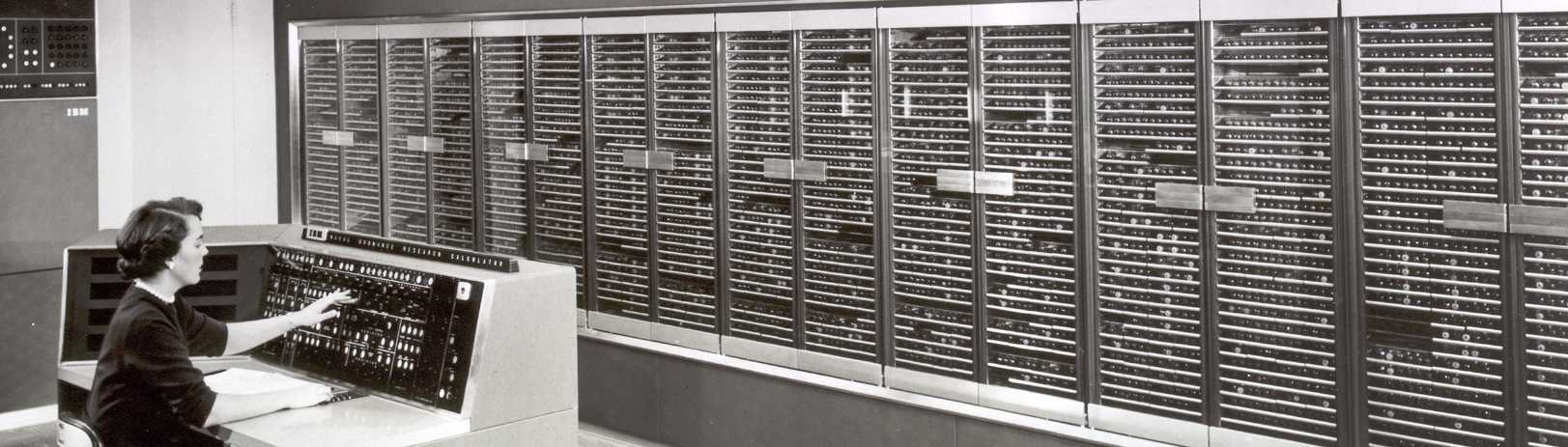
 This document gives a chronology of computing at Columbia University, as
best I can piece it together, written mainly in Jan-Feb 2001, updated
periodically since then (time of last update listed above). It does not
aspire to be a general history or museum of computing, but in some ways it's
not far from one either. Corrections, additional information, and more
photos are always welcome. In most cases where the text says "today", that
means 2001; obviously much has changed since then.
This document gives a chronology of computing at Columbia University, as
best I can piece it together, written mainly in Jan-Feb 2001, updated
periodically since then (time of last update listed above). It does not
aspire to be a general history or museum of computing, but in some ways it's
not far from one either. Corrections, additional information, and more
photos are always welcome. In most cases where the text says "today", that
means 2001; obviously much has changed since then.
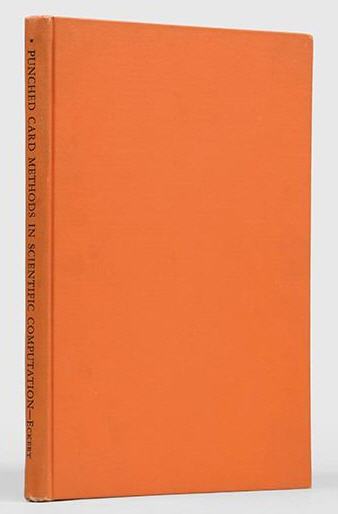 Prof. Eckert publishes Punched Card Methods in
Scientific Calculation [50], the first
computer book. The book "...covers nearly a decade of work by W.J. Eckert
on astronomical calculations by machine processes. Based on firsthand
experience, it describes a gamut of large calculations that could best be
carried out by machines able to process numbers in machine-readable form.
These calculations include the construction of mathematical tables, the
numerical integration of differential equations, numerical harmonic analysis
and synthesis, and the solution of simultaneous equations. ... Often known
as the 'Orange Book' on account of the vividly colored covers of its original
printing, Eckert's book was the bible of many workers engaged in punched card
computing at the IBM Watson Scientific Computing Laboratory at Columbia
University and elsewhere. ... The process of carrying out the integration of
the differential equations is explained in detail. It involves the use of the
multiplier, tabulator, and summary punch in concert, guided by the setting of
a calculation control switch, which acts as a master controller advancing
automatically ... through twelve positions
(Figure 2). This control switch ... was a precursor
of sequential control in electronic
computers" [78].
"Some of the better-known builders of the early computers, like
Vannevar Bush
at MIT, J. Presper Eckert of the ENIAC, and Howard Aiken at Harvard, got their first introduction
in the famous orange book" [90]. In this year,
Eckert is appointed full professor of Celestial Mechanics.
Prof. Eckert publishes Punched Card Methods in
Scientific Calculation [50], the first
computer book. The book "...covers nearly a decade of work by W.J. Eckert
on astronomical calculations by machine processes. Based on firsthand
experience, it describes a gamut of large calculations that could best be
carried out by machines able to process numbers in machine-readable form.
These calculations include the construction of mathematical tables, the
numerical integration of differential equations, numerical harmonic analysis
and synthesis, and the solution of simultaneous equations. ... Often known
as the 'Orange Book' on account of the vividly colored covers of its original
printing, Eckert's book was the bible of many workers engaged in punched card
computing at the IBM Watson Scientific Computing Laboratory at Columbia
University and elsewhere. ... The process of carrying out the integration of
the differential equations is explained in detail. It involves the use of the
multiplier, tabulator, and summary punch in concert, guided by the setting of
a calculation control switch, which acts as a master controller advancing
automatically ... through twelve positions
(Figure 2). This control switch ... was a precursor
of sequential control in electronic
computers" [78].
"Some of the better-known builders of the early computers, like
Vannevar Bush
at MIT, J. Presper Eckert of the ENIAC, and Howard Aiken at Harvard, got their first introduction
in the famous orange book" [90]. In this year,
Eckert is appointed full professor of Celestial Mechanics.
 Eckert leaves Columbia for an assignment with the
US Naval Observatory,
which he rapidly "computerizes" to create accurate air and sea navigation
tables for the US Air Corps and Navy using the techniques he devised at
Columbia [17], which allowed design and production
of the
Air Almanac in record time; the first issue of
the Air Almanac appeared December 1st, 1940, produced entirely by machine
methods. The
Astronomical Computing Bureau in Pupin, now
directed by
Jan
Schilt (but with Eckert still running the show from Washington), was
assigned to tasks for the looming war, such as ballistic firing tables, and
trajectory calculations, and later, design calculations for the
B-29
sighting station [57,59] —
"Mathematics Goes to War" [9]. Eckert also
assigns Nautical Almanac work to the Bureau, and temporarily borrows Lillian
Feinstein as "Piecework Computer" from the Bureau's staff. The Bureau
existed until 1951, but by 1948 most of its work had migrated to Watson Lab [88].
Eckert leaves Columbia for an assignment with the
US Naval Observatory,
which he rapidly "computerizes" to create accurate air and sea navigation
tables for the US Air Corps and Navy using the techniques he devised at
Columbia [17], which allowed design and production
of the
Air Almanac in record time; the first issue of
the Air Almanac appeared December 1st, 1940, produced entirely by machine
methods. The
Astronomical Computing Bureau in Pupin, now
directed by
Jan
Schilt (but with Eckert still running the show from Washington), was
assigned to tasks for the looming war, such as ballistic firing tables, and
trajectory calculations, and later, design calculations for the
B-29
sighting station [57,59] —
"Mathematics Goes to War" [9]. Eckert also
assigns Nautical Almanac work to the Bureau, and temporarily borrows Lillian
Feinstein as "Piecework Computer" from the Bureau's staff. The Bureau
existed until 1951, but by 1948 most of its work had migrated to Watson Lab [88].
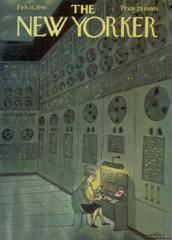 The IBM Selective Sequence Electronic Calculator (SSEC) (PHOTOS AND DETAILS) was designed and built by IBM in
1946-47 under the direction of Columbia Professsor Wallace Eckert and then
installed in IBM HQ at 590 Madison Ave in January 1948. This is one of the
first large-scale electronic computers, and the first machine to combine
electronic computation with a stored program and capable of operating on its
own instructions as data. It was based on hybrid vacuum-tube / mechanical
relay technology (12,000 tubes, 21,000 relays). Fully assembled, it was 140
feet long (60 + 20 + 60 U-shape) (some sources cite different dimensions) and
was used initially for calculating lunar coordinates. Reporters called it a
Robot Brain. Its massive size and configuration established the public
image of computers for decades to come (as in this 1961 New Yorker
cover by Charles Addams).
Aside from solving important scientific problems, it was used
by students of Columbia's pioneering
Machine
Methods graduate course — part of the world's first computer science
curriculum, initiated here in 1946.
The IBM Selective Sequence Electronic Calculator (SSEC) (PHOTOS AND DETAILS) was designed and built by IBM in
1946-47 under the direction of Columbia Professsor Wallace Eckert and then
installed in IBM HQ at 590 Madison Ave in January 1948. This is one of the
first large-scale electronic computers, and the first machine to combine
electronic computation with a stored program and capable of operating on its
own instructions as data. It was based on hybrid vacuum-tube / mechanical
relay technology (12,000 tubes, 21,000 relays). Fully assembled, it was 140
feet long (60 + 20 + 60 U-shape) (some sources cite different dimensions) and
was used initially for calculating lunar coordinates. Reporters called it a
Robot Brain. Its massive size and configuration established the public
image of computers for decades to come (as in this 1961 New Yorker
cover by Charles Addams).
Aside from solving important scientific problems, it was used
by students of Columbia's pioneering
Machine
Methods graduate course — part of the world's first computer science
curriculum, initiated here in 1946.
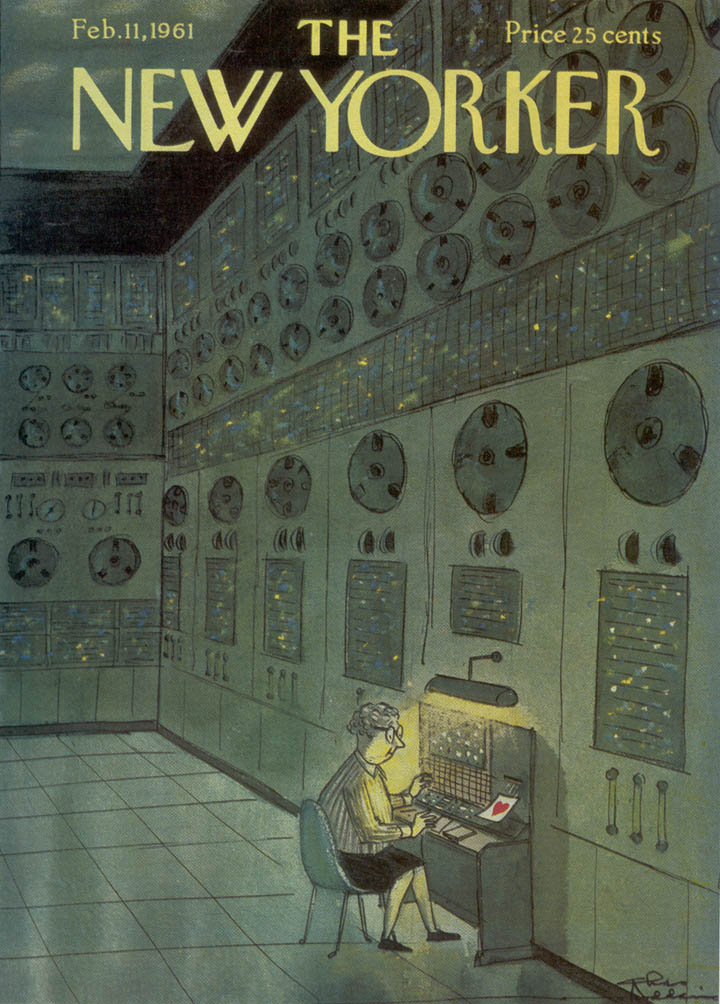
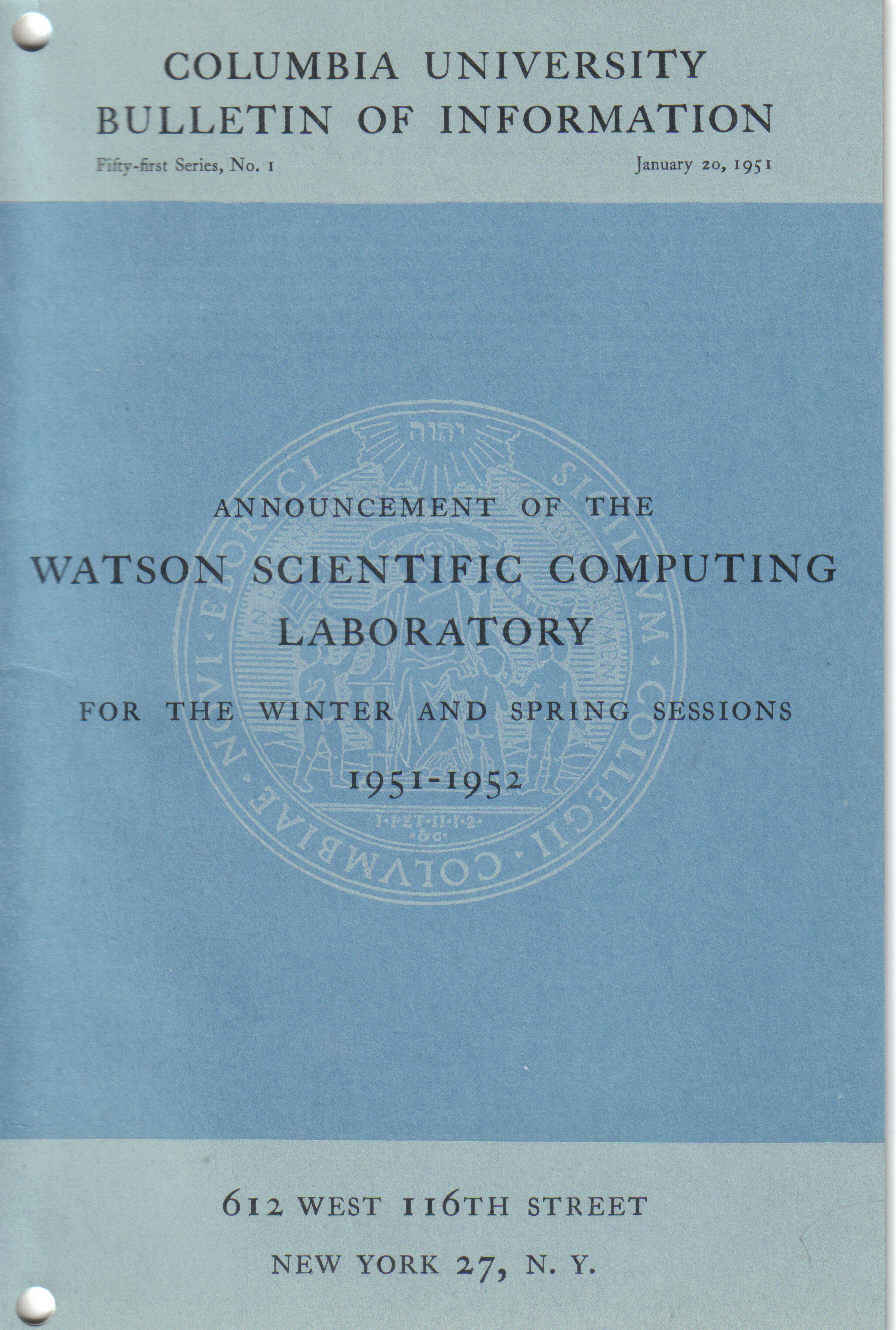 CLICK HERE to view some 1951 Watson Lab
Astronomy, Engineering, and Physics course listings from the 1951 Columbia
Catalog. Herb Grosch
recalls [57]:
"... a little about the courses we gave - that is, at Columbia. These were
all part of the regular university curriculum, listed in the appropriate
catalogs - we had our own special one also - and open to any student with the
prerequisites and the money. We did however encourage our own juniors on
116th Street and at the SSEC to attend as auditors if they did not want to
sign up for credit. ... Most of our offerings were unusual. [Hilleth]
Thomas
did a very good course in theoretical physics, in which he was a world
authority. I did a celestial mechanics course one year; it was really a
mélange of spherical trig, practical and theoretical astronomy (meaning
time and position determination, and orbit computing), and brief mentions of
planetary and satellite mechanics. ... None of my subtopics were taught
anywhere else at Columbia; the astronomy department was solid astrophysics.
And they were what was needed for astronomy calculations. ... Most of our
value as teachers, however, came from the computing courses. Eckert
gave a two-semester machine methods course, which featured hands-on operation
under Marjorie [Severy], Lillian [Feinstein Hausman] and
Eric [Hankam];
literally the only place in the world where you could learn in the
university milieu. ... I did numerical methods - classical interpolation
and matrix arithmetic and integration of differential equations. Most of my
examples, and assigned exercises, were at desk calculator level, but I
lectured from the point of view of machine operation ... This was one
semester, once a year, and Hilleth did an advanced course featuring partial
differential equation solutions and error propagation, every other year. ...
My classes were small; this was a very esoteric discipline indeed in the
Forties. But I had interesting students .. like [Stan] Rothman and [Bill]
McClelland and [John] Backus and Don Quarles. ... So
it was my side of the house that carried the teaching. It went on into the
Fifties, always as part - but a small part - of the Columbia offerings. The
hands-on side of the Machine Methods course was unique, not just because of
the equipment but because real use-'em-every-day men and women were running
it."
CLICK HERE to view some 1951 Watson Lab
Astronomy, Engineering, and Physics course listings from the 1951 Columbia
Catalog. Herb Grosch
recalls [57]:
"... a little about the courses we gave - that is, at Columbia. These were
all part of the regular university curriculum, listed in the appropriate
catalogs - we had our own special one also - and open to any student with the
prerequisites and the money. We did however encourage our own juniors on
116th Street and at the SSEC to attend as auditors if they did not want to
sign up for credit. ... Most of our offerings were unusual. [Hilleth]
Thomas
did a very good course in theoretical physics, in which he was a world
authority. I did a celestial mechanics course one year; it was really a
mélange of spherical trig, practical and theoretical astronomy (meaning
time and position determination, and orbit computing), and brief mentions of
planetary and satellite mechanics. ... None of my subtopics were taught
anywhere else at Columbia; the astronomy department was solid astrophysics.
And they were what was needed for astronomy calculations. ... Most of our
value as teachers, however, came from the computing courses. Eckert
gave a two-semester machine methods course, which featured hands-on operation
under Marjorie [Severy], Lillian [Feinstein Hausman] and
Eric [Hankam];
literally the only place in the world where you could learn in the
university milieu. ... I did numerical methods - classical interpolation
and matrix arithmetic and integration of differential equations. Most of my
examples, and assigned exercises, were at desk calculator level, but I
lectured from the point of view of machine operation ... This was one
semester, once a year, and Hilleth did an advanced course featuring partial
differential equation solutions and error propagation, every other year. ...
My classes were small; this was a very esoteric discipline indeed in the
Forties. But I had interesting students .. like [Stan] Rothman and [Bill]
McClelland and [John] Backus and Don Quarles. ... So
it was my side of the house that carried the teaching. It went on into the
Fifties, always as part - but a small part - of the Columbia offerings. The
hands-on side of the Machine Methods course was unique, not just because of
the equipment but because real use-'em-every-day men and women were running
it."
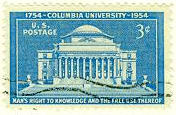
 The Columbia Computer Center publishes two annual Project Abstracts, in
which every single research, instruction, and administrative project carried
out on the IBM 360/91 is listed, as well as publications resulting from
these projects. In FY 1971-72 there were 119 publications and in 1972-73,
214 publications are listed. Each abstract is about 250 pages long; the
first one was generated by a SNOBOL program and printed on the 1403 printer;
the second one was typeset somehow using programs written by Computer Center
technical staff. I would call this the Golden Age of the Computer
Center, reflecting an unparalleled degree of collaboration between the
faculty and the Computer Center and the accomplishment of much work that
might well have had an impact on the real world — medicine, social
research, physical sciences, engineering, every field was represented.
Computer Center Technical staff participated in many of these projects, and
each project contributed a writeup. The projects themselves are
fascinating, about 100 pages of project description in each volume, about 5
projects per page.
The Columbia Computer Center publishes two annual Project Abstracts, in
which every single research, instruction, and administrative project carried
out on the IBM 360/91 is listed, as well as publications resulting from
these projects. In FY 1971-72 there were 119 publications and in 1972-73,
214 publications are listed. Each abstract is about 250 pages long; the
first one was generated by a SNOBOL program and printed on the 1403 printer;
the second one was typeset somehow using programs written by Computer Center
technical staff. I would call this the Golden Age of the Computer
Center, reflecting an unparalleled degree of collaboration between the
faculty and the Computer Center and the accomplishment of much work that
might well have had an impact on the real world — medicine, social
research, physical sciences, engineering, every field was represented.
Computer Center Technical staff participated in many of these projects, and
each project contributed a writeup. The projects themselves are
fascinating, about 100 pages of project description in each volume, about 5
projects per page.
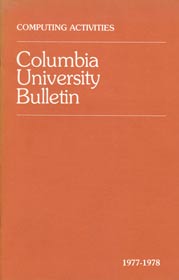 Several technical staff members performed pure R&D, for example
Richard Siegler who worked half-time on an AI medical diagnosis assistant
in SPITBOL with Dr. Rifkin at the Medical Center. An annual catalog, the
Columbia University Bulletin, Computing Activities [7] was published, as well as a Technical Abstract of
each year's research projects. CUCCA was co-sponsor (with EE/CS) of the
University Colloquium in Computer Science. There was an alliance
with NASA Goddard Space Flight Center on 112th Street (Tom's Restaurant
building), which had one of the four existing IBM 360/95s. The academic
user community was quite small. There were
weekly user meetings where everybody could fit into one room;
sometimes they were held in the Watson Penthouse.
Several technical staff members performed pure R&D, for example
Richard Siegler who worked half-time on an AI medical diagnosis assistant
in SPITBOL with Dr. Rifkin at the Medical Center. An annual catalog, the
Columbia University Bulletin, Computing Activities [7] was published, as well as a Technical Abstract of
each year's research projects. CUCCA was co-sponsor (with EE/CS) of the
University Colloquium in Computer Science. There was an alliance
with NASA Goddard Space Flight Center on 112th Street (Tom's Restaurant
building), which had one of the four existing IBM 360/95s. The academic
user community was quite small. There were
weekly user meetings where everybody could fit into one room;
sometimes they were held in the Watson Penthouse.
 The CUCCA Terminal and Plotter User Manual [14] was published, full of photos and detailed
instructions on using the equipment in our public areas. CLICK HERE to see a sampling of video terminals; note
the accompanying PACX boxes. NOW ON LINE in
searchable PDF format. This was printed on our new Xerox 9700, one of the
first laser printers capable of typesetting; it had two fonts, Helvetica and
Courier. The manual itself should interesting to those who harbor a burning
curiosity over every minute detail in the life of President Obama,
since the equipment described here is what he must have used when he was a
Columbia student 1981-83, because there wasn't anything else. Check, for
example, this article he wrote in
Sundial Magazine, March 10, 1983. I suspect he composed it on the
DEC-20, perhaps in EMACS, seated at one of the terminals in our terminal
rooms; for example, the HP-2621s in Carman Hall.
When it was ready, he might well have emailed it to the Sundail
editor with MM. Just a guess!
The CUCCA Terminal and Plotter User Manual [14] was published, full of photos and detailed
instructions on using the equipment in our public areas. CLICK HERE to see a sampling of video terminals; note
the accompanying PACX boxes. NOW ON LINE in
searchable PDF format. This was printed on our new Xerox 9700, one of the
first laser printers capable of typesetting; it had two fonts, Helvetica and
Courier. The manual itself should interesting to those who harbor a burning
curiosity over every minute detail in the life of President Obama,
since the equipment described here is what he must have used when he was a
Columbia student 1981-83, because there wasn't anything else. Check, for
example, this article he wrote in
Sundial Magazine, March 10, 1983. I suspect he composed it on the
DEC-20, perhaps in EMACS, seated at one of the terminals in our terminal
rooms; for example, the HP-2621s in Carman Hall.
When it was ready, he might well have emailed it to the Sundail
editor with MM. Just a guess!
 DECSYSTEM-20 Pocket Guide (click for PDF
of the whole thing). The DEC-20 was an enormously powerful and useful
computing system, yet it was simple enough that we could publish an
accordion-fold pocket guide to just about all that it had to offer. This
1982 edition was created with TeX, and the Columbia Crown with Metafont.
The master was printed on our new Imagen Laser Printer
and the printing and folding done at the Columbia print shop. It was given
out free to all comers (thousands of them).
DECSYSTEM-20 Pocket Guide (click for PDF
of the whole thing). The DEC-20 was an enormously powerful and useful
computing system, yet it was simple enough that we could publish an
accordion-fold pocket guide to just about all that it had to offer. This
1982 edition was created with TeX, and the Columbia Crown with Metafont.
The master was printed on our new Imagen Laser Printer
and the printing and folding done at the Columbia print shop. It was given
out free to all comers (thousands of them).
 Macintosh mania. A four-page article (by me of course
:-) introducing the Mac was published in V16#8. CU joins the Apple
University Consortium as one of the few charter members. AUC membership
required us to buy Macs in bulk for resale on campus. 2000 were ordered right
away. Within a short while, we had written the first version of Macintosh Kermit for it (Bill Catchings, Bill Schilit, and
me). Mac (and PC) sales continue in one form or another until turned over to
J&R, which opened a Columbia-only branch in the basement of Philosophy
Hall in the late 1990s but then jumped ship about 2001.
Macintosh mania. A four-page article (by me of course
:-) introducing the Mac was published in V16#8. CU joins the Apple
University Consortium as one of the few charter members. AUC membership
required us to buy Macs in bulk for resale on campus. 2000 were ordered right
away. Within a short while, we had written the first version of Macintosh Kermit for it (Bill Catchings, Bill Schilit, and
me). Mac (and PC) sales continue in one form or another until turned over to
J&R, which opened a Columbia-only branch in the basement of Philosophy
Hall in the late 1990s but then jumped ship about 2001.
 IBM PC/AT announced, the first IBM PC with memory protection. Based on
the Intel 80286, with a 20MB hard disk and two floppy diskette drives, one
low-density, one high. Battery powered BIOS configuration memory and clock.
Up to 16MB memory. This was the first in the IBM PC line fully capable of
running multitasking operating systems, and soon was host to a number of
them (some companies had managed to produce Unix variants such as Xenix for
the original IBM PC or XT on 8086 but these were not "sustainable".) Of
course this machine was of great interest to the Columbia Computer Center,
which was looking for ways to deploy desktop networked UNIX workstations
for academic use, and we had some internally running different UNIX versions
such as SCO Xenix/286. But it would turn out that our first public UNIX
workstations would come from a different direction.
IBM PC/AT announced, the first IBM PC with memory protection. Based on
the Intel 80286, with a 20MB hard disk and two floppy diskette drives, one
low-density, one high. Battery powered BIOS configuration memory and clock.
Up to 16MB memory. This was the first in the IBM PC line fully capable of
running multitasking operating systems, and soon was host to a number of
them (some companies had managed to produce Unix variants such as Xenix for
the original IBM PC or XT on 8086 but these were not "sustainable".) Of
course this machine was of great interest to the Columbia Computer Center,
which was looking for ways to deploy desktop networked UNIX workstations
for academic use, and we had some internally running different UNIX versions
such as SCO Xenix/286. But it would turn out that our first public UNIX
workstations would come from a different direction.
 Project Aurora, a 6.5-million dollar IBM grant administered by
CUCCA, a "campus-wide move in information and instruction toward the
electronic university." Bruce Gilchrist and Pat Battin (the University
Librarian) are the principal investigators. Aurora paid for an IBM 3083
mainframe to support the Columbia Libraries Information Online (CLIO) system,
and also funded some 30 research projects in the schools and departments.
Project Aurora, a 6.5-million dollar IBM grant administered by
CUCCA, a "campus-wide move in information and instruction toward the
electronic university." Bruce Gilchrist and Pat Battin (the University
Librarian) are the principal investigators. Aurora paid for an IBM 3083
mainframe to support the Columbia Libraries Information Online (CLIO) system,
and also funded some 30 research projects in the schools and departments.
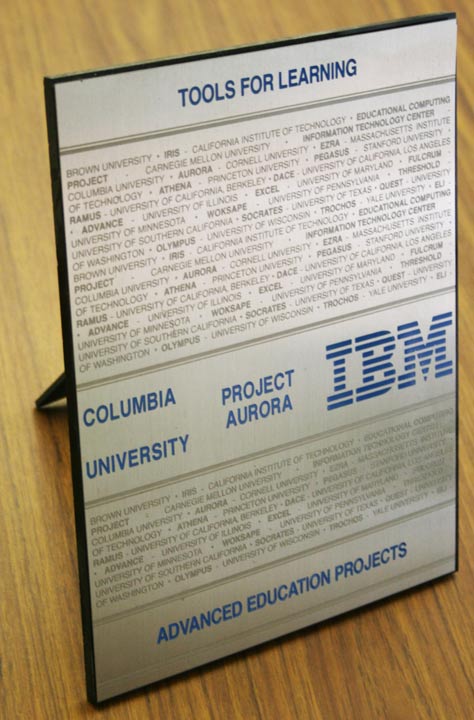
 West German hackers use Columbia's Kermit software to break into dozens
of US military computers and capture information for the KGB, as
described by Cliff Stoll in his 1989
book, The Cuckoo's
Egg [46]. At one point, while Cliff watched
on a jury-rigged T-connected terminal, the hackers were using Kermit to
download a copy of the Telnet source code so they could implant a password
logger, upload the result, recompile it, and install it: "Line by line, I
watched Kermit shovel the program over to the hacker... But I couldn't just
kill Kermit. He'd notice that right away. Now that I was closing in on
him, I especially didn't want to tip my hand. I found my key chain and
reached over to the wires connected to the hacker's line. Jangling the keys
across the connector, I shorted out his circuit for an instant. This added
just enough noise to confuse the computer, but not enough to kill the
connection... It worked like a charm. I'd jangle my keys, he'd see the
noise, and his computer would ask for a replay of the last line..." This
slowed the transfer down so much that the hacker eventually lost patience
and gave up — but it didn't stop Kermit! As long as the connection
stays up, no matter how awful, Kermit pushes the file through. Cliff also
measured the delay between Kermit packet and acknowledgment to estimate the
hacker's distance from California (6000 miles, a fairly accurate estimate of
the distance to Hannover).
West German hackers use Columbia's Kermit software to break into dozens
of US military computers and capture information for the KGB, as
described by Cliff Stoll in his 1989
book, The Cuckoo's
Egg [46]. At one point, while Cliff watched
on a jury-rigged T-connected terminal, the hackers were using Kermit to
download a copy of the Telnet source code so they could implant a password
logger, upload the result, recompile it, and install it: "Line by line, I
watched Kermit shovel the program over to the hacker... But I couldn't just
kill Kermit. He'd notice that right away. Now that I was closing in on
him, I especially didn't want to tip my hand. I found my key chain and
reached over to the wires connected to the hacker's line. Jangling the keys
across the connector, I shorted out his circuit for an instant. This added
just enough noise to confuse the computer, but not enough to kill the
connection... It worked like a charm. I'd jangle my keys, he'd see the
noise, and his computer would ask for a replay of the last line..." This
slowed the transfer down so much that the hacker eventually lost patience
and gave up — but it didn't stop Kermit! As long as the connection
stays up, no matter how awful, Kermit pushes the file through. Cliff also
measured the delay between Kermit packet and acknowledgment to estimate the
hacker's distance from California (6000 miles, a fairly accurate estimate of
the distance to Hannover).
 25th Anniversary of the Columbia Computer Center Symposium. Ken King,
Vladimir Ussachevsky, Ted Bashkow, Cy Levinthal, Jessica Gordon, Robert
Goldberger, Norman Mintz, Elaine Sloan, Dorothy Marshall, Paul Clayton,
Robert Wedgeworth, Ira Fuchs, Richard Sacks. Horace Mann Auditorium,
Teachers College, 10:00am-5:00pm. Materials (courtesy of Stew Feuerstein):
25th Anniversary of the Columbia Computer Center Symposium. Ken King,
Vladimir Ussachevsky, Ted Bashkow, Cy Levinthal, Jessica Gordon, Robert
Goldberger, Norman Mintz, Elaine Sloan, Dorothy Marshall, Paul Clayton,
Robert Wedgeworth, Ira Fuchs, Richard Sacks. Horace Mann Auditorium,
Teachers College, 10:00am-5:00pm. Materials (courtesy of Stew Feuerstein):
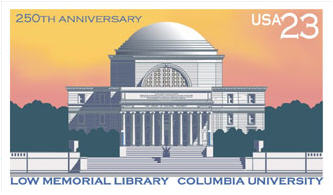
 Herb Grosch dies at 91 years of age. An
authentic computer pioneer, he worked here from 1945 to 1950 and in recent
years was an energetic and colorful contributor to this history. The photo
is from 1951, showing how he looked when he was working in Watson Lab on
116th Street where he came up
with Grosch's Law
(in 1950, not 1965 as Wikipedia states; see
see Chapter 13 of Grosch's autobiography).
Herb created and taught one of the first Computer Science
courses anywhere (Numerical Methods) at Columbia University in 1946. He
went on to a long and contentious career at MIT, GE, IBM, Datamation, the
National Bureau of Standards, Computerworld, and the ACM, and served on the
faculty of numerous universities. He published the third and final edition
of his autobiography, Computer - Bit Slices of a
Life, here on this site.
Herb Grosch dies at 91 years of age. An
authentic computer pioneer, he worked here from 1945 to 1950 and in recent
years was an energetic and colorful contributor to this history. The photo
is from 1951, showing how he looked when he was working in Watson Lab on
116th Street where he came up
with Grosch's Law
(in 1950, not 1965 as Wikipedia states; see
see Chapter 13 of Grosch's autobiography).
Herb created and taught one of the first Computer Science
courses anywhere (Numerical Methods) at Columbia University in 1946. He
went on to a long and contentious career at MIT, GE, IBM, Datamation, the
National Bureau of Standards, Computerworld, and the ACM, and served on the
faculty of numerous universities. He published the third and final edition
of his autobiography, Computer - Bit Slices of a
Life, here on this site.
 Dr. Bruce
Gilchrist, the second director of the Columbia Computer Center (and
a major contributor to this history), dies in Richmond VA at the age of 84
[obituary]
(the first director was
Kenneth
King from 1963 to 1971). Bruce, a genuine pioneer
in computing from the 1950s and a prominent figure in the ACM and AFIPS
(details here), exemplified the long-forgotten
academic and scientific traditions of the computer center and its
predecessor, the IBM Watson Scientific Computing
Laboratory at Columbia University, serving on the Engineering School
faculty and publishing papers in scientific journals as well as several
books on computers and society. Bruce led the Computer Center from 1973 to
1984, staying on in an advisory capacity until 1988. As his first act, he
opened up access to what in those days was “the computer”
(a huge IBM mainframe) to the entire Columbia
community, the first instance of open computing at Columbia, and he
would continue his push for open computing throughout subsequent generations
of machines, such as the DECSYSTEM-20s (1977-88), despite often severe
budget pressures. Bruce was the first to put public terminal rooms in
dormitories (like Carman Hall) and other academic
buildings. Bruce hired mainly out of the Engineering School, launching the
careers of numerous women and men in computing. As a scientist with close
connections to the computer industry, he was able to combine technical
leadership with good humor and humane management. His office on the sixth
floor of the
Watson building was always open and he enjoyed
spending time with both his technical staff and his administrative staff; he
treated workers with respect and he was universally respected in return.
After relinquishing day-to-day management of the Computer Center in 1984, he
concentrated his efforts on the acquisition and installation of the
$20-million-dollar IBM/Rolm Computerized Branch
Exchange, not just a new telephone system for the University, but also a
wiring plant that would eventually provide high-speed data access to every
building and room on the Morningside campus... Open computing fully
realized. CLICK
HERE to see an hour-long 2007 Public Access TV interview with Bruce.
Dr. Bruce
Gilchrist, the second director of the Columbia Computer Center (and
a major contributor to this history), dies in Richmond VA at the age of 84
[obituary]
(the first director was
Kenneth
King from 1963 to 1971). Bruce, a genuine pioneer
in computing from the 1950s and a prominent figure in the ACM and AFIPS
(details here), exemplified the long-forgotten
academic and scientific traditions of the computer center and its
predecessor, the IBM Watson Scientific Computing
Laboratory at Columbia University, serving on the Engineering School
faculty and publishing papers in scientific journals as well as several
books on computers and society. Bruce led the Computer Center from 1973 to
1984, staying on in an advisory capacity until 1988. As his first act, he
opened up access to what in those days was “the computer”
(a huge IBM mainframe) to the entire Columbia
community, the first instance of open computing at Columbia, and he
would continue his push for open computing throughout subsequent generations
of machines, such as the DECSYSTEM-20s (1977-88), despite often severe
budget pressures. Bruce was the first to put public terminal rooms in
dormitories (like Carman Hall) and other academic
buildings. Bruce hired mainly out of the Engineering School, launching the
careers of numerous women and men in computing. As a scientist with close
connections to the computer industry, he was able to combine technical
leadership with good humor and humane management. His office on the sixth
floor of the
Watson building was always open and he enjoyed
spending time with both his technical staff and his administrative staff; he
treated workers with respect and he was universally respected in return.
After relinquishing day-to-day management of the Computer Center in 1984, he
concentrated his efforts on the acquisition and installation of the
$20-million-dollar IBM/Rolm Computerized Branch
Exchange, not just a new telephone system for the University, but also a
wiring plant that would eventually provide high-speed data access to every
building and room on the Morningside campus... Open computing fully
realized. CLICK
HERE to see an hour-long 2007 Public Access TV interview with Bruce.
 Engineering
professor Leon
Lidofsky* dies in Vermont at the age of 94. A World War II
Navy veteran, he was one of Columbia's earliest "hands-on" users of digital
computers, establishing a computer lab on the second floor of the
Engineering Terrace in the mid-1960s that included a room-sized minicomputer
(SEL 810B), a tabletop DEC
PDP-8, plus specialized equipment for data collection and
analysis, one of only a handful of Columbia's
departmental computing facilities at the time. I first met him in 1969 when
I got a student job in his department.
Engineering
professor Leon
Lidofsky* dies in Vermont at the age of 94. A World War II
Navy veteran, he was one of Columbia's earliest "hands-on" users of digital
computers, establishing a computer lab on the second floor of the
Engineering Terrace in the mid-1960s that included a room-sized minicomputer
(SEL 810B), a tabletop DEC
PDP-8, plus specialized equipment for data collection and
analysis, one of only a handful of Columbia's
departmental computing facilities at the time. I first met him in 1969 when
I got a student job in his department.
 Ellie Krawitz (Eleanor Krawitz Kolchin), who worked at Watson Lab in
the late 1940s and wrote this 1949 article describing
the lab and its work, passed away January 25, 2019, in Boca Raton, Florida.
In 2003 she sent me a paper copy of her article, which I transcribed and
posted to this site. In February 2013, Huffington Post stumbled upon
it, contacted and interviewed her, publishing
an article
about her that earned her belated recognition as one of the last
surviving women pioneers in computing. In the years since then, she was
honored by the Association for Computing Machinery and the National Center
for Women in Information Technology, and (as of October 2020) her 1949
article has been translated into over 30 languages from Albanian to
Uzbek.
Ellie Krawitz (Eleanor Krawitz Kolchin), who worked at Watson Lab in
the late 1940s and wrote this 1949 article describing
the lab and its work, passed away January 25, 2019, in Boca Raton, Florida.
In 2003 she sent me a paper copy of her article, which I transcribed and
posted to this site. In February 2013, Huffington Post stumbled upon
it, contacted and interviewed her, publishing
an article
about her that earned her belated recognition as one of the last
surviving women pioneers in computing. In the years since then, she was
honored by the Association for Computing Machinery and the National Center
for Women in Information Technology, and (as of October 2020) her 1949
article has been translated into over 30 languages from Albanian to
Uzbek.
 Howard Eskin (HDE, Howie) died Sunday, October 2, 2022, in the
Saratoga Springs area of New York. I first knew him as the teacher of my
Data Structures class in the Engineering School in Spring 1974. He was such
a good teacher that I signed up for his full-year Programming Languages and
Translators course (CS E4815X) in Fall 1974. I had a full-time job in
the brand-new Laboratory of Computer Science at Mt. Sinai Hospital, which I
enjoyed, but zooming back and forth between Broadway and Madison Avenue
several times a day was a big time waster. Howard always got to know his
students, including me, and one day after class he invited me to his office
in Watson Lab, where he was manager of "the
computer" (a gargantuan
IBM 360/91-75 coupled system) and of the Systems
Group (programmers) at the Computer Center. He showed me the machine room
and around Watson Lab. That day or shortly after he offered me a job in his
group. It sounded great to me because (a) I could take off
for classes no matter when they were, (b) no more zooming across
town, and (c) tuition exemption! I stayed in that job until it
ended 37 years later.
Howard Eskin (HDE, Howie) died Sunday, October 2, 2022, in the
Saratoga Springs area of New York. I first knew him as the teacher of my
Data Structures class in the Engineering School in Spring 1974. He was such
a good teacher that I signed up for his full-year Programming Languages and
Translators course (CS E4815X) in Fall 1974. I had a full-time job in
the brand-new Laboratory of Computer Science at Mt. Sinai Hospital, which I
enjoyed, but zooming back and forth between Broadway and Madison Avenue
several times a day was a big time waster. Howard always got to know his
students, including me, and one day after class he invited me to his office
in Watson Lab, where he was manager of "the
computer" (a gargantuan
IBM 360/91-75 coupled system) and of the Systems
Group (programmers) at the Computer Center. He showed me the machine room
and around Watson Lab. That day or shortly after he offered me a job in his
group. It sounded great to me because (a) I could take off
for classes no matter when they were, (b) no more zooming across
town, and (c) tuition exemption! I stayed in that job until it
ended 37 years later.
 Meanwhile Howard and his wife Lita and his daughters Rebecca and Sarah
became friends with me and my family and all of us were close for about ten
years and did tons of stuff together including some marathon all-family
bicycle trips, road trips to places like
the Old
Rhinebeck Aerodrome (Howard himself was a pilot and took us up several
times, and even let me and my son Peter [right photo, but a bit older] fly the
plane). Lita was Peter's teacher when he started his first school —
Tomkins Hall Nursery School near campus — at about age 2 —
and his daughters babysat my kids (who called them "Sarabecca"). When the
Eskins moved to upstate New York in the mid-1980s, everybody chipped in to
buy Howard a brand new Apple Macintosh, which had just come on the market.
Meanwhile Howard and his wife Lita and his daughters Rebecca and Sarah
became friends with me and my family and all of us were close for about ten
years and did tons of stuff together including some marathon all-family
bicycle trips, road trips to places like
the Old
Rhinebeck Aerodrome (Howard himself was a pilot and took us up several
times, and even let me and my son Peter [right photo, but a bit older] fly the
plane). Lita was Peter's teacher when he started his first school —
Tomkins Hall Nursery School near campus — at about age 2 —
and his daughters babysat my kids (who called them "Sarabecca"). When the
Eskins moved to upstate New York in the mid-1980s, everybody chipped in to
buy Howard a brand new Apple Macintosh, which had just come on the market.
 After that we'd visit them every year
or two, most recently in 2019 (first photo at right). They are great fun,
always upbeat, enthusiastic, generous, and kind. I wish they could live
forever.
Vaçe Kundakçı sent the second
and third photos at right, taken March 15, 2015, in (I think) the Metro
Diner on Broadway with himself, Howard, and Yiorgos Athanassatos. Vace says
"May Howard rest in peace. He was a great teacher, adviser, boss, friend,
neighbor—I owe him a lot."
George Giraldi also said Howard made a difference in his life; it's a
common theme. Joel Rosenblatt: "He gave me my first job at CUCCA..."
(where he still works) "My favorite Howard story is when he came into my
office one day and told me that I was working too hard. He expected to
regularly see me sitting with my feet up reading a book and thinking. I
never forgot this and I always make time to think."
Yiorgos Athanassatos: "God rest him! i am in software because of
him! although im really bad in english, want to honor him..... everything
i did was because of Howard..."
Alan Crosswell: "He was a nice guy. PLT and cookies!" And speaking
of cookies... Daphne (Tzoar) Crosswell: "I am sorry to hear about
Howard - he was a nice guy and a great boss ... My favorite Howard story was
that he'd loudly complain 'Who brought in these cookies? They're terrible'
as he walked down the hall with 3 or 4 cookies to munch on in his office."
Theresa (a.k.a. Terry) Thompson: "I'm sad to hear Howie passed. He was
always pleasant and nice to me. He will be missed by many."
Steve Jensen: "Thanks for letting me know about Howard. I find it
really sad. He was the one who hired me at CUCCA and changed my life by
beginning my career in IT. He was also a good friend who always offered
After that we'd visit them every year
or two, most recently in 2019 (first photo at right). They are great fun,
always upbeat, enthusiastic, generous, and kind. I wish they could live
forever.
Vaçe Kundakçı sent the second
and third photos at right, taken March 15, 2015, in (I think) the Metro
Diner on Broadway with himself, Howard, and Yiorgos Athanassatos. Vace says
"May Howard rest in peace. He was a great teacher, adviser, boss, friend,
neighbor—I owe him a lot."
George Giraldi also said Howard made a difference in his life; it's a
common theme. Joel Rosenblatt: "He gave me my first job at CUCCA..."
(where he still works) "My favorite Howard story is when he came into my
office one day and told me that I was working too hard. He expected to
regularly see me sitting with my feet up reading a book and thinking. I
never forgot this and I always make time to think."
Yiorgos Athanassatos: "God rest him! i am in software because of
him! although im really bad in english, want to honor him..... everything
i did was because of Howard..."
Alan Crosswell: "He was a nice guy. PLT and cookies!" And speaking
of cookies... Daphne (Tzoar) Crosswell: "I am sorry to hear about
Howard - he was a nice guy and a great boss ... My favorite Howard story was
that he'd loudly complain 'Who brought in these cookies? They're terrible'
as he walked down the hall with 3 or 4 cookies to munch on in his office."
Theresa (a.k.a. Terry) Thompson: "I'm sad to hear Howie passed. He was
always pleasant and nice to me. He will be missed by many."
Steve Jensen: "Thanks for letting me know about Howard. I find it
really sad. He was the one who hired me at CUCCA and changed my life by
beginning my career in IT. He was also a good friend who always offered
 wise counsel on a broad range of topics. He had a wonderful sense of humor
and was great fun to spend time with such that it was always a bummer having
to depart. That link had wonderful photos of him. They look just the way I
remembered him."
Bruce Tetelman:
"I am saddened by the news of Howie's death. I have fond memories of my
professor and colleague. He was a caring fun teacher and
I hope I have modelled my teaching career similar to his. One of my
favorite courses was his compiler writing section. His methods
helped me to understand software development and get clarity from the
compiler and execution time point of view. He was also
so easy going and concerned about all his students."
David Millman (Associate Dean for Technology and CIO New York University
Libraries): "I'm very sorry to hear about Howard. He was, he is, a huge role
model. I still think about him often, even though I have hardly seen him
since I was a kid forty years ago. I guess that was an important time for
me."
Tim Lance (Distinguished Service Professor Emeritus, University at
Albany and President and Chair Emeritus, NYSERNet): "Professor Eskin was an
amazing man and we have all suffered a great loss."
Obituary, Capitol Region Daily Gazette, Schenectady NY, 9 October 2022: "In lieu of flowers, donations can be made to Harmony Community Center. Please visit harmonycorners.org."
wise counsel on a broad range of topics. He had a wonderful sense of humor
and was great fun to spend time with such that it was always a bummer having
to depart. That link had wonderful photos of him. They look just the way I
remembered him."
Bruce Tetelman:
"I am saddened by the news of Howie's death. I have fond memories of my
professor and colleague. He was a caring fun teacher and
I hope I have modelled my teaching career similar to his. One of my
favorite courses was his compiler writing section. His methods
helped me to understand software development and get clarity from the
compiler and execution time point of view. He was also
so easy going and concerned about all his students."
David Millman (Associate Dean for Technology and CIO New York University
Libraries): "I'm very sorry to hear about Howard. He was, he is, a huge role
model. I still think about him often, even though I have hardly seen him
since I was a kid forty years ago. I guess that was an important time for
me."
Tim Lance (Distinguished Service Professor Emeritus, University at
Albany and President and Chair Emeritus, NYSERNet): "Professor Eskin was an
amazing man and we have all suffered a great loss."
Obituary, Capitol Region Daily Gazette, Schenectady NY, 9 October 2022: "In lieu of flowers, donations can be made to Harmony Community Center. Please visit harmonycorners.org."
 Kenneth King, first director of the Columbia University
Computer Center 1963-71, died at his home at age 94. For a summary of
his professional life and accomplishments, see
the Ithaca
Journal obituary. Vaçe Kundakçı, CUCC systems
group programmer and systems manager from the early 1970s and then CUCC
director 1990-2005, writes:
Kenneth King, first director of the Columbia University
Computer Center 1963-71, died at his home at age 94. For a summary of
his professional life and accomplishments, see
the Ithaca
Journal obituary. Vaçe Kundakçı, CUCC systems
group programmer and systems manager from the early 1970s and then CUCC
director 1990-2005, writes: