FWP:
SETS
CURLS: {14,6}
DREAMS: {3,3}
This is a verse unusual in its erotic suggestiveness; for other such verses, see {99,4}. In addition, it belongs to the 'snide remarks about famous lovers' set; for discussion see {100,4}. And it's also conspicuous for the remarkable agreement of the commentators on a single interpretation. There must be some commentator somewhere who disagrees, but none of the ones that I'm using; and certainly the mainstream shows a strong and clear consensus. The verse will thus be a good case study, because I think the commentarial consensus is wrong, and it's convenient to argue against a group of opponents who basically speak with one voice.
In the traditional story, based on Jami, Zulaikha's dreams of Joseph occur long before she's met him, and are romantic, idealistic, and almost mystically pure; on the basis of these dreams she weeps, pines, suffers, and sacrifices her erotic prospects by marrying a eunuch. In the second dream, Joseph enjoins upon her strict chastity, though he does promise her in return some kind of reciprocity in the long run. For details, see the Jami version. Her dreams, in short, are full of romantic and mystical longing and suffering, and are inspired by someone she's never met. They're like the dreams of the lover in the ghazal world, only more so.
So why would such dreams be called 'a reproach to the bedding'? The commentators say that 'Zulaikha's dream' is one that the lover himself might have had, or fears to have, or is trying not to have-- but in any case, one that he's contemplating and firmly rejecting as disgraceful. And why so? Because, the commentators say, he has just spent an erotic night with the beloved, so he not only doesn't need to dream of her, but really ought not to do so-- it's apparently a bit vulgar, or unnecessary, or improper, or even insulting to her (because it implies that her recent real presence hasn't been enough).
But this reading really isn't very satisfactory. For if the dream is like 'Zulaikha's dream', it would be a dream of suffering love-in-separation, and why would a thoroughly satisfied lover have to spend so much energy thinking and worrying about having such a dream in the first place? Why would the lover bother to brood about the comparison between imaginary apples (Zulaikha's lonely dreams of longing) and real oranges (his just-now-ended night of lovemaking with the beloved)? And above all, how un-lover-like of him to be so smug about physical satisfaction! He actually seems to sneer at Zulaikha's lonely dreams of a distant beloved-- the way the 'people of the world' foolishly and vulgarly sneer at the lover himself. How can this be?
Not to worry-- it can't. There's a delightful and irresistible way out. For as so often, that first line is a trick, and we've been the victim of a bait-and-switch operation. In fact it's not apples and oranges, it's apples all the way down. The lover too is a dreamer, and the first line is his dream; in the second line he boasts about the superiority of his dream over Zulaikha's. The lover thus compares Zulaikha's yearning, unfulfilled dream not with his own real physical satisfaction (and the weird and farfetched possibility of his then having a dream like hers), but with his own allegedly very different, more potent dream.
Just look, the lover exultantly says-- 'In my vision/sight/show/spectacle [diid], I can actually smell her perfume on my pillow this very minute! How much better can it get!' Zulaikha's dream, he says, is absurdly and pathetically limited (and un-erotic)-- his own dream is far more vivid, satisfying, sensual, and generally superior. That's why to his vision/view, or in his view, or in his opinion (as the verse takes full advantage of diid ), her dream is a 'disgrace to the bedding', and fails to evoke the full richness of the beloved's erotic presence the way his own vision/show/dream does.
The lover's vision even alerts us to its dreamlike quality through its synesthesia: what the lover can 'see' is not the beloved herself, but merely the scent of her perfume. And where there's diid , there's also implicitly the much more common and semi-synonymous diidaar , as the commentators' own language makes clear, so that the conflation between 'vision' and 'vision of the beloved' and 'beloved' can't help but make itself felt. Of course, we also know that the desperate lover is probably protesting too much: where the diidaar is only a diid of perfume, we're not so far away from Zulaikha's dream after all. In his heart the lover surely even realizes this, which is why his attempt to distance himself from Zulaikha's situation is so urgent (and also perhaps, depending on the tone in which we choose to read the verse, so rueful or even self-mocking).
In short, to recognize that the lover too is imagining or dreaming takes full advantage of the richness of diid , and makes for a more piquant, rakish, complex verse, with a sharper wit and greater connection. The only reason I can think of that this reading didn't occur to the commentators is that they fell into the clever trap of the realistic-sounding first line because of their 'natural-poetry' desire for a real night of union for the lover (although real, erotic, satisfying sex is such a rara avis in Ghalib's ghazal world that that prospect in itself should have set off alarm bells in their heads). For another example of such a clever trap in the first line, into which similarly the commentators all too readily fall, see {90,3}.
For other, similarly ambiguous verses about Zulaikha's dream(s), see {117,5x}; {145,9x}; {145,14x}; {226,8x} // {299x,2}; {343x,1}.
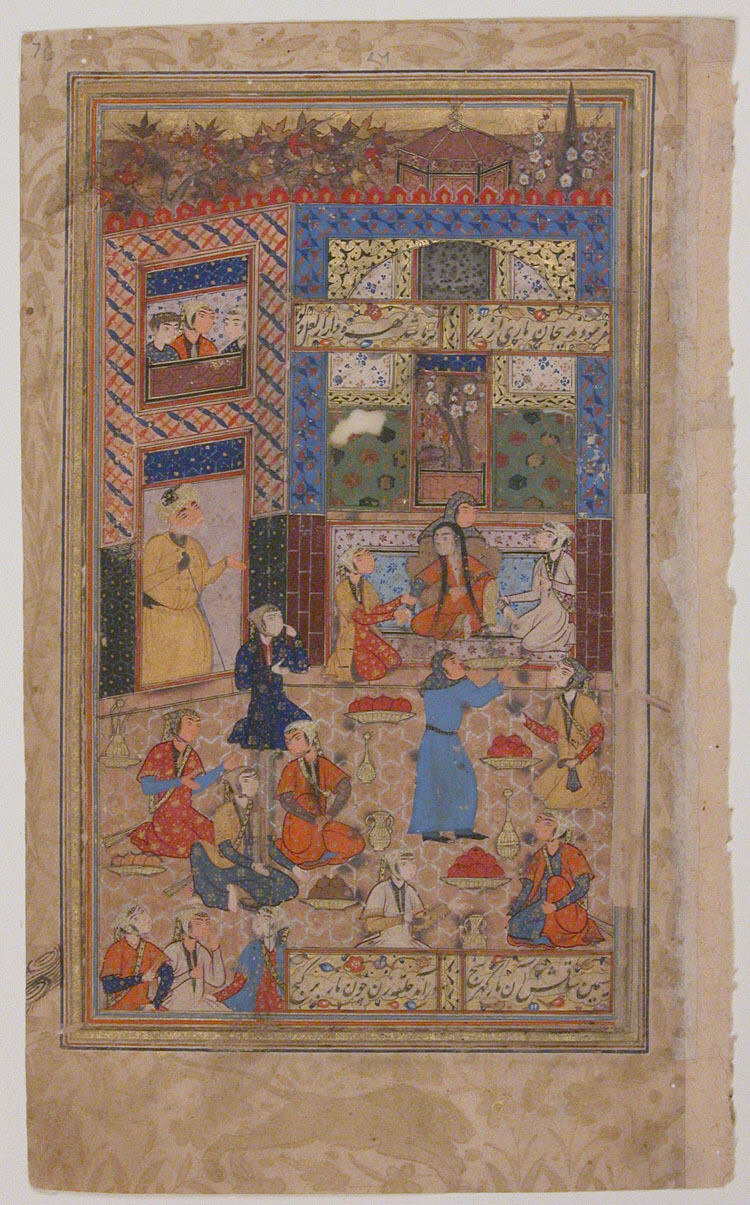
Jami:
The Persian poet Jami (1414-92) includes in his famous masnavi yuusuf-o-zulai;xaa (1483) three dreams that Zulaikha has about Joseph. For the full text of the verse translation by Alexander Rogers (London: 1892, 1910): on the packhum website, go to 'Jami' in the author list, and follow the links. In his 'Preface', Rogers summarizes the plot. These are the relevant 'dream' sections:
=The Seeing by Zuleikha for the First Time of the Sword of the Sun of the Beauty of Joseph in the Sheath of a Dream, and her Being Killed with Love of him by that Sword, p. 35
=The Blowing of the Morning Breeze on Zuleikha, and the Opening of Her Drowsy Eye, p. 38
=The Knotting with Perplexity of the Rope of Anxiety of her Maids from their seeing the Change in the Condition of Zuleikha, and the unloosing by her Nurse with the Point of the Finger of Enquiry of the Knots of that Rope, p. 40
=The Seeing by Zuleikha of Joseph for a Second Time in a Dream, and the Shaking of the Chain of his Love, and Casting him into the Whirlpool of Darkness, p. 45
=The Seeing of Joseph (on him be Peace!) by Zuleikha in a Dream for the Third Time, and her Asking his Name and Place, and the Return of Zuleikha to Wisdom and Sense, p. 49
There's also a partly verse-translated, partly prose-summarized version of the masnavi done by Charles Francis Horne (1917).