 |
 |
|
 |
|
|
 |
||
 |
||
 |
||
 |
||
 |
||
 |
||
 |
||
 |
||
 |
||
 |
||
 |
||
 |
||
 |
||
 |
||
 |
||
 |
||
 |
||
 |
||
 |
||
 |
||
 |
||
|
||
|
|
|||
| About
Biosphere 2: A Bold Experiment in Sustainability Teams Up with an Acclaimed University |
|||
|
|||
|
Biosphere 2 Center has been part of Columbia University since 1996, when, approaching its 250th anniversary, the New York City institution assumed management of the research complex and began the now established academic programs. Since 1996, more than one thousand students from Columbia, Barnard, over 30 Partner Schools, and elsewhere have graduated from the summer and semester programs at Biosphere 2. Some undergraduate students transfer up to 18 Columbia points of credit to their home institutions. Biosphere 2 also offers summer programs for high school students, as well as a year-long master's program in public policy, science, and management of Earth's environment. Through the education programs at Biosphere 2, Columbia is training and inspiring future Earth systems leaders, managers, and planetary citizens to understand the interweaving of the social, biological, and physical sciences. A priority of the curriculum is your acquisition of concepts and skills that enable you to move across traditional disciplinary boundaries, a necessity if decision makers and scientists are to work together toward a sustainable future.
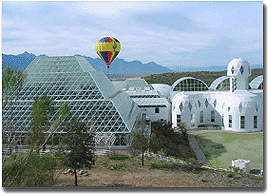
The Case of the Missing Carbon Dioxide Columbia University's involvement with Biosphere 2 began with a scientific puzzle. Something inexplicable was going on within the glass-enclosed, miniature world in Arizona, built to discover whether people could thrive in a self-contained, self-sustaining ecosystem. The three-acre experimental facility seemed to contain all the ingredients to maintain an ecological balance--soil, air, water, flora, and fauna. It was encased in an airtight dome and supported by an impermeable liner. But months after Biosphere 2 was sealed off from the outside world, oxygen levels unexpectedly dropped, threatening the health of the inhabitants and Biosphere 2's initial premise as a unique living laboratory. Noted Columbia University scientist Wally Broecker, a member of the National Academy of Sciences, was called on for advice. He recalls: "In 1991, nine months after the first group of volunteers had been 'sealed' inside, Biosphere 2 representatives met with me in Manhattan. They pulled out a tattered graph that showed a steady decline in oxygen levels. "Clearly, if the decline continued, the eight people who had agreed to live within the self-contained habitat would soon experience oxygen deprivation, abruptly putting an end to the planned two-year mission. "My first guess about the decline, which proved correct, was that bacteria in the soil were consuming oxygen faster than the plants were producing it. 'If so,' they said pulling out another graph,'why hasn�t the carbon dioxide level risen to reflect this?' I didn't have an answer. Thanks to a hard-working Columbia graduate student, Jeffrey Severinghaus, now an associate professor at Scripps Institution of Oceanography at the University of California, and his father, a scientist and amateur builder, we finally did find that carbon dioxide 'hidden' in Biosphere 2's concrete floor."Sometime during the search for the missing carbon dioxide, I became enchanted with the possibility of converting this stunning $250 million greenhouse into a first-rate facility for the study of the impacts of fossil fuel carbon dioxide on plant and coral growth." "So in 1994, when Ed Bass, patron and owner of Biosphere 2, asked me to lead a new research program under the auspices of Columbia University, I eagerly accepted. Columbia University officially took over on January 1, 1996, and thanks to hard work and determination, in just five years, we have transformed that former greenhouse and the desert around it into the Biosphere 2 Center, a thriving campus and research facility with the largest environmental laboratory ever built."Wally Broecker
|