 |
 |
|
 |
|
|
 |
||
 |
||
 |
||
 |
||
 |
||
 |
||
 |
||
 |
||
 |
||
 |
||
 |
||
 |
||
 |
||
 |
||
 |
||
 |
||
 |
||
 |
||
 |
||
 |
||
 |
||
|
||
|
|
|
| Profiles | |
|
Kristi Argenbright
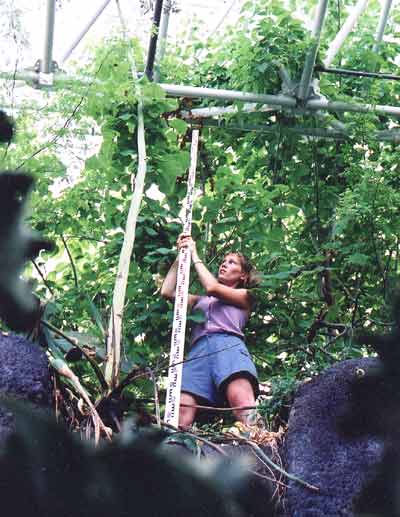
Kristi Argenbright has always loved to climb trees. Dangling 90 feet above the floor of the rainforest biome to collect leaf samples exhilarates her. "As a sophomore, I fell in love with the rainforest the first time I came to Biosphere 2. My semester here changed my life. I had intended to study medicine but became an environmental science major instead. Now I'm hoping to combine my interest in medicine with study of the rainforest and alternative therapies." A master's candidate at Texas Christian University, one of the campus's Partner Schools, Argenbright is back at Biosphere 2 looking at the effect of temperature and carbon dioxide increases on plant growth in the thorn scrub. "In the desert, where the sunsets are spectacular, you are totally surrounded by nature and wildlife. You learn a lot about Earth systems, but you also have a lot of time for inner reflection. At Biosphere 2, I learned that I can make a difference as a steward of our planet1s future." Photo caption: |
|
|
Theresa McHugh
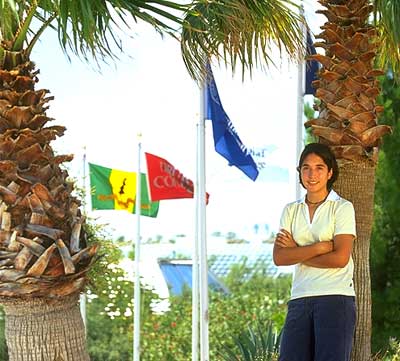
Ask Theresa McHugh, Notre Dame '01, to name her favorite thing about Earth Semester, and she answers without missing a beat: "The research was the best part of my time here." It's no wonder why. McHugh's enthusiasm about plant ecology earned her a research spot in the Biosphere 2's rainforest biome. Her team studied the rainforest's net primary productivity--the rate at which the rainforest produces biomass material like bark and leaves--and compared the productivity of the man-made Biosphere 2 rainforest to that of a natural rainforest. Every Thursday morning, she and her team would meet early and leave the desert behind to spend the day digging through two-thousand square meters of lush, wet rainforest. In charge of recording how many leaves--and how much mass--trees had shed from week to week, Theresa found herself completely absorbed in the work. "I had never done actual fieldwork," she says. "It was fun to be taking part in the type of research that in the past we had only learned about and not actually done ourselves." At semester's end, McHugh and her team combined their numbers in one long equation. They found that the Biosphere 2's rainforest acts much like a naturally occurring rainforest. "It was 14 weeks of eight-hour workdays, and in the end we ended up with one number," says McHugh. "That was cool."Photo caption: |
|
|
Paresh Patel
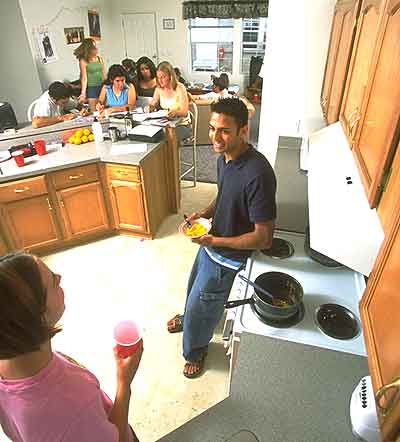
Not too long ago, Paresh Patel found himself faced with the all-important question: How do you spend the summer after your first year of college? "I wanted to do something productive," says Patel, a Columbia '04, a sophomore from Hawthorne, New Jersey. "My options were getting a job or learning about stuff I had no clue about. I opted for the latter." That1s how he found himself in the Earth Systems Field School, one of Biosphere 2's undergraduate summer programs. Before he knew it, Patel was standing at the edge of the Gulf of California, observing sea stars and other sea creatures he1d never seen before, hiking to the top of the Santa Catalina Mountains, and, of course, exploring the Grand Canyon. Patel had never done field sweeps or seen so many vastly different creatures within a small space. "I just wanted to see what it would be like," he says. "I had never even been camping before. . . .The Earth Systems Field School was a great way to get my feet wet." Photo caption:
|
|
|
Jonathan
Harris
"Seeing and experiencing it all" was what Columbia University student Jonathan Harris enjoyed most about his Biosphere 2 courses, which exposed him to a wide range of ideas about environmental research and policy. "Every class had its own personality," he says. In some classes, the environmental science major had the chance to explore what many consider to be radical conservation methods. In others, he studied the sometimes difficult reality of making and implementing science policy. "Environmental activism is valuable, but so is the person who sits down and works within the system," Harris says. "Biosphere 2 provided a great opportunity to connect my personal values with my academic goals." It also allowed the Columbia student the chance to connect to a different kind of environment than he was used to in New York City. Harris found that he felt at home in both. When he's in New York, Jonathan loves to explore the city. During his sophomore semester at Biosphere 2, his free time was for hiking. "I love New York City," he says, 3but I'm also definitely a nature person. The experiences are so polar. I wanted to see it all." Photo caption: |
|
|
Mamta
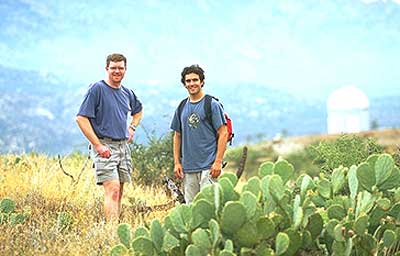
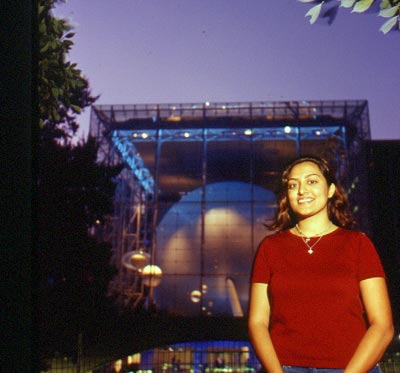
Dadlani "The way we live and learn at Biosphere 2 is truly unique," says Mamta Dadlani, Barnard College '02, a psychology major. "In Astrophysics of the Solar System, for example, we learned not only how planets form, and what they are made of, but also what the great scientists through the ages were contemplating as they made their discoveries." Accustomed to dedicated professors and relatively small classes at Barnard, Dadlani marveled about the sense of community that is fostered at Biosphere 2. "Biosphere 2 is an unbelievable learning experience. The small classes, long discussions, fantastic field trips to some of the country1s most advanced observatories, and the chance to work with real scientists on sophisticated equipment are wonderful. You get to know your teachers not only as professionals, but also as people. "Everyone at Biosphere 2 is there to expand his or her horizons. Being there totally changes your point of view. It gives you a completely new perspective and set of ideas to apply to your life." Photo caption: |
|
|
Ben
Dixon
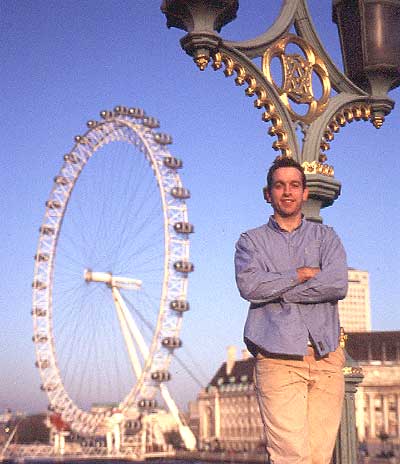
"I came from a largely scientific background as a zoology major at Cambridge University. At Biosphere 2, I learned about Earth and the environment from other perspectives as well--social and economic and legal," says Ben Dixon, who was enticed to leave London, England, for the interdisciplinary approach of Earth Semester. "As part of a close learning community, you get to know the faculty and other students quite well. They challenge your preconceived ideas, and vice versa. I came away with a better understanding how Earth works and the different ways that people think. It makes the program so worthwhile." After Biosphere 2, Dixon worked for the United Nations Environment and Development Forum in London on U.K. environment policies for Earth Summit 2002 in Johannesburg, South Africa. He's now pursuing a master's degree in environmental technology from Imperial College of Science, Technology and Medicine. "Biosphere 2 opened my eyes to the intricacies of environmental issues and how they fit into the global agenda." Photo caption: |
|
|
Israel
Rocha
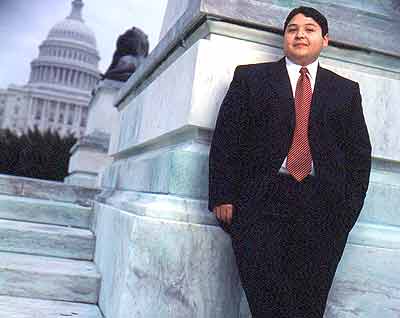
For Israel Rocha, "00 Columbia, Biosphere 2's Earth Semester couldn1t have been more on point. The political science major is press secretary and director of communications for U.S. Congressman Ruben Hinojosa, who represents Texas' 15th District. In his first job out of Columbia as legislative assistant for the congressman, Rocha came into direct contact with environmental issues he had addressed at Biosphere 2. "Biosphere 2 taught me how the environment impacts every aspect of human society--from art to business--and how everything ties back to the environment," says Rocha. "The independent project I worked on at Biosphere 2, on Central Arizona's water resources, was a perfect segue into my Capitol Hill experience. Our district is in an arid part of Texas. Water resources, clean water and air, and conservation are big issues for our constituents." Eventually, Rocha will trade his career experience on Capitol Hill for business school or law school with an environmental program. "Biosphere 2 offered a relaxed environment that was conducive to learning." Photo caption: |