 |
 |
|
 |
|
|
 |
||
 |
||
 |
||
 |
||
 |
||
 |
||
 |
||
 |
||
 |
||
 |
||
 |
||
 |
||
 |
||
 |
||
 |
||
 |
||
 |
||
 |
||
 |
||
 |
||
 |
||
|
||
|
|
|||||
| News, Events, and Information Sessions | |||||
|
|||||
| How Biosphere Programs Can Fulfill Science Requirements for Columbia and Barnard Students.
|
|||||
| Information Sessions and Events for Fall 2002 | |||||
| September
12th 6-7 pm |
Biosphere 2 Re-Entry Meeting | New
York City Columbia University 208 Hamilton Hall 1130 Amsterdam Ave. In the conference room |
|||
| September
18th 6-7pm |
Biosphere 2 Info Session | New
York City Columbia University John Jay Lounge 519 W. 114th St. (on main campus-southeast corner on Amsterdam & 114th) |
|||
| September
27th 12:30-4:30 pm |
Study Abroad Fair | New
York City Columbia University Lerner Hall 2920 Broadway |
|||
| October
1st 6-7 pm |
Biosphere 2 Info Session | New
York City Columbia University Lerner Hall, Room 569 2920 Broadway; Main Campus |
|||
| October
7th 12:30-1 pm |
Barnard Information Session | New
York City Barnard College 202 Austchul Barnard Campus |
|||
| October
17th 6-7 pm |
Simulcast Information Session | New
York City Columbia University Pupin Hall, 14th Floor 528 West 120th Street |
|||
| October
28-30th 5:30-7 pm |
Major Advising Fair | Monday,
October 28th Tuesday , October
30th |
|||
| November
6th 12:30-1:30 pm |
Biosphere Informational Session/ Lunch | New
York City Columbia University SIPA, 15th Floor 420 West 118th Street |
|||
| NEWS Published on
January 24, 2002 | Columbia University Spectator The Bert W. Martin Foundation awards the CU Biosphere 2 Center $800,000 in undergraduate financial aid to expand enrollment. By Morika
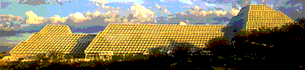
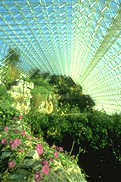
Tsuijimura Earlier this month, the Bert W. Martin Foundation awarded Columbia University�s Biosphere 2 Center an $800,000 gift that will give more undergraduate students an opportunity to study in the Center�s Earth Semester program. The money is specifically for financial aid, an important step in expanding enrollment at the Center. "Because our education programs have only been in existence for 6 years, we do not yet have wealthy alums to support our growth. The Martin Foundation gift is thus highly appreciated," said Charles Wood, Biosphere 2's director of education. Biosphere 2, Columbia's 250-acre campus located in Oracle, Ariz., runs an experimental education program dedicated to teaching students earth systems science and policy crucial to informed leadership and decision-making for the future. Students, who come from a range of universities, pay the same tuition to attend one of the programs at the biosphere as they do at their respective universities. There are currently two semester-long programs. Students enrolled in the Earth Semester study ecology, geology, climatology, as well as legal, political, and policy aspects of sustainability. Students enrolled in the Universe Semester, study astrophysics and astronomy under the night sky of the Arizona desert with access to state of the art telescopes. Peter Neofotis, CC'03, who participated in Earth Semester last spring, described his semester as "inspirational," pointing to not only the Center's educational programs, but also to the support he received from his instructors and classmates. This interaction included several discussions of important issues outside the classroom, helping to create a tight-knit community feel. "I learned not to oversimplify an issue but to examine it from biological, physical, political, and philosophical perspectives. Such a mode of thinking is clearly a great tool for future environmentalists to have," Neofotis said. Thanks to the foundation's grant, more students will have the opportunity to take advantage of the program. The foundation, located in Orlando, Fla., is named after Bert W. Martin, a Chicago industrialist and philanthropist who implemented reforestation programs and other forestry practices that supported his endeavors in lumbering and printing. The Foundation has supported Biosphere 2 in the past with contributions totaling $35,000 in support of the Passport to Learning science education program aimed at elementary and middle school children in the area. While the Biosphere 2 Center includes a 3.1-acre glass-enclosed research facility with several differnt ecosystems, students in the Earth and Universe Semester programs are not confined indoors. Rather, much of the research is done outside the complex and complemented by numerous field trips. Rachel Ganiere, SEAS '03, who went to the Center last spring after hearing recommendations from past alums, said �the professors were so much more approachable" than many at Columbia. Ganiere, an environmental engineering student, said she appreciated the field trips, which allowed her to see the actual phenomena described in class. She made the analogy to an art history major who is able to visit the art museums in New York City. Mamta Dadlani, BC '02, a student in the Universe Semester last spring, wanted to go to Biosphere 2 after taking an introductory astronomy class last year. Dadlani and nine others in the program had full access to huge telescopes and the desert sky. She also interacted closely with the ninety or so students of Earth Semester. Dadlani described casual social events marked by debates about meteor showers--something that is definitely difficult to come by in Morningside Heights. |
|||||