 |
 |
|
 |
|
|
 |
||
 |
||
 |
||
 |
||
 |
||
 |
||
 |
||
 |
||
 |
||
 |
||
 |
||
 |
||
 |
||
 |
||
 |
||
 |
||
 |
||
 |
||
 |
||
 |
||
 |
||
|
||
|
|
| A World-class Research Setting |
|
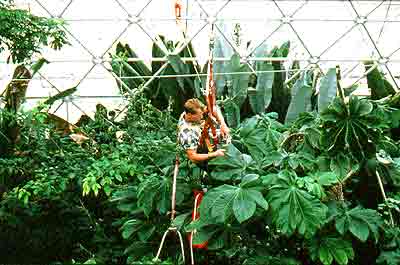
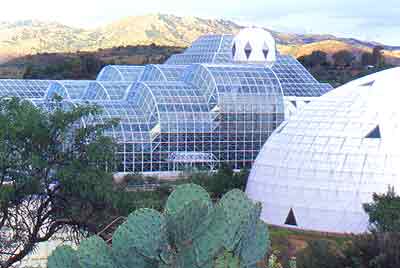
Columbia's Biosphere 2 is the only research center in the world where scientists can control temperature, rainfall, and carbon dioxide levels in ocean, rainforest, agroforest, and desert biomes. For example, in these uniquely controlled environments, scientists may alter the environment by increasing atmospheric carbon dioxide and study how these changes impact on Earth�s ecosystems. In this way, Biosphere 2 provides research results vital to policymakers concerned about the planet�s future. In the last five years, Columbia's Biosphere 2 researchers have made important discoveries about the way human activity influences some of Earth�s basic biological and geochemical systems. The Center is contributing significantly to research in terrestrial plant ecophysiology, biological oceanography, and subsurface soil science. Rapid Loss of Coral Reefs Marine biologist Christopher Langdon uses the Biosphere 2's ocean biome to understand how an increase in atmospheric carbon dioxide will affect the world�s coral reefs. Inside the ocean biome, Langdon doubled the carbon dioxide concentration from preindustrial levels to where scientists predict it could be by 2065. He found that rapidly rising atmospheric levels of carbon dioxide--caused primarily by the burning of fossil fuels and the destruction of tropical forests--have an alarming effect on coral reefs. Based on his findings, Langdon predicts that the rate of coral reef growth will decrease 40 percent by the year 2065. At least 10 million people depend on coral reefs for food, and as cradles of biodiversity, coral reefs are crucial to ocean health. Rainforests Ecosystem specialist Guanghui Lin and his colleagues look at how rising rates of carbon dioxide will affect functions of naturally occurring forests, like rainforests, and how the tropical rainforests could be used to remove carbon dioxide from the atmosphere and store it in their tree trunks and soils. Typically, scientists study the effects on ecosystems of elevated carbon dioxide, global warming, or other climate changes by exposing single leaves or a few seedlings to a change in carbon dioxide concentration or temperature. Observed responses are extrapolated to predict how an entire forest might respond to the changes. But the highly controllable environment�and large size�of the Biosphere 2 Laboratory allows Lin to measure effects on an entire rainforest. The results, Lin says, were surprising. He found that the rainforest�s ability to store carbon dioxide disappears much faster than smaller-scale experiments were showing, especially when global warming occurs as a result of change in the atmospheric composition. This means that the ability of rainforests to offset fossil fuel burning will be significantly lower than previously hoped. Global Warming and Plant Life Terrestrial biologist Kevin Griffin uses Biosphere 2�s intensive forestry biome to learn how global warming affects the most elemental plant functions�respiration and photosynthesis. In Biosphere 2, Griffin adjusts the temperature of a plantation of 70 cottonwood trees. He found that the rate of tree respiration--a process by which leaves emit carbon dioxide into the atmosphere--is higher when whole-tree temperatures are increased than when only individual leaves are warmed. Since the global nighttime temperature is increasing at about twice the rate of the global daytime temperature, plants may release more carbon dioxide into the atmosphere through respiration in the future. Now, Griffin is using Biosphere 2 to conduct a controlled experiment on the effect of carbon saturation on photosynthesis. Like Langdon and Lin, he has changed the carbon dioxide concentration in the agricultural biome to compare its long-term effects on trees. He has divided the cottonwood plantation into three sections�one that mirrors the amount of carbon dioxide in the Earth�s atmosphere now, one that doubles that, and one that triples it.When Stars Explode Astronomer Karen Vanlandingham studies novae�stars that undergo explosions on their surfaces. She observes these explosions using the Biosphere 2 Observatory and Columbia�s telescopes at Kitt Peak. From spectroscopic observations of the gas that is blown off the star, she can determine what elements make up the star. Using computer models that simulate the physical conditions of the gas, she can determine how much material has been ejected into space and how massive the star is. These studies help to determine if current theories of stellar evolution are correct. Through novae explosions (and those of their more energetic counterparts, supernovae) elements such as carbon, nitrogen, and oxygen are created and distributed into space. These are exactly the elements that make up life on Earth, including us. This material then goes into forming the next generation of stars. Vanlandingham joined the Biosphere 2 faculty in fall 1999 and was a member of the inaugural Universe Semester faculty. She has published numerous papers on classical novae.
Student Research Opportunities As a student at Biosphere 2, you will gain exposure to a range of research opportunities in Earth sciences, ecology, astronomy, environmental service, sustainable futures, and policy initiatives. You can take on a semester-long independent research project--perhaps within the Biosphere 2 Laboratory itself--under the close guidance of a faculty mentor. You can participate in ongoing faculty-led research initiatives or design your own project or community service opportunity. The emphasis is on mastering skills meaningful to you in scientific method, data analysis, fieldwork, policy analysis, investigation of environmental issues, art, photography, or writing techniques, or educational outreach. At the end-of-the-semester research fair, you will present your work as a poster, performance, Web page, or by some other means. Some students conduct research in the Biosphere 2 Laboratory itself, but many more work with Biosphere 2 faculty and other local scientists, using the extensive environmental and astronomy resources on and around the Biosphere 2 campus.As a member of the Biosphere 2 academic community, you are invited to regular research seminars given by renowned scientists from around the world who come here to share their latest findings and discoveries. A new resource center in the student village keeps you connected and up-to-date via print and digital resources.
Recent graduates of Biosphere 2 have investigated the following: ° How does the diversity of invertebrate species associated with algae in a natural coral reef compare with that in the Biosphere 2’s controlled ocean biome? ° What is necessary to maintain the health of ecological communities and vegetation within Biosphere 2? ° What is the most energy-efficient design for a house in the Southwest? ° How can we incorporate our environmental and scientific histories in art? ° What physical and biotic factors influence the abundance of mycorrhizae--a mutualism between fungi and plants--in mesquite tree roots? ° What is the history of star formation in and around the cluster M17? ° Can we understand convection in stars by studying convection on the stove? ° What is the chemical composition of a white dwarf?
Other examples of research projects: ° Nitrate isotope composition in the tropical rainforest and agroforestry biomes of Biosphere 2 ° Creation of an interactive sand tank model for public education about water supply issues in the Tucson Basin ° Investigation of Arizona water policy issues ° Monitoring populations of the Huachuca water umbel, a federally listed endangered species ° Initiation of a permanent monitoring station in the dry tropical deciduous forest of Alamos, Mexico ° Plant collection and identification ° Investigation of the effects of livestock grazing in the Southwest ° Monitoring brightness outbursts of flare stars and comets ° Working with local teachers to develop astronomy activities in classrooms
|