 |
 |
|
 |
|
|
 |
||
 |
||
 |
||
 |
||
 |
||
 |
||
 |
||
 |
||
 |
||
 |
||
 |
||
 |
||
 |
||
 |
||
 |
||
 |
||
 |
||
 |
||
 |
||
 |
||
 |
||
|
||
|
|
| A Sense of Place |
|
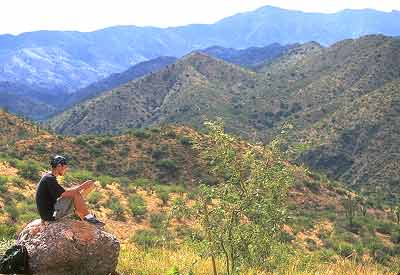
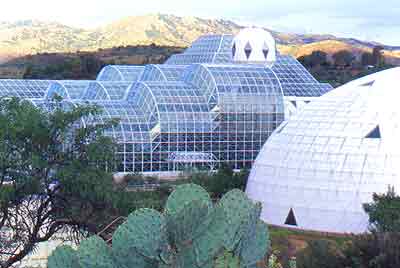
To find Columbia's Biosphere 2 campus, you travel from the Tucson Basin, which is ringed by mountains and shares the landscape with stands of saguaro, paloverde, and creosote. Swinging around the rugged Pusch Ridge Wilderness, you head north. As you pass between the high slopes of the conifer-topped Santa Catalina Mountains on the east and the lower Tortolita Mountains to the west, the land begins to rise. The Sonoran Desert scrub changes, grading into another southwestern ecosystem--desert grasslands. At this nexus of mountain, desert, and grassland, in a beautiful biological and geological mosaic, you come to Biosphere 2. The southwestern ecosystems accessible from the Biosphere 2 campus serve as living laboratories for studying Earth's physical and biological processes. And overhead, the immense southwestern sky, where stars pierce the black night, sheds light on our planet's place in this universe and on the processes and events that shape our cosmos. Inside Biosphere 2, scientists are conducting research using the world's largest time machine. In controlled laboratory settings, researchers are literally able to turn the clock forward to investigate how Earth's ecosystems may react to the higher concentrations of carbon dioxide predicted for the next hundred years. Biosphere 2 offers an alternative setting to the study of Earth systems that complements research in the field around the globe. The data collected here improve models of how global climate change may affect life on Earth, from the scale of photosynthesis within a single leaf through the complexities of an entire ecosystem. The three-acre, glass-enclosed Biosphere 2 Laboratory contains separate, medium-scale biomes: ocean (a coral reef system), rainforest, agroforestry, and desert� thorn scrub�savannah complex. Each is a community of plants and soils--or mesocosms--collectively surrounded by a glass, metal, and concrete shell.
Adjacent to the laboratory is another dome that can open to the sky. This dome contains a modern computer-controlled 24-inch research-grade telescope that students use to study the cosmos. A new academic program--inspired by the dark Arizona sky--enables faculty and students to investigate why, among the nine planets of our very small solar system, only Earth supports life. Biosphere 2 was first constructed in 1984 with the mission of discovering if a crew of men and women could sustain themselves for two years in a closed environment. Founded and still owned by businessman and environmental philanthropist Edward P. Bass, Biosphere 2 has been under the management of Columbia University since 1996.
|