 |
 |
|
 |
|
|
 |
||
 |
||
 |
||
 |
||
 |
||
 |
||
 |
||
 |
||
 |
||
 |
||
 |
||
 |
||
 |
||
 |
||
 |
||
 |
||
 |
||
 |
||
 |
||
 |
||
 |
||
|
||
|
||
 |
||
 |
||
 |
|
| Fieldwork: the Heart of the Learning Experience |
|
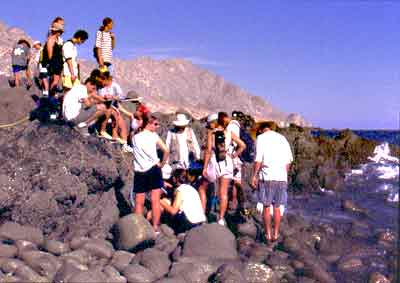
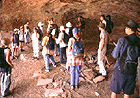
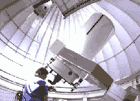
For students at Biosphere 2, the rubber hits the road on field trips, where all the classroom, lab, and on-site field learning come together. As a student in the Earth Semester, you experience the geologic drama of the Southwest, constructing for yourself a landscape and Earth history by interpreting the story told by sedimentary metamorphic rock strata. You come to understand the climatic, physical, and biotic factors that structure ecological communities by experiencing and sampling the rich biota and diverse ecosystems of the Southwest. Woven throughout are encounters with the people who shape and are shaped by the landscape, encouraging you to think critically about your own impact on the environment. Students in the fall semester undertake a week-long exercise on northern Arizona's Colorado Plateau. You hike the Grand Canyon, investigate public lands� management issues, and compare and contrast ecological communities along an elevated gradient. The trip includes stops at Sunset Crater to observe recent volcanic activity and vegetative successions, and the Paleo-Indian ruins. Spring semester students spend a week in the California desert, where you hike canyons that open pages to millions of years of geologic turmoil and explore vegetative communities from low desert through chaparral to pine-topped mountains and vernal pools. You visit the Imperial Valley, Salton Sea, and a farmworker community to investigate the complex linkages among water policy, Colorado River flow, agriculture, environmental and social health, and international relations. Students in both semesters travel to northern Sonora, Mexico, to sample the tide pools of the Sea of Cortez, hike the sand dunes of the Gran Desierto, study the invertebrates and salt-loving plants of a Mexican estero, experience conservation efforts south of the border, and learn about fisheries depletion, tourism, and other development issues in the small Mexican town of Puerto Peñasco. Field excursions for students of astronomy include trips to Kitt Peak National Observatory, where Columbia co-owns research-grade observation telescopes and students make their own observations. Students also visit the Steward Observatory Mirror Laboratory at the University of Arizona, where some of the largest astronomical mirrors are made, as well as Lowell Observatory, Sunset Crater, and Meteor Crater in northern Arizona.
|