| Spring
2003 Undergraduate Programs
Undergraduate:
Earth Semester
16
weeks, 16 points.
Spring 2003: January 21--May 16.
Earth Semester
uses the study of planetary ecosystems to provide a common orientation
for learning in several disciplines. Concerns about greenhouse gases,
energy sustainability, water management, and conservation of biodiversity
are explored. Students learn skills that will help structure student
interactions with Earth and its inhabitants throughout their lives.
These skills span the following areas: scientific method, data analysis,
sample collection, systems modeling, interdisciplinary communication,
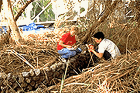
teamwork, and written and oral presentations. Earth Semester fieldwork
takes place at many sites that vary seasonally but may include the
Sea of Cortez, the Grand Canyon, the Santa Catalina Mountains, the
Mojave Desert, and other destinations where students learn directly
from their surroundings.
Undergraduate:
Universe Semester
16
weeks, 16 points.
Spring 2003: January 21--May 16
Universe Semester
is an intensive program in astronomy and astrophysics carrying a
full semester of Columbia University credit. It is designed to appeal
to liberal arts students as well as astronomy and physics majors.
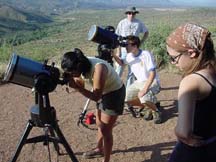
The Biosphere 2 Center in southern Arizona offers the opportunity
to study astronomy in its natural setting, under a dark night sky,
using large telescopes and other research tools that involve discovery
directly by experiment and observation.

Undergraduate:
Research Semester
16
weeks, 16 points.
Spring 2003: January 21--May 16.
This innovative
new program provides undergraduates with an authentic research experience
working in small teams led by leading Ph.D. research faculty at
Biosphere 2. Research opportunities are currently available in ecology,
environmental biology, astronomy, and astrophysics. In the future,
other disciplines such as geoscience and environmental policy will
be included. Research projects are complemented by upper-level course
work in research design and disciplinary science.
Summer
2003 Undergraduate
A college-level mathematics or science course is prerequisite
to all undergraduate courses at the Biosphere 2 Center.
BSPH
BP3021
Earth Systems
Field School:
Field Course in Earth and Environmental Sciences
6 weeks, 6 points
Summer 2: July 7–August 15
Approx. $5,033—click
for fees chart
This field-intensive course in Earth and environmental sciences
teaches students to understand the complex, interdependent, and
dynamic nature of landscapes. Small student groups conduct field
research, examining rocks, plants, and wildlife in their natural
surroundings. Field methods in geology and ecology are taught at
a variety of field sites in Arizona and Mexico, including the Grand
Canyon and Puerto Peñasco, Mexico.
BSPH
BP1020
Sky Islands, Desert
Seas Field School:
Field Course in Ecosystem Management
4 weeks, 4 points
Summer 1: June 2–June 27
Approx. $3,276—click
for fees chart
The “sky island” region of southern Arizona, made up
of a sequence of low valleys and high mountains, marks the intersection
of two great mountain cordilleras and two of the great North American
deserts. These isolated mountain ranges, with their elevational
range of biotic communities, have an extremely high level of biological
diversity. As humans, we are the only species with the ability to
change the environment on a planetary scale and to consider the
global impacts of our actions. This course explores the inextricable
connections between the natural and cultural history, biological
diversity, geology, and conservation of this unique geographical
region. Students assess current management issues affecting public
and private lands and learn how to plan regionally for effective
conservation of diverse but interconnected ecosystems. They extrapolate
the lessons learned on local and regional scales to global environmental
conservation issues and are prepared for a lifetime of conscious
environmental decision making.
BSPH
BP4700
Sea of Cortez
Field School:
A Natural History
4 weeks, 4 points
Summer 1: June 2–June 27
Approx. $3,376—click
for fees chart
Marine ecosystems are being altered and destroyed at a frantic pace.
However, in part because aquatic communities are not as visible
to humans as terrestrial environments, their destruction has often
been completely ignored. This Sea of Cortez course provides an opportunity
for graduate and advanced undergraduate students to learn more about
marine communities, to understand how fragile, diverse, and extremely
beautiful they are, and to conduct a short research project in one
of the most diverse areas of the world. Topics include physical
oceanography, marine chemistry, geology, botany, zoology, and ecology;
research projects emphasize marine biology and ecology. The field
site is at a UNESCO Biosphere Reserve (upper Gulf of California),
allowing students to evaluate, firsthand, the delicate balance between
development and conservation, while also contributing through their
research projects to the understanding of shallow coastal communities.
BSPH
BP3160
Deserts of the
Southwest Field School
6 weeks, 6 points
Summer 2: July 7–August 15
Approx. $5,058—click
for fees chart
The course offers a broad, experience-based understanding of the
different kinds of arid communities, processes that define them,
and the challenges to their sustainable inhabitation. Field comparisons
involve climate patterns, geomorphology, soils, vegetation structure,
biodiversity (plants, invertebrates, vertebrates), and history of
human inhabitation. The most extensive field experience is on the
west coast of Baja California, which served as the main model for
the Biosphere 2 desert biome. Students learn how to identify important
ecosystem processes and components and how to communicate this knowledge.
BSPH
BP4030
Biodiversity Institute
5 weeks, 5 points
Summer 2: July 14–August 15
Approx. $4,283—click
for fees chart
The study of biodiversity is presented as the marriage of systematic
biology with conservation ecology and uses direct experience in
fieldwork and data analysis to help students explore the many levels
of diversity. A variety of field sites in southern Arizona and Sonora,
Mexico, plus classroom and lab work at Biosphere 2, provide fundamental
field, analytical, and database skills that are key to the study
of patterns of evolution and biodiversity. The curriculum addresses
basic concepts in biodiversity science (e.g., quantitative analysis
of field data), biogeography, and systematics (taxonomy, cladistics,
and phylogenetics), and gives students firsthand experience with
various groups of organisms (plants, insects, reptiles, small mammals,
and birds). The historical framework of biodiversity study and current
issues within biodiversity science are also presented. Classroom
lectures, as well as lab, computer, and field exercises, are scheduled.
Fieldwork occurs in the most diverse desert on Earth (the Sonoran
Desert) and also in the “sky island” mountains of southeastern
Arizona (including the Santa Catalina Mountains and Santa Rita Mountains)
and at the Sea of Cortez. Prerequisite: a college-level biology
course.
BSPH
BP3648
Summer of Stars
5 weeks,
5 points
Summer 1: June 2–July 4
Approx. $4,133—click
for fees chart
This beginning observational astronomy course introduces students
to astronomical observation under the spectacularly dark Arizona
sky. Students gain abundant hands-on experience using a wide range
of cameras and telescopes, including solar scopes and the 24-inch
telescope at the Biosphere 2 Observatory. Expeditions are scheduled
to other observatories and astronomical laboratories in and around
Tucson, the astronomy capital of the world.
Fall
2003/Spring 2004
Undergraduate Programs and Course Descriptions
A college-level
mathematics or science course is prerequisite to all undergraduate
courses at the Biosphere 2 Center.
Earth
Semester
16 weeks, 16 points
Fall 2003: September 2–December 19
Spring 2004: January 20–May 14
Approx. $16,765—click
for fees chart
Earth Semester uses the study of planetary ecosystems to provide
a common orientation for learning in several disciplines. Concerns
about greenhouse gases, energy sustainability, water management,
and conservation of biodiversity are explored. Students learn skills
that will help structure their interactions with Earth and its inhabitants
throughout their lives. These skills span the following areas: scientific
method, data analysis, sample collection, systems modeling, interdisciplinary
communication, teamwork, and written and oral presentations. Earth
Semester fieldwork takes place at many sites that vary seasonally
but may include the Sea of Cortez, the Grand Canyon, the Santa Catalina
Mountains, the Mojave Desert, and other destinations where students
learn directly from their surroundings.
Earth
Semester Course Descriptions
BSPH BP3120
Earth Systems Science
4 points
Earth systems science views Earth as a system of interconnected
“spheres,” including atmosphere, hydrosphere, geosphere,
biosphere, cryosphere (ice), and even cosmosphere (everything beyond
Earth). Material and energy cycle among these spheres and determine
the way the environment behaves over the shortest to the longest
time scales. The new field of Earth systems science recognizes that
these different spheres are intimately related and that humans have
significant influence on nearly all the spheres by changing the
rates and directions of material and energy flows among them. For
example, fossil-fuel burning takes ancient carbon from the geosphere
and adds it to the atmosphere, hydrosphere, and biosphere at unprecedented
rates. Earth Systems Science investigates the interconnections of
the spheres by focusing on the geology of the southwest United States
(Arizona and the Gulf of California, in particular), water in the
southwest United States, and the global climate system. The thread
that ties these together is climate, and its regional and global
manifestations.
BSPH BP3150
Ecological Systems
4 points
Ecological systems are complex, dynamic, connected, and adaptive.
Consistent with the focus of Earth Semester on the interconnectedness
of social, physical, and ecological systems, the primary goal is
to demonstrate connections within ecology and the significance of
these connections for the conservation of endangered species, communities,
and biomes. The focus is on three key concepts: (1) Ecosystems are
highly connected and formed by the interactions of coacting organisms
and their environment. (2) To understand these systems it is necessary
to consider how biological processes cascade across multiple biological,
spatial, and temporal scales. (3) Understanding these connections
is essential for developing an understanding of how components of
global change can affect populations of threatened and endangered
species.
BSPH BP3200
Human Role in Environmental Change
3 points
Understanding environmental issues and developing sound environmental
policy requires assessing the role that people have played and continue
to play in creating environmental change. The focus of this course
is on the complex interactions among history, culture, science,
law, and economics inherent in designing, implementing, and assessing
environmental policy. Beginning with a local focus and then turning
to the international arena, we explore the institutions and legislation
characteristic of environmental policy today. Topics include U.S.
environmental history, western water policy and management, industrial
ecology, and international energy policy. Emphasis is placed on
problem-solving skills, team building, leadership, and
collaborative approaches to governance.
BSPH BP3910
Planetary Management Seminar and Laboratory
3 points
This seminar is designed to provide key skills and information needed
for completing Earth Semester assignments on a just-in-time basis.
It covers a wide array of content, activities, and skill-building
exercises that are useful for scientific and policy professionals
trying to address complex issues of global sustainability. Topics
include the scientific method, group dynamics, conflict resolution,
communicating scientific data and analysis, and systems and hierarchy
theory. Each seminar is composed of a conceptual lecture and a hands-on
activity.
Universe
Semester
16 weeks, 16 points
Fall 2003: September 2–December 19
Spring 2004: January 20–May 14
Approx. $16,590—click
for fees chart
Universe Semester is an intensive program in astronomy and astrophysics
carrying a full semester of Columbia University credit. It is designed
to appeal to liberal arts students as well as astronomy and physics
majors. The Biosphere 2 Center in southern Arizona offers the opportunity
to study astronomy in its natural setting under a dark night sky,
using large telescopes and other research tools that involve discovery
directly by experiment and observation.
Universe Semester Course Descriptions
BSPH BP1403
Earth, Moon, and Planets
3 points
The course covers the overall architecture of the solar system plus
motions of the celestial sphere, time and the calendar, the major
planets, the Earth-Moon system, minor planets, comets, and life
in the solar system and beyond. It is similar to the survey course
now offered at Columbia, but the emphasis is tailored to exploit
the night sky and to link with Earth Semester topics.
BSPH BP1404
Beyond the Solar System
3 points
A survey course in stars, galaxies, and cosmology, covering fundamental
properties of nearby stars; nucleosynthesis and stellar evolution;
novae and supernovae; galaxies; and the structure of the universe
and theories of its origin, evolution, and ultimate fate. The emphasis
is tailored to exploit the opportunity for night-sky observations.
BSPH BP1902
Seminar on Puzzles in Our Universe
1 point
Current topics include astrobiology, the discovery of extrasolar
planets, and the SETI (Search for Extraterrestrial Intelligence).
While the theme for the semester is puzzles common to Earth and
Universe Semesters, additional topics are included as well.
BSPH BP2003
Stellar Astrophysics
3 points
A course in stellar astronomy for students with a previous year
of physics or astronomy. Topics include the physics of stellar interiors
and atmospheres, energy generation and nucleosynthesis, novae and
supernovae, stellar necrology, and interacting binary stars.
BSPH BP2004
Galactic and Extragalactic Astrophysics
3 points
A course in galactic and extragalactic astronomy for students with
a previous year of physics or astronomy. Topics include the structure
of our galaxy, the interstellar medium, star clusters, properties
of external galaxies, clusters of galaxies, active galactic nuclei,
and cosmology.
BSPH BP2020
Astrobiology: Desiderata for Life in the Universe
3 points
Recent developments in fields as diverse as deep-sea oceanography,
developmental biology, remote sensing, interplanetary space vehicles,
and high-resolution optical spectroscopy have allowed us to form
these speculations into the subject of a scientific discipline.
We systematically address the disciplines and subdisciplines that
make up the current study of astrobiology. These include the basics
of primitive life on Earth, its evolution, and the conditions necessary
for its existence. We discuss other planets in the solar system
where life similar to ours might survive. The new discoveries of
extrasolar planets are used as examples of how spectroscopy can
be applied to our understanding of otherwise invisible planets.
BSPH BP2603
Waves, Optics, and Modern Physics
3 points
Selected physics topics for students with a previous year of physics
or astronomy. Classical waves and the wave equation, geometrical
optics, interference and diffraction, Fourier series and integrals,
normal modes, wave-particle duality, the uncertainty principle,
basic principles of quantum mechanics, energy levels reflection
and transmission coefficients, and the harmonic oscillator.
BSPH BP3104
Astrophysics of the Solar System
3 points
Similar to the junior/senior-level course for science majors taught
at Columbia, covering major topics in planetary dynamics, celestial
mechanics, geophysics, geology, atmospheres and interiors, and solar
system minor bodies. Emphasizes the physical processes responsible
for the formation and evolution of our solar system.
BSPH BP3461
Order and Disorder in Nature
3 points
We introduce modern views of nonlinear dynamics, catastrophe theory,
chaos, strange attractors, as well as solitons and cellular automata,
with applications to astronomy and physics, biology, chemistry,
and to other natural and social sciences. Extensive use is made
of computer programs for both demonstration and problem solving.
Differential equations and linear algebra are widely applied, but
a background in differential calculus is all that is required.
BSPH BP3648
Observational Astronomy
3 points
Topics include techniques of optical and radio astronomy, asteroid
searches, light curves of variable stars, identification of radio
and x-ray source optical counterparts, and studies of periodic and
quasiperiodic signals in stars. Most observations are conducted
with the telescopes at Biosphere 2. Students also have access to
a 1.3m telescope at MDM Observatory on Kitt Peak, and data archives
from various ground and orbiting telescopes.
BSPH BP3999
Research
3–6 points
A variety of research projects conducted under the supervision of
members of the faculty. Observational, theoretical, and experimental
work in massive stars, binary stars, pulsating stars, galactic structure,
fluid dynamics, and education/outreach. Topic and scope of the work
are arranged with a faculty member in advance; poster presentation
describing the results of the project is given at the end of the
semester.
Research
Semester
16 weeks, 16 points
Fall 2003: September 2–December 19
Spring 2004: January 20–May 14
Approx. $16,590—click
for fees chart
This innovative new program provides upper-level undergraduates
with an authentic research experience working in small teams led
by leading Ph.D. research scientists at Biosphere 2. Research opportunities
are frequently available in ecology, environmental biology, astronomy,
astrophysics, geoscience, and environmental policy. Research projects
are complemented by upper-level course work in research design and
disciplinary
science.
Research Semester Course Descriptions
BSPH BP3648
Observational Astronomy
(elective for the physics/astronomy track)
3 points
Topics include: techniques of optical and radio astronomy, asteroid
searches, light curves of variable stars, identification of radio
and x-ray source optical counterparts, studies of periodic and quasiperiodic
signals in stars. Most observations are conducted with the telescopes
at Biosphere 2. Students also have access to a 1.3m telescope at
MDM Observatory on Kitt Peak and data archives from various ground
and orbiting telescopes.
BSPH BP3770
Scientific Method for the Environmental Sciences
(core component for the environmental track)
3 points
This is a core component of the Biosphere 2 Research Semester for
upper-division undergraduates. The course introduces students to
the process of scientific research by focusing on an explicit analysis
of the thought processes used in defining and planning research.
Topics covered include processes of research planning, conceptual
and propositional analysis for defining research problems, the development
of theories and how to use them, and methods of reasoning and scientific
research as a social process. While the textbook and examples are
focused on the scientific method applied to ecological research,
the concepts and methods are applicable to most fields of environmental
science.
BSPH BP3772
Scientific Method for the Physical Sciences
(core component for the physics/astronomy track)
3 points
This is a core component of the Biosphere 2 Research Semester for
upper-division undergraduates. The course introduces students to
the process of scientific research by focusing on an explicit analysis
of the thought processes used in defining and planning research.
Topics covered include processes of research planning, conceptual
and propositional analysis for defining research problems, the development
of theories and how to use them, and methods of reasoning and scientific
research as a social process. While the textbook is focused on the
scientific method applied to ecological research, the concepts and
methods are applicable to most fields of the natural sciences, and
the course intentionally parallels the Scientific Method for the
Environmental Sciences course. The role of mathematics as a foundation
for research in the physical sciences is covered by explicit use
of mathematics as a method of problem solving.
BSPH BP3990
Environmental Research Technologies
(elective for the environmental track)
4 points
This is a course for upper-division undergraduates who want to learn
about some of the modern technologies used to conduct research in
environmental biology and environmental science. The focus is on
several key technologies including online bibliographic research;
computer-based data management; instrumentation for environmental
monitoring; digital imaging methods for monitoring plant growth;
measurement of photosynthesis using gas exchange, chlorophyll fluorescence,
and remote sensing technologies; stable isotope techniques; and
the chemical analysis of environmental and biological materials
using chromatography and spectroscopy.
BSPH BP3994
Research Tutorial
(core component for all tracks)
2 points
This is a core component of the Biosphere 2 Research Semester for
upper-division undergraduates. The tutorial is a forum for students
and mentors to discuss the progress and results of their research.
An important goal of the tutorial is to demonstrate to students
that open and supportive discussion of ideas, techniques, and problems
can foster the advancement of scientific knowledge. The tutorial
is particularly valuable as a forum for discussing technical or
interpretational issues that may arise while the research project
is being conducted.
BSPH BP3998
Independent Research
(core component for science tracks)
6 points
This is a core component of the Biosphere 2 Research Semester for
upper-division undergraduates. Special faculty-supervised field
or laboratory projects in environmental biology, environmental science,
physics, astronomy, engineering, or applied math are offered. Students
work closely with a faculty mentor on a substantive project to gain
hands-on experience in research. Assessment is based on a manuscript
conforming to the author guidelines of an appropriate journal in
the primary literature.
|