|
Some of the following
courses are offered every semester (Observational astronomy,
research) while others alternate (galactic & extragalactic
astrophysics alternates with astrobiology, order & disorder
alternates with waves & optics) and some depend on student
demand. Students should contact us if there are particular
courses they need to take during their semester the this program.
Astrobiology:
Desiderata for Life in the Universe
suitable for nonmajors |
BSPH 2020, 3
points
lecture, syllabus
|
| Recent
developments in fields as diverse as deep-sea oceanography,
developmental biology, remote sensing, interplanetary
space vehicles, and high-resolution optical spectroscopy
have allowed us to form these speculations into the subject
of a scientific discipline. This course will systematically
address the disciplines and sub-disciplines that make
up the current study of astrobiology. These include the
basics of primitive life on Earth, its evolution, and
the conditions necessary for its existence. We will discuss
other planets in the solar system where life similar to
ours might survive. The new discoveries of extra-solar
planets will be used as examples of how spectroscopy can
be applied to our understanding of otherwise invisible
planets. |
Order
and Disorder in Nature
suitable for science majors |
W3461, 3 points
lecture, syllabus
|
| Modern
views of dynamics, catastrophe theory, chaos, strange
attractors, solitons, cellular automata; with applications
to astronomy and astrophysics, such as sunspot cycles,
and to other branches of the natural sciences.
|
Earth,
Moon, & Planets
suitable for nonmajors |
BSPH 1403, 3
points
lecture, syllabus
|
| The
overall architecture of the solar system. Motions of the
celestial sphere. Time and the calendar. Major planets,
the Earth-Moon system, minor planets, comets. Life in
the solar system and beyond. Similar to the survey course
now offered at Columbia; emphasis tailored to exploit
the night sky, and to link with EARTH SEMESTER topics
(see below). |
Beyond
the Solar System
suitable for nonmajors |
BSPH 1404, 3
points
lecture, syllabus
|
| A
survey course in stars, galaxies, and cosmology. Fundamental
properties of nearby stars; nucleosynthesis and stellar
evolution; novae and supernovae; galaxies; the structure
of the universe and theories of its origin, evolution,
and ultimate fate. Emphasis tailored to exploit the opportunity
for night-sky observations. |
Seminar
on Puzzles in Our Universe
all students |
BSPH 1902, 1
point
seminar, schedule
|
| Current
topics to be covered will include astrobiology, the discovery
of extrasolar planets, and the SETI search. While the
theme for the semester will be puzzles common to Earth
and Universe semester, additional topics will be included
as well. |
Stellar
Astrophysics
suitable for majors |
BSPH 2003, 3
points
lecture, syllabus
|
| A
course in stellar astronomy for students with a previous
year of physics or astronomy. Topics include: the physics
of stellar interiors and atmospheres, energy generation
and nucleosynthesis, novae and supernovae, stellar necrology,
interacting binary stars. |
Galactic
and Extragalactic Astrophysics
suitable for majors |
BSPH 2004, 3
points
lecture, syllabus
|
| A course in galactic and extragalactic
astronomy for students with a previous year of physics
or astronomy. Topics include: the structure of our galaxy,
the interstellar medium, star clusters, properties of
external galaxies, clusters of galaxies, active galactic
nuclei, and cosmology. |
Waves,
Optics and Modern Physics
suitable for majors |
BSPH 2603, 3
points
lecture, syllabus
|
A course on selected physics
topics for students with a previous year of physics or
astronomy. Classical waves and the wave equation, geometrical
optics, interference and diffraction, Fourier series and
integrals, normal modes, wave-particle duality, the uncertainty
principle, basic principles of quantum mechanics, energy
levels, reflection and transmission coefficients, the
harmonic oscillator.
|
Astrophysics
of the Solar System
suitable for majors |
BSPH 3104, 3
points
lecture, syllabus
|
Similar
to the junior/senior-level course for science majors taught
at Columbia, covering major topics in planetary dynamics,
celestial mechanics, geophysics, atmospheres and interiors,
and solar system minor bodies.
|
Observational
Astronomy
all students |
BSPH 3648, 3
points
laboratory, syllabus
|
| Topics
will include: techniques of optical and radio astronomy,
asteroid searches, light curves of variable stars, identification
of radio and X-ray source optical counterparts, studies
of periodic and quasi-periodic signals in stars. Most
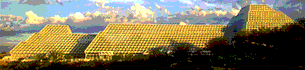
observations will be conducted with the telescopes at
Bio-2. Students will have access to the two larger research
telescopes of MDM
Observatory on Kitt Peak, those on Mount Lemmon, and
data archives of radio and X-ray telescopes. |
Research
all students |
BSPH 3999, 3-6
points
independent, research
|
A
variety of research projects conducted under the supervision
of members of the faculty. Observational, theoretical,
and experimental work in massive stars, binary stars,
pulsating
stars, galactic structure, fluid dynamics and education/outreach.
The topic and scope of the work will be arranged with
a faculty member in advance; a poster presentation describing
the results
of the project is given at the end of the semester. |
A
course from the Earth Semester curriculum
suitable for majors |
3 points
lecture, options
|
| Co-existence
with the EARTH SEMESTER will give our students a chance
to take one course from their menu, and vice versa. In
particular, several pieces of the current EARTH SEMESTER
curriculum derive from astronomy in general (e.g., the
origin of the elements), and others are intimately tied
to the planetary science courses we offer (e.g., Milankovich
cycles, circulation and chemical evolution of planetary
atmospheres, comparative planetary geology). |
|