|
16 weeks /
16 credits
Spring
2003
January 21-May 16
Astronomy had its
beginnings when a few adventurous humans wandered out of caves
and looked up at the night sky. Since then, we've managed
to survive the trend back to the caves (cities), but at the
expense of an increasing gulf between astronomical science
and its origins. Natural science is rooted in the senses and
premised on the distrust of authority, but we teach from textbooks,
under skies which have been rendered starless (the Milky Way
was last seen in New York City when Ulysses Grant was president).
Yet the puzzles and sensory immediacy of the night sky are
still out there, as powerful and fascinating as ever.
Some
of today's humans are adventurous too, and some of these are
sure to be college students. Hence, the UNIVERSE SEMESTER:
an intensive program in astronomy and astrophysics carrying
a full semester of Columbia University credit, and designed
to appeal to liberal-arts students as well as astronomy and
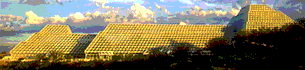
physics majors. The Biosphere 2 Center in southern Arizona
offers the opportunity to study astronomy in its natural setting,
under the night sky, accompanied by telescopes and other research
tools which directly involve discovery by experiment and observation.
This program will runs during the autumn (September-December)
and spring (January-May) semesters.
The
UNIVERSE SEMESTER is like a college, with courses and exams
and problem sets and term papers. But the intimacy and wildness
of the setting give us great advantages. Universe Semester
is more intellectual, more collaborative, more egalitarian,
more earthy, and more research-based than any college or university.
And in some ways, probably even more artistic. For the historically
minded, you might consider it an undergraduate version of
Los Alamos in the 1940s (without the weapons of mass destruction),
or Uraniborg in the 1580s (without Tycho Brahe's tyranny).
The Universe Semester
is an intensive study in astronomy and astrophysics for college
undergraduates interested in the cosmos. Majors in any scientific
field or adventurous liberal arts students can observe stars
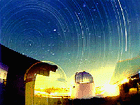
under the clear desert skies at Biosphere 2's Observatory
near Oracle, Arizona as well as Columbia's telescopes at the
Kitt Peak National Observatory in the mountains near Tucson.
The curriculum is ideal for astronomy majors, but it is also
a very unique opportunity for physics majors with interest
in astrophysics to profit by designing a crossover curriculum
which includes one or more courses from the Earth Semester.
Our students come
from colleges and universities across the United States and
around the world to learn with some of the most progressive
astronomy educators in the United States.
Detailed
Course Information
Universe Semester
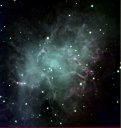 M1
Crab Nebula
M1
Crab Nebula |
Course
Dates
Spring
2003
January 21-May 16
Credits
16 credit hours through Columbia University
Prerequisites
Vary with courses selected by student
Application
Deadline
November 30, 2002.
Location
Biosphere 2 Center near Tucson, AZ, and nearby field sites
in Arizona
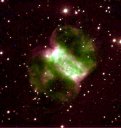
M76
Little Dumbbell Nebula |
Course
Description
The UNIVERSE
SEMESTER is an intensive program in astronomy and astrophysics
for college undergraduates at the Biosphere 2 Center near
Oracle, Arizona. The program is designed for 20-25 students,
and carries a full semester of Columbia University credit.
It runs during both the autumn and spring semesters. Under
clear desert skies, the program will be strongly based on
night-sky observation, with our own telescopes as well as
the large professional telescopes in the mountains near Tucson.
The curriculum is ideal for astronomy majors, but it is also
a very unique opportunity for physics majors with interest
in astrophysics. Majors in any scientific field can profit
by designing a crossover curriculum which includes one or
more courses from the Earth Semester, as can an adventurous
liberal arts student.
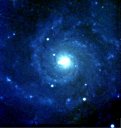 M
74 Spiral Galaxy
M
74 Spiral Galaxy |
While
the setting at Biosphere 2 provides dramatic and unique natural
advantages, the curriculum bears a fair resemblance to traditional
choices. This makes it easier for students and home universities
to integrate our program into an overall four-year program,
and assign credit appropriately. We've designed the UNIVERSE
SEMESTER for, roughly, two categories of student.
One is
a highly science-motivated student interested in a program
more centered around research activities than is feasible
or available at the home institution.
The second
is a liberal-arts student who is nonprofessionally interested
in science and inclined to be adventurous.
We offer
approximately 6 courses during each edition of the UNIVERSE
SEMESTER. On the courses page, you will find the selection
of courses from which the offered courses will be chosen.
We give the Biosphere course numbers and linked syllabi with
descriptions for the course's most recently taught incarnation.
Thus,
typical programs might look like this (Click on the course
number to view the course description.)
| Science
Majors |
|
Liberal
Arts Majors |
| |
|
Choose
from either column. |
|
BP 1902: Seminar |
1
point |
|
BP
1403:
Earth, Moon and Planets |
3
points
|
|
BP
2003:
Stellar Astrophysics |
3 points |
BP
1404:
Beyond the Solar System |
3
points
|
| BP
2004: Galactic and Extragalactic Astrophysics |
3
points |
BP
1902:
Seminar |
1
point
|
| BP
3104: Astrophysics of the Solar System |
3 points |
BP
3648:
Observational Astronomy |
3 points
|
|
BP
3648:
Observational Astronomy |
3 points |
BP
3999:
Research |
3
or 6 points
|
| BP
3999:
Research |
4
points |
|
|
| BP
3461: Order and Disorder |
3
points |
|
|
| BP
2603: Waves, optics and Modern Physics |
3
points |
Earth
Semester |
4
points |
|
(choose 16 points) |
*All of
the astrophotography images on this page was taken by Biosphere
2 astronomy students, credits include:
J.
Baldeau, H. Groch, K. Grossman, E. Soltes H. Abend, K. Becker,
T. Laurance, C. Wright.
|